



Mastering the Microcontroller:
An Introduction to Arduino
Bridge Course for Aspiring Engineers
Exclusively for students joining the School of Electronics and Electrical Engineering (SEEE). Don't miss out to register for our bridge course and level up your skills.
Don't miss out! to register for our Arduino course and level up your skills.
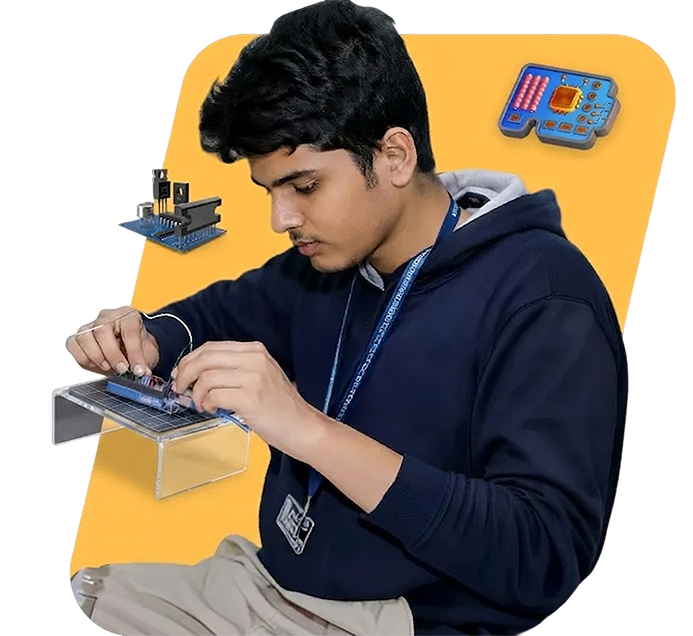
Arduino Advantages
Why Arduino?

Low Entry Barrier
You don't need a background; Arduino is designed for students to begin blinking LEDs within minutes of unboxing.

Massive Open-Source Community
There are millions of tutorials, libraries, and forums available to help troubleshoot any code issue.

Cross-Platform Versatility
The Arduino IDE works on Windows, macOS, and Linux, making it accessible regardless of what laptop you bring to LPU.

Hardware-Software Synergy
A perfect environment to learn how coding directly affects physical hardware, such as sensors and motors.

Prototyping Speed
It allows you to move from an idea to a working prototype - like the Smart Intruder Alert System much faster than traditional breadboarding alone.

Cost-Effective
The boards and components are highly affordable, allowing you to build complex systems like smart irrigation systems without a massive financial investment.
#1
Most Popular Language (TIOBE Index 2025)
Over 15
Over million arduino Developer worldwide
27%
yearly growth in arduino - related Job Postings
110K
Average Salary
Package
Earn credits towards upcoming
term courses.
- Gain hands-on experience in Arduino IDE programming
- Build a real-world project to showcase in your portfolio
- Strengthen problem-solving and logical thinking skills
- Boost your resume and career prospects in tech and data-related fields
*Earn credits towards upcoming term courses.
*Benefits applicable to B.Tech EEE related students only
How You'll Learn Arduino

Live Classes
Step by step explanations

Reading Material
Learn at your own pace

Doubt Clearing
Get personalized help

Weekly Interactive Sessions
Discuss concepts with instructions

Project Driven Learning
Build real-world projects
Weekly Curriculum
Begin with Arduino
Week 1 (Output):
Week 2: (Input):
Week 3 (Actuators):
Week 4 (Capstone):
Step 1 :
Hands-on Portfolio
Build four distinct projects before your first day of university.
Step 2 :
Expert Mentorship
Interact with faculty from the School of Electronics and Electrical Engineering.
Step 3 :
Future Ready
Gain foundational skills in C++ based coding and hardware troubleshooting.
Hear from our previous learners!



The Arduino course transformed my understanding of microprocessors and microcontrollers. Hands-on projects made learning exciting and boosted my confidence in electronics and embedded systems.
Priya Sharma

Learning Arduino helped me understand how microcontrollers work in real applications. The practical sessions on programming and interfacing components were truly valuable and engaging.
Aarav Shukla

This course made complex concepts of microprocessors simple and interactive. Building Arduino-based projects improved my coding, circuit design, and problem-solving skills significantly.
Sneha Verma

The Arduino training provided excellent practical exposure to microprocessors and microcontrollers. I gained technical skills, project experience, and confidence to work on innovative ideas.
Aditya Malik
NIRF
 Report of NIRF Data Capturing System: Management
- Report of NIRF Data Capturing System: Pharmacy
- Report of NIRF Data Capturing System: Engineering
- Report of NIRF Data Capturing System: Overall
- Report of NIRF Data Capturing System: Law
- Report of NIRF Data Capturing System: Architecture
- Report of NIRF Data Capturing System: Innovation
- Report of NIRF Data Capturing System: Agriculture
- Report of SDG Institution
- Report of NIRF Data Capturing System: Management
- Report of NIRF Data Capturing System: Pharmacy
- Report of NIRF Data Capturing System: Engineering
- Report of NIRF Data Capturing System: Overall
- Report of NIRF Data Capturing System: Law
- Report of NIRF Data Capturing System: Architecture
- Report of NIRF Data Capturing System: Agriculture