
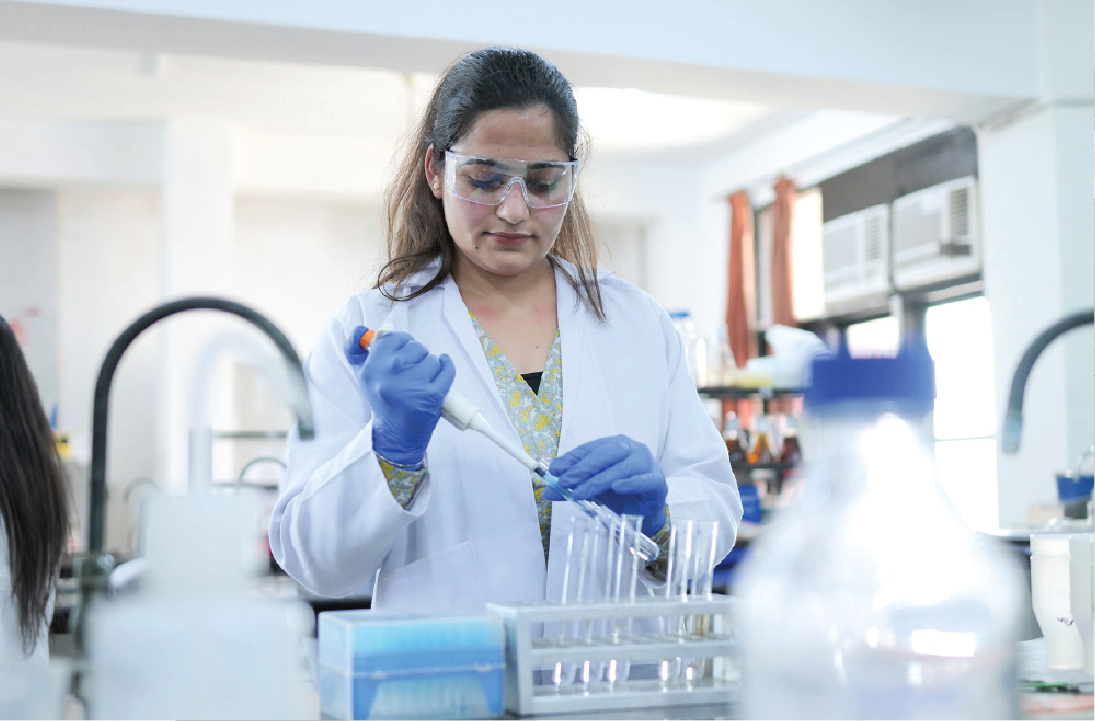
Why Your 12th Subjects are the Foundation of Your Chemical Engineering Career
Most students who aspire to become chemical engineers focus almost entirely on choosing the right college and programme. Very few stop to ask a more fundamental question: Am I building the right academic foundation in Class 12 to actually succeed in chemical engineering? The subjects you study, and how well you understand them, before you set foot in an engineering college, determine how smoothly your B.Tech. Chemical Engineering journey unfolds, and how confidently you enter the workforce at the other end.
Chemical engineering is one of the most intellectually demanding and industrially vital branches of engineering. It sits at the intersection of chemistry, physics, mathematics, and process design, requiring students to think in multiple dimensions simultaneously. A student who arrives at a chemical engineering degree with strong 12th-level fundamentals in these subjects will find the transition to university-level engineering significantly smoother than one who does not. This guide tells you exactly which 12th subjects matter, why they matter, and what to focus on within each one, alongside a complete overview of chemical engineering as a career path in India in 2026.
Key Takeaways:
|
| Did You Know? | Chemical engineering is one of the highest-paying core engineering disciplines in India. B.Tech. Chemical Engineering graduates from top institutions can access starting packages of ₹6 LPA to ₹17 LPA, with roles spanning oil and gas, pharmaceuticals, FMCG, petrochemicals, and environmental engineering. |
What is Chemical Engineering and Why Does it Matter?
Chemical engineering is the branch of engineering that applies principles of chemistry, physics, mathematics, and biology to design, develop, and optimise processes that convert raw materials into useful products. From the fuel in your car and the medicines in your medicine cabinet to the plastics in your smartphone and the fertilisers that grow your food, chemical engineers are responsible for designing and managing the industrial processes that produce virtually every physical product in modern life.
A chemical engineering degree differs from a pure chemistry degree in one key aspect. While chemistry focuses on understanding the properties and behaviour of matter at a molecular level, chemical engineering is concerned with scaling these reactions and processes for industrial production in a safe, efficient, and economically viable manner. This applied approach makes chemical engineers indispensable across a wide range of industries, including oil and gas, pharmaceuticals, food processing, water treatment, nanotechnology, polymer science, environmental engineering, and sustainable energy.
In India, the demand for chemical engineers is growing steadily, driven by the expansion of the pharmaceutical sector, the government’s push for domestic chemical manufacturing under initiatives such as the Production Linked Incentive scheme, and the rising importance of sustainable process engineering in the context of climate change and net-zero commitments.
Course Options After 12th for Chemical Engineering
Students interested in pursuing chemical engineering or physical sciences after Class 12 have several academic pathways available. The following table outlines the key options:
| Course | Level | Duration | Key Eligibility | What it Leads To |
| Diploma in Chemical Engineering | Diploma | 3 Years | Pass in Class 10 with Science and Mathematics | Entry-level technician roles; lateral entry into B.Tech. Year 2 |
| B.Tech. Chemical Engineering | Undergraduate | 4 Years | Class 12 with Physics, Mathematics, Chemistry, and English; minimum 60% aggregate | Core industry roles, M.Tech., research |
| B.Sc. Chemistry | Undergraduate | 3 Years | Class 12 with Chemistry and Physics | Research, teaching, M.Sc., lateral entry into some chemical engineering programmes |
| B.Sc. Physics | Undergraduate | 3 Years | Class 12 with Physics and Mathematics | Research, teaching, M.Sc., applied sciences |
| B.Sc. Mathematics | Undergraduate | 3 Years | Class 12 with Mathematics | Data science, research, teaching, M.Sc. |
| B.Sc. Hons./Hons. with Research (Chemistry) | Undergraduate | 3 Years | Class 12 with Chemistry and Physics | Research-oriented careers, postgraduate studies |
| B.Sc. Hons./Hons. with Research (Physics) | Undergraduate | 3 Years | Class 12 with Physics and Mathematics | Research, academia, postgraduate studies |
| B.Sc. Hons./Hons. with Research (Mathematics) | Undergraduate | 3 Years | Class 12 with Mathematics | Research, data science, postgraduate studies |
| B.Tech. Chemical Engineering (Lateral Entry) | Undergraduate | 3 Years | Diploma in Engineering | Direct Year 2 entry into B.Tech. Chemical Engineering |
| M.Tech. in Chemical Engineering | Postgraduate | 2 Years | B.Tech. or B.E. in Chemical Engineering or related discipline | Senior technical roles, research, academia |
Source: lpu.in/schools/chemical-engineering-and-physical-sciences/ for LPU programme data
For students specifically targeting a B.Tech. Chemical Engineering degree, it is important to note that most universities in India, including Lovely Professional University, require Physics, Mathematics, Chemistry, and English as mandatory subjects in Class 12. This makes the choice of 12th subjects not just academically important but also a prerequisite for eligibility.
Subjects You Should Master in 12th
The academic foundation you build in Class 12 directly determines how well prepared you are for a chemical engineering degree. Here are the five subjects that matter most, and what you should focus on within each:
Physics: The Engine Behind Every Chemical Process
Physics is not merely a supporting subject in chemical engineering; it forms the foundation for understanding how chemical processes behave in real-world conditions. Core subjects such as fluid mechanics, thermodynamics, heat transfer, and mass transfer are all built on fundamental physics concepts first introduced in Class 12.
To understand how this foundation translates into your degree, focus on the following key topics:
- Thermodynamics: Understanding the laws of thermodynamics, heat engines, and entropy forms the basis of chemical engineering thermodynamics, one of the most critical subjects in the B.Tech. curriculum.
- Fluid Mechanics: Concepts such as pressure, viscosity, and fluid flow introduced in Class 12 Physics are expanded into detailed fluid flow operations in chemical engineering.
- Wave Optics and Electromagnetic Theory: These are relevant to instrumentation and process measurement technologies used in chemical industries.
- Mechanics and Motion: Concepts of force, work, energy, and power underpin many mechanical operations in chemical engineering.
Students should aim to build genuine conceptual clarity in physics rather than relying on formula memorisation. At the degree level, chemical engineering requires applying physics principles to complex, real-world problems, which demands a clear and practical understanding.
Chemistry: The Core Subject for Chemical Engineering
If there is one subject that defines your readiness for a chemical engineering degree, it is chemistry. The entire discipline is built on understanding how substances react, transform, and behave under varying conditions of temperature, pressure, and concentration.
A strong foundation in chemistry not only helps you grasp core engineering concepts but also enables you to apply them effectively in real-world industrial processes.
To understand how chemistry supports your journey into chemical engineering, focus on the following key Class 12 topics:
- Physical Chemistry: Concepts such as equilibrium, thermodynamics, electrochemistry, and kinetics are revisited at a more advanced level in subjects like chemical engineering thermodynamics and reactor design.
- Organic Chemistry: Essential for areas such as pharmaceutical engineering, polymer science, petrochemical processing, and biochemical engineering.
- Inorganic Chemistry: Provides the foundation for understanding industrial chemical processes, catalyst behaviour, and corrosion chemistry, relevant to subjects such as metallurgy and corrosion engineering.
- Chemical Kinetics: Understanding reaction rates, activation energy, and catalysis helps ease the transition to reactor design and process calculations in B.Tech. Chemical Engineering.
- Surface Chemistry: Important for fields such as nanotechnology, heterogeneous catalysis, and advanced materials engineering.
Students who invest in mastering Class 12 Chemistry, both theoretical and practical, will find that the early semesters of a B.Tech. Chemical Engineering programme feel like a natural progression rather than an overwhelming leap.
Mathematics: The Language of Chemical Engineering
Mathematics is the language through which chemical engineers model, analyse, and optimise industrial processes. Without a strong mathematical foundation from Class 12, students often struggle with the quantitative demands of chemical engineering, particularly in the early years of the degree.
To build this foundation, focus on the following key topics:
- Calculus (Differentiation and Integration): Widely used in thermodynamics, heat transfer, mass transfer, fluid mechanics, and process dynamics and control.
- Differential Equations: Form the backbone of reactor design, process modelling, and system behaviour analysis.
- Linear Algebra and Matrices: Important for process simulation tools and numerical methods used in engineering calculations.
- Probability and Statistics: Relevant to process control, quality assurance, and experimental data analysis.
- Coordinate Geometry and Vectors: Applied in fluid mechanics and momentum transfer calculations.
Students who find mathematics challenging in Class 12 should strengthen their fundamentals early. The mathematical demands of a B.Tech. Chemical Engineering programme are significant, and gaps in understanding can become more difficult to address over time.
Biology: Optional but Valuable for Related Fields
Biology is not a mandatory subject for B.Tech. Chemical Engineering admission at most institutions. However, it becomes highly valuable for students interested in specialisations such as biochemical engineering, pharmaceutical engineering, biotechnology, or food technology.
Relevant Class 12 topics include cell biology, biochemistry, microbiology fundamentals, enzyme kinetics, fermentation processes, and genetic engineering basics. Students with a background in Biology should consider programmes that offer these specialisation tracks, as they represent some of the fastest-growing and most rewarding career pathways within chemical engineering.
Computer Science: A Valuable Supporting Subject
Computer Science is not required for admission, but it is increasingly important in modern chemical engineering. Today’s engineers rely on simulation tools such as Aspen Plus and COMSOL Multiphysics, along with programming languages such as Python and MATLAB, for process modelling, data analysis, and optimisation.
Students who develop a basic understanding of programming logic, algorithms, and computational thinking in Class 12 are better prepared for the computational aspects of the degree, particularly in subjects such as process calculations and chemical process modelling.
List of Subjects in Chemical Engineering
Once you enter a B.Tech. Chemical Engineering programme, the subjects you study span a wide and interconnected range of disciplines. The table below provides a comprehensive overview of the subjects covered across a typical four-year B.Tech. Chemical Engineering curriculum:
| Core and Foundation Subjects | Applied and Specialisation Subjects | Laboratory Subjects |
| Mathematics | Computer Programming | Physics and Chemistry Lab |
| Chemistry | Fluid Mechanics | Organic Chemistry Lab |
| Physics | Heat Transfer | Physical Chemistry Lab |
| Thermodynamics | Mass Transfer | Fluid Mechanics Lab |
| Applied Mathematics | Process Calculations | Basic Electrical and Electronics Lab |
| Biochemical Engineering and Bioinformatics | Process Equipment Design | Technical Analysis Laboratory |
| Metallurgy and Corrosion Engineering | Process Dynamics and Control | — |
| Electrical and Electronics Engineering | Chemical Process Calculations | — |
| Textile Engineering | Chemical Process Industries | — |
| Paper Engineering | Energy Engineering | — |
| Polymers | Plastic Engineering | — |
| Biotechnology | Environmental Science and Engineering | — |
| Chemical Engineering Thermodynamics | Fluid Flow Operations | — |
| Oil Exploration and Refinery | Engineering Chemistry and Chemical Technology | — |
| Water Technology | Pharmaceutical Engineering | — |
| Mechanics of Solids | Process Engineering | — |
| Business Communication and Ethics | Mechanical Operations | — |
This breadth of subjects is what makes a chemical engineering degree one of the most versatile engineering qualifications available. It also highlights why a strong foundation in Physics, Chemistry, and Mathematics at the Class 12 level is essential for success in the field.
Skills Required for a Chemical Engineering Degree
Beyond subject knowledge, successful chemical engineers possess a distinct set of skills that help them translate academic learning into real-world engineering performance. Here are the core skills required:
Analytical and Problem-Solving Skills
Chemical engineering is fundamentally about solving complex problems, for example, how do you scale a laboratory reaction to industrial production without compromising yield or safety? How do you design a heat exchanger that maximises efficiency within a constrained budget? Analytical thinking and structured problem-solving are the bedrock of every chemical engineering career.
Logical Reasoning and Mathematical Ability
Chemical engineers work with mathematical models of physical and chemical systems on a daily basis. The ability to reason logically through a problem, set up the right equations, and interpret the results correctly is as important as the mathematical mechanics themselves. Students who develop strong logical reasoning in Class 12, particularly through mathematics and physics, will find this skill invaluable across the entire B.Tech. Chemical Engineering curriculum.
Practical Lab and Experimentation Skills
Chemical engineering is not purely theoretical. Labs are a central component of the curriculum, and the ability to conduct experiments carefully, record results accurately, interpret data correctly, and draw meaningful conclusions is a skill that must be developed from Class 12 onwards. Students who engage seriously with their Class 12 chemistry and physics practicals are building habits that will serve them well throughout their engineering education.
Technical Interest in Chemical Engineering Subjects
Students who are genuinely curious about how chemical and physical processes work are naturally better suited to chemical engineering than those drawn to it purely by salary prospects. An interest in questions such as why reactions behave the way they do, how industrial plants are designed, or how new materials are developed indicates a strong alignment with the field. Technical interest plays a crucial role in sustaining motivation through the demanding phases of an engineering degree.
Career Opportunities After B.Tech. Chemical Engineering
A chemical engineering degree opens doors to one of the widest ranges of career opportunities available in any engineering discipline. The following sections outline the key career pathways available to chemical engineering graduates.
Jobs After a B.Tech. Chemical Engineering Degree
B.Tech. Chemical Engineering graduates are recruited across multiple industries, in both core technical roles and interdisciplinary positions. The following table highlights the key job roles and typical salary ranges:
| Job Role | Industry | Average Starting Salary (India) |
| Process Engineer | Oil and gas, chemicals, petrochemicals | ₹4 – ₹8 LPA |
| Chemical Engineer | Pharmaceuticals, FMCG, food processing | ₹4 – ₹7 LPA |
| Production Engineer | Manufacturing, polymer, textile industries | ₹3.5 – ₹7 LPA |
| Quality Control Engineer | Pharma, chemicals, food and beverages | ₹3.5 – ₹6 LPA |
| Environmental Engineer | Water treatment, waste management, sustainability | ₹4 – ₹7 LPA |
| Research and Development Engineer | Chemicals, biotech, nanotechnology | ₹5 – ₹9 LPA |
| Safety Engineer | Oil and gas, chemicals, heavy industry | ₹4 – ₹8 LPA |
| Petrochemical Engineer | Oil refining, gas processing, energy | ₹5 – ₹10 LPA |
Source: Naukri.com salary insights 2025; Payscale.com 2025
Top companies recruiting from LPU’s School of Chemical Engineering and Physical Sciences include Amazon, BT, Concentrix, Siegwerk, Tech Mahindra, Lakshmi Kumaran and Sridharan, Ind-Swift, and Biocon. The school has recorded a highest salary package of ₹17.56 LAC, an average package of ₹8.98 LAC for the top 10% of graduates, a highest internship stipend of ₹1 Lac, and 50+ total recruiters.
Why Choose LPU for B.Tech. Chemical Engineering?
Among the top chemical engineering colleges in India, Lovely Professional University (LPU) stands out for the quality of its B.Tech. Chemical Engineering programme, its industry connections, and its consistent placement outcomes. Here is a comprehensive overview of what LPU offers to chemical engineering students:
| Parameter | Details |
| NIRF Ranking 2025 | Rank 31 among all universities in India |
| NAAC Accreditation | A++ |
| Programme Name | B.Tech. Chemical Engineering |
| Duration | 4 Years (8 Semesters) |
| Eligibility | Pass with 60% aggregate marks in Class 12 with Physics, Mathematics, Chemistry, and English, subject to qualifying LPUNEST |
| Admission Criteria | Merit in LPUNEST, subject to fulfilling eligibility criteria |
| Highest Package |
₹17.56 LPA |
| Top 10% Average Package | ₹8.98 LPA |
| Highest Internship Offered | ₹1 Lakh |
| Top Recruiters | Reliance Industries, Merck India, Jubilant Biosys, ExxonMobil, Shell, Unilever, Nestlé, Tata Chemicals, Amazon India, HCL Technology |
| Research | 1,600+ Publications; 60+ Patents; 50+ Seminars and Workshops; 50+ Collaborative Research |
| Specialised Labs | Process labs with flow meters, heat exchangers, CSTRs, PFRs, batch reactors, Reynolds apparatus, Venturi meters, Aspen Plus simulation tools, and COMSOL Multiphysics |
| Industry Exposure | Live projects, hackathons, internships, guest lectures, educational trips, MOOCs, and industry certifications integrated into the curriculum |
Eligibility for B.Tech. Chemical Engineering at LPU
Candidates must have passed Class 12 with Physics, Mathematics, Chemistry, and English with a minimum of 60% aggregate marks, subject to qualifying LPUNEST, JEE Main, or CUET. A 5% relaxation on aggregate marks applies for North-East states and Sikkim candidates, Defence Personnel and their dependents, and Wards of Kashmiri Migrants.
Admission Process at LPU
Admission to B.Tech. Chemical Engineering at LPU is based on merit in LPUNEST, which can be attempted online from home under live proctoring or at a designated test centre. High LPUNEST scorers are eligible for merit-based scholarships that can significantly reduce the overall programme fee. Students can also seek admission based on JEE Main or CUET scores.
Fee and Scholarship Structure
The programme fee for B.Tech. Chemical Engineering at LPU is ₹1,40,000 per semester, along with an examination fee of ₹5,000 per semester and a one-time uniform fee of ₹4,000.
To make quality education more accessible, LPU offers a structured scholarship system based on LPUNEST performance and Class 12 board results, allowing students to significantly reduce their overall cost.
The scholarship categories include:
- LPU RISE Scholarship: 100% fee waiver on programme fee and hostel accommodation for national rank holders, students with confirmed seats at leading institutions, and school board toppers
- Category A: 60% fee waiver (₹84,000 off per semester); applicable for LPUNEST Category A score or 98% and above in Class 12
- Category B: 50% fee waiver (₹70,000 off per semester); applicable for LPUNEST Category B score or 95% to 97.99% in Class 12
- Category C: 40% fee waiver (₹56,000 off per semester); applicable for LPUNEST Category C score or 90% to 94.99% in Class 12
- Category D: 30% fee waiver (₹42,000 off per semester); applicable for LPUNEST Category D score or 80% to 89.99% in Class 12
This structured approach ensures that students are rewarded for academic performance while keeping the programme financially accessible.
Career Pathways at LPU
The B.Tech. Chemical Engineering programme at LPU is designed to prepare students for diverse career directions through structured pathways that align with individual goals and industry demands:
- Corporate Jobs: Multiple sub-pathways focused on preparing students for roles across sectors such as chemicals, oil and gas, pharmaceuticals, energy, and manufacturing, aligned with industry requirements
- Government Jobs: Dedicated preparation support for civil services, Public Sector Undertakings (PSUs), and other government sector opportunities
- Higher Studies: Preparation for competitive exams such as GATE, UGC-NET, CAT, and MAT, along with guidance for postgraduate education and research pathways
- Entrepreneurship: Support through Startup School and e-Coaches for building new ventures, scaling existing businesses, and exploring social entrepreneurship
- Research: Opportunities to pursue research careers in academia and industry, supported by LPU’s research ecosystem
- Masters Abroad: Preparation for exams such as GRE, GMAT, IELTS, and TOEFL, along with counselling for international universities and scholarship opportunities
These pathways ensure that students can align their academic journey with long-term career aspirations across industry, academia, entrepreneurship, and global opportunities.
Facilities for Chemical Engineering Students at LPU
LPU’s chemical engineering students have access to state-of-the-art process laboratories equipped with industrial-grade equipment including flow meters, heat exchangers, ball mills, CSTRs (Continuous Stirred Tank Reactors), PFRs (Plug Flow Reactors), batch reactors, Reynolds apparatus, and Venturi meters. Advanced simulation tools such as Aspen Plus and COMSOL Multiphysics are integrated into the curriculum, bridging the gap between academic learning and industrial practice. Beyond labs, students benefit from a 670-acre campus with modern infrastructure, a dedicated placement cell, and access to LPU’s network of 500+ partner universities across 80+ countries for global exposure and international learning opportunities.
| Did You Know? | LPU Chemical Engineering alumni have secured placements at some of the world’s most prestigious organisations including ExxonMobil, Shell, Unilever, and Nestlé, and have pursued higher studies at leading universities in the USA, UK, Canada, and Germany in specialisations including sustainable energy, nanotechnology, and process engineering. |
Conclusion
The path to a successful chemical engineering career begins not in the college lecture hall, but in your Class 12 classroom. The depth of your understanding of Physics, Chemistry, and Mathematics in senior secondary school directly determines how confidently you navigate the demanding curriculum of a B.Tech. Chemical Engineering degree and how well-prepared you are for the high-stakes industrial roles that follow.
Mastering these subjects is not about scoring marks. It is about building genuine conceptual clarity in the principles that underpin every aspect of chemical engineering, from thermodynamics and fluid mechanics to reactor design and process optimisation. Students who approach Class 12 with this mindset arrive at engineering college with a significant and lasting advantage.
For students who are ready to take that next step, Lovely Professional University’s B.Tech. Chemical Engineering programme offers a rigorous, industry-integrated, and placement-focused education at one of India’s highest-ranked private universities. With NAAC A++ accreditation, a highest placement package of ₹17.56 Lakh, a top 10% average package of ₹8.98 Lakh, state-of-the-art process laboratories, and a research ecosystem with 1,600+ publications and 60+ patents, LPU is among the strongest choices for aspiring chemical engineers in India today.
Explore B.Tech. Chemical Engineering at LPU, learn about scholarship opportunities at lpu.in/scholarship/scholarship.php, and take the first step towards your chemical engineering career today.
Frequently Asked Questions (FAQs)
Q: Which subjects are important in 12th for chemical engineering?
Physics, Chemistry, and Mathematics are the three mandatory and most critical subjects in Class 12 for chemical engineering. Chemistry forms the disciplinary core of the degree, Mathematics underpins all quantitative and modelling work, and Physics provides the foundational principles for thermodynamics, fluid mechanics, and heat and mass transfer. Computer Science, while not mandatory, is an increasingly valuable supporting subject given the role of simulation and programming tools in modern chemical engineering practice.
Q: Is B.Sc. Chemistry enough to become a chemical engineer?
A B.Sc. in Chemistry builds a strong foundation in chemical sciences but does not cover the engineering principles required in chemical engineering, such as process design, fluid mechanics, thermodynamics, heat and mass transfer, and reactor engineering.
To become a chemical engineer, a B.Tech. or B.E. in Chemical Engineering is the standard qualification. Some institutions may offer lateral entry or bridge pathways for B.Sc. Chemistry graduates into postgraduate chemical engineering programmes, but these options vary by institution.
Q: What is the difference between B.Tech. Chemical Engineering and M.Tech. in Chemical Engineering?
B.Tech. Chemical Engineering is a four-year undergraduate programme that covers the full breadth of chemical engineering fundamentals and prepares graduates for industry entry-level roles. M.Tech. in Chemical Engineering is a two-year postgraduate programme that offers deep specialisation in a specific area such as process engineering, petroleum refining, polymer technology, or environmental engineering, and is aimed at graduates who want to pursue senior technical roles, research, or academia. M.Tech. typically requires a B.Tech. or B.E. in Chemical Engineering or a closely related discipline as a prerequisite.
Q: Can I pursue chemical engineering after B.Sc. Chemistry?
In some cases, yes. A few institutions offer M.Tech. or integrated postgraduate programmes in chemical engineering that are open to B.Sc. Chemistry graduates. Additionally, students who hold a B.Sc. Chemistry degree may be eligible for lateral entry into certain chemical engineering programmes at the postgraduate level. However, this route is not universally available, and students are advised to check specific institutional eligibility requirements before applying.
Q: Is Mathematics compulsory for chemical engineering?
Yes, Mathematics is a compulsory subject for B.Tech. Chemical Engineering admission at virtually all institutions in India, including Lovely Professional University. At LPU, candidates must have passed Class 12 with Physics, Mathematics, Chemistry, and English as mandatory subjects with a minimum of 60% aggregate marks. Mathematics remains integral to the B.Tech. Chemical Engineering curriculum itself, appearing in subjects such as applied mathematics, chemical engineering thermodynamics, process dynamics and control, and numerical methods.
Q: Which is better: B.Sc. Chemistry or B.Tech. Chemical Engineering?
The choice depends on your career goals. A B.Sc. in Chemistry is better suited for students interested in pure research, teaching, or careers in analytical chemistry, and it provides a strong foundation for pursuing an M.Sc. or Ph.D. in chemistry.
A B.Tech. in Chemical Engineering is more suitable for students aiming to work in core industries such as oil and gas, pharmaceuticals, petrochemicals, FMCG, and environmental engineering. It is also the standard qualification for professional engineering roles.
In terms of starting salary and industry placement opportunities, B.Tech. Chemical Engineering generally offers a stronger immediate return.
Q: What are the career options after a chemical engineering degree?
Career options after a chemical engineering degree are broad and diverse. The following are the most prominent pathways:
- Process engineer, production engineer, or plant engineer in oil and gas, chemicals, or manufacturing
- Research and development engineer in pharmaceuticals, biotechnology, or advanced materials
- Environmental engineer in water treatment, waste management, or sustainability consulting
- Quality control or regulatory affairs engineer in pharma or FMCG
- Safety and HSE engineer in heavy industry or petrochemicals
- Higher studies in M.Tech. in Chemical Engineering, MBA, or international postgraduate programmes
Q: Why is Chemistry important for chemical engineering?
Chemistry forms the foundation of chemical engineering. It underpins every aspect of the discipline, from understanding how reactions occur and designing reactors to managing separation processes, developing pharmaceutical formulations, and working with polymers.
Core areas such as physical chemistry, organic chemistry, inorganic chemistry, and chemical kinetics are directly integrated into the B.Tech. Chemical Engineering curriculum, building on the concepts introduced in Class 12.
Q: What are the eligibility criteria for B.Tech. Chemical Engineering at LPU?
Candidates must have passed Class 12 with Physics, Mathematics, Chemistry, and English with a minimum of 60% aggregate marks, subject to qualifying LPUNEST, JEE Main, or CUET. A 5% relaxation on aggregate marks is available for North-East states and Sikkim candidates, Defence Personnel and their dependants, and Wards of Kashmiri Migrants.
Q: What is the admission process for B.Tech. Chemical Engineering at LPU?
Admission is based on merit in LPUNEST, LPU’s university-level entrance and scholarship test. LPUNEST can be attempted online from home under live proctoring or at a designated test centre. Students may also be admitted based on JEE Main or CUET scores. High LPUNEST scorers are eligible for merit-based scholarships that can significantly reduce the programme fee. For detailed admission information visit lpu.in/admission.
Q: What are the placement opportunities for Chemical Engineering at LPU?
LPU’s B.Tech. Chemical Engineering placement record includes a highest package of ₹17.56 LPA and a top 10% average package of ₹8.91 LPA. Top recruiters include Reliance Industries, Merck India, Jubilant Biosys, ExxonMobil, Shell, Unilever, Nestlé, Tata Chemicals, Amazon India, DXC Technology, and HCL Technology, among others. Internship opportunities offer stipends of up to ₹1 Lakh per month, giving students meaningful industry exposure before graduation.
Q: What facilities does LPU offer for Chemical Engineering students?
LPU offers state-of-the-art process laboratories equipped with flow meters, heat exchangers, ball mills, CSTRs, PFRs, batch reactors, Reynolds apparatus, and Venturi meters. Advanced simulation tools including Aspen Plus and COMSOL Multiphysics are integrated into the curriculum. Beyond labs, students benefit from live projects, hackathons, internships, guest lectures from industry professionals, educational trips, MOOCs, and industry certifications as standard components of the B.Tech. Chemical Engineering programme.