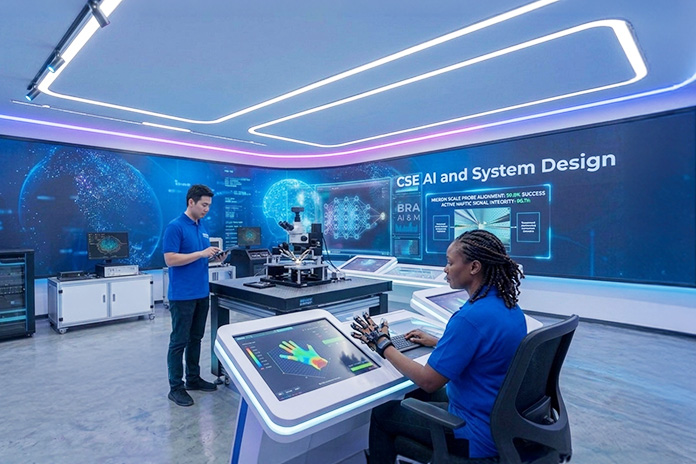
The career scope after B.Tech. (CSE – AI and System Design) with Global Tech Immersion is wide-ranging, future-oriented, and strongly aligned with the needs of the modern technology industry. Graduates can pursue roles such as Artificial Intelligence Engineer, Machine Learning Engineer, System Design Engineer, Cloud Engineer, and Data Scientist across sectors in India and globally.
Artificial Intelligence is now at the core of innovation, influencing how organisations operate, interact with customers, and scale their services. At the same time, system design ensures that these intelligent systems function efficiently at scale, supporting millions of users and vast amounts of data.
In today’s competitive environment, employers are increasingly looking for professionals who possess not only technical knowledge but also practical experience and global exposure. This makes programmes that combine AI, system design, and global immersion particularly relevant for students aiming to build long-term careers in technology.
The Expanding Role of AI and System Design in Modern Careers
Artificial Intelligence and system design have evolved into foundational pillars of the digital economy. Organisations are integrating AI into core operations to enhance efficiency, automate processes, and improve decision-making. System design complements this by ensuring that applications are scalable, reliable, and capable of handling increasing user demands.
Across industries, the role of AI is expanding rapidly. In healthcare, it is used for diagnostics and predictive analysis. In finance, it supports fraud detection and risk management. In e-commerce, it powers recommendation engines and logistics optimisation.
| Did You Know?
According to NASSCOM, India is expected to become a major hub for AI talent, with demand continuing to grow across industries. This widespread adoption ensures that professionals skilled in AI and system design will remain in high demand in the coming years. As organisations continue to innovate, the demand for professionals who can combine intelligence with scalability will only increase. |
Understanding the Programme and Its Relevance
The B.Tech. (CSE – AI and System Design) with Global Tech Immersion programme is designed to bridge the gap between academic learning and industry expectations. It combines core computer science principles with specialised training in Artificial Intelligence and system architecture.
The programme emphasises both theoretical understanding and practical application. Students are encouraged to work on real-world projects, which helps them develop problem-solving skills and gain hands-on experience.
A key feature of the programme is its global immersion component. This exposes students to different technology ecosystems and industry practices, enabling them to understand how global organisations operate.
By integrating technical knowledge with industry exposure and global learning, the programme prepares students to meet the evolving demands of the technology sector and equips them with the mindset required for long-term career success.
Key Skills That Shape Career Outcomes
The programme focuses on developing a comprehensive set of skills that directly influence career opportunities and long-term growth.
Technical Skills
Students gain a strong foundation in Artificial Intelligence, machine learning, programming, and system design. They learn how to build intelligent systems, design scalable architectures, and work with cloud-based technologies.
Practical Skills
The emphasis on real-world projects allows students to apply their knowledge in practical scenarios. This helps them understand industry challenges and develop effective solutions.
Professional Skills
In addition to technical expertise, students develop communication, teamwork, and problem-solving abilities. These skills are essential for working in dynamic and collaborative environments.
| Did You Know? The World Economic Forum highlights that analytical thinking and AI-related skills are among the most important capabilities for future jobs.These combined skills ensure that graduates are well-prepared for diverse career opportunities and are capable of adapting to evolving industry requirements. |
How Global Tech Immersion Enhances Career Scope
Global Tech Immersion is a defining feature of this programme and plays a crucial role in enhancing career prospects. It provides students with exposure to different technology ecosystems, enabling them to understand how innovation takes place in various parts of the world.
Through interaction with industry professionals, students gain valuable insights into current trends, best practices, and emerging technologies. This exposure helps them align their skills with industry requirements.
Global immersion also enhances adaptability and cultural awareness, which are essential for working in international teams. It builds confidence and prepares students to operate effectively in diverse professional environments.
Overall, this experience significantly improves employability, strengthens professional networks, and opens up opportunities in both domestic and global job markets.
In addition, global exposure helps students understand how different markets approach technology adoption and innovation. This understanding can be particularly valuable for those aspiring to work with multinational organisations or build solutions for global audiences. It also enhances the ability to collaborate effectively across time zones, cultures, and technical ecosystems.
Career Opportunities After This Programme
Graduates of this programme can explore a wide range of career opportunities across industries. The combination of AI expertise, system design knowledge, and global exposure makes them suitable for various roles.
Artificial Intelligence Engineers work on developing intelligent systems and automation solutions. Machine Learning Engineers design and deploy algorithms that enable systems to learn from data.
System Design Engineers focus on building scalable architectures, while Cloud Engineers manage infrastructure and deployment processes. Data Scientists analyse data to generate insights and support decision-making.
These roles are in demand across sectors such as IT, finance, healthcare, e-commerce, and consulting. The diversity of opportunities ensures that graduates can choose career paths based on their interests, skills, and long-term aspirations.
Career Growth Trajectory in AI and System Design
A career in Artificial Intelligence and system design offers strong long-term growth, both in terms of roles and responsibilities. Unlike many traditional fields, career progression in this domain is closely linked to skill development and practical experience.
At the entry level, professionals typically begin as AI Engineers, Machine Learning Engineers, or Junior Developers, focusing on building models, writing code, and supporting system development. As they gain experience, they move into more specialised roles where they take ownership of larger systems and projects.
At the mid-career level, professionals may transition into roles such as Senior AI Engineer, System Architect, or Technical Lead. These positions involve designing complex systems, making architectural decisions, and mentoring junior team members.
With further experience, career paths can expand into leadership and strategic roles such as Engineering Manager, AI Consultant, or Technology Director. Some professionals also choose to move into research, entrepreneurship, or product management roles.
The inclusion of global exposure and industry experience can accelerate this growth by providing broader perspectives and access to diverse opportunities. Professionals who continuously upgrade their skills and stay aligned with industry trends are more likely to achieve faster career progression.
Emerging Career Paths and Future Opportunities
The rapid advancement of technology has led to the emergence of new and specialised career paths. These roles go beyond traditional job profiles and offer exciting opportunities for innovation.
Some emerging roles include AI Product Manager, Robotics Engineer, AI Research Scientist, and MLOps Engineer. These positions require a combination of technical expertise and strategic thinking.
The growing focus on ethical AI has also created demand for roles such as AI Ethics Specialist. These professionals ensure that AI systems are developed and used responsibly.
As technology continues to evolve, new career opportunities will continue to emerge, making this field dynamic, adaptable, and highly future-focused.
Industry Applications of AI and System Design
Artificial Intelligence and system design are applied across multiple industries, making this field highly versatile.
In healthcare, AI supports diagnostics and personalised treatment. In finance, it powers fraud detection and risk analysis. In e-commerce, it enhances customer experience through recommendation systems and efficient logistics.
System design ensures that these applications function at scale, handling large volumes of users and data efficiently. This combination of AI and system design creates opportunities across industries and allows professionals to explore diverse career paths.
The Role of Internships and Industry Exposure in Career Growth
Practical exposure plays a critical role in shaping career outcomes. Internships and industry interactions allow students to apply theoretical knowledge in real-world scenarios.
Through these experiences, students gain familiarity with industry tools, workflows, and problem-solving approaches. They also develop confidence and improve their readiness for professional roles.
Industry exposure helps build professional networks and provides insights into career pathways. Employers often prefer candidates with hands-on experience, as it demonstrates their ability to contribute effectively from the beginning.
Global tech immersion further enhances this by providing exposure to diverse industry environments, making students more adaptable and competitive.
Career Scope Comparison
| Aspect | Regular B.Tech CSE | With Global Tech Immersion |
| Exposure | Classroom-focused learning | Exposure to multiple tech ecosystems including global environments |
| Learning Approach | Theory-driven | Application and industry-driven |
| Industry Interaction | Limited | Continuous engagement with industry professionals |
| Professional Network | Local | Global and diverse network |
| Career Readiness | Moderate | High and industry-aligned |
Industry Trends and Salary Outlook
The salary potential in AI and system design roles reflects the growing demand for skilled professionals.
| Role | India (Entry–Mid) | Global (Entry–Mid) |
| AI Engineer | ₹6–22 LPA | $80,000 – $140,000 |
| Machine Learning Engineer | ₹8–30 LPA | $90,000 – $150,000 |
| Data Scientist | ₹6–25 LPA | $85,000 – $140,000 |
| Cloud Engineer | ₹5–20 LPA | $75,000 – $130,000 |
| Backend / System Engineer | ₹6–28 LPA | $80,000 – $140,000 |
According to Glassdoor, AI and Machine Learning roles are among the highest-paying jobs in the technology sector. Global opportunities often offer even higher compensation.
Salary growth in this field is strongly influenced by skills, practical experience, and exposure to real-world systems.
Skills Gap in the Industry and How This Programme Addresses It
One of the biggest challenges in the technology industry today is the gap between academic learning and industry expectations. While many graduates possess theoretical knowledge, employers often find that candidates lack practical exposure, problem-solving ability, and familiarity with real-world systems.
This gap becomes even more evident in fields such as Artificial Intelligence and system design, where the complexity of real-world applications requires hands-on experience. Building machine learning models in a controlled academic setting is significantly different from deploying them in live environments where scalability, latency, and reliability are critical factors.
Programmes that integrate practical learning, industry exposure, and global immersion play an important role in addressing this challenge. By exposing students to real-world projects, industry tools, and diverse working environments, such programmes help bridge the gap between theory and practice.
Students learn not only how to build solutions but also how to adapt them to real-world constraints. This includes understanding user behaviour, optimising system performance, and ensuring scalability. These are critical skills that employers actively look for in candidates.
As a result, graduates are better prepared to transition into professional roles and contribute effectively from the early stages of their careers.
Why This Programme Stands Out
This programme stands out because it integrates multiple dimensions of learning into a single pathway. It combines Artificial Intelligence, system design, and global exposure, ensuring that students develop both technical expertise and practical understanding.
The emphasis on industry interaction ensures that students remain aligned with current trends and expectations. The global immersion component enhances their perspective, adaptability, and readiness for international opportunities.
Admission to this programme is conducted through LPUNEST, which also provides scholarship opportunities based on performance.
Final Thoughts
The field of Artificial Intelligence and system design is continuously evolving, and the expectations from professionals are increasing accordingly. Employers today seek individuals who can combine technical knowledge with practical skills and global exposure.
As industries continue to adopt intelligent systems and scalable technologies, the demand for such professionals will only grow. This makes career opportunities in this field both stable and future-focused.
In addition, the ability to work across industries, adapt to emerging technologies, and collaborate in global environments will define long-term success. Professionals who continuously upgrade their skills and gain practical exposure are more likely to achieve sustained career growth.
Programmes that integrate technical learning with real-world exposure and global immersion provide a strong foundation for long-term success and help students build meaningful careers in the technology domain.
FAQs
What is the career scope after B.Tech. (CSE – AI and System Design) with Global Tech Immersion?
The career scope is extensive and includes roles such as Artificial Intelligence Engineer, Machine Learning Engineer, System Design Engineer, Cloud Engineer, and Data Scientist across industries in India and globally.
How does global tech immersion improve career opportunities?
Global tech immersion enhances practical exposure, builds cross-cultural skills, and helps students understand global industry practices, which improves employability.
Are AI and system design professionals in demand?
Yes, demand is increasing rapidly across industries due to digital transformation and the growing adoption of Artificial Intelligence technologies.
What skills are required for a career in AI and system design?
Key skills include programming, machine learning, data analysis, system architecture, cloud computing, and problem-solving abilities.
Can this programme lead to global career opportunities?
Yes, the inclusion of global immersion prepares students for international roles by providing exposure to global work environments and industry standards.