Somewhere in your first week, you’ll hear seniors talk about C, Java, or whatever language they started with — and it might make you wonder why your first semester begins with Python instead. If that question is sitting in the back of your mind, here’s the honest answer: it’s not a lesser starting point, and it’s not a warm-up you rush through before the “real” languages arrive. Python is, quietly, one of the most important languages you’ll learn in your entire degree — and starting with it is a deliberate, well-reasoned choice.
Python Is Built to Get Out of Your Way
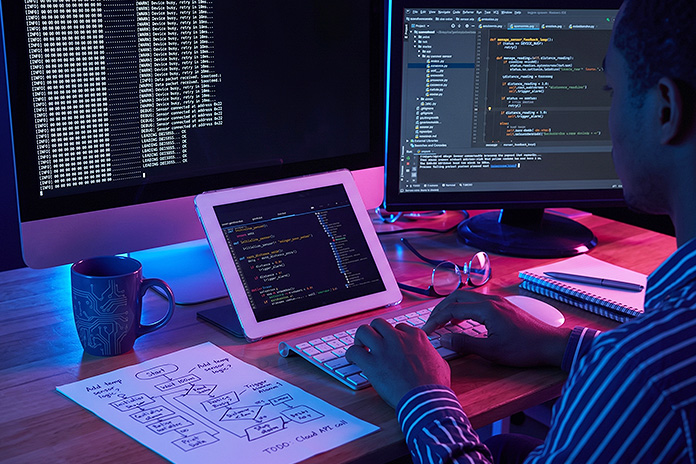
The biggest hurdle in the first semester isn’t understanding logic — it’s understanding logic while also fighting unfamiliar syntax. Python strips away a lot of that friction. There’s no semicolon to forget, no complicated setup around variable types, no dense punctuation standing between you and the idea you’re trying to express. That means when you write your first loop or your first function, you’re actually thinking about what the code does, not decoding what the language wants from you.
This is exactly why Python programming language is used to teach programming at universities and bootcamps around the world, not just at LPU. It was designed, from the ground up, to be readable — code that looks close to plain English. That design choice isn’t a convenience for Python for beginners; it’s the reason Python has become one of the most widely used languages in the industry today, from small scripts to massive production systems.
Semester One Is Building Two Things at Once — Not Just One
It’s tempting to think of your first semester as just a lesson in “how to think like a programmer,” with the language itself being incidental. That undersells what’s actually happening. You’re building two things at the same time: computational thinking — breaking a problem into steps, recognizing patterns, debugging your own logic — and genuine command of Python itself, a language you’ll very likely keep using long after this semester ends.
Python isn’t a disposable vehicle you’ll set aside once the thinking clicks. It’s one of the most widely used languages in the industry, and the fluency you build with it now — writing clean functions, working with its data structures, getting comfortable with its libraries — carries forward directly into internships, projects, and eventually the job you’re working toward. Learning to think computationally and learning Python programming basics properly aren’t two separate tracks competing for your attention this semester; they’re two outcomes you’re meant to walk away with, and both matter.
Other Languages Aren’t Being Skipped — They’re Coming at the Right Time
If you’re worried that starting with Python means you’ll be behind on something like C or Java later, that’s not how this works. Languages that deal more directly with memory, structure, or strict typing make a lot more sense once you already understand the logic underneath them. Starting with Python doesn’t delay that learning — it makes it click faster when it does arrive, because you’ll be layering new syntax on top of thinking patterns you’ve already built, instead of learning both at once.
Think of it less as “first language” and more as “foundation language.” Every other language you learn afterward will be compared, whether consciously or not, against the clarity you first found in Python — and that comparison usually works in your favor. For students considering Python vs C for beginners or Python vs Java for beginners, the real question isn’t which language is universally better, but which language helps build the right foundation at the right stage.
It’s Also the Language Powering the Tools Everyone’s Talking About
Beyond being a good teaching language, Python happens to be the backbone of a lot of what’s exciting in tech right now — data science, automation, and especially AI and machine learning tooling. Nearly every major AI framework and library students hear about today is built in or works primarily through Python. Starting here doesn’t just ease you into programming; it puts you a step ahead if any of those areas end up interesting you later, because you won’t need to learn a new language before you can even begin exploring them.
The benefits of learning Python become even clearer when you see how naturally it connects to Python for artificial intelligence, Python for machine learning, and Python for data science. Nothing about your first semester is a placeholder — it’s groundwork that stays useful long after the semester ends, and in Python’s case, it stays useful for the rest of your career if you choose to go deeper into it.
Don’t Confuse “Easier to Read” With “Not Serious”
One trap first-years fall into is assuming that because Python is more readable, it’s somehow less rigorous — and then not taking the fundamentals seriously because the syntax feels forgiving. That’s a mistake. The concepts you learn this semester — loops, conditionals, functions, basic data structures — are the same concepts every language builds on. Learning them well now, in a language that lets you focus on the logic, sets the tone for everything that follows.
In fact, the students who treat Python casually in first semester — assuming it’s “just Python” and not worth full effort — are usually the ones who struggle most when the syllabus later expects them to already have these fundamentals down cold. Respect the language for what it’s quietly teaching you, not just for how it looks on the surface. Developing strong Python programming skills and understanding core Python programming concepts can make the transition to more advanced programming much smoother.
The Honest Takeaway
Python isn’t the easy version of learning to code — it’s the version designed to teach you how to think like a programmer without unnecessary friction in the way, and it happens to double as one of the most valuable, widely used languages in the industry today. Take this semester seriously, get comfortable with the fundamentals, and trust that whatever language comes next will make a lot more sense because of the groundwork you’re laying right now — groundwork built in a language that will very likely stay relevant to you long after the first semester ends. The importance of Python programming lies not only in how approachable it is, but also in how widely its skills can be applied across modern technology and a future Python programming career.








![Career Paths after B Sc. Information Technology [2+2 with International Credit Transfer Option]](https://www.lpu.in/blog/wp-content/uploads/2025/11/Career-Paths-after-B-Sc.-Information-Technology-22-with-International-Credit-Transfer-Option-100x70.png "Career Paths after B Sc. Information Technology [2+2 with International Credit Transfer Option]")