
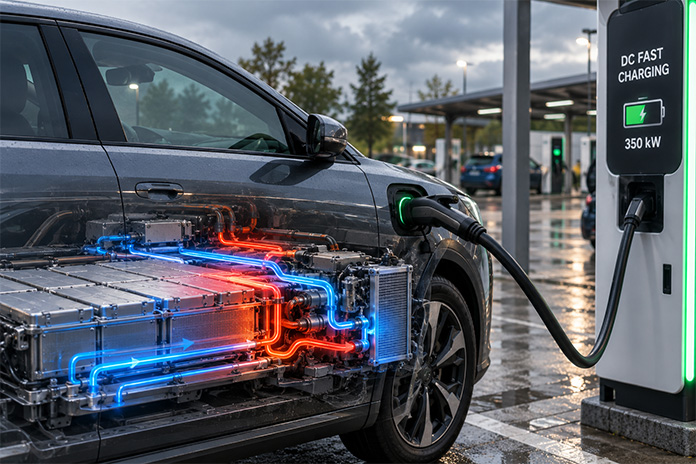
Understanding DC Fast Charging and Battery Thermal Management
The rapid growth of electric vehicles (EVs) is transforming the global transportation industry. As more consumers and businesses adopt electric mobility, the demand for faster, safer, and more efficient charging solutions continues to increase. Among the technologies supporting this transition, DC fast charging has become an important advancement in modern electric transportation.
Unlike conventional AC charging, where the vehicle’s onboard charger converts alternating current into direct current, DC fast chargers perform this conversion externally and deliver regulated DC power to the battery through the vehicle’s charging interface. This allows compatible electric vehicles to charge at significantly higher power levels, reducing charging time.
However, high-power EV charging introduces an important engineering challenge: managing the heat generated within the battery and associated electrical components.
Lithium-ion batteries, which power most modern electric vehicles, are sensitive to temperature variations. Excessive heat can accelerate battery degradation, reduce charging efficiency, and create potential safety concerns. Similarly, extremely low temperatures can limit charging performance and increase the risk of lithium plating under unsuitable charging conditions.
This is where EV battery thermal management becomes essential.
A well-designed battery thermal management system regulates battery temperature, supports efficient charging, and helps protect the battery from excessive thermal stress. Understanding thermal management in electric vehicles is therefore important for developing reliable, long-lasting, and efficient EV charging solutions.
Why Does DC Fast Charging Generate Heat?
One of the most important aspects of EV fast charging technology is understanding how charging current affects battery temperature.
During charging, electrical energy is stored in battery cells through electrochemical reactions. Although modern lithium-ion batteries are highly efficient, a portion of the supplied energy is converted into heat because of internal electrical resistance and electrochemical processes.
The resistive component of heat generation can be represented by the equation:
P = I²R
Where:
- P represents resistive heating power in watts.
- I represents the charging current in amperes.
- R represents the effective electrical resistance in ohms.
This equation explains the relationship between charging current and resistive heating.
As the current increases, resistive heat generation increases approximately with the square of the current, assuming resistance remains constant.
For example, doubling the current can increase resistive heating by approximately four times under otherwise comparable conditions.
This relationship is central to understanding DC fast charging heat generation.
However, resistive heating is not the only source of battery temperature changes. Electrochemical polarization, reversible entropic heat effects, and other internal processes also influence the battery’s thermal behaviour.
During fast charging, these effects can become more significant, particularly when the battery is operating at high current levels or outside its preferred temperature range.
Consequently, efficient battery heat dissipation is essential for maintaining stable charging performance and protecting battery components.
How DC Fast Charging Affects Battery Temperature
Understanding how DC fast charging affects battery temperature is important for both EV manufacturers and vehicle owners.
Lithium-ion batteries operate most effectively within temperature ranges determined by their cell chemistry, design, and operating conditions.
When battery temperature becomes too low, internal resistance may increase and electrochemical reactions can slow down. Charging at excessive current under these conditions can increase the risk of lithium plating, which may contribute to permanent battery degradation.
At elevated temperatures, unwanted chemical reactions can accelerate, potentially reducing battery capacity and long-term performance.
Poor temperature regulation may lead to several challenges:
- Faster degradation of battery materials.
- Reduced battery capacity over time.
- Lower charging efficiency.
- Increased thermal stress on battery components.
- Uneven temperature distribution across battery cells.
- Greater safety risks under extreme operating conditions.
Effective EV battery temperature management helps reduce these risks by maintaining appropriate thermal conditions during charging and vehicle operation.
The objective is not simply to keep the battery as cold as possible. Instead, the system must maintain a suitable temperature range that balances charging speed, efficiency, battery life, and safety.
EV Battery Thermal Management: The Battery’s Cooling Shield
A battery thermal management system (BTMS) is designed to regulate battery temperature and minimise temperature differences between individual cells and modules.
The system may include cooling channels, heat exchangers, pumps, fans, sensors, thermal interface materials, and electronic control units.
An efficient battery cooling system performs several important functions:
- Removes excess heat during charging and discharging.
- Maintains suitable battery operating temperatures.
- Reduces temperature differences between cells.
- Supports consistent charging performance.
- Helps minimise temperature-related battery degradation.
- Contributes to overall electric vehicle battery safety.
Different approaches to electric vehicle battery cooling are used depending on vehicle design, battery chemistry, charging requirements, and cost considerations.
1. Air Cooling for EV Batteries
Air cooling for EV batteries is one of the simpler thermal management methods.
This approach uses natural airflow or electrically powered fans to transfer heat away from battery cells and modules.
Air cooling systems generally have fewer components than liquid-based systems, making them relatively lightweight and cost-effective.
Their main advantages include:
- Simple system architecture.
- Lower manufacturing complexity.
- Reduced maintenance requirements in some designs.
- Relatively low system weight and cost.
However, air has limited heat-transfer capability compared with many liquid coolants.
Consequently, air cooling may struggle to remove the heat generated during sustained high-power charging, particularly in hot environments or densely packed battery systems.
For these reasons, air cooling is more commonly associated with battery applications where thermal loads are comparatively moderate.
2. Liquid Cooling for EV Batteries
Liquid cooling for EV batteries is widely used in modern high-performance electric vehicles.
In this method, a coolant circulates through channels, cooling plates, or other thermal structures positioned near battery cells.
The coolant absorbs heat from the battery and transfers it to a radiator, heat exchanger, or refrigeration-assisted cooling circuit.
Compared with air cooling, liquid-based systems can provide greater heat-transfer capability and more precise temperature regulation.
The major benefits include:
- Improved heat removal during rapid charging.
- More uniform battery temperature distribution.
- Better thermal control under demanding conditions.
- Support for sustained charging performance.
- Reduced thermal stress on battery components.
Effective lithium-ion battery cooling is particularly important during repeated fast-charging sessions, when battery temperature may rise rapidly.
However, liquid cooling systems require additional components such as pumps, coolant channels, seals, and heat exchangers.
These components increase design complexity and require careful engineering to ensure reliability and prevent leakage.
3. Refrigerant-Based Battery Cooling
Refrigerant-based battery cooling is another approach used in advanced electric vehicle thermal systems.
This method uses the vehicle’s refrigeration circuit, directly or through a coolant-to-refrigerant heat exchanger, to remove heat from the battery.
Refrigerant-assisted cooling can be especially useful when ambient temperatures are high or when the battery requires cooling below the temperature achievable through ambient-air heat rejection alone.
Some EVs integrate battery cooling with cabin air-conditioning and heat-pump systems to improve overall thermal efficiency.
However, this integration requires sophisticated controls to balance battery cooling, passenger comfort, energy consumption, and system reliability.
The choice between air, liquid, and refrigerant-based cooling depends on the vehicle’s thermal requirements and engineering priorities.
Comparing EV Battery Cooling Technologies
Different thermal management methods offer distinct advantages and limitations.
| Cooling Technology | Main Advantages | Key Limitations |
| Air Cooling | Simple, lightweight, relatively affordable | Limited heat-transfer capability |
| Liquid Cooling | Efficient heat removal and improved temperature uniformity | Additional components and system complexity |
| Refrigerant-Based Cooling | Strong cooling capability under demanding conditions | More complex integration and energy management |
| Immersion Cooling | Potentially effective direct heat transfer and temperature uniformity | Fluid compatibility, sealing, cost, and serviceability challenges |
Selecting an appropriate cooling method is important for maintaining battery performance during high-power EV charging.
The Role of the EV Battery Management System
Thermal hardware alone cannot ensure safe and efficient charging.
The EV battery management system (BMS) acts as the monitoring and control intelligence of the battery pack.
It continuously evaluates important battery parameters, including:
- Cell and pack voltage.
- Charging and discharging current.
- Battery temperature.
- State of charge (SoC).
- Estimated state of health (SoH).
- Cell balancing and operating limits.
Temperature sensors positioned throughout the battery provide information that helps the BMS identify potentially unsafe operating conditions.
The BMS coordinates with the vehicle’s charging controller and thermal management controls to maintain charging within acceptable limits.
For example, when battery temperature approaches a predefined threshold, the system may request reduced charging current, activate additional cooling, or modify charging behaviour.
This process is commonly associated with thermal derating in EVs.
What Is Thermal Derating in EVs?
Thermal derating is the controlled reduction of electrical power or current to prevent components from exceeding their allowable temperature limits.
During DC fast charging, thermal derating helps protect battery cells and other electrical components from excessive heating.
Although this process may temporarily reduce charging speed, it supports long-term battery reliability and safety.
The charging experience is therefore the result of continuous coordination between the battery, charger, power electronics, BMS, and thermal control systems.
Battery Preconditioning: Preparing the Battery Before Charging
One of the important developments in modern electric vehicles is battery preconditioning.
This technology adjusts battery temperature before a charging session begins.
For example, when a driver selects a compatible fast-charging station through the vehicle’s navigation system, some EVs can predict the upcoming charging event and prepare the battery accordingly.
If the battery is too cold, the thermal system may warm it.
If the battery is too hot, the system may activate cooling to bring it closer to the desired charging temperature.
Preconditioning can offer several benefits:
- Improved charging performance.
- Reduced charging time under suitable conditions.
- More consistent charging behaviour.
- Reduced temperature-related charging restrictions.
- Better control of battery thermal stress.
However, the benefits depend on battery chemistry, vehicle design, ambient temperature, initial battery condition, and charging infrastructure.
Preconditioning is particularly useful in cold climates, where a battery may otherwise be unable to accept high charging power immediately.
By preparing the battery in advance, the vehicle can improve charging efficiency while operating within appropriate safety limits.
Thermal Management and Electric Vehicle Battery Safety
Maintaining suitable battery temperatures is an important part of electric vehicle battery safety.
Lithium-ion batteries contain materials that can undergo undesirable reactions when exposed to severe thermal, electrical, or mechanical abuse.
Under extreme conditions, uncontrolled heat generation may contribute to thermal runaway, a dangerous process in which rising temperature triggers additional heat-producing reactions.
A properly designed thermal management system helps reduce temperature-related risks during normal operation.
However, cooling alone cannot eliminate all potential battery hazards.
Battery safety also depends on cell chemistry, mechanical protection, electrical isolation, manufacturing quality, fault detection, and protective control systems.
The BMS, thermal system, and battery pack architecture must therefore work together to maintain safe operating conditions.
This integrated approach is essential for supporting reliable EV operation as charging power and battery energy density continue to increase.
Immersion Cooling for EV Batteries: An Emerging Technology
As charging requirements become more demanding, engineers are exploring new methods of transferring heat away from battery cells.
One emerging approach is immersion cooling for EV batteries.
In this method, battery cells or modules are placed in contact with a specially engineered electrically insulating fluid.
The fluid absorbs heat directly from exposed surfaces and transports it away through a circulation or heat-exchange system.
Potential advantages include:
- Improved thermal contact with battery components.
- More uniform temperature distribution.
- Effective heat transfer in compact battery arrangements.
- Potential support for demanding charging conditions.
However, immersion cooling also introduces technical challenges.
Engineers must evaluate fluid compatibility, long-term chemical stability, sealing requirements, electrical insulation, maintenance, cost, and environmental considerations.
Although immersion cooling is promising, its suitability for mass-market EV applications depends on further development, validation, and commercial feasibility.
AI-Assisted Thermal Management in Electric Vehicles
Another developing area is AI-assisted thermal management.
Traditional thermal control systems commonly use predefined operating rules and sensor feedback to regulate cooling and heating.
Advanced control approaches can combine battery measurements, operating history, predictive models, and machine-learning techniques to estimate future temperature changes.
For example, predictive algorithms may consider:
- Battery state of charge.
- Recent charging and driving behaviour.
- Ambient temperature.
- Battery temperature distribution.
- Expected charging power.
- Planned routes and charging stops.
Using these inputs, an intelligent thermal controller could adjust cooling or heating before temperatures reach restrictive limits.
Potential benefits include improved temperature regulation, reduced energy consumption, and more efficient charging preparation.
However, AI-based systems require reliable data, robust validation, and appropriate safety controls.
For this reason, AI-assisted thermal management is best understood as an emerging enhancement to established battery monitoring and control technologies rather than a replacement for fundamental safety systems.
Future of EV Battery Cooling Technology
The future of EV battery cooling technology will be influenced by the growing demand for shorter charging times, improved battery life, and higher vehicle efficiency.
As manufacturers develop increasingly powerful charging architectures, thermal engineers must address the challenges associated with higher current levels, increased heat generation, and complex battery pack designs.
Several technologies are expected to play important roles in future development.
Advanced Thermal Interface Materials
Thermal interface materials improve heat transfer between battery cells and cooling structures.
New materials may help reduce thermal resistance and improve temperature uniformity.
Improved Cooling Channel Designs
Optimised cooling plates and coolant pathways can improve heat transfer while reducing pressure losses, system weight, and energy consumption.
Phase-Change Materials
Phase-change materials absorb or release thermal energy as they transition between physical states.
When integrated appropriately, they may help moderate short-term temperature fluctuations.
Intelligent Thermal Control
Predictive algorithms and advanced sensors could allow thermal systems to respond more efficiently to changing operating conditions.
Integrated Vehicle Thermal Systems
Future electric vehicles may increasingly combine battery cooling, cabin climate control, power electronics cooling, and heat-pump technology within coordinated thermal architectures.
These developments aim to improve efficiency, reliability, and charging performance while managing system complexity.
Ultimately, faster charging will depend on advances in battery chemistry, charging infrastructure, power electronics, and thermal engineering working together.
Conclusion
DC fast charging is more than the rapid transfer of electrical energy into an electric vehicle battery.
It is a coordinated engineering process involving electrical systems, electrochemical reactions, temperature regulation, charging controls, and safety mechanisms.
As charging current increases, resistive heat generation can rise significantly. Without effective thermal regulation, excessive temperatures may reduce battery performance, accelerate degradation, and create safety concerns.
Modern EV battery thermal management addresses these challenges through cooling technologies, temperature sensors, intelligent controls, and battery preconditioning.
Methods such as liquid cooling, refrigerant-assisted cooling, and emerging immersion cooling solutions demonstrate how thermal engineering continues to evolve alongside electric mobility.
At the same time, developments in predictive control and AI-assisted thermal management may improve the efficiency of future battery cooling systems.
As electric vehicles become more advanced, the success of fast-charging technology will depend not only on delivering higher power but also on maintaining safe and efficient battery operating conditions.
In simple terms, DC fast charging provides the speed, while thermal management provides the temperature control needed to support battery performance, reliability, and long-term health.
Together, these technologies are helping shape a safer, more efficient, and more sustainable future for electric mobility.