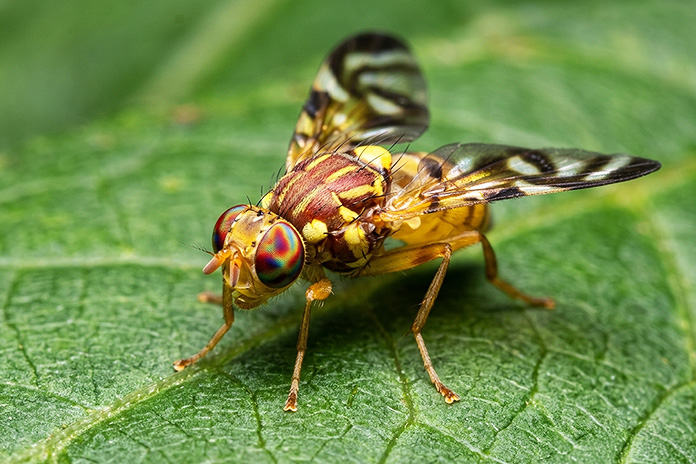
In economic entomology, few insect families present as intractable and expensive a challenge to global horticulture as the Tephritidae. Known as “true fruit flies” distinct from the smaller laboratory vinegar flies (Drosophilidae) the family comprises over 5,000 species across nearly 500 genera.
A highly specialized subset of polyphagous and oligophagous species poses a primary threat to international agricultural value chains. These Tephritid Fruit Flies are among the most economically significant pests affecting horticultural production and international trade.
Females oviposit directly into host fruits; the hatched larvae devour the pulp, eventually exiting to pupate in the soil before emerging as adults. Managing these destructive pests requires a deep understanding of their behavioral ecology, reproductive mechanics, and Integrated Pest Management (IPM) frameworks.
The increasing importance of Fruit Fly Biosecurity has made these pests a major concern for agricultural systems worldwide. Effective Fruit Fly Management requires integration of biological knowledge, monitoring systems, quarantine protocols, and sustainable control approaches.
The role of Agricultural Entomology has become crucial in developing environmentally responsible solutions for managing fruit fly populations while protecting agricultural productivity and global Horticultural Trade.
1. Taxonomic Profile and Key Economic Genera
The most economically devastating tephritids are concentrated within five prominent genera:
- Bactrocera: Predominant in Asia, Africa, and the Pacific. Key pests include the Oriental fruit fly (Bactrocera dorsalis) and the olive fruit fly (Bactrocera oleae).
- Ceratitis: Native to sub-Saharan Africa but established globally. The Mediterranean fruit fly or “Medfly” (Ceratitis capitata) is notoriously adaptable to cooler temperate zones and infests hundreds of commercial crops.
- Anastrepha: Widely distributed across the Americas. Species like the Mexican fruit fly (Anastrepha ludens) and the South American fruit fly (Anastrepha fraterculus) enforce strict market quarantine restrictions in the Western Hemisphere.
- Zeugodacus: Closely related to Bactrocera, these pests heavily target cucurbitaceous plants. The melon fly (Zeugodacus cucurbitae) is highly destructive to melons, cucumbers, and squashes.
- Rhagoletis: Predominant in temperate regions, often exhibiting narrow host specificities. Notable examples include the apple maggot (Rhagoletis pomonella) and the cherry fruit fly (Rhagoletis cingulata).
Understanding the taxonomy, host preference, and geographical distribution of Tephritidae species is essential for designing effective Fruit Fly Pest Management in Horticulture programs.
2. Phytosanitary Biosecurity: Historical and Contemporary Case Studies
The movement of fresh agricultural commodities across borders depends heavily on strict Agricultural Biosecurity systems. Since fruit flies can establish in new regions through infested fruits, countries implement Fruit Fly Quarantine Regulations and advanced monitoring systems to prevent economic losses.
A. The 2026 Japanese Import Suspension on Indian Mangoes
The severe trade implications of tephritid biosecurity were highlighted in May 2026, when Japan’s Ministry of Agriculture, Forestry and Fisheries (MAFF) suspended fresh mango imports from India.
This disruption, the first in twenty years was triggered after quarantine inspectors identified operational lapses during a March 2026 audit at a primary Vapour Heat Treatment (VHT) facility in Rehmanpur, Uttar Pradesh.
VHT is a non-chemical quarantine protocol using precise, high-humidity thermal energy to raise the fruit core temperature to 46.5°C–47°C for a specified duration, eliminating internal eggs and larvae without degrading quality.
Operating under a zero-tolerance policy, the Yokohama Plant Protection Association barred all shipments certified after March 25, 2026, due to temperature monitoring and documentation deficiencies.
This incident highlights the importance of Fruit Fly Biosecurity in International Trade and demonstrates how failures in Phytosanitary Certification can impact agricultural exports.
This ban struck at the peak export season (April to June), halting shipments of premium cultivars like Alphonso, Kesar, Langra, and Banganapalli, which compounded the financial strain on growers already suffering from climate-driven heatwaves.
B. The 2014 European Union (EU) Trade Restrictions
In May 2014, the European Union implemented a sweeping temporary ban on Indian Alphonso mangoes and four critical vegetables (bitter gourd, eggplant, snake gourd, and taro).
The restriction was driven by repeated interceptions of Bactrocera dorsalis. Backed by the UK’s DEFRA to protect domestic greenhouse tomato and cucumber industries from potential establishment, the ban motivated significant infrastructural upgrades.
Following exhaustive inspections of packing facilities by the EU Food and Veterinary Office, the mango restrictions were lifted in early 2015.
Such incidents demonstrate why effective Biosecurity Measures for Fruit Fly Control are essential for maintaining international market access and protecting agricultural economies.
3. High-Risk Tephritid Species in the Indian Subcontinent
India’s diverse agro-climatic zones support multiple destructive tephritid species, broadly categorized by host preference. Effective Tephritid Fruit Fly Management in India requires detailed knowledge of pest biology, host range, seasonal occurrence, and environmentally sustainable control strategies.
These pests significantly influence horticultural productivity, making Fruit Fly Management in Mango Orchards and other fruit-producing regions an important area of research in Agricultural Entomology.
Fruit-Targeting Pests
- Bactrocera dorsalis (Oriental Fruit Fly): Highly aggressive and dominant across India’s mango, guava, and citrus orchards; it drives strict global quarantine enforcement.
Due to its wide host range and economic impact, developing effective Mango Fruit Fly Control Methods has become essential for reducing crop losses and maintaining export quality. - Bactrocera zonata (Peach Fruit Fly): Widespread in northern and western India, primarily targeting stone fruits (peaches, plums) and acting as a secondary pest in mangoes.
- Bactrocera correcta (Guava Fruit Fly): Frequently co-occurs with B. dorsalis in southern and western regions, targeting guava and mango crops.
Cucurbit-Targeting Pests
- Zeugodacus cucurbitae (Melon Fly): Females oviposit in young, tender gourds, melons, and pumpkins, causing severe structural deformity and complete crop loss.
- Zeugodacus tau: Highly polyphagous pest in northern and northeastern India that infests cucurbits alongside non-cucurbit hosts like tomatoes and chilies.
The management of these species requires a combination of monitoring, biological control, cultural practices, and advanced technologies. Integrated approaches help develop effective Fruit Fly Infestation Management strategies while reducing dependence on chemical pesticides.
4. Modern Sustainable Management Paradigms
Historical reliance on broad-spectrum organophosphates and synthetic pyrethroids has given way to tiered, area-wide Integrated Pest Management (IPM) to mitigate insecticide resistance, chemical residues, and ecological disruptions.
Modern Integrated Pest Management for Fruit Flies focuses on combining multiple control approaches, including behavioral techniques, biological control, monitoring systems, and precision agriculture technologies.
The goal of sustainable management is not complete elimination of insects but maintaining pest populations below economic damage levels while protecting beneficial organisms and environmental health.
Sustainable Fruit Fly Management practices are becoming increasingly important in horticulture as growers seek safer solutions that meet international food safety and export standards.
Figure 1: Sustainable Management of Tephritid Fruit Flies
Behavioral Control via Semiochemicals
a. Male Annihilation Technique (MAT):
Uses high-affinity parapheromone lures like methyl eugenol for B. dorsalis or cue-lure for Z. cucurbitae combined with a toxicant to selectively collapse the male mating pool.
MAT is one of the important IPM Strategies for Fruit Flies, especially in regions where fruit flies cause severe economic losses. By reducing male populations before reproduction, this approach helps lower future pest generations.
2. Bait Spray Application:
Pairs a protein-rich food attractant with a low-toxicity insecticide. Because immature females require protein for vitellogenesis, they are selectively eliminated before oviposition.
Bait sprays represent an effective Fruit Fly Control method because they target specific pest behaviors while reducing unnecessary pesticide applications.
Sterile Insect Technique (SIT)
An area-wide genetic control method where mass-reared males are sterilized via ionizing radiation and released. Mating between wild females and sterile males yields no viable offspring, suppressing localized populations.
SIT is considered an advanced component of Area-wide Integrated Pest Management, especially for managing invasive fruit fly populations and protecting high-value horticultural crops.
Conservation and Biological Augmentation
Employs hymenopteran parasitoids (e.g., Fopius arisanus, Diachasmimorpha longicaudata) that target eggs or larvae within the fruit.
Soil applications of entomopathogenic fungi like Metarhizium anisopliae or Beauveria bassiana effectively target subterranean pupae.
These biological approaches support environmentally friendly Fruit Fly Pest Management in Horticulture by reducing chemical dependency and promoting ecosystem balance.
Future and Advanced Management Using AI
Artificial intelligence is transforming pest management from reactive approaches to predictive systems. The integration of technology with entomology is creating new possibilities for AI in Fruit Fly Management and precision-based agricultural protection.
AI transforms fruit fly management from reactive to predictive by integration IoT e-traps with computer vision for automated, real-time species identification.
These Smart Pest Monitoring Systems allow farmers and researchers to detect pest outbreaks earlier, improve decision-making, and implement targeted control measures.
a) Bioacoustic Wingbeat Identification
Smart traps use embedded AI (like CNNs on ESP32 microcontrollers) to process audio spectrograms, identifying fruit flies in real time with up to 96% accuracy via unique wingbeat sounds.
The use of AI in Agriculture is revolutionizing pest surveillance by enabling automated identification, data collection, and real-time monitoring of insect populations.
b) Hyperspectral Drone Surveillance
UAVs leverage AI and hyperspectral imaging to detect early canopy damage and larval fruit rot, mapping infestation hotspots before fruit drops.
These technologies support precision-based Fruit Fly Management by helping farmers identify affected areas and apply control measures efficiently.
c) Optogenetic and IIT Automation
AI tracking systems (YORU framework) disrupt mating behaviors via light-based neural control and optimize sorting pipelines to production of Wolbachia-infected or sterile males.
Such innovations demonstrate how modern Agricultural Innovation is combining entomology, biotechnology, and artificial intelligence to create advanced pest management solutions.
d) Autonomous Quarantine Verification
Machine learning models scan cargo transit parameters and thermal sensors at border controls to guarantee automated phytosanitary compliance.
These systems strengthen Fruit Fly Biosecurity by improving inspection accuracy, reducing human error, and supporting faster international agricultural trade.
Conclusion
Tephritid fruit flies represent a premier challenge where ecological resilience meets global market vulnerability. Trade disruptions, such as the 2026 India-Japan suspension, underscore that fruit fly management is an intersection of farm-level ecology and rigorous quarantine compliance.
Effective Fruit Fly Biosecurity, Integrated Pest Management, and advanced Phytosanitary Certification systems are essential for protecting global horticultural trade and maintaining food security.
Transitioning from reactive chemical covers to proactive, area-wide IPM and flawless post-harvest engineering remains vital to safeguarding international market integrity.
The future of fruit fly control lies in combining traditional entomological knowledge with AI-driven monitoring, sustainable agriculture practices, and innovative technologies. Through integrated approaches, Tephritid Fruit Flies can be managed effectively while supporting resilient horticultural systems worldwide.






![Why B.Tech. (Chemical Engineering) [Lateral Entry] at LPU Stands Out](https://www.lpu.in/blog/wp-content/uploads/2025/11/Why-B.Tech_.-Chemical-Engineering-Lateral-Entry-at-LPU-Stands-Out-100x70.png "Why B.Tech. (Chemical Engineering) [Lateral Entry] at LPU Stands Out?")