
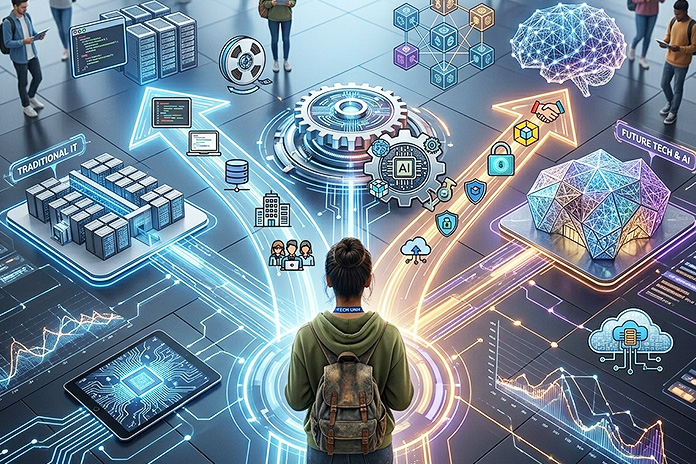
Introduction: Understanding Careers in an AI-Driven World
Artificial Intelligence (AI) is transforming the way people work, learn, and build technology. Every few months, discussions about AI replacing jobs create uncertainty among students planning their careers. For someone choosing a degree in 2026, this concern is natural — investing years in education means wanting a career path that remains valuable in the future.
However, the real question is not whether AI will replace every job. The bigger question is: which careers are AI-proof in the future, and what skills will help professionals stay relevant?
The future belongs to people who can work with AI, understand its applications, and use technology to solve complex problems. Instead of eliminating engineering careers, AI is creating demand for professionals who can design, develop, manage, and improve intelligent systems.
A Computer Science Engineering (CSE) degree provides students with the foundation required to build these future-ready skills and explore careers that grow with artificial intelligence.
What Does the Future of AI Mean for Careers?
Artificial Intelligence is changing industries by automating repetitive tasks and improving decision-making processes. Jobs based mainly on routine activities are more likely to be affected by automation, while careers requiring creativity, problem-solving, technical expertise, and human understanding continue to grow.
The most valuable professionals in the future will not be those who avoid AI but those who know how to use it effectively.
This shift is creating new opportunities in areas such as:
- Artificial Intelligence
- Machine Learning
- Data Science
- Cloud Computing
- Cybersecurity
- Software Development
- Robotics
These fields represent some of the most promising future-proof careers in technology.
Why CSE Professionals Have an Advantage in the AI Era
A Computer Science Engineering graduate is not only a user of technology but also someone who understands how digital systems are created.
There is a major difference between:
- Using AI tools for daily tasks
- Building, improving, and managing AI-powered systems
CSE students learn concepts such as:
- Programming
- Algorithms
- Data Structures
- Machine Learning
- Software Development
- Database Systems
- Cloud Technologies
These skills help graduates become creators of technology rather than only consumers.
This is why AI-proof jobs for computer science students continue to expand as organizations look for professionals who can develop and manage intelligent solutions.
Careers That Will Survive Artificial Intelligence
While no career remains completely unchanged by technology, some professions are more adaptable because they involve innovation, decision-making, and advanced technical knowledge.
Some of the strongest careers that will survive artificial intelligence include:
1. Artificial Intelligence and Machine Learning Engineer
AI engineers design and develop intelligent systems that allow machines to learn, predict, and make decisions.
They work on:
- Machine learning models
- Neural networks
- Automation systems
- AI applications
As more industries adopt AI, this remains one of the strongest ai resistant careers for engineering graduates.
2. Data Scientist and Data Engineer
Modern organizations generate huge amounts of data. Data professionals help companies analyze information and make better decisions.
Their responsibilities include:
- Data analysis
- Predictive modeling
- Data management
- Building data systems
As businesses become more data-driven, these roles are becoming essential.
3. Cybersecurity Specialist
As technology grows, cybersecurity becomes increasingly important. AI itself creates new security challenges, increasing the need for experts who can protect digital systems.
Cybersecurity professionals work on:
- Threat detection
- Data protection
- Network security
- Risk management
This makes cybersecurity one of the most secure careers in the age of AI.
4. Cloud Computing Engineer
Organizations are moving their systems to cloud platforms for better flexibility and scalability.
Cloud professionals manage:
- Cloud infrastructure
- Digital services
- Data storage systems
- Enterprise applications
With increasing digital transformation, cloud computing remains a major future career area.
AI Does Not Replace Industries – It Transforms Them
A common misconception is that AI will remove the need for professionals in different industries. In reality, AI is becoming a tool that helps experts work more effectively.
Healthcare
AI helps healthcare professionals through:
- Medical image analysis
- Disease prediction
- Patient data analysis
Engineers build and maintain these AI-powered healthcare systems.
Finance
Banks and financial companies use AI for:
- Fraud detection
- Risk assessment
- Automated services
Technology professionals help create secure and efficient financial solutions.
Agriculture
AI supports precision farming through:
- Weather analysis
- Crop monitoring
- Data-based farming decisions
Education
AI enables:
- Personalized learning
- Intelligent tutoring systems
- Automated assessment
Across industries, professionals who understand AI become valuable contributors.
What Makes a Career AI-Proof?
A career becomes more future-ready when it involves skills that AI cannot easily replace.
Important qualities include:
Problem-Solving Ability
Professionals who can identify challenges and create solutions remain valuable.
Creativity and Innovation
AI can generate outputs, but human creativity helps develop new ideas and strategies.
Technical Knowledge
Understanding technology allows professionals to adapt as tools evolve.
Continuous Learning
The ability to learn new technologies is one of the most important skills in the AI era.
How to Build an AI-Proof Career
Students preparing for future careers should focus on developing both technical and practical skills.
A roadmap to how to build an ai proof career includes:
Step 1: Build Strong Technical Foundations
Learn:
- Programming languages
- Computer fundamentals
- Data structures
- Algorithms
Step 2: Understand AI Technologies
Explore:
- Machine Learning
- Generative AI
- Data Science
- Automation
Step 3: Gain Practical Experience
Work on:
- Projects
- Internships
- Real-world applications
Step 4: Develop Industry Skills
Learn modern technologies such as:
- Cloud platforms
- Cybersecurity tools
- Data analytics systems
This approach helps students prepare for future-proof engineering careers.
Role of a CSE Degree in Building Future Career Opportunities
A B.Tech. CSE degree is becoming more than just a pathway into software companies. It provides skills that can be applied across multiple industries.
Modern CSE programs with specializations in areas such as:
- Artificial Intelligence
- Generative AI
- Cloud Computing
- Cybersecurity
- Data Science
help students prepare for evolving technology careers.
At Lovely Professional University (LPU), B.Tech. CSE programs focus on industry-relevant learning, practical exposure, and emerging technologies. The curriculum is designed to help students develop skills required for technology-driven industries.
The goal is to prepare graduates who can contribute to organizations adopting AI solutions across different sectors.
Future-Proof Careers in Technology: Looking Ahead
The future of work will not be about humans versus AI. It will be about professionals who know how to collaborate with intelligent systems.
The strongest careers will belong to people who combine:
- Technical expertise
- Creativity
- Adaptability
- Problem-solving skills
From AI engineers and data scientists to cybersecurity experts and cloud specialists, many technology careers are expected to grow alongside AI.
Conclusion: Building a Career That Grows With AI
The rise of Artificial Intelligence is changing the job market, but it is also creating new possibilities. The careers most likely to remain valuable are those connected with innovation, technology development, and human problem-solving.
Students choosing Computer Science Engineering today are preparing for a future where AI will become part of almost every industry.
The goal is not to find a career untouched by AI. The goal is to build skills that make you valuable in an AI-powered world.
By developing technical knowledge, practical experience, and a willingness to adapt, students can create careers that grow with artificial intelligence and remain relevant for years to come.