The Indian monsoon is the lifeline of agriculture, particularly for the Kharif agriculture season across North India. States such as Punjab, Haryana, Uttar Pradesh, Bihar, Rajasthan, Uttarakhand and parts of Madhya Pradesh depend on the southwest monsoon to varying degrees for crop establishment, growth and productivity. Although irrigation has reduced dependence on rainfall in some regions, timely and well-distributed monsoonal rainfall remains crucial for sustaining climate-resilient agriculture and supporting sustainable agriculture in India.
Monsoonal rainfall is much more than a source of water—it is a major driver of Kharif agriculture in North India. The relationship between monsoon and agriculture is particularly significant, as rainfall timing, intensity, duration and distribution influence sowing, germination, crop growth, nutrient availability, irrigation demand and final yield. While adequate monsoon rainfall can support productive agriculture and reduce pressure on groundwater, erratic or extreme rainfall can create serious risks. Understanding the impact of monsoon on agriculture is therefore essential for improving farming outcomes.
The greatest agricultural challenge is not simply a shortage of rainfall but increasing rainfall variability in agriculture, a concern that is becoming increasingly important in discussions about climate change and agriculture. Farmers may experience delayed monsoon onset, prolonged dry spells, intense rainfall events or rainfall concentrated within a few days. Such variability can disturb sowing schedules and create alternating conditions of drought and waterlogging. Heavy rainfall may also cause soil erosion, crop lodging, nutrient loss and damage to standing crops.
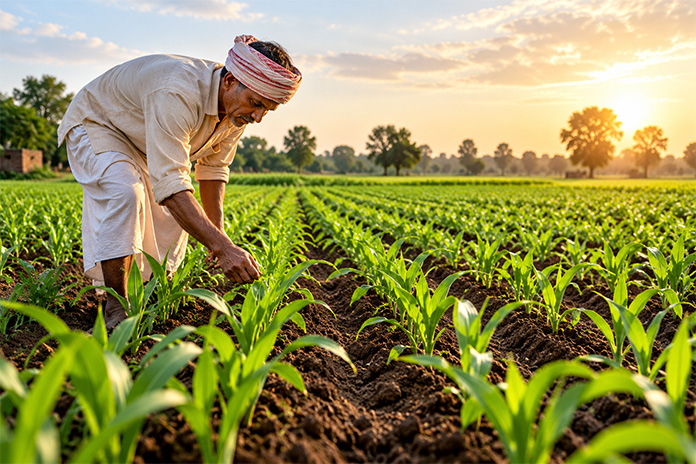
Kharif crops in India are generally sown with the onset of the southwest monsoon, beginning around June and continuing through July in much of North India. Important Kharif crops include rice, maize, cotton, soybean, sorghum, pearl millet, pigeonpea, mungbean and urdbean. The arrival of monsoon rainfall provides the moisture required for seed germination, seedling establishment and early vegetative growth. This close relationship between monsoon rainfall and Kharif crops plays a significant role in determining seasonal agricultural productivity.
The timing of the first effective rainfall is particularly important. Adequate rainfall after a prolonged hot and dry summer softens the soil, improves seedbed conditions and facilitates sowing. For rainfed farmers, the onset of monsoon often determines when field operations can begin, highlighting the importance of rainfed agriculture in India. Good monsoon rainfall can substantially reduce the requirement for irrigation. This is particularly significant in regions where groundwater is heavily exploited. In Punjab and Haryana, for instance, rainfall during the Kharif season can supplement irrigation in crops such as rice, maize and cotton. Reduced pumping can help lower energy consumption and pressure on groundwater resources, contributing to more sustainable agricultural water management and groundwater conservation in agriculture.
The most immediate benefit of monsoonal rain is the availability of soil moisture. During the early Kharif period, rainfall supports germination and establishment of crops. Effective soil moisture management is therefore essential for maintaining favourable growing conditions. In rainfed areas, insufficient rainfall during this period can result in poor germination, uneven plant populations and the need for resowing. Rice, for example, requires substantial water during establishment and subsequent growth. In areas where rice is transplanted, rainfall can supplement irrigation water and maintain favourable field moisture.
Rainfall during the vegetative and reproductive stages influences crop biomass production and ultimately yield. Adequate soil moisture promotes root development, nutrient uptake, photosynthesis and canopy development, supporting healthy Kharif crop production. However, rainfall is beneficial only when it is received in appropriate amounts and at suitable intervals. A long dry spell can cause moisture stress, while excessive rainfall may create waterlogging, particularly in poorly drained fields. Thus, rainfall distribution is often more important than seasonal rainfall total alone.
An effective resilient farming system should combine three principles:
STORE → DRAIN → REUSE
During moderate rainfall, farmers should store water through ponds, farm reservoirs and improved soil-water conservation. Such rainwater harvesting in agriculture can help maintain water availability during periods of limited rainfall. During extreme rainfall, excess water should be drained safely to prevent waterlogging, making waterlogging management in agriculture an important component of resilient farming systems. Stored water can subsequently be reused during dry spells. This approach is particularly relevant to the monsoon-dependent agricultural systems of Punjab, Haryana, Uttar Pradesh and Bihar and supports climate-resilient farming practices in North India.
Farmers should also consider short-duration cultivars where rainfall uncertainty is high. These climate-resilient crop varieties can help crops escape terminal drought or late-season rainfall. Healthy soil acts as a natural buffer against both drought and excessive rainfall. A soil rich in organic matter can hold more water during dry periods while also allowing better infiltration during heavy rainfall. Modern climate-smart agriculture should combine traditional knowledge with weather forecasting and digital technologies. Farmers can modify sowing dates, irrigation, fertilizer application and plant-protection operations according to short- and medium-range weather forecasts. Such weather-based agricultural advisories can help farmers make timely decisions and improve their preparedness for changing weather conditions.
Satellite rainfall estimates, soil-moisture information and crop-weather models can further support location-specific advisories, strengthening the adoption of climate-resilient farming approaches.
Resilient agriculture is not about fighting rainfall—it is about managing rainfall intelligently. Under low rainfall, the priority should be to conserve every drop; under heavy rainfall, the priority should be to safely remove, store and utilize excess water.
The future strategy for Kharif agriculture in North India should therefore move from a simple “drought management” or “flood management” approach to an integrated rainfall variability management approach. Combining suitable crops and varieties with soil-water conservation, drainage, rainwater harvesting, weather advisories and diversified farming systems can substantially improve the resilience and sustainability of agricultural production.