
Key takeaways
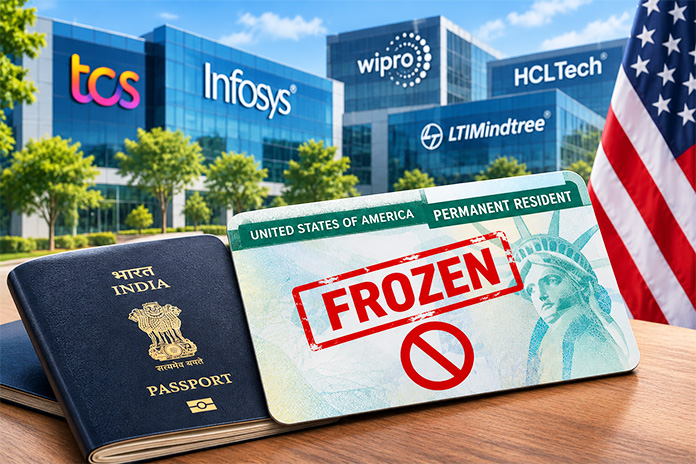
- On 8 October 2026, the US suspended eight companies, including Infosys, TCS, Wipro and HCL, from PERM, the main route to employer-sponsored green cards.
- My analysis of US Department of Labor data shows the six IT services firms together had just 32 certified PERM applications in nine months under their main US entities, and fewer than 100 even counting smaller affiliates. Microsoft alone had 1,504.
- TCS has independently confirmed the pattern, saying its PERM filings were in single digits over the past two years.
- The bigger risk falls on individual professionals near the six-year H-1B limit, not on Indian IT companies.
- The policy could even strengthen the offshore model it appears to target.
What happened?
On 8 October 2026, US Labor Secretary Keith Sonderling, alongside Vice President JD Vance, announced that the Department of Labor would stop accepting new PERM applications, and stop processing pending ones, from eight companies: Microsoft, Adobe, Cognizant, Infosys, Tata Consultancy Services (TCS), Wipro, HCL Technologies and Capgemini.
Officials cited alleged fraud and the need to protect American workers. The Labor Department’s Inspector General said subpoenas had been served. No end date has been announced, and the formal order has not yet been published. These are allegations under investigation, not findings of wrongdoing.
Indian headlines quickly described the move as a blow to Indian IT. The data suggests otherwise.
The US green card freeze has brought renewed attention to US Immigration Policy 2026, particularly its implications for skilled professionals, multinational technology companies and employer-sponsored permanent residency.
What is PERM, and how is it different from H-1B?
- H-1B is a temporary US work visa for skilled roles, generally capped at six years.
- PERM is the process in which the US Department of Labor certifies, at an employer’s request, that no qualified US worker is available for a job. It is the first step towards most employer-sponsored green cards.
The suspension applies only to PERM. It does not cancel anyone’s H-1B status or existing green card.
Understanding the relationship between the H-1B visa and green card process is particularly important when assessing US work visa restrictions. PERM labour certification plays a central role in the Employment-based green card process for many foreign professionals.
What does the data actually show?
To test the headlines, I analysed the Department of Labor’s public PERM disclosure file, which covers decisions issued between 1 October 2025 and 30 June 2026.
Figure 1: Certified PERM applications, October 2025 – June 2026. Microsoft alone far exceeds all six IT services firms combined. Source: US Department of Labor; author’s analysis.
Table 1: Certified PERM applications by employer, October 2025 – June 2026
| Company | Certified PERM applications | Named in suspension? |
| Microsoft | 1,504 | Yes |
| Deloitte Consulting | 695 | No |
| Nvidia | 693 | No |
| JPMorgan Chase | 617 | No |
| Adobe | 168 | Yes |
| HCL America | 22 | Yes |
| Capgemini America | 7 | Yes |
| TCS | 2 | Yes |
| Wipro (subsidiaries) | 1 | Yes |
| Infosys | 0 | Yes |
| Cognizant | 0 | Yes |
Source: US Department of Labor, PERM Disclosure Data FY2026 Q3. Author’s tabulation of cases with status “Certified”, matched by employer name.
Three findings stand out:
- The Indian IT majors barely use PERM now. Infosys had no certified cases in this period and TCS had two. TCS has independently confirmed this pattern: on 9 October it said its PERM applications were in single digits over the past two years, and that it expects no impact on its workforce plans.
- The heaviest user is American. Microsoft’s 1,504 certifications are more than ten times those of all six IT services firms combined.
- Volume does not explain the selection. Deloitte, Nvidia and JPMorgan each had far more certifications than the six IT firms, yet none was named.
One limitation: the file records decisions issued in this period, not every application filed, so some cases may still be pending.
The PERM suspension 2026 has therefore raised important questions about the actual dependence of major technology employers on permanent residency sponsorship, including Infosys US immigration practices and TCS green card sponsorship trends.
Why did the Indian IT majors stop sponsoring green cards?
The data suggests a shift that began well before this announcement. Over the past several years, Indian IT companies appear to have increased hiring of local US staff, partly in response to visa costs and political pressure. TCS has reiterated its plan to hire an additional 15,000 people in the US over the next five years. A business model built on local hiring and offshore delivery needs far fewer green-card sponsorships.
These developments reflect how Indian IT companies US immigration strategies have evolved alongside changing workforce requirements, immigration regulations and global service-delivery models.
How should we read the government’s decision?
The government’s view. The administration says it is protecting American workers from misuse of immigration programmes. However, specific evidence has not yet been made public.
Microsoft’s response. Microsoft says about 80% of its roughly 6,000 H-1B applications in the last fiscal year were to extend or change the status of existing employees, not to hire new people. But “existing employees” can include graduates moving from student work permits to H-1B status, and whether these count as new hires is part of the debate.
The open question. Until the government publishes its findings, it is unclear why these eight companies were chosen.
The decision has also intensified discussions surrounding US green card policy and its potential influence on employer-sponsored immigration pathways for international technology professionals.
Who actually bears the cost?
Mainly individual professionals, especially those working at US technology firms and nearing the six-year H-1B limit.
Extending an H-1B beyond six years generally requires a PERM or immigrant petition to have been pending for at least 365 days. The Department of Labor reported that PERM applications took an average of 336 days to process in August. A freeze on pending cases hits hardest the workers whose timelines were already tight. Their current work authorisation remains valid, but their path to permanent residency is on hold.
For affected professionals, the relationship between the H-1B visa and green card application process becomes especially significant when evaluating long-term employment and residency plans.
What does this mean for you?
- For students planning to work in the US: Ask employers early whether and when they sponsor green cards. Sponsorship policy now matters as much as salary.
- For professionals on H-1B: Know where your case stands. Workers with an already approved immigrant petition (I-140) are generally in a stronger position than those still waiting on PERM. For individual advice, consult a qualified immigration lawyer.
- For investors and analysts: The question is not which firms were named, but how much each business model depends on this pathway. For the Indian majors, both the data and TCS’s own statement suggest the dependence is low.
Understanding US Immigration Policy 2026 and changing US work visa restrictions can help students and professionals make more informed decisions about international career opportunities and long-term employment planning.
Could the policy backfire?
Restricting skilled immigration may have an unintended effect. If skilled workers cannot settle in the US, some of their work may move offshore, and offshore delivery is what Indian IT firms sell. A policy that names Indian IT companies could, over time, reinforce the very model it appears to target.
The US green card freeze may consequently influence how multinational IT companies balance domestic recruitment, international workforce mobility and offshore technology operations.
Frequently asked questions
Does the PERM suspension cancel H-1B visas?
No. It applies only to PERM labour certification. Existing H-1B status and green cards are not cancelled.
Which companies were suspended from PERM?
Microsoft, Adobe, Cognizant, Infosys, TCS, Wipro, HCL Technologies and Capgemini.
How long will the suspension last?
No end date has been announced as of 9 October 2026.
Are Indian IT companies heavily affected?
US Department of Labor data suggests their direct exposure is low, because they had already sharply reduced green-card sponsorship. TCS has said it expects no impact on its workforce plans.
Conclusion
The headlines said Indian IT was the target. The primary data points elsewhere: the Indian majors had already moved away from PERM, a pattern TCS itself has confirmed, while the heaviest user among the eight was an American technology company. The more pressing concern is for individual professionals whose long-term plans now face uncertainty.
For students of business, the episode carries a broader lesson. When access to talent depends on changing policy, both companies and individuals need to build that risk into their plans.
Sources
- US Department of Labor, PERM Disclosure Data FY2026 Q3
https://www.dol.gov/agencies/eta/foreign-labor/performance - US Department of Labor, PERM processing times
https://www.dol.gov/agencies/eta/foreign-labor/performance - Reuters, 8 October 2026
https://www.reuters.com/business/us-suspending-permanent-residency-program-for-microsoft-vance-says-2026-10-08/ - Microsoft public statement, 8 October 2026
https://blogs.microsoft.com/on-the-issues/2026/10/08/microsoft-comment-on-recent-immigration-questions/ - TCS statement, as reported by The Hindu
https://www.thehindu.com/business/tcs-sees-no-impact-from-us-green-card-programme-suspension-workforce-hiring/article71562477.ece