
Technology has always created new opportunities for engineers. The rise of the internet led to demand for web developers, the smartphone revolution created opportunities for mobile app developers, and cloud computing increased the need for software and cloud engineers. Today, Generative AI is driving the next wave of innovation.
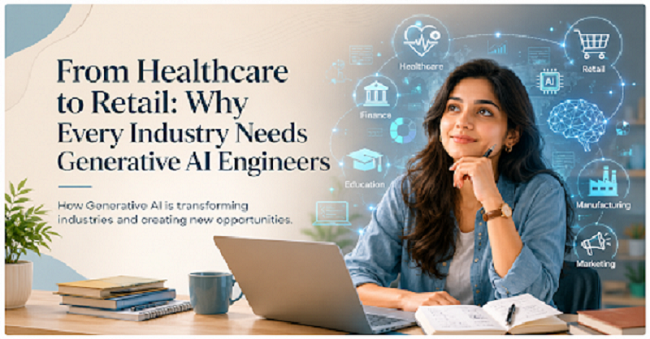
Across industries, organisations are using Generative AI to solve problems, improve efficiency, enhance customer experiences, and unlock new possibilities. Hospitals are exploring AI-powered clinical support systems, banks are investing in intelligent financial solutions, educators are adopting personalised learning platforms, and retailers are using AI to better understand and serve their customers.
However, these innovations do not happen on their own. Behind every AI-powered application, virtual assistant, recommendation engine, or content generation tool are professionals who design, develop, deploy, and optimise these technologies.
As Generative AI adoption accelerates, industries are increasingly seeking engineers who can build AI-powered solutions tailored to their unique challenges and requirements. This growing demand is creating exciting opportunities for students who want to combine computer science expertise with cutting-edge AI technologies.
In this article, we explore how Generative AI is transforming key industries and why a B.Tech. CSE with a specialisation in Generative AI could be the most future-ready engineering degree you can pursue today.
How Generative AI is Transforming Key Industries
Here is a closer look at how Generative AI is transforming key industries, and why each one is increasingly seeking engineers who can build these solutions.
Healthcare
Healthcare is emerging as one of the most significant adopters of Generative AI. Hospitals, healthcare providers, pharmaceutical companies, and research institutions are increasingly using AI-powered systems to assist with clinical documentation, patient communication, medical research, diagnostics, and healthcare analytics.
However, healthcare is also one of the most sensitive environments in which AI can operate. Unlike a consumer application where an incorrect response may cause inconvenience to a user, errors in healthcare can have serious consequences. AI systems handling patient records, treatment recommendations, or clinical information must, therefore, be accurate, reliable, secure, and compliant with strict healthcare regulations.
This creates a challenge that goes far beyond simply using an existing AI tool. Healthcare organisations need specialised professionals who can develop AI solutions tailored to medical workflows, integrate them with existing healthcare systems, safeguard sensitive patient information, and ensure that these technologies operate responsibly at scale.
As the healthcare sector continues to invest in AI-driven innovation, the demand for Generative AI engineers is growing rapidly. These professionals play a critical role in building the intelligent systems that support healthcare providers, improve operational efficiency, and help deliver better patient experiences.
Opportunities for Generative AI Engineers in Healthcare
Professionals with expertise in Generative AI can contribute to the healthcare sector by:
- Developing AI-powered clinical support systems
- Building virtual healthcare assistants and patient support tools
- Creating intelligent medical documentation solutions
- Designing healthcare analytics platforms
- Developing AI applications for medical research and innovation
Finance & Banking
The banking and financial services industry is among the fastest adopters of Generative AI. From intelligent virtual assistants and automated customer support to fraud detection, risk assessment, and financial analysis, AI is rapidly becoming a core part of modern banking operations.
However, financial institutions cannot rely solely on generic, off-the-shelf AI tools. Banks process vast amounts of sensitive customer information, manage high-value transactions, and operate within strict regulatory frameworks. An inaccurate recommendation, a security vulnerability, or a system failure can result in financial losses, regulatory penalties, and a loss of customer trust.
As a result, banks and financial organisations are increasingly investing in custom AI solutions designed specifically for their operational, security, and compliance requirements. These systems must be reliable, scalable, secure, and capable of integrating seamlessly with existing financial infrastructure.
This growing reliance on AI-powered financial systems has created strong demand for Generative AI engineers who can build, customise, and deploy solutions tailored to the needs of the banking sector. Whether developing intelligent financial assistants, enhancing fraud detection systems, automating financial reporting, or creating personalised banking experiences, these professionals play a critical role in shaping the future of financial services.
Opportunities for Generative AI Engineers in Finance & Banking
Professionals with expertise in Generative AI can contribute to the finance sector by:
- Developing intelligent banking assistants
- Building AI-powered fraud detection and risk assessment systems
- Creating financial analytics and reporting platforms
- Designing personalised banking and investment solutions
- Integrating Generative AI into customer service and operational workflows
Media, Marketing & Advertising
The media, marketing, and advertising industry was among the first to experience the impact of Generative AI. Today, organisations are using AI-powered technologies to create content, generate images and videos, personalise campaigns, analyse audience behaviour, and engage customers at an unprecedented scale.
However, successful marketing is about far more than generating content quickly. Brands must maintain a consistent voice, deliver relevant messages to diverse audiences, and ensure that published content aligns with business objectives and brand guidelines. A poorly designed AI system can produce inaccurate information, inconsistent messaging, or content that fails to resonate with its intended audience.
As businesses increasingly integrate AI into their creative and marketing workflows, they require solutions that are tailored to their unique requirements. This has created growing demand for Generative AI engineers who can develop content-generation platforms, recommendation systems, audience intelligence tools, and other AI-powered applications that support modern marketing and media operations.
From helping brands create personalised customer experiences to building platforms capable of generating and optimising content at scale, these professionals play a key role in the future of digital communication and engagement.
Opportunities for Generative AI Engineers in Media, Marketing & Advertising
Professionals with expertise in Generative AI can contribute to the media and marketing sector by:
- Developing AI-powered content generation platforms
- Building intelligent marketing automation tools
- Creating image, video, and multimedia generation systems
- Designing personalised content recommendation engines
- Developing AI solutions for audience analysis and campaign optimisation
Education
Education is undergoing a significant transformation with the adoption of Generative AI. Schools, universities, and EdTech companies are increasingly using AI-powered technologies to create personalised learning experiences, generate educational content, provide intelligent tutoring, and support students with instant feedback and guidance.
However, education is not simply about delivering information. Every learner has different abilities, learning styles, strengths, and challenges. An effective AI-powered learning system must be capable of adapting to diverse educational needs while maintaining accuracy, relevance, and academic integrity. Inaccurate explanations, biased content, or poorly designed learning experiences can negatively impact student outcomes.
As educational institutions and EdTech companies continue to invest in AI-powered learning platforms, they require professionals who can develop solutions that are engaging, scalable, and aligned with educational objectives. This has created growing demand for Generative AI engineers who can build intelligent tutoring systems, adaptive learning platforms, educational content generation tools, and AI-driven learning support applications.
By helping create technologies that make learning more personalised, accessible, and interactive, these professionals are playing an increasingly important role in shaping the future of education.
Opportunities for Generative AI Engineers in Education
Professionals with expertise in Generative AI can contribute to the education sector by:
- Developing AI-powered tutoring systems
- Building adaptive learning platforms
- Creating educational content generation tools
- Designing intelligent assessment and feedback systems
- Developing AI-driven learning analytics solutions
Retail & E-commerce
The retail and e-commerce industry is increasingly leveraging Generative AI to create personalised shopping experiences, improve customer support, optimise inventory management, and enhance marketing campaigns. From AI-powered product recommendations and virtual shopping assistants to automated product descriptions and customer engagement tools, AI is becoming a key driver of modern retail operations.
However, delivering personalised experiences at scale is a complex challenge. Retailers serve millions of customers with different preferences, purchasing behaviours, and expectations. Generic AI tools are often unable to account for a company’s unique product catalogue, customer data, pricing strategies, and business objectives. A poorly designed system can result in irrelevant recommendations, inconsistent customer experiences, and missed business opportunities.
To remain competitive, retailers are increasingly investing in customised AI solutions that can analyse customer behaviour, predict trends, improve product discovery, and streamline operations. This has created strong demand for Generative AI engineers who can design, develop, and deploy intelligent retail technologies tailored to specific business needs.
Whether building recommendation engines, developing AI-powered shopping assistants, or creating systems that help retailers better understand their customers, these professionals are helping shape the future of commerce in an increasingly digital world.
Opportunities for Generative AI Engineers in Retail and E-commerce
Professionals with expertise in Generative AI can contribute to the retail and e-commerce industry by:
- Developing intelligent product recommendation engines
- Building AI-powered shopping assistants and chatbots
- Creating automated content generation systems for product catalogues
- Designing customer behaviour analytics platforms
- Developing AI solutions for inventory planning and demand forecasting
Generative AI Career Paths Across Industries
As organisations across sectors continue to invest in AI-powered solutions, a growing range of roles is emerging for professionals with expertise in Generative AI. The following career paths represent some of the opportunities available across key industries:
| Industry | Potential Roleso |
| Healthcare | Healthcare AI Engineer, Medical AI Application Developer, AI Solutions Developer (Healthcare) |
| Finance & Banking | Financial AI Engineer, Banking AI Solutions Developer, AI Systems Engineer (Financial Services) |
| Media & Marketing | Generative AI Engineer, AI Content Platform Developer, Multimodal AI Engineer |
| Education | Educational AI Engineer, AI Learning Platform Developer, EdTech AI Engineer |
| Retail & E-commerce | Retail AI Engineer, Recommendation Systems Engineer, E-commerce AI Developer |
Beyond Traditional Coding: The Skills Generative AI Engineering Demands
Building AI-powered applications requires a different set of skills from traditional software development. Conventional software follows predefined rules; a developer writes instructions, and the system executes them. Generative AI systems work differently. They learn from large datasets, generate content, recognise patterns, and support decision-making in ways that cannot be reduced to simple if-then logic.
This shift demands skills that most traditional Computer Science programmes were not designed to teach. Working with large language models, fine-tuning pre-trained AI systems, designing effective prompts, building retrieval-augmented generation pipelines, and deploying AI applications using frameworks such as LangChain or Hugging Face require knowledge that goes beyond conventional software engineering.
At the same time, organisations are not simply looking for data scientists or ML researchers. They need engineers who can take AI capabilities and build production-ready applications around them, professionals who understand both the software development lifecycle and the unique demands of working with AI systems.
This gap between what traditional programmes offer and what the industry now needs has created demand for specialised programmes that combine core Computer Science fundamentals with focused, hands-on training in Generative AI technologies.
B.Tech. (CSE) – Generative Artificial Intelligence [Gen AI] at Lovely Professional University
Lovely Professional University offers a B.Tech. (CSE) – Generative AI programme that combines the fundamentals of Computer Science Engineering with specialised training in Generative AI technologies, in tie-up with Microsoft.
The programme is designed to help students build a strong foundation in artificial intelligence, machine learning, and AI application development, with exposure to industry-relevant tools, technologies, and certifications aligned with the evolving demands of the AI ecosystem. Through practical, hands-on learning experiences, students develop the skills needed to contribute to AI-powered solutions across healthcare, finance, media, education, retail, and other sectors.
For students who want to move beyond using AI to actually building it, this programme offers a focused pathway into one of the fastest-growing fields in technology.
Explore the B.Tech. (CSE) – Generative AI [Gen AI] programme at LPU and take the first step towards a career in AI engineering.
Frequently Asked Questions
What is Generative AI?
Generative AI is a branch of Artificial Intelligence that can create content such as text, images, videos, code, and audio. Unlike traditional AI systems that primarily analyse data, Generative AI can generate new outputs based on patterns learned from large datasets.
Will Generative AI replace software engineers?
Generative AI is changing the nature of software development, but it is also creating demand for professionals who can build, customise, and manage AI-powered systems. Many organisations are seeking engineers with expertise in both computer science and artificial intelligence.
What is the difference between using AI and building AI?
Using AI involves interacting with existing tools and applications to perform tasks more efficiently. Building AI involves designing, developing, training, deploying, and improving AI-powered systems that can be used by individuals and organisations.
Do Generative AI engineers need strong programming skills?
Yes. Programming forms an important part of AI development. Generative AI engineers often work with programming languages, machine learning frameworks, and software development tools to build intelligent applications.
How can students prepare for careers in Generative AI while still in school?
Students can begin by strengthening their understanding of mathematics, logical reasoning, programming fundamentals, and emerging technologies. Exploring AI concepts through online resources, projects, and academic programmes can also be beneficial.
What skills are required to become a Generative AI engineer?
A strong foundation in computer science, programming, machine learning, data analysis, and artificial intelligence is important. Knowledge of AI frameworks, large language models, and problem-solving techniques can also help students prepare for careers in this field.
How is a Generative AI engineer different from a traditional software engineer?
While traditional software engineers primarily build rule-based applications, Generative AI engineers work with AI models, machine learning systems, and intelligent applications capable of generating content, recognising patterns, and supporting decision-making.
What career opportunities can a B.Tech. (CSE) – Generative AI [Gen AI] graduate explore?
Graduates may pursue roles such as Generative AI Engineer, AI Engineer, AI Application Developer, AI Solutions Developer, Machine Learning Engineer, AI Systems Engineer, NLP Engineer, and AI Platform Engineer.
Why should students consider a specialised B.Tech. (CSE) – Generative AI [Gen AI]?
As AI adoption continues to grow across industries, organisations are seeking professionals with specialised knowledge of AI technologies. A dedicated programme can help students build the technical expertise and practical skills required to contribute to the development of AI-powered solutions.
How can the B.Tech. (CSE) – Generative AI [Gen AI] programme at LPU prepare students for the future?
The programme combines core Computer Science Engineering concepts with specialised training in Generative AI technologies, helping students develop the knowledge and practical skills required to build AI-powered applications and solutions across industries.