
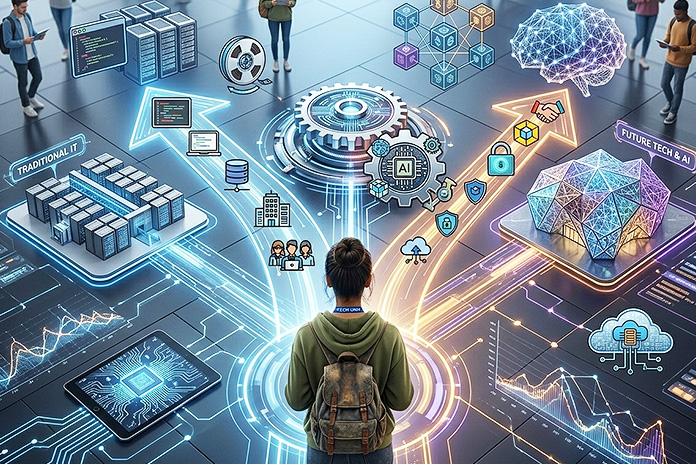
For years, learning to code meant spending hours writing programs, debugging errors, searching documentation, and gradually understanding how different technologies work. Today, a CSE student can describe a problem to an AI tool and receive a working piece of code within seconds.
That changes the way we write software. It also raises an important question for every B.Tech in Computer Science and Engineering student and graduate:
If AI can generate code, what should you learn now?
The answer isn’t to stop learning programming. It is to understand programming at a deeper level and learn how to work effectively with AI.
Artificial intelligence is changing software development, but it hasn’t eliminated the need for engineers. Instead, it is changing what engineers are expected to do—and the B.Tech CSE skills that will matter most.
AI Can Write Code. Can You Understand It?
One of the biggest changes brought by generative AI is the ability to produce code quickly.
AI tools can help generate functions, explain errors, suggest improvements, write test cases, and even create parts of an application. This can significantly reduce the time required for routine coding tasks.
But generated code isn’t automatically correct.
It may contain bugs, security vulnerabilities, inefficient logic, outdated approaches, or assumptions that don’t match the actual requirements.
This creates an important distinction:
Using AI to generate code is not the same as knowing how to engineer software.
A strong Btech CSE student should be able to read AI-generated code, understand its logic, identify potential problems, test it, and modify it when necessary.
The better your fundamentals, the better you can judge what AI produces.
Don’t Abandon Programming Fundamentals
When technology changes, fundamentals become even more important.
Concepts such as data structures, algorithms, object-oriented programming, databases, operating systems, computer networks, and software engineering principles remain valuable because they help you understand what is happening beneath the tools you use. These programming fundamentals are also among the most important technical skills for CSE students.
Imagine receiving a complex piece of code from an AI assistant.
If you understand the underlying concepts, you can ask:
- Is this algorithm efficient?
- What happens with a large dataset?
- Is the code secure?
- Could this create a memory or performance problem?
- Is there a simpler solution?
- Will this architecture scale?
Without fundamentals, it becomes difficult to evaluate the answer.
AI can accelerate your coding. It cannot replace your engineering judgement.
Learn to Give Better Instructions
Working with AI effectively is becoming a practical skill. Developing AI literacy for students and building AI skills for CSE students can help future engineers use these technologies more effectively.
A vague request such as “Build me a website” may produce something generic. A well-defined request that explains the objective, users, constraints, technology, expected behaviour, and desired output is far more useful.
This doesn’t mean that prompt writing alone is the future of software engineering.
Rather, it means students should learn how to communicate problems clearly to both humans and AI systems.
Good AI-assisted development often begins with good problem definition.
Before asking an AI tool for a solution, understand what you are trying to solve.
Debugging Is More Important Than Ever
When AI makes coding faster, debugging and verification become increasingly important.
AI-generated code may look convincing even when it is wrong. A student who simply copies and runs it may not know what failed when the output is unexpected.
Develop the habit of testing systematically.
Understand error messages. Trace program execution. Check assumptions. Create test cases. Compare expected and actual results.
Don’t ask AI only to “fix the code.” Ask it to explain why the problem occurred, then verify the explanation yourself.
The goal should be to become better at debugging—not better at copying fixes. These are essential coding skills for CSE students and problem-solving skills for programmers.
Build Real Projects, Not Just AI Demos
AI has made it easier to create impressive-looking prototypes. That makes genuine project experience even more important.
Don’t stop at generating a chatbot because it is easy to build one.
Ask yourself:
What problem am I solving?
Maybe you’re building a system to help students organise academic resources, a tool that analyses data, an application that automates a repetitive task, or a platform that improves an existing process.
Then think beyond the initial prototype.
How will users interact with it? How will data be stored? How will authentication work? What happens if the input is incorrect? How will you test it? How will you deploy it? What are the privacy and security considerations?
This is where engineering begins.
Building such projects is an important part of project-based learning for CSE students and helps develop practical skills for CSE students. Students can also strengthen their Git and GitHub skills and version control skills while working on real software projects.
Learn to Work With AI, Not Depend on It
AI can be an excellent learning companion.
You can ask it to explain a difficult concept in simpler language, generate practice questions, compare approaches, review your code, or help you explore an unfamiliar technology.
But there is a danger in outsourcing your thinking.
If you ask AI to solve every programming problem before attempting it yourself, you may finish assignments faster while developing weaker problem-solving skills.
A useful rule is simple:
Think first. Use AI second. Verify always.
Try solving the problem yourself. Use AI when you are stuck or want another perspective. Then understand the final solution rather than accepting it blindly.
Cybersecurity and Responsible AI Matter
As AI becomes part of software development, understanding responsible technology use becomes increasingly important.
Students should become familiar with concepts such as data privacy, secure coding, authentication, access control, bias, hallucinations, intellectual property, and responsible use of AI-generated content.
A technically impressive application can still be a poor solution if it exposes sensitive data or creates security risks.
The future engineer needs both technical capability and professional judgement.
Develop Skills AI Cannot Easily Replace
If AI can increasingly handle routine coding tasks, students should invest in capabilities that remain valuable when routine work becomes automated.
These are important skills required for CSE students and skills for B.Tech CSE graduates:
- Problem definition
- System design
- Critical thinking
- Communication
- Creativity
- Collaboration
- Domain knowledge
- Decision-making
- Understanding users and business requirements
A company doesn’t simply need someone who can produce code. It needs people who can understand a problem and determine what should be built, why it should be built, and how it should work.
Strong communication skills for CSE students, teamwork skills for engineers, and other soft skills for CSE students can therefore be just as important as technical knowledge. Together, these contribute to the employability skills for CSE graduates and job-ready skills for CSE graduates that employers look for.
Don’t Chase Every AI Trend
The AI ecosystem changes extremely quickly.
New models, frameworks, platforms, and tools appear constantly. Trying to learn every new tool can become exhausting and can prevent you from developing depth.
Instead, build a strong foundation in computer science and then explore AI tools relevant to your interests.
Learn the concepts behind the technology, not just the names of the latest tools.
Today’s popular tool may change. The ability to understand and adapt will remain valuable.
The CSE Graduate of Tomorrow
The future isn’t necessarily about choosing between traditional programming and AI.
It is about combining both.
A strong B.Tech CSE degree graduate will understand programming fundamentals, algorithms, software development, and system design while also knowing how to use AI effectively. They will develop software development skills, along with the skills required for software developers in an increasingly AI-assisted industry.
They will be able to collaborate with AI tools without becoming dependent on them. They will know when to accept an AI-generated suggestion, when to question it, and when to reject it completely.
Most importantly, they will understand that software engineering is about solving problems—not simply producing code.
Final Thoughts
AI is not making computer science education irrelevant. It is making strong computer science foundations more valuable.
The question is no longer simply, “Can you code?”
It is increasingly:
Can you understand a problem, design a solution, use the right tools—including AI—and take responsibility for the result?
For CSE students, this is an opportunity rather than a threat.
Learn the fundamentals. Build real projects. Practise problem-solving. Develop strong communication skills. Experiment with AI. Question its output. Keep learning.
The engineers who thrive in an AI-assisted world won’t necessarily be those who write every line of code themselves.
They will be those who know what to build, why to build it, how to build it well, and how to use AI intelligently along the way.
These combined industry-ready skills for CSE students can help graduates become better prepared for modern software roles and develop the broader CSE placement skills employers increasingly value. Ultimately, the key question for students remains: what skills should a B.Tech CSE graduate have to stay relevant in a changing technology landscape?