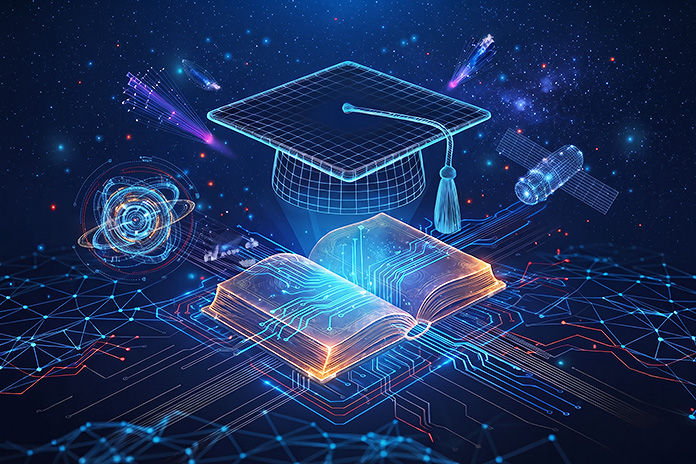
Artificial Intelligence is rapidly changing the way people live, work, communicate, and learn. In the field of education, AI has emerged as one of the most powerful technologies of the modern age. It is no longer limited to advanced research laboratories or technical industries. Today, AI is being used in schools, colleges, universities, online learning platforms, coaching centers, and professional training programs. From personalized learning applications to intelligent tutoring systems, AI is reshaping the educational experience for both students and teachers. Education has traditionally followed a common classroom model where one teacher teaches many students at the same pace. However, every student has a different learning style, speed, interest, and level of understanding. Some students may understand a topic quickly, while others may need repeated explanation and additional practice. This is where AI can make a major difference. AI-based learning platforms can analyze a student’s performance, identify strengths and weaknesses, and provide customized learning material. For example, if a student is weak in mathematics, an AI tool can suggest extra practice questions, simple explanations, videos, and quizzes based on the student’s current level. This helps students learn at their own pace and reduces the pressure of competing with others.
Personalized learning is one of the most important contributions of AI in education. Instead of giving the same content to every learner, AI can create a learning path suited to individual needs. It can recommend topics, adjust difficulty levels, provide instant feedback, and track progress over time. This makes learning more meaningful and student-centered. A student who is advanced in a subject can move to higher-level concepts, while a student who is struggling can receive additional support. In this way, AI helps bridge learning gaps and improves academic confidence. AI for personalized learning enables students to receive customized learning experiences. AI is also highly useful for teachers. Teachers often spend a lot of time on repetitive administrative tasks such as checking tests, preparing reports, recording attendance, creating worksheets, and analyzing student performance. AI can help automate many of these tasks. Objective-type tests can be evaluated instantly, student performance data can be summarized quickly, and learning analytics can show which students need extra help. This saves valuable time for teachers and allows them to focus more on teaching, mentoring, discussion, creativity, and emotional support. Therefore, AI should not be seen as a replacement for teachers. Instead, it should be understood as a supportive tool that makes teachers more effective.
Another major benefit of AI in education is improved access to learning. In many regions, students do not have access to quality teachers, libraries, or educational resources. AI powered learning platforms can provide learning support to students in remote areas through digital devices and internet-based systems. Virtual tutors, educational chatbots, translation tools, and voice-based learning applications can help students overcome geographical and language barriers. For example, a student who does not understand English well can use AI translation tools to learn concepts in a familiar language. Similarly, students who cannot attend physical classes regularly can use AI in education platforms for flexible learning. AI also plays an important role in inclusive education. Students with disabilities often face difficulties in traditional classroom settings. AI tools such as speech-to-text, text-to-speech, screen readers, smart subtitles, and adaptive learning interfaces can make education more accessible. A visually impaired student can listen to digital content, while a student with writing difficulties can use voice input tools. AI can also help identify learning disabilities at an early stage by observing patterns in student responses and behavior. This allows teachers and parents to provide timely support.
Assessment is another area where AI is bringing significant change. Traditional assessment mainly depends on final exams, marks, and grades. However, marks alone do not always show the complete picture of a student’s learning. AI can support continuous assessment by tracking how a student learns over time. It can analyze quiz results, assignment performance, response time, participation, and mistakes. Based on this data, AI can provide early warnings if a student is falling behind. Teachers can then intervene before the problem becomes serious. This makes assessment more diagnostic and supportive rather than only judgmental. AI can also improve the quality of feedback. In traditional classrooms, students may have to wait for days or weeks to receive feedback on their work. AI tools can provide instant feedback, especially in subjects involving objective answers, grammar, coding, mathematics, and language learning. Immediate feedback helps students correct mistakes quickly and understand concepts better. For example, an AI writing tool can suggest grammar corrections, sentence improvements, and vocabulary alternatives. A coding platform can immediately show errors in a program and suggest possible solutions. This improves learning efficiency.
In higher education, AI in higher education is becoming increasingly important for research, academic writing, data analysis, literature review, and skill development. Students and researchers can use AI tools to search for academic sources, summarize information, organize ideas, analyze data, and improve writing clarity. However, it is important that students use AI ethically. AI should support learning, not replace original thinking. Copying AI-generated content without understanding or acknowledgment can harm academic integrity. Therefore, educational institutions must create clear policies regarding the responsible use of AI. The use of artificial intelligence for students should focus on improving learning outcomes while maintaining academic honesty.
Despite its advantages, AI in education also has several challenges. One major concern is overdependence. If students use AI only to get ready-made answers, their critical thinking, problem-solving ability, and creativity may become weak. Education is not only about finding answers; it is also about questioning, reasoning, discussing, and understanding. Therefore, students must be trained to use AI as a learning assistant, not as a shortcut.
Data privacy is another serious issue. AI systems often collect large amounts of student data, including performance records, learning behavior, personal details, and sometimes even biometric information. If this data is not protected properly, it can be misused. Schools and universities must ensure that AI tools follow strong data protection policies. Students and parents should also be informed about how their data is collected and used.
Bias in AI systems is also a concern. AI tools learn from data, and if the data contains bias, the AI system may produce biased results. For example, an AI-based evaluation system may unfairly favor certain writing styles, languages, or backgrounds. This can create inequality instead of reducing it. Therefore, AI tools used in education must be carefully tested, monitored, and improved.
Another challenge is the digital divide. While some students have access to smartphones, laptops, high-speed internet, and advanced AI tools, others do not. If AI-based education grows without equal access, it may increase educational inequality. Governments, institutions, and technology providers must work together to make AI-supported education affordable and accessible for all learners. The growth of AI based education and educational technology should focus on creating equal opportunities for every student.
The future of AI in education is promising, but it must be guided by human values. Teachers will continue to play the most important role in education because they provide empathy, motivation, moral guidance, creativity, and human connection. AI can provide information, analysis, and personalization, but it cannot fully replace the emotional and social role of a teacher. The ideal future of education will be a partnership between teachers and AI, where technology supports human teaching rather than replacing it.
In conclusion, AI has the potential to transform education by making learning more personalized, accessible, inclusive, and efficient. It can help students learn at their own pace, support teachers in administrative and academic tasks, improve assessment, and expand access to quality education. At the same time, its use must be responsible, ethical, and balanced. Students must be encouraged to think critically, teachers must be trained to use AI effectively, and institutions must protect privacy and fairness.
If used wisely, AI can become a powerful educational partner that prepares learners for a technology-driven future while keeping human values at the center of education. The continuous development of how AI is transforming education, AI learning, and AI powered personalized learning will continue to influence the way students and teachers experience learning.