Chemical engineering has always been at the forefront of industrial innovation, enabling the efficient conversion of raw materials into valuable products. Today, the discipline is entering a new era driven by Artificial Intelligence (AI) and Machine Learning (ML). The growing use of AI in chemical engineering and machine learning in chemical engineering is transforming the way chemical processes are designed, operated, optimized, and controlled, creating new opportunities for safer, more efficient, and sustainable process industries.
The integration of AI and machine learning in chemical engineering is also creating new possibilities for engineers to combine traditional process knowledge with data-driven technologies. From process optimization to predictive maintenance, artificial intelligence in chemical engineering is becoming increasingly relevant across modern manufacturing.
From Traditional Models to Intelligent Processes
Conventional chemical engineering relies heavily on first-principles models, experimental data, and engineering correlations. While these approaches remain fundamental, modern process industries generate enormous volumes of data from sensors, distributed control systems, laboratory analyses, and production records. AI and ML can extract useful patterns from this data and support faster and more informed decision-making.
This is where data-driven chemical engineering is becoming increasingly important. Machine learning algorithms can be used to predict product quality, equipment performance, energy consumption, and process behaviour. For complex and highly nonlinear systems, these data-driven approaches can complement traditional mathematical models and provide valuable insights that may be difficult to obtain through conventional techniques alone.
The growing adoption of industrial AI is therefore helping chemical engineers work with large amounts of operational data while making process analysis more efficient.
Applications Across Process Industries
One of the most promising applications of AI and ML is process optimization. AI in process industries can help plants operate under multiple constraints involving temperature, pressure, flow rates, composition, energy consumption, and product specifications. AI for process optimization can identify operating conditions that improve productivity while reducing energy and raw-material consumption.
Similarly, AI-driven process optimization can support engineers in identifying better operating strategies and responding to changing production conditions. Machine learning in process industries can also help analyse historical production data and identify patterns that may support better decision-making.
Predictive maintenance is another important application. Unexpected equipment failures can result in production losses, safety risks, and expensive repairs. Predictive maintenance in chemical engineering uses historical and real-time equipment data to help identify abnormal behaviour and predict potential failures before they occur.
AI is also increasingly relevant to process control. AI process control can assist in handling complex and dynamic processes, improving stability and reducing deviations from desired operating conditions. When combined with advanced sensors and automation, these systems can contribute to more responsive and efficient manufacturing.
In many cases, AI works alongside advanced process control systems, giving engineers additional tools to monitor and optimize industrial operations.
AI for Sustainable Chemical Engineering
Sustainability is one of the major challenges facing the process industries. Chemical engineers are expected to reduce greenhouse-gas emissions, minimise waste, improve energy efficiency, and develop cleaner production pathways.
AI for sustainable chemical engineering can contribute by identifying energy-saving opportunities, optimizing heat and mass integration, improving reaction conditions, and supporting the development of alternative processes.
AI can also play a role in AI for energy efficiency, helping engineers identify patterns in energy consumption and explore operating conditions that may reduce unnecessary energy use.
In areas such as carbon capture, hydrogen production, renewable fuels, and waste valorisation, AI-driven modelling can accelerate the exploration of promising technologies. For example, AI in carbon capture can support process modelling and optimization, while AI in hydrogen production can assist in studying production conditions, materials, and process efficiency.
Digital Twins: Connecting Models and Reality
The emergence of digital twins represents another significant development. A digital twin is a virtual representation of a physical process, equipment system, or plant that can be updated using real-time operational data.
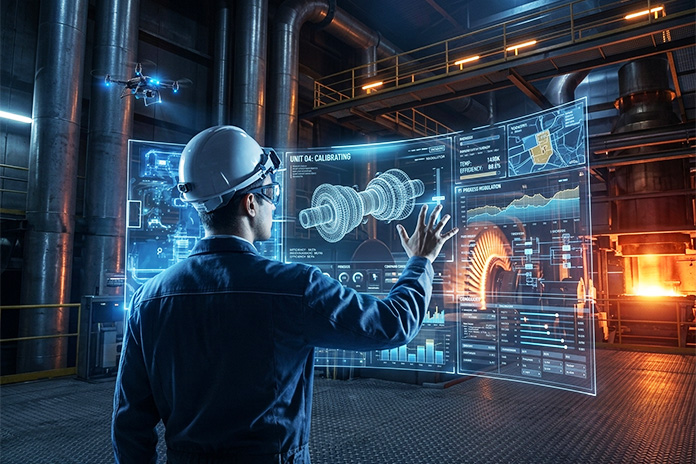
Digital twins in chemical engineering combine process models, sensors, and AI to help engineers monitor plant performance, test operating scenarios, and evaluate possible improvements without disrupting actual production.
This approach has the potential to transform plant operation from a reactive system into a more predictive and proactive one.
By connecting real-world process data with digital models, digital twins can also support AI applications in chemical engineering, particularly in areas such as process monitoring, optimization, maintenance, and operational planning.
The Human Role Remains Central
Despite the rapid progress of AI, chemical engineering knowledge remains essential. AI models depend on reliable data, appropriate physical understanding, and careful validation. A model that produces accurate predictions under one set of operating conditions may not necessarily perform well under another.
Therefore, the future is not about replacing chemical engineers with AI. Rather, it is about empowering chemical engineers with intelligent tools. Engineers will increasingly need expertise in process modelling, data science, AI, optimization, and domain-specific knowledge to develop trustworthy and useful solutions.
This is why machine learning for chemical engineers is becoming an increasingly valuable area of knowledge. Understanding how machine learning works and how it can be applied to real chemical processes can help engineers make better use of emerging technologies.
Looking Ahead
The integration of AI and ML with chemical engineering is likely to become a defining feature of next-generation process industries. From intelligent process control and predictive maintenance to sustainable process design and digital twins, these technologies can help industries become more productive, resilient, and environmentally responsible.
The future of AI in chemical engineering lies in combining the strengths of chemical engineering fundamentals with the power of data and artificial intelligence. As this convergence continues, chemical engineers will play a crucial role in shaping industries that are not only smarter and more efficient, but also safer and more sustainable.
The real opportunity lies in combining traditional engineering knowledge with AI in chemical engineering, machine learning in chemical engineering, and modern data-driven approaches. As AI technologies continue to evolve, their role across process industries is likely to expand further.
The future of chemical engineering is not simply digital it is intelligent, data-driven, and sustainable.