
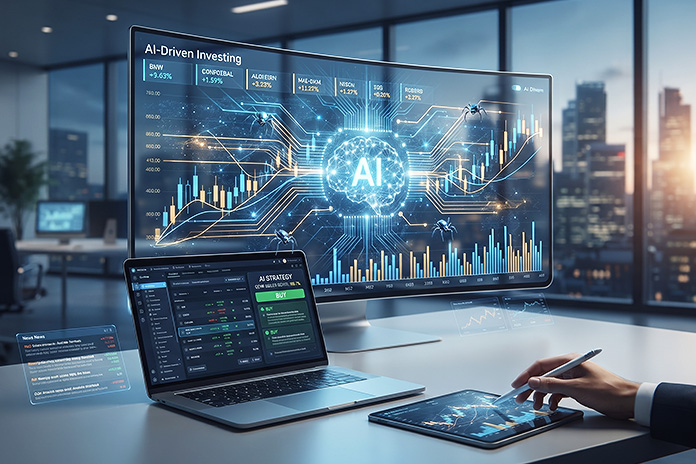
People, in the old days, would generally have their investing decisions based on their experience, instinct, as well as many hours of their own manual work – going through charts, analyzing companies, etc. Now, try to picture a system that can, in a matter of seconds, handle millions of bits of separate pieces of information, directly recognize with lightning speed the existing patterns, and at the same time make decisions at a way higher speed than the fastest human brain. Finance is actually progressing in this direction.
The investment industry driven by AI is not an idea of a future era anymore, as it is already one of the forces transforming the market. AI-driven investing is changing the way investors analyse opportunities, manage risks, and make decisions. The growing role of Artificial intelligence in finance has introduced new possibilities where technology supports smarter and faster financial strategies.
This fundamental change is really about leveraging technology to increase the level of wisdom in our decision-making. TensorFlow and Scikit-learn, for example, offer various means and capabilities to financial analysts and software developers resulting in the building of analytical models that are way beyond the traditional ones in their scope and complexity.
Apart from relying simply on historical prices of shares or company’s earnings, these deeply-trained models can take into consideration so much more, such as the entire world’s economic landscape or the behavior of people spending their money online. Therefore, it is a win-win situation – quick understanding and well-grounded decisions.
The combination of Machine learning in finance, Data science in finance, and advanced analytics has enabled professionals to develop AI investment strategies that can process large amounts of financial data. These AI algorithms in finance help identify patterns, improve forecasting, and support more informed investment decisions.
Some of the biggest financial institutions are well familiar with that. For instance, BlackRock employs AI for their risk management purposes and at the same time for the portfolio optimization of their clients which ultimately reaches a very high level of efficiency and quality which would be, to a great extent, impossible to achieve without the use of that technology.
Similarly, Zerodha is on a mission to equip the normal retail investors that have never dealt with advanced tools and strategies directly to the core through the use of data-analytical tools made available and very user-friendly.
These developments highlight the importance of AI financial technology in modern markets. From AI risk management in finance to AI in portfolio management, artificial intelligence is becoming an important part of how financial institutions operate and deliver services.
Speed is, definitely, a very important characteristic of AI but not the only point why AI is incredibly attracting one’s attention. When it comes to the way markets behave there is usually great uncertainty and unpredictability.
As a matter of fact, old method-based models will mostly be giving the correct solution of the problems that they were trained with or have been encountered before. When it comes to the cases that will be new ones to the model, it is quite likely that it will be failing.
AI will not be changing the world completely overnight but it can be a game-changer and one of the best strategic tools available in this scenario by its ability to learn from the new piece of information (the market) and at the same time come up with the adjusted way of handling the situation.
For example, the program can be programmed to immediately signal if it perceives something odd in the trading patterns or the start of the path, so to speak, to increased market uncertainty which would be the case when most of the investors have not even noticed that.
This ability makes AI-powered investing and Algorithmic investing powerful tools in today’s financial ecosystem. The use of AI for stock market prediction and How machine learning is used in finance demonstrates how technology can support investors in understanding market behaviour and identifying potential opportunities.
More and more people are also looking for their investment plans providing them with a large degree of customization and personalization. Traditional investment strategies that are still dominant are just one-size-fits-all solutions which, to some extent, don’t really work with human investors since their needs and aims are incredibly different.
AI, however, can come to the rescue and creates an investment approach or a portfolio that is better matching the specific individual’s requirements and preferences.
In case someone wants to invest to build up a fund for purchasing their own house, or they are a totally different person who wants to prepare for their retirement, or simply they want to be able to grow their capital slowly but surely – this is a valid example of technology coming into one’s help and showing that the respective investment can be, in fact, very closely related to the person who is making the investment and changes in one’s life.
So far, just to give an example, PayPal and Razorpay have been the leading ones in the market when it comes to using data not just to analyze things but also to come up with some very highly personalized financial services provision, and this trend is one that will strongly show its impact in the future.
This represents the growth of Personalized investment strategies using AI and AI-based financial planning, where investors can receive solutions aligned with their financial goals. The use of Artificial intelligence for wealth management is helping create more customized and data-driven approaches for individuals.
Despite all the positive aspects, there is a dark side to it – one cannot simply use the options and functionalities of the algorithms at the risk of completely ignoring the possible negative sides and also forgetting about the necessity of being critical of the model implementation.
One of the things that people raise as a concern is the lack of transparency of the models – and even the people who in disguise are the experts are not able to provide an explanation as to how the respective models actually come to a certain decision.
Another scary thing is the bias in the data. Not to mention, there is also the necessity of investment in appropriate controls to address these issues through measures such as compliance, audit, and governance.
Such systems will be an enabler of innovation and, at the same time, they can also be considered to be the partners of the innovators.
Therefore, while exploring the Benefits of AI-driven investing, it is equally important to understand challenges related to ethics, transparency, and responsible use of technology. Strong governance frameworks will ensure that Artificial intelligence continues to support innovation in financial services.
So, it is quite an important that the AI’s are not in the game for replacing human beings. The future “champion” or, top, human finance professionals will be those who just do not have an understanding of the markets but are also capable of working very closely with the technology and using data and technology to really interpret information and coming up with better/more optimal decision-making.
The future of finance will belong to professionals who understand both traditional financial concepts and emerging technologies like Machine learning, Data analytics, and Financial technology. The ability to combine human judgement with AI capabilities will define successful professionals in the era of modern finance.
The use of AI technologies is not only a dream, it is part of the financial landscape at this very moment. Thus, the question that really is concerning us all is: are we ready to embrace it, or are we still struggling to catch up?
The future of AI in financial services will depend on how effectively businesses and professionals adopt these innovations. Understanding the Role of AI in modern finance, AI applications in investment banking, and emerging AI investment opportunities will help shape the next generation of financial decision-making.