A decade ago, “future-proofing your career” meant learning a new software tool or picking up a certification on the side. Today, it means something far bigger: rethinking what it means to be valuable in a world where machines can write, code, diagnose, and even advise, often faster than we can. AI isn’t just changing what we do at work. It’s changing who gets to do it, and what skills separate the people who thrive from the people who get left behind.
The discussion around future skills, AI-driven world, future skills for AI, and future skills for an AI-driven world has become central to understanding the future of work. As organizations move towards an AI-powered workplace, professionals need to develop the right combination of AI skills, AI competencies, workplace skills, and future-ready skills to remain competitive.
The good news? Nobody actually knows the full shape of the AI-driven economy yet not governments, not corporations, not even the AI labs building the tools. But across classrooms, boardrooms, and international policy circles, a surprisingly consistent picture is emerging of the competencies that will matter most.
The Technical Backbone
Start with the obvious: AI runs on data, and understanding data is no longer optional. Data literacy in the AI era has become one of the most important technology skills for professionals. Data literacy the ability to read, question, and act on data-driven insights has quietly become as fundamental as reading and writing once were. Alongside it sits programming fluency (Python programming remains the workhorse language), a working knowledge of machine learning skills, and comfort navigating cloud computing skills through platforms like AWS or Azure, since most AI tools now live in the cloud rather than on a laptop.
But there’s a fifth technical skill that’s growing faster than the rest: AI literacy itself not building models, but knowing how to work with them. Developing AI literacy and understanding the importance of AI literacy is becoming essential for professionals, students, and organizations preparing for the future. Recent research from organizations tracking global education trends notes that even young children are already forming views on how to use AI responsibly, verify its answers, and know when to trust it and when not to. That instinct verify, don’t just accept may end up being one of the most valuable AI skills for students and professionals in the next decade.
The Human Edge
Here’s the twist nobody saw coming quite this clearly: as AI gets better at technical tasks, the “soft skills” are becoming the hard currency. Human skills in an AI-driven economy are becoming increasingly important because machines cannot fully replace human creativity, empathy, and judgment. Critical thinking, creativity, emotional intelligence, and adaptability aren’t backup skills anymore they’re the main event.
AI can summarize a market report in seconds, but it still takes a human to decide what that report actually means for a real business, a real team, a real community. Analysts increasingly describe this as a “last-mile” phenomenon: AI drafts, humans judge. It’s a division of labor where nuance, context, and lived experience still belong entirely to us.
The ability to combine creativity and AI collaboration, along with critical thinking in the age of AI, will define many future careers. Professionals who understand how to collaborate with AI while applying human judgment will become valuable contributors to the evolving AI workforce.
Educators are already redesigning classrooms around this insight. Rather than treating AI fluency and human skills as separate tracks, forward-thinking schools are weaving them together teaching students not just to use AI tools, but to question them, catch their errors, and know when human judgment should override the algorithm entirely.
Skills Educators and Employers Are Prioritizing
| Skill | Why It Matters Now |
| Data Literacy | Foundation for interpreting AI-driven insights |
| AI / Prompt Fluency | Getting useful, accurate output from AI tools |
| Critical Thinking | Verifying AI output; making judgment calls AI can’t |
| Creativity | Turning AI-generated insight into original ideas |
| Emotional Intelligence | Collaboration, trust-building — things AI can’t fake |
| Adaptability | Keeping pace with tools that change every few months |
Learning Never Really Stops Now
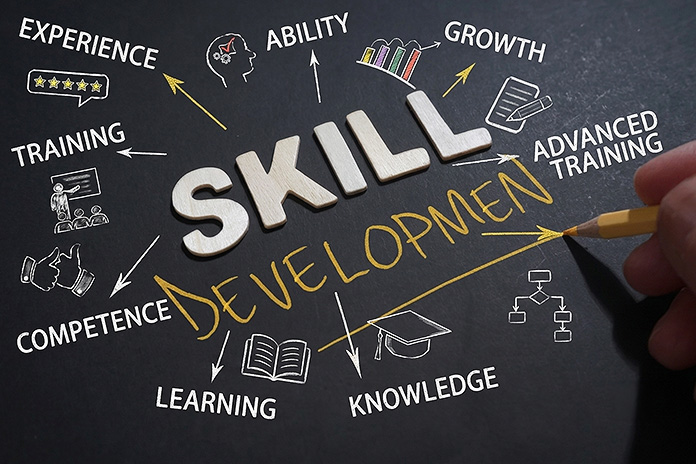
Perhaps the biggest cultural shift is this: the idea of “finishing” your education is quietly dying. In the era of future skills and the AI-driven world, continuous learning has become one of the most important skills for the future. Online platforms, employer-run bootcamps, and government-backed digital literacy programs are proliferating precisely because the shelf life of a technical skill has shrunk.
What you learned about AI two years ago is already outdated. That’s not a discouraging fact it’s simply the new baseline. With rapid advancements in emerging technologies, AI in education, and AI in the workplace, professionals need to continuously develop AI skills, artificial intelligence skills, and technology skills to stay relevant.
Lifelong learning has shifted from a nice ideal to a practical necessity, and the people who build a habit of continuous, curious upskilling will have a real structural advantage over those who don’t. Developing lifelong learning in the digital age helps individuals adapt to changing future careers, evolving workplace demands, and the growing expectations of a future-ready workforce.
For students and professionals, regularly upgrading knowledge in areas such as AI literacy, programming skills, Python programming, machine learning skills, cloud computing skills, and AI prompt engineering can create better opportunities in an increasingly AI-powered workplace.
The Equity Question Nobody Can Ignore
None of this matters if access to these skills isn’t shared fairly. AI’s promise of personalized, scalable education could genuinely help close long-standing gaps between wealthy and under-resourced communities but only if the underlying infrastructure, connectivity, and training reach those communities in the first place.
As AI competencies and future competencies for the workplace become essential for career growth, ensuring equal access to AI education, digital literacy, and future-ready skills is critical. Global research consistently flags the same concern: without deliberate policy and investment, AI risks widening the very inequalities it could help solve, especially in low-income and rural regions where access to devices, reliable internet, and trained teachers remains limited.
Creating inclusive opportunities for developing essential AI skills for professionals, AI skills for students, and skills needed for artificial intelligence careers will play a major role in building a balanced and accessible AI workforce.
Where This Leaves Us
The future of work isn’t a story about AI replacing humans it’s a story about which combination of human and machine skills wins. The way AI is changing the future of work highlights the importance of combining technical expertise with uniquely human abilities.
Data fluency without creativity is brittle. Creativity without critical thinking is unfocused. Strong data literacy in the AI era, combined with critical thinking in the age of AI and creativity and AI collaboration, will define the professionals who succeed in the coming years.
And none of it works if the people who most need these opportunities can’t access them. The individuals, schools, and organizations that treat technical and human skills as a single, intertwined toolkit and commit to learning continuously are the ones who won’t just survive the AI-driven world. They’ll help shape it through innovation, adaptability, and the right combination of future skills, AI competencies, and human skills in an AI-driven economy.