
Key Takeaways
|
Criminal investigations often rely on scientific evidence such as a DNA profile, a fingerprint match, or a toxicology report, and behind every crucial piece of evidence is a trained forensic science professional who carefully analyses it to help investigators uncover the truth. For graduates with a background in science or allied health, especially those who have an interest in solving criminal investigations, an M.Sc. in Forensic Sciences could be the perfect pathway to turn that interest into a profession. In this article, we’ll explore how forensic science professionals help solve criminal cases and how an M.Sc. in Forensic Sciences can prepare you for this exciting and rewarding career.
What Does a Forensic Science Professional Do?
A forensic science professional applies scientific methods to the questions an investigation needs answered: what happened, in what order, and who was involved. The work is objective by design. The main tasks include:
- Evidence Collection and Preservation: Securing, documenting, and packaging evidence to prevent contamination and maintain its integrity for laboratory analysis and legal proceedings.
- Biological Analysis: Examining blood, saliva, tissue, and other biological samples to identify or exclude individuals using scientific techniques.
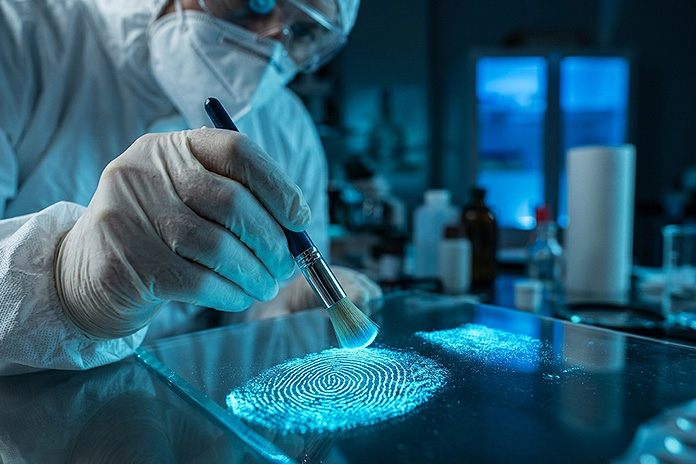
- Fingerprint and Impression Analysis: Comparing fingerprints, footprints, tyre marks, and other impressions to establish links between people, objects, and crime scenes.
- Digital Evidence Examination: Recovering and analysing data from computers, mobile devices, storage media, and other digital sources.
- Forensic Report Preparation: Documenting examination methods, findings, and conclusions in clear, accurate reports for investigators and the courts.
- Expert Testimony: Presenting scientific findings in court and explaining the evidence in a clear and unbiased manner to judges and juries.
Each of these tasks feeds the same goal: turning raw material into findings an investigator and a court can rely on.
How Does Forensic Science Analysis Help Solve Criminal Cases?
By applying scientific techniques at every stage of an investigation, forensic professionals ensure that conclusions are based on facts rather than assumptions. Some of the key ways forensic science contributes to solving criminal cases include:
Crime Scene Investigation
Forensic professionals carefully examine crime scenes to identify, document, and collect evidence while ensuring it remains uncontaminated for further analysis.
Evidence Analysis
Samples such as DNA, fingerprints, blood, fibres, firearms, or digital data are analysed in specialised laboratories to uncover information that may identify suspects or reconstruct events.
Victim And Suspect Identification
Scientific techniques such as DNA profiling, fingerprint analysis, dental records, and facial reconstruction help establish the identity of victims or suspects when conventional methods are not possible.
Event Reconstruction
By studying physical evidence and its relationship to the crime scene, forensic experts piece together the sequence of events to determine how an incident occurred.
Investigative Support
Forensic findings help investigators verify statements, eliminate innocent individuals, narrow down suspects, and develop stronger leads during the investigation.
Courtroom Evidence
Once the investigation is complete, forensic professionals prepare detailed reports and may present expert testimony to explain the scientific evidence, helping the court make informed decisions.
Overview of M.Sc. Forensic Sciences Programme at LPU
Lovely Professional University offers M.Sc. Forensic Sciences under the School of Bioengineering and Biosciences, built around the practical and research skills the field actually needs. The table below sets out the key details you need before applying, so you can weigh duration, eligibility, and fee in one place.
| Programme Details | Information |
| Programme Name | M.Sc. Forensic Sciences |
| School | School of Bioengineering and Biosciences |
| Duration | 2 Years (4 Semesters) |
| Eligibility | 55% in a relevant bachelor’s degree |
| Scholarship | Scholarship based on qualifying exam percentage/LPUNEST/CUET/JAM |
Specialisations Offered in LPU’s M.Sc. Forensic Science Programme
LPU’s M.Sc. in Forensic Sciences allows students to specialise in advanced domains, helping them develop deeper knowledge and practical skills in their chosen field. The specialisation options include:
Advanced Forensic Anthropology and Odontology
Focuses on the identification of human remains using skeletal and dental evidence. Students learn techniques used in criminal investigations, disaster victim identification, and medico-legal cases.
Advanced Questioned Document and Fingerprint Examination
Covers the scientific examination of handwriting, signatures, printed documents, and fingerprints to verify authenticity, detect forgery, and establish identity during investigations.
Digital Evidence and Examination
Develops expertise in collecting, preserving, and analysing digital evidence from computers, mobile devices, and other electronic systems to support cybercrime and criminal investigations.
Forensic Biology and DNA Interpretation
Provides advanced training in analysing biological evidence such as blood, saliva, hair, and other body fluids. Students also learn DNA profiling and interpretation techniques used to identify individuals and establish links between suspects, victims, and crime scenes.
Forensic Chemistry and Toxicology
Focuses on the analysis of chemicals, drugs, poisons, explosives, and other substances that may be associated with criminal investigations. Students gain practical experience in laboratory techniques used to detect, identify, and interpret chemical evidence.
Skills You Develop During M.Sc. Forensic Sciences Programme
The M.Sc. Forensic Sciences programme at LPU is built to develop skills through laboratory work, research, and case-based learning rather than theory alone. The skills students build over the course of the programme include:
- Scientific Observation: Training teaches students to notice the detail others overlook at a scene or under a microscope, so nothing that matters to a case is missed.
- Analytical Thinking: Students learn to interpret results and weigh what they do and do not prove, which keeps conclusions defensible in court.
- Laboratory Techniques: Hands-on work with forensic instruments teaches students to run tests accurately and repeatably.
- Evidence Handling: Students practise preserving samples and maintaining chain of custody, the step that keeps a result admissible.
- Report Writing: Students produce records of methods and findings that hold up to scrutiny and cross-examination.
- Critical Reasoning: Case-based problem solving trains students to test alternative explanations before drawing a conclusion.
- Communication: Students learn to explain complex results to non-scientists, the skill that decides how evidence lands in a courtroom.
- Attention to Detail: Repeated laboratory practice builds the discipline to follow every step, because a single missed one can compromise a case.
- Ethical Judgement: Students are trained to stay objective and report only what the evidence supports, whichever side it favours.
These skills are built through structured training and repeated practice rather than picked up on the job alone. That is where advanced education earns its place.
How LPU’s M.Sc. Forensic Science Prepares You for a Career in Forensics
Whether you hold a B.Sc. Hons. Forensic Sciences or another eligible qualification, the programme is designed to deepen your scientific knowledge and prepare you for the practical demands of modern forensic investigations. At LPU, this is achieved through a curriculum that includes:
Extensive Laboratory Training
The programme provides hands-on training in specialised laboratories covering crime scene investigation, forensic biology, forensic chemistry, toxicology, ballistics, fingerprint examination, forensic anthropology, and digital forensics. This practical exposure helps students become familiar with the techniques and equipment used in professional forensic settings.
Dissertation-Based Research
Students undertake Dissertation I to Dissertation IV, allowing them to apply research methodologies to real forensic problems. This develops analytical thinking, scientific reasoning, evidence interpretation, and research skills that are valuable in both industry and academia.
Industrial Internship Opportunities
Students who choose the internship pathway gain full-term industry exposure in forensic laboratories, research organisations, healthcare institutions, cyber security firms, and related sectors. These internships provide first-hand experience of laboratory operations, evidence analysis, investigative procedures, and professional workplace practices.
Industry-Relevant Skill Development
The curriculum focuses on developing the practical competencies expected by employers, including evidence handling, forensic documentation, scientific analysis, crime scene investigation, and investigative problem-solving. Students also strengthen communication and professional skills required for collaborative forensic work.
Exposure to Modern Forensic Technologies
Throughout the programme, students work with contemporary forensic techniques and scientific methods used in criminal investigations. This ensures they graduate with knowledge that aligns with current industry practices and evolving forensic technologies.
Conclusion
An M.Sc. in Forensic Sciences is more than a postgraduate qualification. It is an opportunity to develop the scientific expertise, practical skills, and investigative mindset needed to work on real criminal cases. If solving cases through evidence is the work you want to do, the next step is to enroll in a programme that trains you for it properly. Visit the LPU admissions office and speak with a professional to check your eligibility and to know about the admissions process.
Frequently Asked Questions
Is an M.Sc. in Forensic Sciences necessary to become a forensic scientist?
While some entry-level roles may be available after a bachelor’s degree, an M.Sc. in Forensic Sciences is often preferred for specialised laboratory and research positions. It provides advanced technical knowledge, practical training, and research experience that strengthen career prospects.
Can forensic science professionals work outside criminal investigations?
Yes. In addition to supporting criminal investigations, forensic science professionals can work in cybersecurity, insurance fraud investigation, pharmaceutical companies, healthcare organisations, research institutions, and academia.
Do forensic scientists visit crime scenes regularly?
It depends on the role. Crime scene investigators regularly visit crime scenes to collect and preserve evidence, while many forensic scientists primarily analyse that evidence in laboratories.
What is the difference between a forensic scientist and a crime scene investigator?
A crime scene investigator is responsible for identifying, documenting, and collecting evidence at the scene of a crime. A forensic scientist examines that evidence in a laboratory using scientific techniques and prepares reports that support the investigation.
Which industries hire M.Sc. Forensic Science graduates besides government laboratories?
Graduates can find opportunities in private forensic laboratories, cybersecurity firms, healthcare organisations, pharmaceutical companies, insurance companies, research institutions, and universities.
Is coding required for a career in digital forensics?
Coding is not mandatory for every digital forensics role. However, a basic understanding of programming, operating systems, and digital investigation tools can be beneficial, especially in cybercrime investigations.
What are the emerging trends in forensic science careers?
Digital forensics, cybercrime investigation, forensic DNA analysis, forensic toxicology, and AI-assisted evidence analysis are among the fastest-growing areas, creating new career opportunities for forensic science professionals.
Can M.Sc. Forensic Science graduates pursue a Ph.D. or research career?
Yes. After completing a post graduate in forensics , graduates can pursue a Ph.D. in Forensic Sciences and build careers in academic research, forensic innovation, teaching, or advanced laboratory research.





![Why B.Tech. Aerospace Engineering [Lateral Entry] at LPU Stands Out?](https://www.lpu.in/blog/wp-content/uploads/2025/10/B-Tech-Aerospace-Engineering-Lateral-Entry-02.png "Why B.Tech. Aerospace Engineering [Lateral Entry] at LPU Stands Out?")