
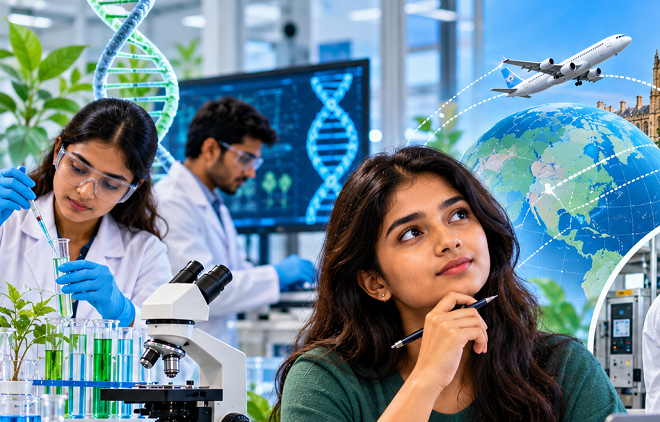
1. Who Should Consider Choosing B.Tech. Biotechnology with a [2+2] Credit Transfer Pathway?
Biotechnology is transforming industries by combining biological sciences with engineering, technology, and innovation. From developing medicines and improving agricultural productivity to creating sustainable solutions, biotechnology plays an important role in addressing global challenges. For students passionate about biological sciences and interested in international education, the B.Tech. biotechnology [2+2] pathway offers an opportunity to combine scientific learning with global academic exposure.
A B.Tech. biotechnology [2+2] program generally allows students to complete their first two years at a home university and transfer eligible credits to an overseas partner institution for the remaining two years. This biotechnology [2+2] credit transfer option suits students who enjoy laboratory experiments, scientific research, technological problem-solving, and exploring different learning environments.
The programme is particularly suitable for students who:
- Have an interest in biology, chemistry, mathematics, and applied sciences.
- Want to gain international academic and research exposure.
- Are interested in pharmaceutical, healthcare, agricultural, or industrial biotechnology.
- Plan to pursue higher education or research opportunities abroad.
- Are comfortable adapting to new cultures and independent learning environments.
A [2+2] biotechnology degree can be a promising choice for students looking for an international biotechnology program that combines a strong scientific foundation with overseas learning opportunities. However, before choosing a B.Tech. biotechnology international credit transfer pathway, students should carefully consider the eligibility requirements, academic expectations, and financial commitments to ensure the programme aligns with their long-term career goals.
2. Why Is This Program Ideal for Students Seeking Global Careers in Biotechnology?
Biotechnology is an internationally connected field, with research institutions and companies collaborating across borders to develop scientific solutions.
Students interested in biotechnology global careers may benefit from exposure to different research environments, technological practices, and academic perspectives.
An international biotechnology pathway can introduce students to the expectations of global research and industrial organisations while helping them develop adaptability and cross-cultural communication skills.
Some important sectors offering biotechnology career opportunities include pharmaceuticals, medical diagnostics, agricultural biotechnology, food technology, environmental biotechnology, and industrial bioprocessing.
| Biotechnology Sector | Potential Career Opportunities |
| Pharmaceutical Biotechnology | Quality Control Analyst, Bioprocess Associate |
| Healthcare and Diagnostics | Laboratory Technologist, Research Assistant |
| Agricultural Biotechnology | Plant Tissue Culture Specialist, Research Associate |
| Industrial Biotechnology | Fermentation Technologist, Production Associate |
| Environmental Biotechnology | Environmental Laboratory Analyst, Bioremediation Associate |
| Bioinformatics | Bioinformatics Analyst, Biological Data Associate |
Students interested in biotechnology jobs abroad should understand that employment depends on qualifications, relevant experience, technical expertise, and country-specific regulations.
While an international degree pathway can support preparation for global biotechnology careers, it does not automatically guarantee overseas employment.
Developing strong laboratory skills, research experience, and professional connections can improve readiness for international biotechnology careers and help students explore biotechnology jobs globally.
Did You Know?
Biotechnology is a globally connected field where researchers from different countries collaborate to develop medicines, improve agricultural practices, and discover sustainable solutions. International academic exposure can help students understand different scientific approaches and research methods. |
3. How Does the [2+2] Model Benefit Students Academically and Professionally?
One of the major [2+2] degree benefits is the opportunity to experience two different academic environments during a single undergraduate journey.
The programme can allow students to develop their scientific foundation at their home institution before experiencing the teaching methods, research practices, and academic culture of an overseas university.
The potential [2+2] international credit transfer benefits extend beyond classroom education.
Students may gain experience with different laboratory approaches, assessment methods, interdisciplinary projects, and international academic expectations.
The biotechnology credit transfer program can also encourage independence, adaptability, communication skills, and cultural understanding.
| Academic Stage | Learning Focus | Potential Benefits |
| Years 1–2: Home University | Biotechnology fundamentals, laboratory techniques, engineering principles | Strong scientific foundation and academic preparation |
| Credit Transfer Stage | Academic eligibility, credit evaluation, documentation | Preparation for international academic transition |
| Years 3–4: Overseas University | Advanced coursework, specialised laboratory activities, research projects | Global academic exposure and technical development |
| Graduation Stage | Degree completion and career preparation | Opportunities for higher education and professional development |
The exact structure, transferred credits, awarding university, and graduation requirements depend on the approved agreement between participating institutions.
For students interested in study abroad biotechnology opportunities, international credit transfer can provide an alternative to beginning their entire undergraduate education overseas.
The B.Tech. biotechnology international program can therefore be valuable for students who want to combine scientific education with international experience.
Did You Know?
International biotechnology research brings together scientists with different expertise to investigate complex biological challenges. Such collaborations encourage knowledge sharing, scientific innovation, and the development of new approaches to healthcare and disease prevention. |
4. What Learning Style Suits Students Opting for an International Biotechnology Path?
Students pursuing international biotechnology education should be comfortable with practical experiments, scientific discussions, independent research, and collaborative learning.
Unlike programmes focused mainly on theoretical knowledge, biotechnology learning often requires students to apply scientific principles in laboratory and project settings.
A successful student should enjoy observing biological processes, analysing experimental results, and understanding how scientific discoveries become useful technologies.
Biotechnology practical learning may involve activities such as microbial cultivation, biochemical testing, DNA analysis, and laboratory instrumentation.
Similarly, biotechnology hands-on learning encourages students to develop technical confidence through experiments and structured laboratory assignments.
Biotechnology project-based learning may involve investigating scientific problems, designing experiments, interpreting data, and presenting findings.
Students who enjoy teamwork and scientific exploration may find biotechnology experiential learning particularly rewarding.
Since international institutions may follow different teaching and assessment methods, flexibility and self-discipline are also important.
Strong communication, critical thinking, laboratory documentation, and time-management abilities are valuable B.Tech. biotechnology skills for students entering an international academic environment.
5. How Does This Program Help You Build a Strong Biotechnology Foundation?
A strong understanding of scientific principles is essential before exploring advanced biotechnology applications.
The B.Tech. biotechnology curriculum generally introduces students to core areas such as cell biology, microbiology, biochemistry, molecular biology, genetics, and bioprocess engineering.
These subjects establish the biotechnology fundamentals needed for advanced academic study and professional training.
Students gradually develop biotechnology technical skills through theoretical instruction, laboratory exercises, assignments, and research-oriented activities.
Important areas of learning may include:
Molecular Biology and Genetics: Understanding DNA, RNA, gene expression, and molecular mechanisms.
Microbiology: Studying microorganisms and their applications in healthcare, agriculture, and industry.
Biochemistry: Exploring biochemical reactions, enzymes, proteins, and cellular metabolism.
Bioprocess Engineering: Learning how biological processes are applied in industrial production.
Bioinformatics: Understanding the use of computational methods to interpret biological information.
Laboratory Techniques: Developing familiarity with experimental procedures, scientific instruments, and safety practices.
These subjects support the development of biotechnology laboratory skills, analytical thinking, and experimental accuracy.
By combining theoretical knowledge with laboratory practice, students can strengthen their biotechnology foundation and develop the biotechnology practical skills needed for advanced study.
A well-structured academic foundation also helps students adapt to specialised courses offered by international universities.
Did You Know?
Biotechnology combines biology with engineering and technology to develop solutions for real-world challenges. From producing life-saving medicines to creating environmentally friendly materials, biotechnology has applications across healthcare, agriculture, and manufacturing. |
6. When Is It the Right Time to Choose the [2+2] Global Credit Transfer Option?
Students should ideally begin exploring international credit transfer opportunities while planning their undergraduate admission.
Early preparation provides time to understand academic requirements, evaluate overseas institutions, and estimate the overall financial commitment.
The B.Tech. biotechnology [2+2] admission process may involve academic eligibility at the home university followed by additional requirements for international transfer.
General B.Tech. biotechnology eligibility requirements vary by institution and may include specified Class 12th subjects and minimum qualifying marks.
Students interested in the international pathway should also review the relevant biotechnology [2+2] program eligibility conditions.
Important considerations include:
- Minimum academic performance required for overseas transfer.
- Recognition and transferability of completed academic credits.
- English-language proficiency requirements, where applicable.
- Availability of seats at the international partner university.
- Tuition fees, accommodation expenses, and living costs.
- Visa, insurance, and other immigration requirements.
- Degree-awarding arrangements and graduation conditions.
International credit transfer eligibility may differ from the requirements for admission to the home university.
Therefore, students should not assume that joining a [2+2] programme automatically guarantees overseas transfer.
Understanding [2+2] degree eligibility early can help students prepare academically and financially for their intended biotechnology study abroad experience.
7. What Career Outcomes Can You Expect After Completing the B.Tech. Biotechnology [2+2] Program?
Graduates can explore various B.Tech. biotechnology career options depending on their technical knowledge, practical experience, specialisation, and professional interests.
The expanding applications of biotechnology across healthcare, agriculture, food processing, and industrial manufacturing create different types of biotechnology employment opportunities.
Entry-level biotechnology graduate jobs may involve laboratory operations, production processes, quality testing, documentation, and research assistance.
Students can explore biotechnology jobs in pharmaceutical companies, diagnostic laboratories, research organisations, food industries, and biotechnology manufacturing units.
Those interested in biotechnology jobs abroad should research country-specific hiring requirements, work authorisation rules, and professional qualifications.
International academic experience may support applications for further education and help students understand different professional environments.
However, the overall biotechnology career scope depends on factors such as technical proficiency, internships, research exposure, and market demand.
Some specialised research positions may require postgraduate qualifications.
Graduates interested in advanced scientific careers can consider master’s programmes in biotechnology, molecular biology, bioinformatics, biomedical sciences, or related disciplines.
With suitable qualifications and experience, students may pursue global biotechnology careers across research, manufacturing, healthcare, and emerging biotechnology industries.
8. How Does the Program Support Aspirations for Innovation and Entrepreneurship?
Biotechnology offers opportunities not only for employment but also for research-based innovation and entrepreneurship.
Students interested in biotechnology innovation can explore scientific solutions to challenges involving healthcare, agriculture, sustainability, and industrial production.
An international academic environment may expose students to different research practices, innovation ecosystems, and collaborative project opportunities.
Biotechnology research and innovation can involve areas such as diagnostic technologies, sustainable biomaterials, agricultural improvement, and microbial applications.
Students interested in biotechnology entrepreneurship can explore how scientific ideas are developed into commercially useful products or services.
Potential biotech startup opportunities include:
- Developing biological testing and analytical services.
- Exploring sustainable biotechnology products.
- Creating agricultural biotechnology solutions.
- Building bioinformatics and biological data services.
- Developing specialised research-support services.
Starting a biotechnology startup requires more than scientific knowledge. Entrepreneurs must also understand business planning, regulatory requirements, intellectual property, product validation, and funding.
Developing biotechnology entrepreneurial skills through innovation projects, business competitions, and interdisciplinary collaboration can help students understand these challenges.
Although commercialising biotechnology products can be complex, the field offers interesting biotech business opportunities for students with scientific curiosity and entrepreneurial ambition.
Did You Know?
Biotechnology offers opportunities beyond traditional laboratory careers. Scientific discoveries can inspire startups focused on medical diagnostics, sustainable biomaterials, agricultural technologies, and bioinformatics, allowing researchers to turn innovative ideas into practical solutions. |
9. Alumni Success Stories
The experiences of B.Tech. biotechnology alumni can offer useful insights into the different directions graduates may pursue after completing their studies.
Some graduates choose laboratory-based careers, while others continue with postgraduate education, scientific research, quality assurance, or biotechnology-related business activities.
Biotechnology alumni success stories often highlight the importance of practical skills, research experience, academic mentorship, and continuous learning.
For students considering international education, alumni experiences can also provide information about adapting to overseas universities, managing academic expectations, and preparing for professional opportunities.
Prospective students exploring LPU biotechnology alumni experiences should look for verified graduate profiles, official university features, and documented professional achievements.
It is important to evaluate biotechnology graduate success through authentic information rather than relying only on promotional claims.
Students can also connect with graduates to understand their experiences with laboratory training, international academic transitions, and career preparation.
Such conversations can provide realistic insights into biotechnology alumni careers and the factors contributing to long-term biotechnology career success.
10. How Does This Program Align with Long-Term Global Career Goals?
Choosing an undergraduate programme should involve thinking beyond the first job after graduation.
Students interested in a long-term biotechnology career should consider how their academic choices support future specialisation, research opportunities, and professional development.
An international credit transfer pathway may help students build familiarity with different scientific approaches and academic systems.
This experience can be useful when planning postgraduate education, research training, or a global biotechnology career.
Effective biotechnology career planning involves identifying preferred sectors, developing relevant technical skills, and gaining practical experience.
For example, students interested in pharmaceutical research may benefit from advanced study in molecular biotechnology or drug development.
Those interested in industrial biotechnology may focus on fermentation technology, bioprocess engineering, or manufacturing operations.
Students exploring biotechnology career opportunities abroad should also understand international employment regulations and the qualifications expected by employers.
Long-term biotechnology professional growth depends on continuous learning, professional networking, technical competence, and adaptability.
As the future of biotechnology develops through advances in genomics, computational biology, personalised medicine, and sustainable technologies, graduates with interdisciplinary knowledge may discover new professional directions.
A thoughtfully selected international programme can support biotechnology career growth by helping students prepare for an increasingly interconnected scientific environment.
11. Final Words
Choosing B.Tech. biotechnology [2+2] is an important academic decision for students who want to combine scientific education with international exposure.
The programme can offer opportunities to develop laboratory skills, understand advanced scientific concepts, experience different academic cultures, and prepare for future studies or employment.
However, students should evaluate their interests, academic readiness, financial resources, and long-term goals before selecting an international pathway.
For those exploring a B.Tech. biotechnology international program, Lovely Professional University (LPU) offers a B.Tech. Biotechnology pathway with an international credit transfer option, subject to the applicable programme and partner-university requirements.
Students considering LPU should review the current curriculum, international partner options, transfer conditions, fees, and eligibility requirements with the university before applying.
With careful preparation, international biotechnology education can become a meaningful step towards exploring diverse biotechnology career opportunities.
Ultimately, success in global biotechnology careers depends on developing scientific knowledge, practical abilities, research experience, and a commitment to continuous learning.
12. Frequently Asked Questions (FAQs)
1. What is the B.Tech. biotechnology [2+2] programme?
The B.Tech. biotechnology [2+2] pathway generally allows students to complete the first two years of undergraduate study at a home university and transfer eligible credits to an international partner institution for the remaining two years, subject to approved arrangements.
2. What are the eligibility requirements for biotechnology international credit transfer?
B.Tech. biotechnology eligibility and international transfer requirements vary by university. Students may need to satisfy minimum academic performance standards, credit requirements, English-language proficiency conditions, and other partner-university criteria.
3. Is studying biotechnology abroad beneficial?
International biotechnology education can provide exposure to different teaching methods, laboratory environments, research practices, and cultures. Its value depends on the quality of the programme, academic opportunities, costs, and individual career goals.
4. What career opportunities are available after B.Tech. Biotechnology?
The biotechnology career scope includes opportunities in pharmaceuticals, diagnostics, agricultural biotechnology, industrial bioprocessing, food technology, quality assurance, and research assistance.
5. Can students get biotechnology jobs abroad after completing the [2+2] programme?
Students may apply for biotechnology jobs abroad, but employment depends on qualifications, relevant skills, experience, employer requirements, and applicable immigration regulations. International study does not guarantee overseas placement.