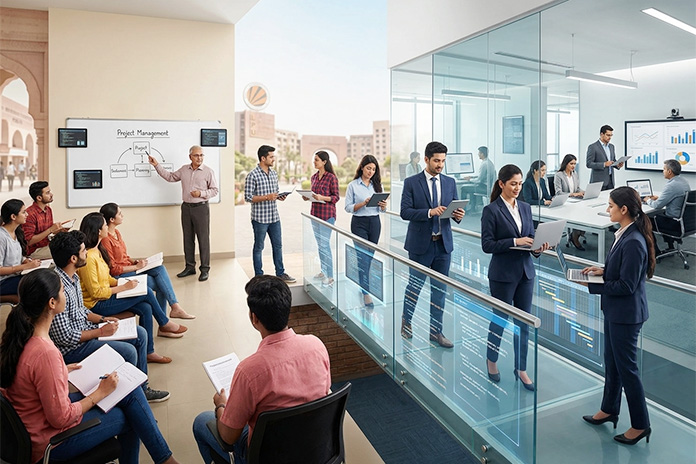
Education is evolving rapidly in today’s digital era. Traditional classroom learning alone is no longer enough to prepare students for the fast-changing professional world. Industries today expect graduates to possess practical knowledge, adaptability, technical understanding, and problem-solving abilities from the very beginning of their careers. Because of this shift, universities are increasingly adopting advanced teaching approaches that combine technology with practical learning.
Among the modern education trends shaping higher education today, blended learning has emerged as one of the most effective approaches. At Lovely Professional University, the focus is not limited to classroom teaching alone. The university follows an advanced LPU education model that combines traditional academic learning with digital platforms, practical implementation, collaborative projects, and continuous skill development.
This hybrid learning system helps students move beyond passive learning and develop industry-ready skills that align with real-world expectations.
UNDERSTANDING BLENDED LEARNING
Blended learning is a modern educational approach that combines physical classroom teaching with digital learning platforms and interactive practical experiences. Instead of depending entirely on lectures, students learn through multiple methods such as online activities, coding environments, simulations, assignments, discussions, and project-based learning.
The blended learning benefits are significant because students gain flexibility, continuous practice opportunities, and a more interactive learning experience. Rather than memorizing concepts for examinations, students actively apply what they learn through implementation and experimentation.
This approach also supports the growing concept of digital classroom India, where technology plays a central role in improving accessibility, engagement, and learning outcomes.
THE LPU EDUCATION MODEL
One of the strongest aspects of the LPU education model is its emphasis on combining theoretical understanding with practical application. Students are encouraged to participate actively in learning instead of simply attending lectures and taking notes.
The university integrates:
- Classroom learning
- Digital coding environments
- Technical simulations
- Project-based assignments
- Online learning platforms
- Collaborative activities
- Industry-oriented workshops
This structure creates a hybrid learning system where students continuously practice concepts while receiving guidance from faculty and digital learning tools.
Instead of limiting learning to a fixed classroom schedule, students gain access to resources and platforms that allow them to learn, test, improve, and experiment beyond classroom hours.
THE ROLE OF DIGITAL CLASSROOMS IN MODERN EDUCATION
The concept of digital classroom India is transforming how students interact with education. Technology now allows students to visualize concepts, solve problems interactively, access learning material instantly, and practice skills in real-time environments.
At LPU, digital learning tools help students:
- Access technical content anytime
- Practice coding and simulations regularly
- Collaborate on projects digitally
- Receive quick feedback on assignments
- Improve through continuous learning cycles
This digital integration helps students stay aligned with modern education trends where flexibility, accessibility, and hands-on learning are becoming increasingly important.
BUILDING INDUSTRY-READY SKILLS THROUGH PRACTICAL LEARNING
One of the biggest challenges in education today is the gap between academic learning and industry expectations. Many students understand theoretical concepts but struggle when asked to apply them in practical scenarios.
To address this challenge, the LPU education model focuses strongly on practical implementation and continuous skill development. Students regularly work on coding tasks, technical projects, presentations, simulations, and problem-solving activities that closely resemble real workplace situations.
This practical approach helps students develop important industry-ready skills such as:
- Problem-solving ability
- Logical thinking
- Technical confidence
- Team collaboration
- Communication skills
- Adaptability to new technologies
- Analytical reasoning
These skills are essential in modern professional environments where employers expect graduates to contribute effectively from the beginning of their careers.
THE IMPORTANCE OF CONTINUOUS PRACTICE
A major advantage of blended learning is that students can continuously improve through practice and feedback. Learning becomes an ongoing process rather than something restricted to examinations.
At LPU, students are encouraged to:
Learn. Apply. Improve. Repeat.
This process helps them:
- Understand concepts more deeply
- Identify mistakes quickly
- Improve technical accuracy
- Build confidence through regular practice
- Strengthen practical understanding
The continuous learning cycle prepares students for internships, placements, technical assessments, and real-world projects more effectively than traditional memorization-based learning methods.
WHY MODERN EDUCATION TRENDS MATTER
The future workplace is becoming increasingly technology-driven and globally connected. As industries evolve, educational institutions also need to evolve to prepare students for changing professional expectations.
Modern education trends now focus on:
- Skill-based learning
- Digital integration
- Practical exposure
- Industry collaboration
- Flexible learning systems
- Technology-enabled education
Universities that successfully combine these elements are helping students become more adaptable, career-ready, and capable of handling future challenges.
The hybrid learning system followed at LPU reflects these evolving educational needs by creating a balance between academics, technology, and practical implementation.
HOW BLENDED LEARNING SUPPORTS LONG-TERM CAREER GROWTH
The blended learning benefits extend beyond academics and placements. Students who continuously engage in practical learning often become more confident learners and independent thinkers.
Through regular exposure to digital tools, practical assignments, collaborative activities, and implementation-based learning, students become better prepared to adapt to changing technologies and workplace environments.
This learning style also encourages curiosity, self-learning habits, and continuous improvement — qualities that are highly valuable for long-term professional growth.
CONCLUSION
Education today is no longer limited to traditional classrooms and theoretical lectures. Students need practical exposure, digital learning opportunities, and real-world skill development to succeed in competitive industries.
Through its advanced LPU education model, focus on blended learning benefits, and technology-driven teaching methods, LPU creates a learning environment that supports both academic excellence and professional growth.
By combining classroom teaching with digital platforms, practical exposure, and continuous implementation, the university helps students develop strong industry-ready skills aligned with modern education trends and the evolving landscape of digital classroom India.
As industries continue changing, hybrid learning systems and application-based education are likely to play an increasingly important role in shaping the future of student learning and career success.








![Is B.Sc. Information Technology [Lateral Entry] the Right Course for You?](https://www.lpu.in/blog/wp-content/uploads/2026/01/Is-B.Sc_.-Information-Technology-Lateral-Entry-the-Right-Course-for-You-100x70.png "Is B.Sc. Information Technology [Lateral Entry] the Right Course for You?")