For decades, sustainable agriculture has been the guiding principle of environmentally conscious farming. The idea was simple: do no harm, maintain what we have, and make sure future generations inherit a planet capable of feeding them. It was a reasonable goal, and for a long time, it felt like enough. The growing focus on regenerative agriculture vs sustainable agriculture reflects a shift from simply maintaining resources to actively restoring them.
But a growing movement of farmers, scientists, and policymakers is now arguing that sustainability, on its own, no longer goes far enough. Decades of intensive farming have left our soils depleted, our waterways polluted, and our ecosystems fragmented. Simply maintaining the status quo will not undo that damage. What’s needed now is active restoration — and that is the promise of regenerative agriculture.
What Makes Regenerative Agriculture Different
Regenerative farming moves beyond the idea of “doing less harm” and asks a bigger question: how can farming actively heal the land it depends on? Rather than treating soil as a passive substrate for crops, it treats the entire farm as a living system to be rebuilt – one that rebuilds degraded soils, restores biodiversity, pulls carbon out of the atmosphere, and revitalises the rural communities that depend on agriculture for their livelihoods. This is central to the benefits of regenerative agriculture and the importance of regenerative agriculture for the future of food production.
Importantly, regenerative agriculture is not a rigid checklist of approved techniques. It’s better understood as a philosophy – a way of farming that works with natural processes instead of overriding them with chemical inputs and mechanical force. The specific practices a farmer adopts will vary depending on climate, soil type, and crop, but the underlying principle stays the same: partner with nature rather than fight it. These approaches are often described as regenerative agriculture practices, regenerative farming practices, and regenerative farming techniques for farmers.
Soil Health: The Foundation of Everything
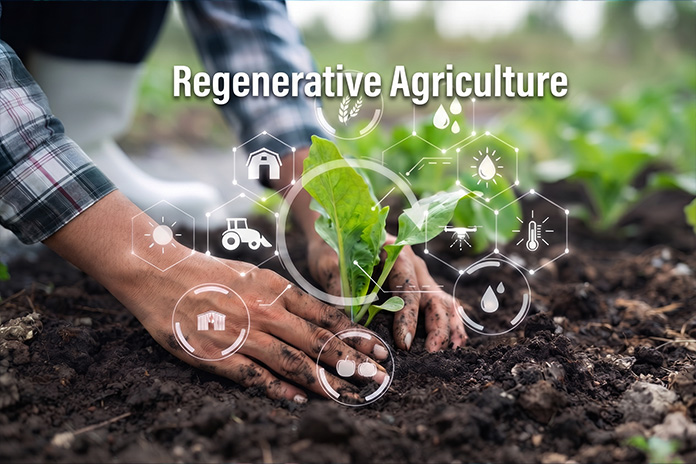
At the heart of regenerative agriculture lies a deceptively simple idea – soil health matters more than almost anything else. Healthy soil isn’t just dirt that holds a plant upright. It’s a dense, living ecosystem, home to billions of microorganisms, fungi, insects, and plant roots, all working together to cycle nutrients, retain water, and store carbon. Effective soil health management, particularly through maintaining soil organic matter, is therefore fundamental to regenerative agriculture and soil health.
Conventional farming, with its heavy reliance on tillage and synthetic inputs, tends to disrupt this underground web of life. Regenerative practices aim to do the opposite. No-till farming leaves the soil structure intact, protecting fungal networks and preventing erosion. Cover cropping keeps living roots in the ground year-round, feeding soil microbes even during the off-season. Composting returns organic matter to the earth instead of shipping it off as waste. Diverse crop rotations break pest cycles naturally and replenish different nutrients with each planting. Together, these practices don’t just protect the soil — they actively rebuild it, allowing a damaged ecosystem to recover its vitality. This process of soil regeneration and regenerative soil management demonstrates how regenerative agriculture restores degraded soil.
Carbon Farming: Turning Soil Into a Climate Solution
One of the most compelling dimensions of regenerative agriculture is its potential role in the fight against climate change. Carbon farming can help turn soils rich in organic matter into a climate solution. Soils rich in organic matter can draw down and store meaningful amounts of atmospheric carbon dioxide – effectively turning farmland into a carbon sink rather than a carbon source. This connection between soil carbon, regenerative agriculture and climate change, and regenerative agriculture for sustainable farming is attracting growing attention.
This has caught the attention of governments and corporations searching for natural climate solutions that complement, rather than compete with, food production. It has also opened up new income streams for farmers through emerging carbon credit markets, where landowners can be compensated for verified increases in soil carbon storage. For many farmers, this represents a rare win-win: healthier land and a new revenue channel, achieved through the same set of practices.
Biodiversity: Building Resilience Into the Landscape
Monoculture farming – growing a single crop across vast stretches of land – has long been the backbone of industrial agriculture. It’s efficient in the short term, but it strips landscapes of variety, leaving them fragile and highly vulnerable to pests, diseases, and extreme weather. This is one reason why discussions around regenerative agriculture vs conventional farming have become increasingly important.
Regenerative agriculture takes the opposite approach. Farmers integrate diverse crops, hedgerows, wetlands, and wildlife corridors directly into their land, creating a mosaic of habitats rather than a monoculture desert. The result is a more resilient agricultural landscape – one that supports pollinators, natural pest predators, and wildlife, while also proving more resistant to shocks. Biodiversity, in other words, isn’t just good for nature; it’s good insurance for farmers too. Such regenerative agriculture practices for farmers can contribute to more resilient and sustainable farming systems.
An Old Idea, Rediscovered — Especially in India
Interestingly, much of what regenerative agriculture advocates for today isn’t entirely new. In India, many of these principles closely mirror traditional farming practices that were widely used before being sidelined during the Green Revolution’s push for chemical-intensive, high-yield monocultures. Many of these approaches can be understood as regenerative agriculture practices that emphasise natural resource conservation and long-term soil health.
Reviving these traditional approaches – this time informed by modern scientific understanding of soil biology and ecosystem dynamics – represents a genuine opportunity. It offers a path to restoring the health of India’s agricultural soils while also improving long-term farm profitability, rather than treating ecological restoration and economic viability as competing goals. This makes regenerative agriculture and farm profitability an increasingly relevant area of discussion for modern agriculture.
A Fundamental Rethink, Not Just a Farming Method
Regenerative agriculture is steadily gaining momentum around the world, from small family-run farms experimenting with cover crops to large corporate supply chains rethinking their sourcing standards. But at its core, this movement is about more than adopting a new set of techniques. The future of regenerative agriculture will depend on how effectively farmers, researchers, policymakers, and communities adapt these principles to local conditions.
It represents a fundamental rethinking of humanity’s relationship with the land – a shift from viewing soil as a resource to be extracted from, to seeing it as a living system to be nurtured. If sustainability asked us to tread lightly, regeneration asks something bolder: to leave the land better than we found it.

![Career Paths after B.Tech. Biomedical Engineering [Lateral Entry]](https://www.lpu.in/blog/wp-content/uploads/2025/12/Career-Paths-after-B.Tech_.-Biomedical-Engineering-Lateral-Entry-1-100x70.png "Career Paths after B.Tech. Biomedical Engineering [Lateral Entry]")
![Is B.Tech. Chemical Engineering [Lateral Entry] the Right Course for You](https://www.lpu.in/blog/wp-content/uploads/2025/11/Is-B.Tech_.-Chemical-Engineering-Lateral-Entry-the-Right-Course-for-You-100x70.png "Is B.Tech. Chemical Engineering [Lateral Entry] the Right Course for You?")