Introduction
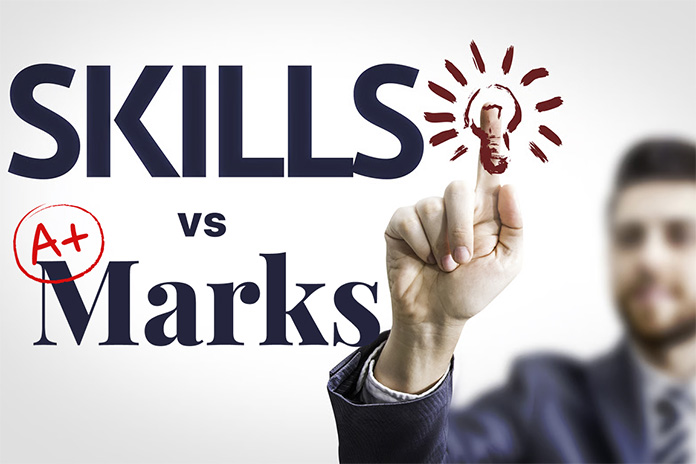
One of the most common questions students face throughout their academic journey is whether marks truly define success. From school to college, marks are often treated as the main measure of intelligence and achievement. However, as students move closer to their careers, many realize that marks alone are not enough.
The skills vs grades debate is becoming more important today because the professional world expects students to do more than just score well. As educators, we often see students with high marks struggle in practical situations, while some students with average marks perform confidently because they have strong skills.
This blog aims to help students understand the importance of both marks and skills, and why the right balance matters.
The Importance of Marks
Marks have always played an important role in education. They provide a standard way to evaluate a student’s understanding of subjects.
Why Marks Matter
- They reflect academic performance
- They help in shortlisting for higher studies and placements
- They create discipline and consistency in studying
- They provide a measurable way to track progress
For students, especially in the early stages, marks can motivate them to stay focused and committed. However, marks mainly test how well a student can understand, remember, and present information in exams. That is important, but it is only one part of learning.
The Importance of Skills
Skills are about applying knowledge in real-life situations. These include communication, problem-solving, teamwork, leadership, technical knowledge, creativity, and critical thinking.
The importance of skills India is growing because industries are changing quickly. Employers need students who can adapt, learn new tools, work in teams, and solve real problems.
Why Skills Matter
- They help in solving practical problems
- They improve confidence and independence
- They increase employability
- They prepare students for real work environments
- They support long-term career growth
In today’s world, employability skills students develop during college can strongly influence their professional journey.
Real Student Scenarios
To understand this better, let us look at some common student situations.
Scenario 1: High Marks, Low Practical Ability
A student consistently scores high marks in exams but struggles to apply concepts in projects or internships. When faced with real-world tasks, they feel underprepared.
Learning: Marks alone do not guarantee practical understanding.
Scenario 2: Average Marks, Strong Skills
Another student may have average marks but actively works on projects, learns new tools, participates in workshops, and improves communication skills. During interviews, this student performs better because of practical knowledge.
Learning: Skills can create strong opportunities when supported by consistent effort.
Scenario 3: Balanced Approach
A student maintains decent marks while also focusing on internships, online courses, presentations, projects, and practical exposure.
Learning: A balanced approach leads to the best outcomes.
Why Students Focus Only on Marks
There are many reasons students prioritize marks over skills:
- Pressure from family and society
- Fear of failure
- Lack of awareness about skill development
- Traditional exam-focused education system
- Belief that marks alone guarantee success
This mindset needs to change gradually. Marks are important, but they should not become the only goal. Students must also understand the value of skill based education for real growth.
What Do Employers Really Look For?
In today’s competitive environment, employers evaluate students on multiple factors. Marks may help in shortlisting, but final selection often depends on practical ability and confidence.
Employers usually look for:
- Problem-solving ability
- Communication skills
- Teamwork and collaboration
- Practical knowledge
- Adaptability
- Willingness to learn
- Professional attitude
These are important career success factors because companies want candidates who can contribute from day one and grow with the organization.
Finding the Right Balance
It is not about choosing between skills and marks. It is about balancing both.
Marks help students build academic discipline, while skills help them become career-ready. A student with strong marks but weak practical ability may struggle. Similarly, a skilled student with very poor academic performance may face challenges in shortlisting.
Practical Tips for Students
- Focus on understanding concepts, not just memorizing
- Participate in projects, workshops, internships, and competitions
- Improve communication and presentation skills
- Learn digital tools related to your field
- Build a portfolio or project record
- Manage time between academics and skill-building
- Stay curious and keep learning beyond textbooks
This balance helps students develop strong job readiness skills and prepares them for real career opportunities.
Role of Educators
Educators play a major role in shaping student perspectives. By encouraging discussions, project-based learning, presentations, case studies, and practical activities, teachers can help students connect theory with real-world application.
A good education system should not only prepare students for exams but also for life, work, and continuous learning. This is where skill based education becomes essential.
Conclusion
In conclusion, both skills and marks are important, but they serve different purposes. Marks may open doors, but skills help students walk through those doors confidently.
The skills vs grades debate should not be seen as a competition. Instead, students should focus on becoming well-rounded individuals who can perform academically and practically.
Success is not defined by marks alone. It is defined by how well students apply knowledge, adapt to challenges, communicate ideas, and continue growing. Therefore, students should aim not just to score well, but to learn well, improve consistently, and build skills that support long-term success.