Introduction
Plant genomics is transforming modern agriculture by helping scientists understand how crops grow, adapt, and survive under stress. Today, plant genomics research plays a key role in solving global challenges like climate change, food security, and sustainable agriculture.
With the rise of agricultural biotechnology India and global innovation, researchers are using genomic insights to build stronger, smarter crops. This shift is not just scientific—it’s practical, helping farmers improve productivity through crop resilience technology and genetic crop improvement.
What is Plant Genomics and Why It Matters
Plant genomics studies the DNA structure and function of plants. It helps scientists identify traits responsible for drought resistance, disease tolerance, and yield improvement.
This forms the foundation of:
- sustainable farming science
- agri innovation India
- advanced breeding techniques
By decoding plant genomes, researchers can create crops that are more resilient and efficient.
How Plant Genomics is Driving Crop Resilience
1. Genetic Crop Improvement
Modern genomics allows precise modification of crops. Techniques like CRISPR help in targeted gene editing, improving plant traits faster than traditional methods.
This is the future of:
- genetic crop improvement
- high-yield and stress-resistant crops
2. Crop Resilience Technology
With unpredictable weather patterns, crops need to withstand extreme conditions.
Through crop resilience technology, scientists can:
- Improve drought tolerance
- Enhance pest resistance
- Increase water efficiency
This ensures stable food production even under climate stress.
3. Role of Agricultural Biotechnology in India
India is emerging as a leader in agricultural biotechnology India, focusing on sustainable solutions for farming.
Initiatives and research programs are:
- Promoting genomic literacy
- Supporting farmers with advanced crop solutions
- Encouraging agri innovation India
This strengthens the country’s agricultural ecosystem.
Technological Advancements in Plant Genomics
Recent advancements in sequencing technologies have made plant genomics research faster and more accurate.
Key developments include:
- High-throughput sequencing
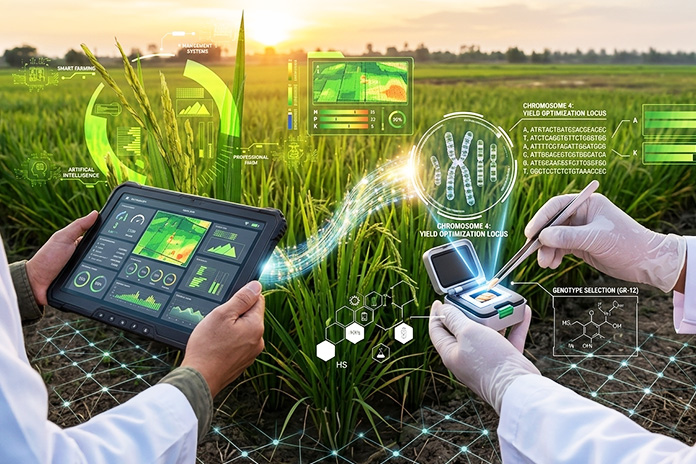
- AI-driven genome analysis
- Multi-omics integration
These technologies support sustainable farming science by enabling better decision-making and crop planning.
Real-World Applications in Agriculture
Plant genomics is already making a difference:
- Development of drought-resistant crops
- Improved disease resistance
- Better nutrient efficiency
These applications highlight the growing importance of:
- crop resilience technology
- genetic crop improvement
Challenges and Ethical Considerations
Despite its benefits, plant genomics faces challenges:
- Regulatory concerns around gene editing
- Data complexity and analysis
- Ethical debates on modified crops
Balancing innovation with safety is crucial for the future of agricultural biotechnology India.
Future of Plant Genomics in Agriculture
The future lies in combining genomics with AI data science, and environmental studies.
Emerging trends include:
- AI-based crop prediction
- Climate-resilient crop development
- Integration of genomics with smart farming
This will further boost:
- agri innovation India
- sustainable farming science
Conclusion
Plant genomics is reshaping agriculture by making it more resilient, efficient, and sustainable. With continuous advancements in plant genomics research, the focus is shifting toward smarter farming solutions.
From crop resilience technology to genetic crop improvement, and the rise of agricultural biotechnology India, the future of farming looks promising.
In simple terms, plant genomics is not just about science—it’s about securing food for the future while protecting our environment.