
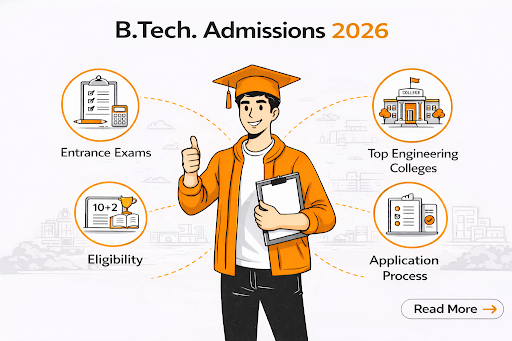
As we enter the 2026 academic cycle, B.Tech. admission remains the most powerful gateway for students aspiring to lead in an era defined by Artificial Intelligence, Quantum Computing, and Sustainable Engineering. With the global industry now pivoting toward Industry 4.0, an engineering degree is no longer just a qualification; it is a launchpad for high-impact careers in Data Science, Cybersecurity, and Robotics.
In India, securing a seat in a premier institution requires a strategic navigation of national, state, and university-level engineering entrance exams. From the high-stakes JEE Main and JEE Advanced to specialised university benchmarks like LPUNEST, understanding the shifting eligibility mandates and application timelines is critical. Beyond the standard 10+2 (PCM) requirements, 2026 sees a renewed focus on academic merit and technical aptitude as the primary filters for India’s top-ranked engineering colleges.
This comprehensive guide provides a deep dive into B.Tech. admissions 2026, offering a step-by-step roadmap to navigate high-yield entrance exams, updated eligibility criteria, and the recruitment trends that led to recent record-breaking ₹2.5 Crore+ placement packages.
B.Tech. Admission 2026 at LPU: At a Glance
|
Top Engineering Entrance Exams in India for B.Tech. Admission 2026
To secure B.Tech. admission 2026, students typically navigate three tiers of examinations: National, State, and University-level. These tests evaluate core proficiency in Physics, Chemistry, and Mathematics, serving as the primary filter for India’s top-ranked engineering institutions.
Given the high competition, most aspirants follow a “Multiple-Exam Strategy” – appearing for at least 3-4 different tests to maximise their chances of securing a seat in a high-ROI program.
Recognised B.Tech. Entrance Examinations for 2026
| Exam Category | Exam Name | Eligibility Criteria | Associated Institutions |
| National Level | JEE Main | 10+2 with Physics, Chemistry, and Mathematics | NITs, IIITs, CFTIs, and top colleges |
| National Level | JEE Advanced | Top rankers of JEE Main | Indian Institutes of Technology (IITs) |
| University Level | LPUNEST | 10+2 with PCM (60% Aggregate) | Lovely Professional University |
| University Level | BITSAT | 10+2 with PCM (75% aggregate) | BITS Pilani campuses |
| University Level | VITEEE | 10+2 with Physics, Chemistry, and Mathematics | Vellore Institute of Technology |
| University Level | SRMJEEE | 10+2 with PCM | SRM Institute of Science and Technology |
| State Level | MHT CET | 10+2 with PCM | Engineering colleges in Maharashtra |
| State Level | WBJEE | 10+2 with PCM | Engineering colleges in West Bengal |
| Private/Consortium | COMEDK UGET | 10+2 with PCM | Private engineering colleges in Karnataka |
| University Level | KIITEE | 10+2 with PCM | Kalinga Institute of Industrial Technology |
Most students choose to appear for one National exam (JEE Main) and at least two University-level exams like LPUNEST to secure their admission and scholarship options.
Note: Application timelines, eligibility requirements, and examination schedules may vary each year. Candidates should refer to the respective official websites for the latest updates regarding B.Tech. admission 2026.
B.Tech. Admission Eligibility Criteria 2026: What You Need to Know
To secure B.Tech. admission 2026, candidates must navigate a two-tier eligibility landscape. While national institutes (IITs/NITs) maintain a strict academic threshold, premier private universities like LPU offer more flexible, merit-based pathways.
Meeting these foundational requirements is the first step toward qualifying for top engineering entrance exams in India.
Core Academic Requirements
- Qualifying Examination: Completion of 10+2 (Higher Secondary) or an equivalent examination from a recognised board (CBSE, ICSE, State Boards, etc.).
- Mandatory Subject Trio: You must have studied Physics, Mathematics, and English as compulsory subjects.
- The “Chemistry” Alternative: While Chemistry is traditional, many universities including LPU now allow you to substitute it with Biotechnology, Computer Science, Biology, or Information Technology to meet the eligibility for B.Tech. admission.
- Note: The Biology substitute is particularly relevant for students eyeing specialised streams like B.Tech. Biotechnology, Food Technology, or Biomedical Engineering.
- Minimum Aggregate Marks: * National Level (IITs/NITs): A minimum of 75% aggregate marks in 10+2 (65% for SC/ST).
- University Level (LPU/Private): Typically requires 60% aggregate marks in PCM/PCB. (Note: LPU specifically requires 60% with Physics, Mathematics, and English).
Entrance Exam & Direct Admission
- Mandatory Testing: Qualifying in a recognised engineering entrance exam (such as JEE Main, LPUNEST, or BITSAT) is generally mandatory for seat allotment and scholarship eligibility.
- Direct Admission Merit: Some institutions offer direct admission in B.Tech. for high-achievers. At LPU, students with a very high JEE Main percentile or 90% above in 10+2 may be eligible for direct admission and top-tier scholarship brackets.
- Lateral Entry: If you hold a 3-year Diploma in Engineering or a B.Sc. (Non-Medical), you can skip the first year and apply for lateral entry admission in B.Tech., entering directly into the 3rd semester.
Students are advised to review the admission requirements of their chosen institution carefully before applying for B.Tech. admission 2026.
B.Tech. Lateral Entry Admission 2026: A Shortcut for Diploma Holders
For students holding a 3-year Diploma in Engineering or a B.Sc. (Non-Medical/CS), lateral entry admission in B.Tech. is the most efficient pathway to an engineering degree. By entering directly into the 2nd year (3rd semester), candidates leverage their technical background while saving one full year of academic study.
Why Choose Lateral Admission in B.Tech?
- Time Efficiency: Skip the foundational first-year subjects and dive straight into core engineering specialisations.
- Cost-Effective: Pay for only three years of tuition instead of four.
- Career Acceleration: Enter the professional workforce one year earlier than traditional B.Tech. students.
Is LPUNEST Mandatory for Lateral Entry at LPU?
Yes. To secure lateral admission in B.Tech. at Lovely Professional University, candidates must qualify for the LPUNEST (LET).
Unlike other universities where entrance tests are just for “passing,” LPUNEST (LET) serves two critical purposes:
- Eligibility: It confirms your technical proficiency for 2nd-year entry.
- Scholarship Gateway: Your score determines your scholarship slab, which can significantly reduce your per-semester fee.
Top Specialisations for Lateral Entry 2026
Most engineering colleges in India offer lateral entry across all major streams, allowing students to continue their diploma expertise or switch to a high-demand field:
- Computer Science Engineering: Ideal for those with a Diploma in IT or CS.
- Mechanical & Electrical Engineering: Focus on automation and EV technology.
- Civil Engineering: Focused on smart city infrastructure and sustainable design.
- Electronics and Communication (ECE): Perfect for diving into 5G and IoT.
This pathway provides diploma holders with an opportunity to obtain a bachelor’s degree in engineering and expand their career prospects in technical and engineering fields.
Best B.Tech. Specialisations for 2026: Future-Proof Your Career
Choosing the right engineering branch is no longer just about interest; it’s about industry demand and placement ROI. In 2026, the most successful engineers are those who bridge the gap between “Core” principles and “New-Age” technologies like Generative AI and IoT.
1. The “Digital Titans” (High Demand & High Salary)
These specialisations are at the forefront of the global tech boom, often commanding starting packages ranging from ₹12 LPA to ₹30 LPA+.
- B.Tech. in Computer Science Engineering (CSE): The “trunk” of modern engineering. In 2026, CSE remains the most versatile degree, focusing on full-stack development and cloud architectures.
- Artificial Intelligence (AI) and Machine Learning: With India projected to need over 1 million AI professionals by 2026, this is the fastest-growing sector.
- Data Science & Analytics: Often called the “new oil,” this branch focuses on transforming messy data into actionable business intelligence.
- Cybersecurity & Blockchain: As digital threats escalate, experts in ethical hacking and secure systems are in critical demand across banking and defence.
2. Core Engineering: The “Evergreen” Evolved
Traditional branches have received a “Tech Upgrade” in 2026. Core engineers who understand AI and Automation are now the most valued in the manufacturing sector.
- Electronics and Communication (ECE): The backbone of 5G/6G rollout and the Semiconductor revolution in India.
- Mechanical Engineering (with Robotics soul): Now focusing on Electric Vehicle (EV) Technology and smart manufacturing.
- Civil Engineering (Smart Cities): Moving toward Sustainable Infrastructure and AI-driven urban planning.
3. Industry-Collaborative B.Tech. Programmes
At Lovely Professional University, the curriculum is co-designed with global tech giants to ensure you graduate with industry certifications already on your CV.
- B.Tech. CSE (Gen AI) in tie-up with Microsoft: Master the future of automated creativity and coding.
- B.Tech. CSE (Cloud Computing) in tie-up with Google Cloud: Gain hands-on experience in the backbone of modern IT infrastructure.
- B.Tech. ECE (Semiconductor & VLSI) in tie-up with Intel: Enter the high-growth chip-design industry.
- B.Tech. CSE (Cybersecurity) in tie-up with CompTIA: Prepare for global security certifications while completing your degree.
The B.Tech. curriculum for each specialisation may vary in terms of coursework, laboratory training, internships, and industry exposure. Students should carefully evaluate their interests, career prospects, and emerging technology trends before selecting a suitable engineering branch.
B.Tech. Career Roadmap 2026: Specialisations & Top Recruiters
| B.Tech. Specialisation | Focus Areas for 2026 | Top Global & Domestic Recruiters | Average Starting Salary (2026 Est.) |
| CS / AI / Machine Learning | LLM Pipelines, Generative AI, Robotics | Google, Microsoft, NVIDIA, Amazon, Tesla | ₹12 LPA – ₹18 LPA |
| Data Science & Analytics | Big Data, Predictive Modeling | Accenture, Mu Sigma, Swiggy, Oracle | ₹10 LPA – ₹15 LPA |
| Cybersecurity | Ethical Hacking, Cloud Security | CompTIA, Quick Heal, Cisco, CrowdStrike | ₹11 LPA – ₹16 LPA |
| Electronics & Comm. (ECE) | 5G/6G, VLSI Design, Semiconductors | Intel, Samsung, Qualcomm, Apple | ₹10 LPA – ₹17 LPA |
| Mechanical Engineering | EV Technology, Industry 4.0, Mechatronics | Tesla, Bosch, Tata Motors, L&T | ₹3 LPA – ₹5.5 LPA |
| Civil Engineering | Smart Infrastructure, Sustainable Design | L&T, DLF, NHAI, Tata Projects | ₹3 LPA – ₹5 LPA |
LPU Placement “Wall of Fame”: Breaking Global Records
While the industry average is rising, LPU students are setting new national benchmarks. The university has become a preferred hub for Fortune 500 giants, resulting in record-breaking offers for the 2025-2026 batch.
- ₹3 Crore International Package: A historic milestone for LPU graduates in the global tech space.
- ₹2.5 Crore Domestic Package: Secured by Sri Vishnu (B.Tech Robotics & Automation), one of the highest packages ever recorded for a student in India.
- 1,700+ Dream Offers: A massive volume of students securing packages between ₹10 LPA and ₹64 LPA.
- Fortune 500 Magnet: Consistent recruitment from Google, Microsoft, Amazon, and Palo Alto Networks.
Top-Ranked Private Engineering Colleges in India 2026: NIRF Standings
Choosing a premier institution is a critical step in your engineering journey. While infrastructure and faculty are vital, the National Institutional Ranking Framework (NIRF) 2025 serves as the most trusted benchmark for academic excellence and placement outcomes in India.
Below are the top-performing private engineering institutions that have consistently secured positions in the NIRF Top 50, making them the most sought-after choices for the 2026 admission cycle.
| College Name | NIRF 2025 Engineering Rank | Best Known For (2026 Focus) |
| SRM Institute of Science and Technology | 14 | Research Innovation & Global Internships |
| Vellore Institute of Technology (VIT) | 16 | High Placement Volume & Diverse Specialisations |
| Amity University, Noida | 37 | Industry Integration & Corporate Tie-ups |
| Lovely Professional University (LPU) | 48 | Record-Breaking Packages & Future-Tech Labs |
These institutions are recognised for their state-of-the-art laboratories, industry-aligned curriculum, and strong placement cells that bridge the gap between classroom learning and global career opportunities.
B.Tech. Admission Process 2026: Step-by-Step Guide
Navigating the B.Tech. admission process in India requires precision and timing. While each university has its own nuances, most premier institutions like LPU follow a structured timeline that integrates entrance testing with merit-based seat allocation.
Follow this 6-step roadmap to secure your engineering seat for the 2026 academic session:
Step 1: Verify Eligibility & Specialisations
Before applying, ensure you meet the 10+2 requirements (typically 60% in PCM for private universities or 75% for NITs/IITs). This is also the time to choose your B.Tech specialisation – whether it’s a core field or an industry-collaborative programme with giants like Google or Microsoft.
Step 2: Register for Entrance Exams (Current Window)
For 2026, most national and university-level exams are open.
- LPUNEST 2026 (Phase 2): Registration is currently open until 25 March 2026.
- JEE Main 2026: Ensure you have your session scores ready for the upcoming counselling rounds.
Step 3: Slot Booking & Examination
Flexible Exam Modes: When booking your slot, you can choose between:
- Online Remotely Proctored Exam: Take the test from the comfort of your home using a laptop and a mobile device (acting as a ‘third eye’). This is the recommended mode for convenience.
- Test Centre-Based Exam: Choose from over 300+ cities across India if you prefer a traditional exam environment.
Important: Once you select the “From Home” option during slot booking, you cannot switch back to a Test Centre-based exam, so choose carefully!
Step 4: Result Declaration & Merit Ranking
After the exam, universities release a merit list based on your performance. For LPUNEST Phase 2, results are scheduled for 3 April 2026. Your rank will determine your eligibility for specific branches and scholarship slabs.
Step 5: Online Counselling & Seat Allotment
Qualified candidates must participate in online counselling.
- Choice Filling: Select your preferred engineering branch and campus.
- Allotment: Seats are allocated based on your rank, preference, and availability.
- Scholarship Confirmation: Your entrance score will automatically be applied to calculate your fee waivers (up to ₹8.4 Lakhs at LPU).
Step 6: Document Verification & Fee Payment
To confirm your seat, you must deposit an initial fee and upload the necessary documents (10th/12th marksheets, entrance scorecard, and ID proof). For B.Tech. lateral entry students, a Diploma/B.Sc. marksheet is also required at this stage.
Following these steps carefully can help students navigate the B.Tech. admission process smoothly and secure admission to their preferred engineering college.
Essential Document Checklist for B.Tech. Admission 2026
Organising your paperwork is as important as your entrance exam score. Whether you are reporting for physical verification at LPU or applying for lateral entry, keep at least three sets of self-attested photocopies along with your original documents.
1. Mandatory Academic Records
- Class 10th Marksheet & Passing Certificate: Required as proof of your Date of Birth (DOB).
- Class 12th Marksheet & Passing Certificate: The primary document for eligibility verification.
- Entrance Exam Scorecard: A printed copy of your JEE Main, LPUNEST 2026, or BITSAT result.
- LPUNEST Hall Ticket: Must be preserved as it is often required during the final admission steps.
2. Identity & Address Proof
- Aadhaar Card: Ensure the name matches your 10th marksheet exactly. (Passport or PAN Card are also accepted).
- Passport Size Photographs: Carry at least 10–15 recent coloured photographs with a light background.
3. Transfer & Character Certificates
- Transfer Certificate (TC) / School Leaving Certificate: Issued by your last attended school/college.
- Migration Certificate: Mandatory if you are changing your education board (e.g., shifting from CBSE to a State University).
- Character Certificate: Issued by the Head of the Institution last attended.
4. Special Category Documents (If Applicable)
- Category Certificate: Valid SC/ST/OBC/EWS certificates for reservation or fee waivers.
- Gap Year Affidavit: If you took a drop year, a notarised Gap Affidavit is mandatory to explain the break in studies.
- Income Certificate: Required to claim specific merit-cum-means scholarships.
5. Additional Checklist for B.Tech. Lateral Entry
- Diploma/B.Sc. Marksheets: All semester marksheets and the final passing certificate.
- Equivalence Certificate: In some cases, if your diploma is from a non-AICTE approved board.
Career Opportunities After B.Tech. 2026
A B.Tech. degree in 2026 is no longer just a technical qualification; it is a versatile foundation for a career in the AI-augmented global economy. With the rise of Industry 4.0, traditional roles have evolved, and entirely new sectors like Green Tech, Space Technology, and Autonomous Systems have opened up.
1. High-Growth Tech Roles (₹12 LPA – ₹35 LPA+)
- AI/ML Specialist: Designing neural networks and Generative AI models for healthcare, finance, and automation.
- Cybersecurity Architect: Protecting critical digital infrastructure from evolving global threats.
- Cloud Solution Architect: Managing enterprise-level migrations for the booming SaaS and IT sectors.
- Data Scientist: Transforming big data into strategic business intelligence.
2. Core Engineering & Emerging Sectors
- EV Design Engineer: Driving the electric mobility revolution in India’s automotive sector (e.g., Tesla, Tata Motors).
- Robotics & Automation Engineer: Designing smart factories and surgical robots.
- Sustainable Infrastructure Planner: Focused on green building and smart city development.
- Semiconductor/VLSI Engineer: Joining India’s mission to become a global chip-manufacturing hub (e.g., Intel, Micron).
3. Strategic & Managerial Pathways
Many engineering graduates now leverage their analytical skills to pivot into high-paying non-technical roles:
- Technical Product Manager: Bridging the gap between engineering teams and business goals.
- Management Consultant: Solving complex business problems for firms like McKinsey or BCG.
- Entrepreneurship: Building tech-driven startups with support from university incubation centres.
Why LPUNEST 2026 is the Ultimate Gateway for B.Tech. Aspirants
The Lovely Professional University National Entrance and Scholarship Test (LPUNEST) is more than just a standard university entrance exam; it is a high-stakes gateway to one of India’s most successful placement ecosystems. While it determines admission to LPU’s established engineering programmes in Punjab, its true value lies in being the primary eligibility tool for record-breaking career opportunities and massive financial aid.
The LPUNEST Advantage: High-ROI Engineering
- The Gateway to Record Placements: LPUNEST is the first step toward joining an elite network that recently secured a ₹3 Crore international package and a ₹2.5 Crore domestic package (secured by a B.Tech. Robotics student).
- Massive Scholarship Gateway: Performance in LPUNEST can significantly reduce the cost of your degree. While the maximum scholarship of up to ₹8.4 Lakhs is most accessible during Phase 1 (ending March 31, 2026), high scorers in the current phase can still unlock substantial fee waivers. As we move into later phases, these scholarship brackets typically decrease, so applying now ensures the highest possible ROI.
- Global Fortune 500 Access: Qualifying through LPUNEST places you in the recruitment pool for giants like Google, Microsoft, Amazon, and Palo Alto Networks, who have collectively made over 6,000+ offers to LPU Vertos.
LPUNEST 2026 Phase 2: Key Deadlines (Current Cycle)
For students seeking B.Tech. admission 2026, the Phase 2 window is currently active. The exam is conducted in a flexible online mode, allowing you to choose your own test slot.
| Event | Official Date |
| Registration Deadline | 25 March 2026 (Extended from March 10) |
| Exam Window (Remotely Proctored) | 15 February – 31 March 2026 |
| Exam Window (Test Centre-Based) | 15 March – 31 March 2026 |
| Result Announcement | 3 April 2026 |
| Counselling (Round 1) | 3 April – 5 April 2026 |
“Register for LPUNEST 2026 Phase 2 Before 25 March – [Apply Now]”
FAQs: B.Tech. Admission 2026
1. What is the eligibility for B.Tech. admission?
Candidates must complete 10+2 or an equivalent examination with Physics, Chemistry, and Mathematics (PCM) from a recognised board. Universities may also require candidates to qualify in an entrance examination such as JEE Main, LPUNEST, or other engineering entrance exams.
2. Which entrance exams are required for B.Tech. admission in India?
Some widely recognised entrance examinations for B.Tech. admission include JEE Main, JEE Advanced, BITSAT, VITEEE, LPUNEST, SRMJEEE, and several state-level engineering entrance tests conducted across India.
3. What is the B.Tech. admission process in India?
The B.Tech. admission process generally follows these steps:
- Eligibility Check: Pass 10+2 with PCM (usually 60% aggregate).
- Entrance Exam: Register for JEE Main or LPUNEST.
- Result & Ranking: Qualify for the cutoff.
- Counselling: Select your preferred branch (CSE, AI, etc.).
- Documentation: Complete document verification and fee payment.
4. Is direct admission in B.Tech. possible in 2026?
Yes, several private engineering colleges such as LPU offer direct admission based on Class 12th merit or management quota. However, appearing for university-level exams like LPUNEST is recommended to secure scholarships and better branch choices.
5. Can I apply for multiple entrance exams for B.Tech. admission?
Yes. Many students apply for multiple engineering entrance exams to increase their chances of securing admission to reputed engineering colleges in India.
6. What is lateral entry admission in B.Tech.?
Lateral entry admission in B.Tech. allows diploma holders or eligible B.Sc. graduates to enter directly into the second year (third semester) of a B.Tech. programme instead of starting from the first year.
7. Which is the best B.Tech. specialisation?
Popular B.Tech. specialisations include Computer Science Engineering, Artificial Intelligence and Data Science, Electronics and Communication Engineering, Mechanical Engineering, and Civil Engineering. The best specialisation depends on a student’s interests, career goals, and industry demand.
8. How do I choose the right engineering college for B.Tech.?
Students should consider factors such as NIRF rankings, infrastructure, faculty expertise, placement records, industry collaborations, and available specialisations when selecting an engineering college.
9. Can I get a scholarship for B.Tech admission in 2026?
Yes. Many universities in India offer merit-based scholarships for B.Tech. students based on entrance examination scores or academic performance in Class 12. For instance, Lovely Professional University offers scholarships through LPUNEST, where students can become eligible for financial support of up to ₹8.4 lakhs per student, depending on their entrance exam performance. These scholarships are designed to support talented students and make quality engineering education more accessible.
10. What career options are available after completing a B.Tech. programme?
Graduates with a B.Tech. degree can pursue roles such as software engineer, data analyst, artificial intelligence engineer, mechanical design engineer, civil engineer, or electronics engineer. Many students also pursue higher studies such as an M.Tech. programme or MBA to specialise further.
11. Can I apply for B.Tech. after a 1-year gap?
Yes. Most universities in India accept students with a one-year study gap for B.Tech. admission, provided they meet the required eligibility criteria such as completing 10+2 with Physics, Chemistry, and Mathematics and qualifying in the relevant entrance examination.
At institutions such as Lovely Professional University, candidates may need to appear for LPUNEST for admission and scholarship consideration. During the admission process, students with a gap year are usually required to submit a Gap Affidavit (a self-declaration or notarised document) explaining the reason for the gap, such as preparing for competitive examinations or personal circumstances.
12. Is CUET required for B.Tech. admission in India?
CUET-UG is accepted by some universities for selected engineering programmes. However, JEE Main and university-level entrance exams such as LPUNEST remain the primary pathways for B.Tech. admission at many engineering institutions in India.
13. How does the LPUNEST scholarship work for B.Tech aspirants?
Scholarships are awarded based on three “Cut-off Categories” (A, B, and C). Your LPUNEST score determines which category you fall into, which then dictates your fee waiver. For Phase 2 (the current cycle), even if you aren’t in the top 10%, you can still secure significant financial aid.
14. What are the specific LPUNEST score cutoffs for 2026?
While cutoffs can vary slightly based on the difficulty of each test slot, the tentative Phase 2 cutoffs for B.Tech (out of 400 marks) are:
- Category A: 300+ Marks (Qualifies for the highest scholarship slab)
- Category B: 212+ Marks
- Category C: 150+ Marks (Minimum score for merit-based scholarship)
15. Exactly how much can I save on fees in Phase 2?
The scholarship amount depends on your chosen B.Tech stream. For the high-demand “Group 1” programmes (like CSE, AI, and Data Science), the benefits are:
- Category A Scorer: 60% Scholarship (Up to ₹8.4 Lakhs total)
- Category B Scorer: 50% Scholarship
- Category C Scorer: 40% Scholarship
| ⚠️ Phase 2 Alert: After the March 25th deadline, these scholarship percentages typically drop by 5-10% as the university moves into Phase 3. Register now to lock in these current rates. |
Conclusion: Navigating Your B.Tech. Journey in 2026
Securing B.Tech. admission 2026 is more than just passing an entrance exam; it is a strategic decision to align your academic foundation with the future of global technology. With the engineering landscape shifting toward Industry 4.0 and AI-integrated roles, your choice of institution and specialisation will define your career trajectory for the next decade.
Whether you are aiming for national-level excellence through JEE Main or seeking the high-ROI, industry-collaborative ecosystem of Lovely Professional University, the key to success lies in early preparation and meeting critical deadlines. By understanding the eligibility criteria for B.Tech. and identifying the branches that offer the best placement outcomes, you can transition from a student to a future-ready engineer.
The opportunity to join a network that has secured record-breaking ₹3 Crore international packages and ₹2.5 Crore domestic offers is within reach. Evaluate your options, verify your documents, and take the first step toward a global engineering career today.
Don’t miss out on the Phase 2 opportunities: Register for LPUNEST 2026 before the 25 March deadline to secure your seat and merit-based scholarship.