
| Key Takeaways:
|
Some career choices help you get a job, while others prepare you to lead, grow, and make an impact. An MBA degree empowers you to do the latter, making it one of the most popular choices among students who want to excel in management, leadership, business, finance, marketing, analytics, or entrepreneurship. In this article, we will discuss MBA course details, including course duration, eligibility, subjects, specialisations, career scope, online and Distance MBA options, and whether an MBA course is the right choice for you. Let’s begin by understanding why choosing the right course is a significant decision for students.
Why Choosing the Right Course Matters? The Importance of an MBA Degree
Choosing the right graduation isn’t just a decision; it’s the first big step toward shaping your future, career, and identity in the professional world. Many students, especially those from commerce backgrounds, struggle with the right career decision after B.Com/BBA. This is where career planning for graduates becomes essential.
You need a course that offers not only academic excellence but also real-world application and professional growth. For thousands of graduates, an MBA has proven to be that perfect bridge between education and leadership. In today’s rapidly evolving business landscape, where digital transformation and global connectivity define success, making an informed choice about your postgraduate education can determine whether you become a follower or a leader in your field.
The Master of Business Administration has consistently remained one of the most valued degrees worldwide, opening doors to executive positions, entrepreneurial ventures, and international career opportunities.
What is an MBA Degree? Full Form, Duration, and Course Overview
The full form of MBA is Master of Business Administration. It’s a globally recognised postgraduate degree focused on business and management.
What is an MBA degree?
The MBA course is more than just learning theories; it’s about applying strategies, analysing business cases, managing teams, and driving growth. An MBA is a graduate-level degree designed to equip students with advanced skills in business management, leadership, and decision-making, covering areas like finance, marketing, strategy, and operations.
MBA Course Duration
The MBA course duration is typically 2 years, divided into 4 terms. Each term is designed to gradually build management knowledge, practical business skills, leadership abilities, and industry exposure.
During the first year, the MBA course is usually structured across 4 terms, focusing on core management subjects such as finance, marketing, organisational behaviour, human resource management, communication skills, research methodology, and career planning. These terms help students build a strong foundation in business, management, leadership, analytical thinking, and professional communication.
In the second year, students continue with another 4 terms, moving towards advanced learning, specialisation electives, internships, live projects, case studies, industry exposure, and placement-focused preparation. Across the complete 2-year MBA course duration, students progress through 8 terms that combine academic learning with practical business application, helping them develop decision-making skills for managerial and leadership roles.
Let’s look at the MBA course details in a snapshot:
| Aspect | Details |
| Duration | 2 years (Full-time) |
| Eligibility | A graduation in any discipline |
| Focus Areas | Finance, Marketing, HR, IT, International Business |
| Entry Requirements | Entrance exam scores (CAT, MAT, XAT, GMAT) + Interview |
| Career Outcome | Leadership roles, higher salary packages, and global opportunities |
An MBA degree provides access to a vast network of professionals and a broader understanding of global business trends, making it a valuable investment for those seeking to advance their careers or forge new paths in the business landscape.
| Did You Know?
The MBA (Master of Business Administration) degree has long been heralded as a gateway to a successful career in business and management, with opportunities that are more dynamic and expansive than ever before as we approach 2025. |
Online MBA and Distance MBA Options at LPU
LPU also offers flexible MBA learning options for students and working professionals who may not be able to pursue a regular full-time MBA degree. These include the Online MBA and Distance MBA formats.
The Online MBA from LPU Online is a 2-year programme divided into 4 semesters. It offers Live and recorded video lectures by expert faculty, weekend live lectures, master classes by industry experts, flexible online exams, placement support, and 12 career-focused specialisations. With a recommended commitment of around 8–10 hours per week, it can be suitable for learners looking for flexible and affordable online MBA programs.
LPU offers a Distance MBA through LPU Distance Education. The Master of Business Administration distance education programme has a minimum duration of 2 years and a maximum duration of 4 years, giving learners more flexibility to complete the programme at their own pace.
What is the MBA Eligibility Criteria? Who Can Apply for the Course
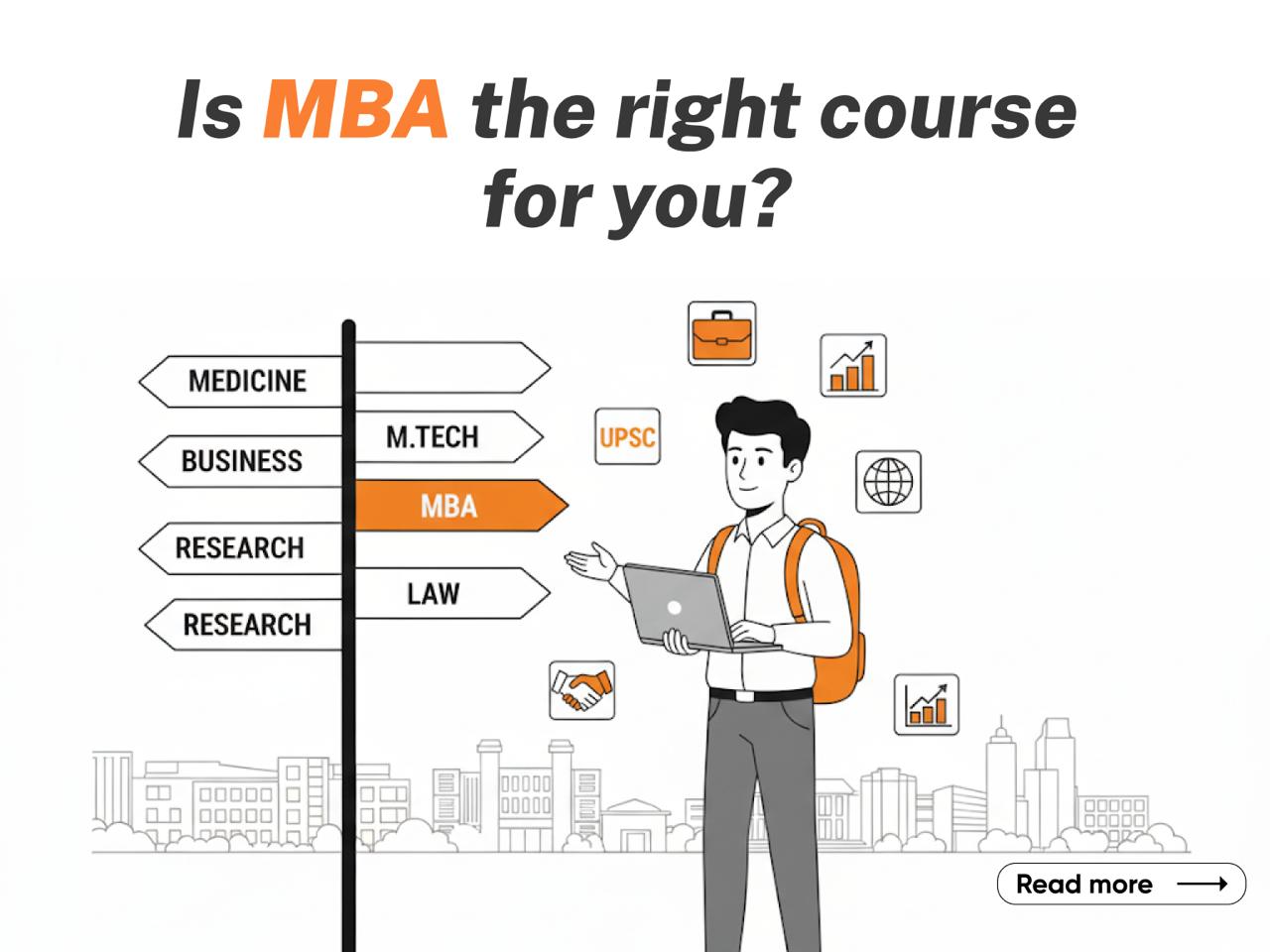
Ask yourself: Is an MBA course right for me? If you aim to lead teams, grow businesses, or become an entrepreneur, an MBA is a step in the right direction. Wondering if you can pursue an MBA course after 12th? Well, It is not possible, as an MBA degree is a postgraduate programme that requires students to complete a Bachelor’s degree first. Anyone with a bachelor’s degree in any stream, such as BBA, B.Tech., BCA, or B.Com., preferably with a knack for communication, analysis, and leadership, can apply.
Ideal candidates for an MBA degree are those who:
- Dream big and think strategically
- Possess strong communication and analytical skills
- Show le transition into management roles
- Aspire adership potential and initiative
- Want tofor entrepreneurial ventures
- Seek global career opportunities
Some of the qualities which characterise successful MBA students include high levels of initiative and energy, capacity for hard work, strong task orientation, willingness to learn, and a temperament suitable for teamwork.
Whether you’re a fresh graduate or a working professional, if you have the drive to lead and the vision to innovate, an MBA can be the catalyst that transforms your career trajectory.
MBA Eligibility Criteria at LPU
The MBA eligibility criteria at LPU are designed for graduates as well as candidates with recognised professional qualifications. To apply for the MBA course, candidates must meet the academic requirements and complete the admission process, which may include an entrance test, video essay, and interview.
- Candidates must have passed a Bachelor’s degree in any discipline or equivalent with 55% aggregate marks.
- Admission is subject to qualifying LPUNEST or any accepted entrance exam, such as CAT, XAT, MAT, CMAT, or CUET.
- Candidates also need to qualify the Video Essay and Interview as part of the admission process.
- Candidates who have completed Company Secretary (CS) from the Institute of Company Secretaries of India (ICSI) may also apply, subject to qualifying the Video Essay and Interview.
- Candidates who have completed Chartered Accountancy (CA) from the Institute of Chartered Accountants of India (ICAI) may also apply, subject to qualifying the Video Essay and Interview.
- Candidates who have completed Cost & Management Accountancy (CMA) from the Institute of Cost Accountants of India may also apply, subject to qualifying the Video Essay and Interview.
Students from backgrounds such as BBA, B.Com, BCA, engineering, arts, science, commerce, and other streams can apply if they meet the MBA eligibility criteria.
Admission is based on LPUNEST or CAT or XAT or MAT or CMAT or CUET merit, subject to the fulfilment of the eligibility criteria.
What Do You Study in an MBA Course? Syllabus and Subject Details
The MBA course subjects and syllabus cover comprehensive areas like Finance, Marketing, HR, Operations, IT, and International Business. The MBA course curriculum is industry-aligned, blending academics with practical experience.
Here’s what is taught in the MBA programme at LPU:
1. Core MBA Course Subjects
The MBA course subjects are spread across 8 terms over 2 years, helping students progress from core management learning to specialisation electives, projects, internship, capstone work, and placement-focused preparation.
MBA Course Subjects Across Terms
| Term | Key MBA Course Subjects |
| Year 1, Term 1 | Career Planning-I, Communication Skills for Leaders-I, Corporate Finance-I, Financial Reporting, Statements and Analysis-I, Marketing Management-I, Organisational Behaviour and Human Resource Dynamics-I, Research Methodology-I |
| Year 1, Term 2 | Business Analytics-I, Career Planning-II, Corporate Finance-II, Financial Reporting, Statements and Analysis-II, Language Elective 1, Marketing Management-II, Operations Management and Research-I, Organisational Behaviour and Human Resource Dynamics-II |
| Year 1, Term 3 | Analytical Skills-I, International Business Environment-I, Language Elective 2, Managerial Economics, Spreadsheet Modelling and Analysis, Specialisation Electives 1, 2 and 3 |
| Year 1, Term 4 | Analytical Skills-II, Business Analytics-II, Language Elective 3, Research Methodology-II, Specialisation Electives 4, 5 and 6 |
| Year 2, Term 1 | Corporate Strategy and Entrepreneurship-I, Field Project, Functional Acceleration Bootcamp, Internship, Operations Management and Research-II, Specialisation Electives 7, 8 and 9 |
| Year 2, Term 2 | Capstone Project-I, Field Project, Interview Mastery: Building Confidence and Skills, Specialisation Electives 10, 11 and 12 |
| Year 2, Term 3 | Capstone Project-II, Design Thinking, Emerging Technologies for Managers, Field Project, Indian Knowledge System, Legal Aspects of Business and Ethics-I |
| Year 2, Term 4 | Corporate Strategy and Entrepreneurship-II, Field Project, International Business Environment-II, Legal Aspects of Business and Ethics-II |
2. Specialisation Electives Offered in the MBA Course
Students can also choose from a wide range of specialisation electives based on their career interests and industry goals. These MBA programs and electives help students build focused expertise in areas such as finance, analytics, marketing, operations, HR, healthcare, technology, and entrepreneurship.
Some of the specialisation electives include:
| Area | Specialisation Electives |
| Analytics and Technology | Advanced Business Analytics, Business Analytics, Information Technology, FinTech |
| Finance and Banking | Finance, Corporate Finance, Financial Markets, Financial Analysis and Consulting, Financial Consulting, Investment Banking, Banking and Financial Services, Auditing and Taxation |
| Marketing and Digital Business | Digital Marketing, Sales and Marketing, E-Commerce, Retail Management |
| People and Organisation | Human Resource Management, Human Resources, Organisational Behaviour |
| Operations and Management | Operations, Product Management, Service Management, Strategy |
| Sector-Specific Management | Agribusiness Management, Hospital and Health Care Management |
| Entrepreneurship | Entrepreneurship |
Advanced Learning Methods in MBA Course:
- Case-Based Teaching & Business Simulations
- Live Projects & Industry Certifications in Digital Marketing, Financial Modelling, and Six Sigma
- Workshops on Leadership, Creativity, Innovation, Excel Modelling
- Entrepreneurship and Business Plan Development
- Community development projects addressing social issues, fostering social sensitivity and responsibility
- Gamified & Experiential Learning that integrates technology, AI, and strategic thinking
LPU’s MBA curriculum brings business theory to life, ensuring students are future-ready from day one.
Why is an MBA Degree a Game-Changer?
MBA degree education transforms not just your resume; it transforms how you think, lead, and connect in the business world. Here’s why it’s a true game-changer:
Transformational Benefits of an MBA Course:
- 360-Degree Business Understanding: You get exposure to all aspects of running a business, from strategy and operations to finance and HR, providing comprehensive knowledge that most other degrees cannot offer.
- Leadership Development: Through simulations, team projects, and internships, you sharpen your leadership style and learn to manage diverse teams effectively.
- Industry-Ready Skills: Data analysis, decision-making, crisis handling, and digital marketing skills that every employer needs in today’s competitive marketplace.
- Global Perspective: Business schools connect you to global faculty, exchange programmes, and international case studies, preparing you for the interconnected business world.
- Better Career Outcomes: Higher salary packages, leadership roles, and entry into global companies become attainable goals rather than distant dreams.
The scope after an MBA in 2026 is vast and varied, offering numerous career paths across traditional and emerging industries. It’s not just about what you study; it’s how it changes the way you think and act in the real world.
| Did You Know?
In 2026, the opportunities available to MBA graduates are more dynamic and expansive than ever before, with the rise of remote work expanding the scope of opportunities globally. |
What are Some of the Popular Specialisations in MBA?
In 2026, trending MBA specialisations are focused on innovation, technology, and sustainability. These future-proof MBA streams give graduates a competitive edge in tomorrow’s job market.
Best MBA Specialisations in 2026:
| Specialisation | Why It’s Trending |
| Business Analytics | Data-driven decision-making across industries |
| Digital Marketing | Huge growth in online branding and e-commerce |
| Financial Technology (FinTech) | Merging finance with digital tools |
| International Business | Globalization of markets needs cross-border management |
| Healthcare Management | Rapid growth in the medical, wellness, and hospital sectors |
| Sustainability & ESG | Green business strategies and corporate responsibility |
| AI & Data Science in Management | Leveraging tech for smarter business solutions |
Data analytics, healthcare Management, supply chain management, marketing, and finance are the most in-demand MBA specialisations in 2026, based on current global business trends and data-driven strategies for future growth.
With the rapid deployment of AI technology, AI and machine learning specialists rank among the fastest-growing career paths worldwide, with an expected net growth of more than 80% between now and 2030.
These specialisations represent the convergence of traditional business acumen with cutting-edge technology and social responsibility, positioning graduates at the forefront of business innovation.
What are the Top Skills You’ll Develop in an MBA Course?
To thrive in today’s competitive landscape, MBA graduates need to master both technical expertise and interpersonal intelligence – skills gained in the MBA that form the core of a transformative educational journey.
Core Skills Developed During an MBA Course:
Leadership & Strategic Skills:
- Leadership & Team Management – Learn to inspire, motivate, and guide diverse teams toward common objectives.
- Strategic Thinking & Business Planning – Develop the ability to see the big picture and create long-term organisational strategies.
- Decision-Making Under Pressure – Master the art of making critical business decisions with limited information and tight deadlines.
Communication & Interpersonal Skills:
- Effective Communication & Presentation – Hone your ability to articulate ideas clearly to stakeholders at all levels.
- Negotiation & Conflict Resolution – Build skills to handle complex business negotiations and resolve workplace conflicts.
- Cross-Cultural Communication – Develop competency to work effectively in global, multicultural business environments.
Analytical & Technical Skills:
- Data Interpretation & Decision-Making – Learn to analyze complex business data and derive actionable insights.
- Financial Analysis & Management – Understand financial statements, budgeting, and investment decisions.
- Digital Literacy & Technology Integration – Adapt to emerging technologies and digital transformation initiatives.
These soft and hard skills in an MBA course collectively shape you into a confident and future-ready professional capable of thriving in any business environment.
| Did You Know?
Many MBA programmes now integrate courses in artificial intelligence, blockchain applications, and big data analytics to prepare graduates for a tech-driven business environment. |
What is the Scope of an MBA Degree? Career Options and Future Opportunities
The future scope of MBA degree is promising and spans across multiple sectors, with the MBA career outlook showing strong growth potential. MBA graduates with strong cross-cultural communication skills and the ability to manage remote teams will find themselves in high demand.
Sector-wise Career Opportunities:
| Sector | Job Roles Available | Growth Prospects |
| IT & Analytics | Business Analyst, Product Manager, Data Strategist | High demand with 30%+ growth |
| Finance & Banking | Investment Banker, Financial Analyst, Risk Manager | Stable with fintech integration |
| Consulting | Strategy Consultant, Business Advisor, Management Consultant | Strong growth in digital consulting |
| FMCG & Retail | Brand Manager, Category Manager, Supply Chain Head | Evolving with e-commerce trends |
| Healthcare | Healthcare Administrator, Medical Marketing Manager | Rapidly expanding sector |
| Sustainability | ESG Specialist, Climate Risk Analyst, Sustainability Manager | 30% CAGR projected growth |
With rising global demand, the demand for an MBA degree in the coming years is expected to soar – especially for tech-integrated business roles and sustainability-focused positions.
What are the Internship & Project Opportunities Available in an MBA Course?
At leading universities like LPU, internships and live projects are an essential part of the MBA experience.
MBA Course Industry Exposure at a Glance:
| Opportunity Type | Details |
| Summer Internship | Work with leading corporates across domains—get hands-on experience and build networks. |
| Live Projects | Real-time collaboration with startups, brands, and NGOs |
| Capstone Projects | Business problems solved under faculty and industry mentor guidance |
| Industrial Visits | Site tours and process walkthroughs at major firms |
| Corporate Guest Lectures | Regular sessions by CEOs, CHROs, and industry leaders |
Real-World Application Skills Taught in an MBA Degree:
These experiences turn you from a student to industry-ready professional by providing practical exposure to:
- Strategic planning and execution
- Team management and leadership
- Problem-solving under real constraints
- Client interaction and stakeholder management
- Project delivery and performance measurement
The internship component serves as a crucial testing ground where theoretical knowledge meets practical application, often leading to pre-placement offers and valuable industry connections.
Alumni Success Stories
Successful MBA alumni from LPU are making remarkable strides in their careers, proving how the right education can spark real transformation. These inspiring MBA career journeys reflect not just professional success but also personal growth and creativity, serving as motivation for future business leaders.
Abhinav Singh secured a stellar placement at Sobha Realty with an impressive package of 29 lakhs. His story exemplifies how dedication, combined with the right guidance and education, can lead to extraordinary success. Abhinav’s career is a shining example of alumni achievements after MBA, and stands among the many inspiring stories that define the LPU MBA experience.
| Did You Know?
57% of those who wanted to make a career change within the business industry in 2022 said they were successful after completing their MBA, highlighting the degree’s effectiveness in facilitating career transitions. |
How to Plan Your Career with an MBA Degree?
Once you step into the MBA journey, it’s important to make the most of every opportunity. Here’s how to truly maximise your success:
1. During Your MBA Programme
Academic Excellence & Skill Building:
- Stay Active in Clubs & Case Competitions: Build confidence, leadership skills, and industry recognition.
- Pursue Additional Certifications: Add value with credentials in Six Sigma, Google Analytics, Financial Modeling, and project management.
- Participate in International Exchange Programmes: Gain a global perspective and cross-cultural competency.
Professional Networking:
- Build a Strong LinkedIn Profile: Connect with alumni, recruiters, and industry mentors.
- Attend Industry Conferences and Seminars: Stay updated with current trends and make professional contacts.
- Engage with Guest Speakers: Build relationships with visiting industry leaders and executives.
Practical Application:
- Use University Placement Services: Participate in mock interviews, resume-building sessions, and career counselling.
- Take on Leadership Roles: Lead student committees, organise events, and manage team projects.
- Explore Consulting Projects: Work on real business problems for actual companies.
2. Strategic Career Planning
- Be Industry-Aware: Attend webinars, conferences, and company visits to understand market dynamics.
- Explore Global Exposure: Take advantage of international immersion programmes or online global case challenges.
- Stay in Touch with Faculty & Peers: Maintain relationships for recommendations, job leads, and referrals.
These career tips for MBA students help you grow after the MBA and ensure success during placements.
Higher Studies and Global Certifications After MBA
An MBA isn’t the end; it’s the beginning of new and limitless possibilities. The journey of learning and growth continues well beyond graduation.
1. Advanced Educational Pathways:
Higher Education After MBA Degree:
- Ph.D. in Management: For those interested in research, academia, or specialised consulting roles.
- Executive Programmes: Advanced leadership programmes from top business schools for senior management roles.
- Post-Graduate Diplomas: Specialised certifications in emerging fields like AI, blockchain, or sustainability.
Professional Certifications for MBA Graduates:
- CFA (Chartered Financial Analyst): Essential for finance and investment management careers.
- PMP (Project Management Professional): Valuable for operations and strategic project leadership.
- Six Sigma Black Belt: Critical for process improvement and quality management roles.
- Digital Marketing Certifications: Google, Facebook, and HubSpot credentials for marketing professionals.
2. Global MBA Certifications
International Mobility Options:
- CPA (Certified Public Accountant) for accounting and finance roles abroad
- ACCA (Association of Chartered Certified Accountants) for global finance careers
- FRM (Financial Risk Manager) for risk management positions worldwide
These credentials enhance your professional profile and open doors to global opportunities, allowing you to compete in international markets and secure positions with multinational corporations.
3. Continuous Learning Culture
The business world evolves rapidly, and successful MBA graduates understand the importance of lifelong learning. Whether through formal certifications, executive education, or industry-specific training, maintaining current knowledge and skills is essential for sustained career growth.
| Did You Know?
Many top business schools now offer alumni access to lifelong learning platforms, allowing MBA graduates to continuously update their skills and knowledge as industries evolve. |
Conclusion
The MBA course at LPU redefines business education; preparing you not just for a job, but for a leadership journey. Through experiential learning, industry-aligned specialisations, and robust placement support, LPU turns your ambition into achievement. It’s where future business leaders are shaped to thrive in a competitive world.
The success stories of MBA graduates stand as proof of the programme’s impact, with professionals excelling in top corporates, entrepreneurial ventures, and global roles. With experienced faculty, practical learning opportunities, and exposure to real-world business challenges, an MBA is more than an academic programme; it is a transformative experience that shapes confident, innovative, and socially responsible leaders.
At LPU, you don’t just learn business, you learn to lead it. For more information about the MBA degree, course details, fee, and entrance information, please visit our programme page.
Frequently Asked Questions (FAQs)
Q1. Does LPU offer industry collaborative MBA programmes?
Yes, LPU offers several industry collaborative programmes such as MBA Business Analytics in knowledge partnership with EY, MBA Financial Markets in tie up with NSE Academy, and MBA Supply Chain and Logistics in tie up with CII Institute of Logistics. We also offer specialised MBA programmes such as MBA Data Science and Artificial intelligence, MBA Digital and Social Media Marketing, MBA Fintech and Artificial Intelligence, MBA Hospital and Healthcare Management, and MBA International Business.
Q2. What is the average salary after an MBA in 2026?
The average salary after an MBA in 2026 can vary based on the institute, specialisation, prior experience, industry and job role. Sectors such as finance, marketing, consulting, HR, analytics and operations may offer different salary ranges.
At LPU, placement outcomes have been strong, with the highest salary package going up to ₹49.4 lakh and the average package of the top 10% students at ₹13.60 lakh.
Q3. Can I do an MBA degree without work experience?
Yes, fresh graduates can pursue an MBA, though 1-3 years of experience can enhance understanding and opportunities; Executive MBA programmes usually need 3-5 years.
Q4. What are the top MBA entrance exams?
Major MBA entrance exams in India include CAT, XAT, MAT, CMAT, NMAT and SNAP, while some institutions also accept GMAT or GRE.
For LPU MBA admission, candidates need 55% aggregate marks in a Bachelor’s degree in any discipline or equivalent. LPU offers LPUNEST as an entrance option, along with CAT, XAT, MAT, CMAT or CUET scores, followed by a video essay and interview. LPUNEST can be taken as an online remotely proctored test from home or at a test centre, and may also serve as a scholarship test.
Q5. Is an MBA degree worth it for career growth?
Yes, an MBA equips you with leadership, strategic, and analytical skills, opening doors to higher-level roles, entrepreneurial opportunities, and global career prospects.
Q6 Can you pursue an MBA course after 12th?
An MBA course cannot usually be pursued directly after 12th, as it is a postgraduate degree. Students first need to complete a Bachelor’s degree such as BBA, B.Com, BCA, or another recognised undergraduate course. After graduation, they can apply for an MBA if they meet the required MBA eligibility criteria.
Q.7 Does LPU offer affordable online MBA programmes?
Yes, LPU offers an Online MBA programme with live and recorded lectures, flexible online exams, industry master classes, placement support, and 12 career-focused specialisations. The course is available for ₹40,400 per semester and offers no cost EMI options. Click here for more information.
Q.8 What is the duration of the Distance MBA course at LPU?
The Distance MBA at LPU has a minimum duration of 2 years and a maximum duration of 4 years, giving learners flexibility to complete the programme at their own pace. Click here for more information.