Introduction
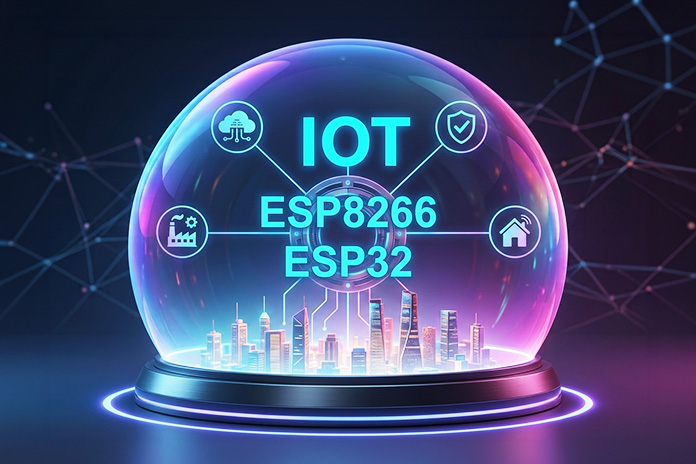
Digital technologies have rapidly evolved to the point where people interact with the world as they see it. The Internet of Things (IoT) stands out among the various technological advancements as one of the most significant innovations of the 21st century. With that, IoT empowers all sorts of objects to interact with the Internet, gather and deliver information and to make intelligent decisions with little or no human interaction. The Internet of Things (IoT) is transforming industries all over the world with its smart homes, wearable health devices, automation in industries, and smart agriculture.
So, at the core of many of the IoT applications are the use of inexpensive and powerful microcontroller platforms that make device connectivity easy. Among these, both ESP8266 and ESP32 are extremely popular owing to their wireless communication features as well as their low cost with an easy programming interface. These development boards have facilitated students, researchers, engineers, and tinkerers to create innovative solutions for IoT development in an effortless and rapid way.
Understanding the Internet of Things
The Internet of Things (IoT) is the interconnectivity of devices – like animals, appliances, and cars – that gather, send, and share information over the Internet. Unlike conventional systems that need to be continually human looked after, IoT units can check out conditions, connect to cloud stages, and trigger automatic activities contingent upon adjustable rules.
There are four key components to a typical IoT system:
Collect data like temperature, humidity, pressure, motion, or light, activate things such as turning on an appliance.
Microcontroller / Processing Unit: Performs calculations and algorithms on sensor data, regulating the operation of the device.
Communication Network: Provides options for using a data transmission system such as wireless networks, Bluetooth, LoRa, Zigbee or cellular networks. This enables reliable IoT connectivity and supports different forms of IoT wireless communication.
Cloud Platform and User Interface: Stores, analyses, and visualizes data, allows the user to be in the field or off-site and still monitor and control the device.
Improved efficiencies, cost reduction, predictive maintenance, and data-driven decision making are among the areas which are rendering IoT more popular.
The ESP8266 was introduced as a cheap Wi-Fi-enabled microcontroller to change all that, making easy and wireless connectivity possible for all. The addition of Wi-Fi to embedded systems was usually a high cost and complicated solution before being added on. The ESP8266 comes equipped with a built-in Wi-Fi module that can communicate with the internet, alongside its microcontroller, and allows developers to build additional things that communicate via Wi-Fi without the extra expense of networking equipment. It offers programming in the Arduino IDE and will appeal to the neophyte and the education sector.
The ESP8266 has some interesting characteristics, such as:
- Built-in Wi-Fi module (2.4 G)
• Low power consumption which is suited for battery-operated system
• The display has multiple General-Purpose Input/Output (GPIO) pins. Various interface options include UART, SPI, I2C and PWM interfaces.
• Compact size and low cost
The ESP8266‘s capability to require few components and construct quickly has proven to be a great selection for IoT embedded systems and IoT fundamentals training. It is also suitable for IoT projects using ESP8266, particularly for basic monitoring and automation applications.
The ESP32 has a much greater degree of success and is a much more powerful and versatile module than the ESP8622 like its predecessor. It is built to offer the necessary processing power, various communication channels and enhanced security for more advanced applications.
The ESP32 has several benefits, including:
Dual-core high-performance processor, Premiered with built-in Wi-Fi and Bluetooth radio. Included Wi-Fi and Bluetooth radio. The number of GPIO pins and analog input channels were expanded. Additional GPIO pins and analog input channels were added. Support for camera module and audio interface devices.
The ESP32 is ideal for research and product development applications due to these advanced features. It is particularly suitable for ESP32 for advanced IoT projects that require greater processing power and connectivity.
ESP8266 vs ESP32: Choosing the Right Platform
When it comes to deciding between ESP8266 or ESP32 it is heavily application-dependent.
For basic IoT applications like a temperature sensor, smart light, weather, and home automation where the requirement is Wi-Fi, the ESP8266 is perfect. It can be especially useful for ESP8266 for home automation projects and other simple connected-device applications.
However, if the project needs to handle multiple tasks, connect with Bluetooth, achieve greater processing power, or for achieve greater security, the ESP32 is chosen. The ESP32 benefits significantly from its hardware architecture when it comes to projects such as Wearable Devices, Robotic Systems, Industrial Automation, Smart Healthcare, and Edge Machine Learning applications.
In both platforms, the same tool-chain is used, making the smooth switch from ESP8266 to ESP32 as the project becomes more complex. This makes IoT with ESP8266 and IoT with ESP32 useful approaches for learners progressing from basic to advanced IoT projects.
Future Trends
The progression of IoT will easily stay bound tightly to developments in Artificial Intelligence (AI), Machine Learning (ML), 5G communication and edge calculating. Newer ESP32 variants have already built-in support for AI-driven inference and voice recognition to process data on local devices, without having to pull everything to a cloud server. Direct results of all these developments will be a rapidly growing demand for intelligent IoT devices that will characterize all these new cities, autonomous vehicles, Industry 4.0, and digital healthcare.
Future IoT Systems will be more autonomous, energy-efficient, secure and capable of real-time decision-making. The Future of IoT technology is expected to bring further growth in areas such as Industrial IoT, IoT smart agriculture, and IoT smart healthcare.
The skills acquired by students and researchers in the ESP8266 and ESP32 platforms today have the potential to become valuable assets in the creation of tomorrow’s smart systems and digital transformation projects. These skills can also support the development of IoT applications using ESP32 and IoT applications using ESP8266 for practical, real-world solutions.
Conclusion
The Internet of Things (IoT) has revolutionized the communication, interaction and intelligent decision making between devices. What popular platforms like ESP8266 and ESP32 have done is put IoT development in the hands of everyone by providing developers of all technical levels with affordable, feature-rich platforms to create effective, scalable, and meaningful solutions.
The ESP32 is an improvement over the ESP8266, especially for more complex IoT deployments where multiple connectivity options and advanced security features are required, and, of course, where you have more computing power. Combined, these platforms have become essential tools of education, research and industry.
With the advancement of IoT technologies, learning how to develop with ESP will continue to be a valuable skill for aspiring engineers and technology professionals. Today’s students can create a smarter home, healthier community, optimized industries and sustainable solutions to the future by using these platforms in a creative and technical way.