
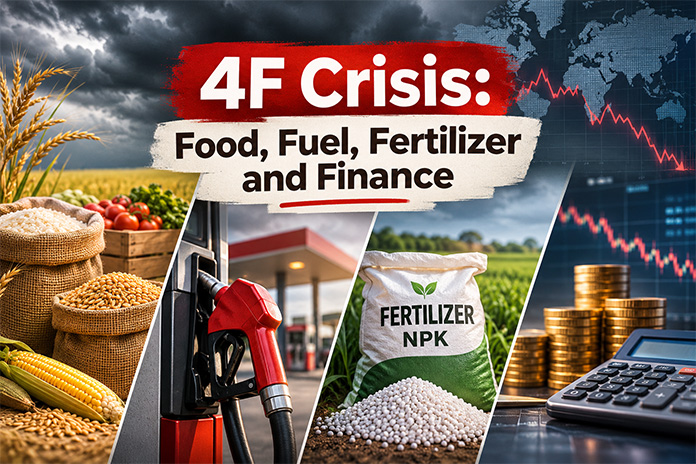
Economists rarely worry about a single number. More often, they worry about a pattern: several pressures arriving at once, each making the others harder to manage. This was the picture that External Affairs Minister S. Jaishankar described at the United Nations in late September, about the “4F crisis,” classified as fuel, food, fertiliser, and finance. This interconnected challenge, often described as India’s 4F crisis, reflects the growing complexity of economic pressures. It is more than a news headline; it is a working case study of how risk travels through an economy. Jaishankar told the General Assembly that developing nations bear the heaviest weight of this crisis, citing a severe El Niño, shrinking fertiliser supplies, and growing barriers to grain trade. A few days later, speaking in New York, he warned that a major food crisis could emerge within months. These are strong claims from a foreign minister. The more useful question is simpler: how much of this is actually visible in India’s own data? Understanding the 4F crisis in India requires examining how these pressures interact rather than viewing them independently.
First, consider fuel, as it is the oldest and most familiar of the four pressures. India imports approximately 90 percent of the crude oil it consumes. This dependence on crude oil imports in India makes domestic energy costs particularly sensitive to international market developments. Brent crude reached a high of 138.2 dollars a barrel in April and continued to trade near 100 dollars per barrel. To soften the impact, the government cut the excise duty on petrol and diesel by ten rupees in March. This is a familiar policy move: the government absorbed part of the cost so that households would not have to pay for it. This is risk transfer in its simplest form, shifted from the consumer to the public exchequer. Food prices tend to transmit such shocks most directly, and September’s figures made this clear. Retail inflation rose to 5.54 percent, up from 4.83 percent the previous month, while food inflation alone reached 7.74 percent, with onion prices more than doubling over the year. These figures highlight the significance of food inflation in India and its impact on household purchasing power. Rural households were affected more severely, with inflation reaching 6.08 percent, compared with 4.88 percent in urban areas. The government responded by releasing buffer stocks of onions at 35 rupees per kilogram; in essence, inventory management was applied at the scale of an entire country rather than a single warehouse.
Fertilizer receives far less public attention than fuel or food, yet it quietly connects the two. The fertiliser crisis in India illustrates how agricultural production can become vulnerable to disruptions in global energy supplies. India depends on imports for roughly 85% of the natural gas required to produce urea, and when shipping through the Strait of Hormuz was disrupted, domestic urea plants reportedly operated at approximately half their normal capacity. Even so, farmers continued to pay the same fixed price of 266.50 rupees per bag of urea, because the Cabinet raised subsidy rates ahead of the kharif season to cover the shortfall. The budgeted subsidy of roughly 1.71 lakh crore rupees is now expected to be exceeded. This growing pressure on fertiliser subsidy in India demonstrates how agricultural support measures can influence government expenditure. In other words, farms were protected, but the cost landed squarely on the government’s balance sheet.
Finance is the channel that links everything else to the wider world. This connection becomes especially important during periods of global economic uncertainty, when international financial decisions can influence domestic markets. The US Federal Reserve raised interest rates by 25 basis points on September 16, bringing its range to 3.75–4.00 percent, which made dollar-denominated assets more attractive almost immediately. Foreign investors responded by withdrawing roughly 44,166 crore rupees from Indian equities by early October, and the rupee weakened to 96.84 against the dollar, close to its lowest level on record. Such rupee depreciation can increase the domestic cost of imported commodities and place additional pressure on businesses dependent on foreign supplies. Reserves, fortunately, still cover approximately 11 months of imports, a comfortable buffer by most standards. The Reserve Bank of India responded by raising the repo rate to 5.50 percent on October 7, its first increase since early 2023. It now projects growth of 7.1% alongside inflation of approximately 5.2%. This decision illustrates a dilemma familiar to anyone who studies monetary policy: how much growth should be sacrificed to preserve price stability? Such decisions also highlight the challenges associated with India’s monetary policy during periods of overlapping economic pressures.
What makes the 4F framework genuinely useful, rather than merely a convenient label, is how closely its components are linked. The fuel food fertiliser finance crisis demonstrates how pressures originating in one sector can influence several others. Costlier oil weakens the rupee. A weaker rupee raises the cost of fertilizer imports. Rising fertilizer costs expand the subsidy bill. A stretched subsidy bill can, eventually, push food prices higher. The four pressures are therefore better understood not as separate problems but as a single loop with four names. This interconnected cycle illustrates India’s economic interdependence and the importance of understanding how different sectors influence one another.
Exposure to this loop depends largely on where one sits within it. Exporters benefit from a weaker rupee, while importers absorb the resulting pressure. Borrowers face a higher cost of credit, although domestic mutual funds added nearly 38,307 crore rupees in September, offsetting some of the foreign outflow. Farmers remain protected for now, but that protection carries a cost that someone else is bearing. These competing interests reflect the broader Indian economic challenges associated with balancing growth, inflation, and financial stability. Is India, then, in crisis? A growth of 7.8% in the most recent quarter, supported by substantial reserves, suggests otherwise, at least for the present. Still, the 4F framework offers a useful reminder that economic resilience is rarely permanent. It is something policymakers must actively manage, one trade-off at a time. Understanding economic interdependence in India is therefore essential for recognising how policy decisions and global developments shape the country’s economic resilience.