When parents visit us during the admission process, many questions are quite similar.
“When should my child start preparing for placements?”
“Is an internship necessary?”
“How many projects should they make?”
“Will doing more certificates help them get a job?”
And sometimes there is another question that parents don’t always ask directly:
“My child has just started B.Tech CSE. Should I already be worried about placements?”
The simple answer is: there is no need to panic.
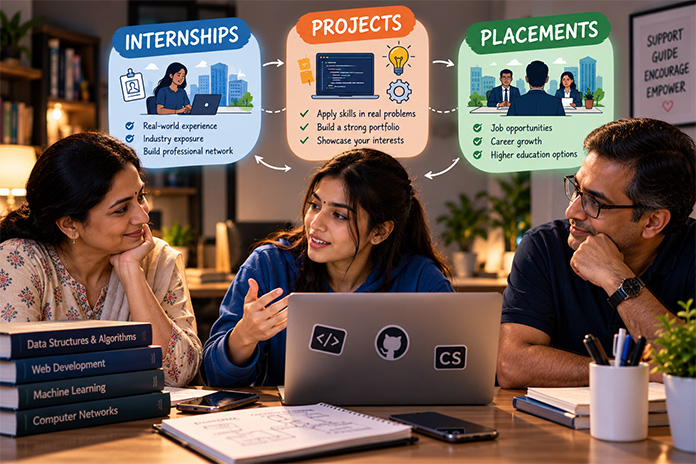
A CSE student’s career is built gradually. Internships, projects and placements are connected, but they are not three separate boxes that a student has to tick as quickly as possible.
As a teacher, I believe parents can play an important role in this journey. Understanding the role of parents in student career development—along with knowing when and why students should pursue these opportunities—is equally important.
First, Understand the Difference
Let’s start with three words parents hear frequently.
A Project
A project is something a student builds to apply what they have learned.
It could be a simple application in the first year and something more advanced later.
For example, a beginner might create a student record system. Later, the same student might build a web application, data analytics project, automation tool or AI-based application.
These projects for computer science students should demonstrate practical understanding rather than simply add another item to a resume.
The purpose of a project is not simply to put something on a resume.
It should help the student answer:
“What can I actually build with what I have learned?”
An Internship
An internship gives a student exposure to a professional environment.
Instead of only learning concepts in the classroom, students get an opportunity to see how those concepts are used in practical work.
An internship may involve development, testing, data analysis, documentation, research, AI, cybersecurity, cloud technologies or many other areas.
The important thing is not just the certificate at the end.
The real value is the experience and learning gained during the internship. Exploring internships for CSE students can help students understand workplace expectations, apply their technical knowledge and discover which career paths interest them.
A Placement
Placement is the process through which students get opportunities to apply for full-time roles after completing their degree.
Companies may evaluate students through different stages such as aptitude tests, coding assessments, technical interviews, HR or managerial discussions, group activities, communication rounds or other role-specific assessments.
For students, understanding campus placements for CSE students means recognising that the process involves more than academic marks. Technical knowledge, problem-solving, communication and practical experience can all contribute to their preparation.
So, placements are not something that suddenly begin in the final semester.
The foundation was built much earlier.
Does a First-Year Student Need an Internship Immediately?
This is one of the biggest concerns parents have.
Suppose your child has just entered B.Tech CSE and is still learning basic programming.
They may be trying to understand loops, functions, arrays or object-oriented programming.
At this stage, seeing seniors doing internships can sometimes make a first-year student feel that they are already behind.
They are not.
The first year should primarily be about building fundamentals and exploring the field.
A student can certainly explore internships or learning opportunities if they find something suitable, but parents don’t need to turn “getting an internship” into a first-year deadline.
A strong foundation can make later internships much more meaningful.
As students gain confidence, they can gradually explore internship opportunities for B.Tech CSE students that match their current skills and interests. The aim should be to find meaningful learning experiences rather than pursue an internship simply because others are doing so.
Projects Should Grow With the Student
Another common misconception is:
“My child needs five or ten projects for a good resume.”
Quantity is not necessarily the point.
Imagine two students.
Student A has eight projects copied from tutorials but cannot explain how they work.
Student B has two projects and can clearly explain the problem, technologies, design decisions, challenges and improvements.
The second student’s learning may be easier to demonstrate during an interview.
This is why parents should encourage children to understand what they build, rather than simply increasing the number of projects on a resume.
Meaningful projects can also help students prepare for internships and placements in computer science by giving them practical examples to discuss during interviews.
Don’t Turn Certificates Into a Competition
Parents naturally feel happy when they see their child completing courses and receiving certificates.
And certificates can certainly represent learning.
But collecting certificates should not become the main goal.
A student might complete ten online courses and still struggle to write a basic program.
Another student might complete fewer courses but actually practise programming, build projects and understand the concepts.
This is where understanding certifications vs projects for placements becomes useful. Certifications can demonstrate that a student has studied a subject, while projects can provide evidence of how they apply that knowledge. Both can be valuable, depending on the student’s goals and the opportunities they pursue.
Instead of asking:
“How many certificates did you get?”
parents can sometimes ask:
“What did you learn from that course?”
That small change in the conversation can encourage deeper learning.
What About AI and Generative AI?
This is an area where parents are understandably curious.
Students today have access to tools that can explain programming concepts, generate code, help debug errors, analyse data and support project development.
Generative AI can be useful, but students need to learn how to use it responsibly.
If a student asks AI to create an entire project, submits it and cannot explain the code, the project may have very little learning value.
But if the student uses AI to understand an error, explore an unfamiliar concept, generate test cases or compare approaches, it can become a useful learning assistant.
Parents don’t necessarily need to tell students:
“Don’t use AI.”
A better question is:
“What are you learning with AI?”
That encourages responsible use rather than complete dependence.
When Should Placement Preparation Begin?
There is no need for a first-year student to behave like a final-year placement candidate.
However, this doesn’t mean students should ignore placements until the last semester.
A practical four-year placement preparation roadmap can help students and parents understand how preparation can progress throughout the degree without creating unnecessary pressure.
A healthy progression could look something like this:
First Year — Explore and Build Foundations
Focus on:
- Programming fundamentals
- Problem-solving
- Communication
- Understanding the CSE field
- Small projects
- Exploring different technology areas
The goal is to discover interests and become comfortable with programming.
Second Year — Build Skills
Students can gradually work on:
- Data structures and algorithms
- Development skills
- Databases
- Projects
- Hackathons
- Relevant certifications or courses
- Exploring internships
This is often the stage where students begin understanding which areas interest them.
As they progress, they can also begin identifying the skills required for CSE placements, such as programming proficiency, problem-solving, communication and the ability to explain their technical decisions.
Third Year — Gain Practical Exposure
Students can focus more seriously on:
- Internships
- Larger projects
- Technical skills
- Industry exposure
- Resume development
- Coding practice
- Communication and interview preparation
The goal is to connect classroom learning with practical experience.
At this stage, students can explore relevant internships, strengthen their portfolios and begin understanding the expectations of employers in their preferred domains.
Final Year — Prepare for Opportunities
Now the focus becomes more placement-oriented.
Students may work on:
- Technical interview preparation
- Coding assessments
- Aptitude, where relevant
- Resume refinement
- Communication
- Mock interviews
- Company and role-specific preparation
The exact journey will naturally differ from student to student.
What Parents Can Do
Parents don’t need to become placement trainers.
Their role can be much simpler—and sometimes much more valuable.
For parents seeking placement guidance for parents, the most useful starting point is understanding their child’s progress, interests and learning needs instead of focusing only on placement outcomes.
Encourage, Don’t Compare
If a friend’s child has already completed an internship, that doesn’t automatically mean your child is behind.
Every student’s starting point, interests and learning pace are different.
Comparison can create unnecessary pressure.
Ask About Learning, Not Just Outcomes
Instead of repeatedly asking:
“When will you get placed?”
try asking:
“What are you learning these days?”
Instead of:
“How many projects have you made?”
ask:
“Tell me about the project you are working on.”
These conversations can help students think about their development rather than only the final result.
They also provide a practical starting point for career guidance for parents of engineering students, helping parents support progress without turning every conversation into a discussion about jobs and salaries.
Let Students Explore
A student may initially say they want to become a web developer and later become interested in AI.
Another may discover an interest in cybersecurity or data science.
Exploration is a normal part of a CSE degree.
Students don’t always need to have their entire career planned in the first year.
Encourage Consistency
One of the most useful things parents can encourage is regular effort.
A student who spends some time every week learning, practising and building is likely to develop more useful habits than someone who studies intensely only before placement season.
One Important Thing Parents Should Remember
Internships, projects and placements are not independent achievements.
They are connected.
A student learns concepts.
Those concepts are used to solve problems.
Problems become projects.
Projects help students understand practical work.
Internships provide professional exposure.
That experience can then contribute to future career opportunities.
The journey is gradual.
There will also be mistakes, unfinished projects, rejected internship applications, difficult subjects, programming errors and periods when students feel confused.
These experiences are not necessarily signs that something has gone wrong.
They are part of learning.
A Message to Parents
As parents, it is natural to want the best career for your child.
You may hear about a friend’s child getting an internship in the first year, another student completing multiple certifications, or someone receiving a high placement package.
It is easy to start wondering:
“Is my child doing enough?”
Before asking that question, look at something more important:
Is my child learning, improving and becoming more independent?
If a CSE student is gradually developing programming skills, building meaningful projects, learning to communicate, exploring technologies, using AI responsibly and becoming more confident in solving problems, they are already moving in the right direction.
A B.Tech CSE degree is a four-year learning journey—not a four-month race toward a placement.
Parents don’t need to control every step.
They can provide something equally valuable:
support, patience, encouragement and the confidence to let their child grow.
Because ultimately, the goal is not simply to help a student get a placement.
It is to help them become a young professional who is prepared to learn, adapt, solve problems and build a career of their own.