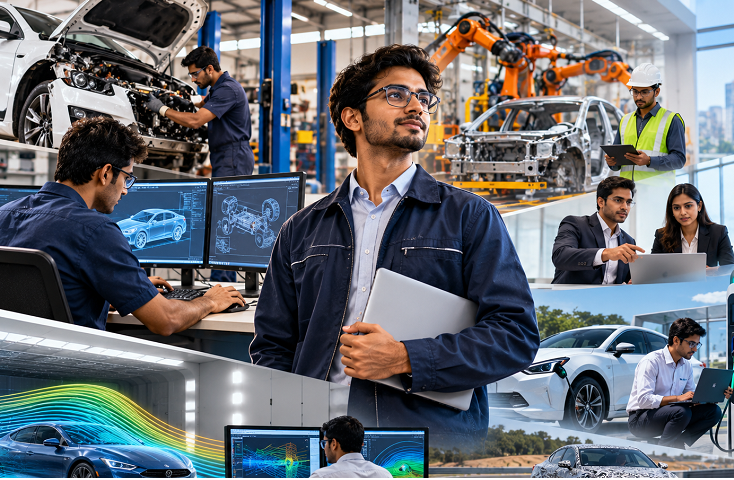
The automobile industry has come a long way from traditional petrol and diesel vehicles. Today, electric cars, intelligent safety systems, connected vehicles, and automated manufacturing are changing how automobiles are designed, produced, and maintained. These developments have created new opportunities for engineers who understand both conventional automotive systems and emerging technologies.
For students interested in cars, engines, vehicle design, and modern mobility solutions, B.Tech. automobile engineering offers an opportunity to turn that interest into a professional career. The programme combines mechanical engineering principles with automotive technology, manufacturing processes, electronics, and vehicle performance.
A B.Tech. automobile engineering course generally takes four years and introduces students to the technical aspects of vehicle development. Students pursuing an automobile engineering degree learn how different vehicle systems work together, from engines and transmissions to braking systems and electronic controls.
Choosing automobile engineering after 12th can be particularly suitable for students who enjoy physics, mathematics, technology, and practical problem-solving. With the changing landscape of automobile engineering in India, graduates can explore careers in vehicle manufacturing, electric mobility, automotive design, research, and technical services.
This automobile engineering career guide explores the industry’s scope, specialisations, employment opportunities, salaries, government jobs, and higher education options.
What Is the Scope of B.Tech. Automobile Engineering in Today’s Automotive Industry?
The automobile industry is undergoing significant technological changes. Vehicle manufacturers are investing in electric mobility, advanced electronics, connected systems, alternative fuels, and improved manufacturing technologies.
As a result, the B.Tech. automobile engineering scope is no longer limited to traditional automobile production and maintenance.
Engineers are increasingly involved in designing energy-efficient vehicles, developing battery management systems, improving vehicle safety, and testing advanced automotive technologies.
Major areas creating opportunities
| Industry Area | Opportunities for Automobile Engineers |
| Electric Vehicles | Battery systems, electric powertrains, charging technologies, and vehicle testing |
| Automotive Manufacturing | Production planning, quality control, automation, and process improvement |
| Vehicle Design | Computer-aided design, component development, and performance analysis |
| Automotive Electronics | Sensors, electronic control systems, and vehicle diagnostics |
| Research and Development | Prototype development, material testing, and automotive innovation |
| Connected and Intelligent Vehicles | Vehicle software integration, sensor technologies, and driver-assistance systems |
The scope of automobile engineering in India is influenced by investments in automotive manufacturing, electric vehicles, component production, and mobility infrastructure.
Students exploring automobile engineering careers can find opportunities with vehicle manufacturers, automotive component suppliers, engineering service providers, and technology companies.
However, the availability of automobile engineering job opportunities depends on technical skills, practical experience, market conditions, and the requirements of individual employers.
The expanding role of software and electronics is also making interdisciplinary knowledge increasingly valuable for students seeking automotive engineering jobs.
Why Is B.Tech. Automobile Engineering a Smart Career Choice Today?
Students often ask why study automobile engineering when the automotive industry is changing so quickly.
One important reason is that vehicles are becoming more technologically advanced, creating a need for professionals who can understand and improve complex engineering systems.
Automobile engineering brings together several technical disciplines, including mechanical engineering, electronics, manufacturing, materials science, and increasingly, computer programming.
This combination gives students the flexibility to explore different automobile engineering career opportunities.
Reasons to consider this field
- Growing importance of electric mobility
Electric vehicles require engineers who understand electric motors, batteries, thermal management, power electronics, and vehicle integration.
- Opportunities for practical innovation
Automobile engineering involves solving real problems related to vehicle efficiency, safety, performance, durability, and environmental impact.
- Multiple career directions
Graduates can pursue roles in manufacturing, design, testing, research, technical sales, maintenance engineering, and quality management.
- Exposure to emerging technologies
Developments in connected vehicles, advanced driver-assistance systems, and manufacturing automation are influencing the future of automobile engineering.
- Opportunities for continued learning
The industry offers scope for technical certifications, postgraduate studies, research, and management education.
For students who enjoy understanding how machines work and want to participate in technological development, automobile engineering as a career can be a rewarding choice.
The long-term automobile engineering career prospects are strongest for graduates who continuously update their skills as automotive technologies evolve.
Specializations You Can Explore in B.Tech. Automobile Engineering
One advantage of studying automobile engineering is the opportunity to develop expertise in a particular technical area.
Different automobile engineering specializations focus on different aspects of vehicle design, development, manufacturing, and performance.
| Specialization | What Students Learn | Potential Career Direction |
| Automotive Design | Vehicle components, CAD modelling, and design principles | Automotive Design Engineer |
| Electric Vehicle Technology | Batteries, electric motors, charging, and power management | EV Systems Engineer |
| Vehicle Dynamics | Steering, suspension, braking, and handling | Vehicle Dynamics Engineer |
| Automotive Powertrain | Engines, transmissions, and electric drive systems | Powertrain Engineer |
| Automotive Electronics | Sensors, controllers, and electrical systems | Automotive Electronics Engineer |
| Automobile Manufacturing | Production methods, quality systems, and industrial automation | Production Engineer |
| Autonomous Vehicle Technology | Sensors, control systems, and intelligent mobility | Autonomous Systems Engineer |
Electric Vehicle Technology
Electric vehicle technology is becoming an important area within automotive engineering. Students interested in EV engineering can study electric propulsion, battery systems, charging infrastructure, and energy efficiency.
Automotive Design and Vehicle Engineering
Automotive design focuses on creating vehicle components and systems that meet performance, safety, and manufacturing requirements.
Students interested in vehicle engineering may explore computer-aided modelling, structural analysis, and product development.
Automotive Electronics and Intelligent Vehicles
Modern vehicles use electronic control units, sensors, communication networks, and software-based systems.
Knowledge of automotive electronics is useful for understanding these technologies.
Meanwhile, autonomous vehicle technology combines engineering with computer vision, sensors, and control algorithms. Careers in this area generally require additional software and specialised technical knowledge.
The right specialisation depends on a student’s interests, technical strengths, and career plans.
Key Skills to Succeed in B.Tech. Automobile Engineering
Completing an engineering degree provides an academic foundation, but practical abilities are equally important.
Employers often look for graduates who can apply engineering concepts to actual technical challenges.
Developing relevant automobile engineering skills during college can improve preparation for internships and entry-level roles.
Important technical skills
| Skill | Why It Matters |
| CAD and 3D Modelling | Helps create and modify vehicle components |
| Mechanical Design | Supports understanding of structures and mechanical systems |
| Manufacturing Processes | Useful for production and industrial engineering |
| Automotive Electronics | Helps explain modern vehicle control and diagnostic systems |
| Programming Basics | Supports automation, simulation, and data analysis |
| Testing and Diagnostics | Useful for identifying vehicle performance and reliability issues |
| EV Technology | Builds understanding of electric powertrains and battery systems |
| Data Analysis | Helps interpret testing, quality, and manufacturing data |
Technical software and practical exposure
Developing CAD skills through software such as AutoCAD, CATIA, SolidWorks, or similar design tools can be helpful for students interested in product development.
Knowledge of simulation tools, MATLAB, and basic programming may also support technical projects.
For students interested in electric mobility, developing EV technology skills can provide a foundation for further specialisation.
Along with automotive technical skills, communication, teamwork, problem-solving, and time management are important.
The most useful skills for automobile engineering students are those strengthened through practical application.
Participating in automotive competitions, design challenges, internships, and student engineering projects can help graduates demonstrate their abilities.
Career Options After B.Tech. Automobile Engineering
There are several career options after B.Tech. automobile engineering, depending on a graduate’s interests and skills.
Some professionals work directly with vehicle manufacturers, while others join component suppliers, engineering consultancies, research organisations, or technical service companies.
Popular career roles
| Job Role | Main Responsibilities |
| Automobile Design Engineer | Designs and improves automotive components and systems |
| Production Engineer | Manages and improves manufacturing operations |
| Quality Control Engineer | Checks products and processes against quality standards |
| Vehicle Testing Engineer | Evaluates vehicle performance, safety, and reliability |
| Research and Development Engineer | Supports prototypes, experiments, and new technologies |
| EV Engineer | Works on electric propulsion and related vehicle systems |
| Automotive Service Engineer | Diagnoses technical problems and supports maintenance operations |
| Automotive Electronics Engineer | Works with sensors, electronic systems, and vehicle controls |
Automobile Design Engineer
Vehicle design is a suitable direction for graduates interested in technical drawings, modelling, and product development.
Vehicle design jobs may involve preparing CAD models, evaluating component specifications, and collaborating with manufacturing teams.
Production and Manufacturing Engineer
Manufacturing remains an important source of automobile engineering jobs.
Professionals working in automobile production jobs may oversee assembly processes, improve productivity, reduce manufacturing defects, and maintain production standards.
Research and Development Engineer
Automotive research jobs involve improving vehicle technologies, developing prototypes, and testing engineering solutions.
These positions often require strong technical fundamentals, analytical abilities, and sometimes postgraduate qualifications.
Electric Vehicle Engineer
EV engineering jobs can involve battery systems, electric motors, thermal management, and testing.
Graduates may need additional training in electrical engineering and power electronics to qualify for specialised roles.
Overall, the range of jobs after B.Tech. automobile engineering makes the field suitable for students with different technical interests.
Scope and Salary Trends for B.Tech. Automobile Engineering Graduates
Salary is an important consideration when choosing an engineering programme.
However, the B.Tech. automobile engineering salary varies considerably depending on the employer, job role, location, technical skills, and experience.
Fresh graduates generally begin with entry-level responsibilities before progressing into specialised engineering or management positions.
Factors influencing salary
| Factor | How It Can Affect Earnings |
| Technical Skills | Specialised design, simulation, electronics, and EV skills may improve opportunities |
| Work Experience | Experienced engineers may qualify for higher-responsibility positions |
| Employer Type | Compensation differs between manufacturers, suppliers, startups, and consulting firms |
| Job Location | Major industrial and automotive centres may offer different salary levels |
| Specialisation | Certain advanced technical roles may command higher compensation |
| Project Experience | Relevant internships and practical work can strengthen a candidate’s profile |
The automobile engineering salary in India should be evaluated using current job advertisements, verified placement reports, and employer-specific information rather than relying on a single average figure.
The automobile engineering salary for freshers can differ significantly from the earnings of professionals with several years of experience.
Students should also consider learning opportunities, career progression, job responsibilities, and professional development.
Over time, automobile engineering career growth may involve moving into senior design, production management, research, technical consulting, or project leadership positions.
Top Recruiters That Hire B.Tech. Automobile Engineering Graduates
India has a large automotive manufacturing and component ecosystem, with companies involved in passenger vehicles, commercial vehicles, two-wheelers, electric mobility, and automotive technology.
Several well-known automotive companies in India recruit engineers for different technical functions.
Companies students can explore
| Company | Major Business Area |
| Tata Motors | Passenger and commercial vehicles |
| Mahindra & Mahindra | SUVs, commercial vehicles, and mobility solutions |
| Maruti Suzuki | Passenger vehicle manufacturing |
| Hyundai Motor India | Passenger vehicles |
| Bajaj Auto | Two-wheelers and three-wheelers |
| TVS Motor Company | Two-wheelers and mobility solutions |
| Ashok Leyland | Commercial vehicles |
| Bosch | Automotive components, electronics, and technology |
| Ather Energy | Electric two-wheelers |
| Sona BLW Precision Forgings | Automotive components and drivetrain technologies |
These are examples of organisations operating in the automotive sector, not a guaranteed list of campus recruiters for any particular university.
The recruitment requirements of automobile companies differ by department and job profile.
Some automobile industry recruiters hire graduates through campus placements, while others advertise opportunities through company career portals, internships, and recruitment drives.
Students interested in automobile engineering companies hiring should regularly review official career websites and build skills relevant to their preferred roles.
What After Graduation? Higher Studies & Certifications
Graduates who want to develop deeper expertise can consider higher studies after B.Tech. automobile engineering.
Postgraduate education may be useful for students interested in research, specialised technical roles, teaching, or management.
Higher education options
M.Tech. in Automobile or Automotive Engineering
An M.Tech. automobile engineering or M.Tech. automotive engineering programme can help students specialise in vehicle systems, design, manufacturing, and related research areas.
M.Tech. in Mechanical Engineering
Students interested in thermal engineering, machine design, manufacturing, or computational mechanics may explore relevant postgraduate programmes, subject to eligibility.
MBA After Automobile Engineering
An MBA after automobile engineering may be suitable for graduates who want to move towards operations, supply chain management, product management, marketing, or business leadership.
Research and Doctoral Studies
Students interested in academic research can pursue advanced studies in automotive systems, materials, sustainable mobility, and related engineering disciplines.
Professional certifications
Useful automobile engineering certifications may include training in:
- CAD and automotive design software
- Electric vehicle systems and battery technology
- Automotive electronics and embedded systems
- Quality management and manufacturing processes
- Vehicle testing and simulation
- Programming and engineering data analysis
Students can also explore EV certification courses, automotive design courses, and other specialised programmes.
Before enrolling, it is important to check the course provider’s credibility, curriculum, practical components, and relevance to career goals.
Top Government Exams and Career Opportunities After B.Tech. Automobile Engineering
Students interested in public-sector employment can explore several government jobs after B.Tech. automobile engineering.
However, eligibility varies depending on the recruiting organisation, engineering discipline, examination, and specific vacancy.
An automobile engineering degree does not automatically qualify graduates for every mechanical engineering or technical government post.
Government examination and employment options
| Examination or Organisation | Possible Opportunities | Important Consideration |
| UPSC Civil Services Examination | Administrative and other civil services | A recognised bachelor’s degree is generally required, along with other eligibility conditions |
| GATE | Postgraduate admission and some recruitment opportunities | Candidates must check paper selection and individual institution or employer requirements |
| State Public Service Commissions | Engineering and administrative posts | Accepted degree disciplines vary by notification |
| SSC | Certain graduate-level and technical posts | Eligibility differs by examination and post |
| State Transport Departments | Technical, inspection, and administrative roles | Degree, licensing, and other requirements vary by state |
| Public Sector Undertakings | Engineering and technical roles | Recruitment may be restricted to specified engineering disciplines |
GATE and postgraduate opportunities
Graduates can explore the Graduate Aptitude Test in Engineering (GATE), subject to the examination’s eligibility requirements.
However, qualifying in GATE does not guarantee admission to every postgraduate engineering programme or eligibility for every PSU position.
Government engineering recruitment
Some technical vacancies may accept automobile engineering graduates, while others specifically require mechanical, electrical, or another engineering discipline.
Therefore, students seeking government mechanical engineering jobs or PSU jobs after automobile engineering must carefully read the official recruitment notification.
Transport department opportunities
Certain transport department jobs may involve vehicle inspection, technical compliance, or transport administration.
These roles can have specific educational, licensing, and experience requirements.
Overall, government exams after automobile engineering provide possible career routes, but eligibility should always be confirmed from official notifications.
Final Thoughts
The future of automobile engineering is closely connected with changes in mobility, manufacturing, energy systems, electronics, and vehicle technology.
For students who enjoy understanding machines, designing components, and solving practical engineering problems, this field offers several directions to explore.
A successful automobile engineering career requires more than completing a degree. Building technical skills, gaining internship experience, working on meaningful projects, and staying informed about industry developments can make a considerable difference.
The growth of electric mobility, advanced manufacturing, and intelligent vehicle technologies is creating opportunities for graduates who are willing to learn new skills.
At the same time, traditional engineering knowledge remains important because vehicle safety, mechanical reliability, manufacturing quality, and performance continue to be essential.
Students exploring automobile engineering career prospects should choose their specialisations carefully and develop practical experience alongside academic learning.
Universities that encourage hands-on engineering education, industry interaction, and technical projects can help students prepare for this changing environment.
Lovely Professional University (LPU) is one institution students may consider when exploring engineering education. Its emphasis on practical learning, laboratory-based activities, student projects, and industry exposure can support the development of relevant engineering skills.
Before choosing a programme, students should review its current availability, curriculum, eligibility requirements, facilities, and placement information.
Ultimately, long-term automobile engineering career growth depends on curiosity, technical competence, adaptability, and a willingness to keep learning.
Frequently Asked Questions (FAQs)
1. What is the scope of B.Tech. Automobile Engineering in India?
The B.Tech. automobile engineering scope in India includes opportunities in vehicle manufacturing, automotive design, quality control, testing, research, electric mobility, and technical services. Career opportunities depend on industry demand, individual skills, and practical experience.
2. What are the best career options after B.Tech. Automobile Engineering?
Popular automobile engineering career options include Automobile Design Engineer, Production Engineer, Quality Engineer, Vehicle Testing Engineer, R&D Engineer, and EV Engineer. Students can choose a role based on their technical interests and specialisation.
3. What is the salary of an automobile engineer in India?
The automobile engineer salary varies by employer, location, job responsibilities, experience, and technical expertise. Freshers should compare verified placement information and current job listings to understand realistic salary expectations.
4. Can automobile engineering graduates apply for government jobs?
Yes, graduates can apply for suitable government jobs after B.Tech. automobile engineering, provided they meet the eligibility requirements. UPSC Civil Services, selected state-level recruitment examinations, and certain technical positions may be relevant options.
5. Is Automobile Engineering a good career for the future?
Automobile engineering can be a good career for students interested in vehicles and technology. Developments in electric mobility, vehicle electronics, manufacturing automation, and intelligent transportation are creating new areas for learning and professional growth.