For more than a century, the automobile has been one of humanity’s most important inventions. It changed the way we travel, transformed cities, connected economies, and gradually turned long-distance journeys into everyday experiences.
But the basic idea of the automobile has remained remarkably unchanged: four wheels, a road, and a destination.
Today, that idea is beginning to face a new question.
What if the road itself is no longer necessary?
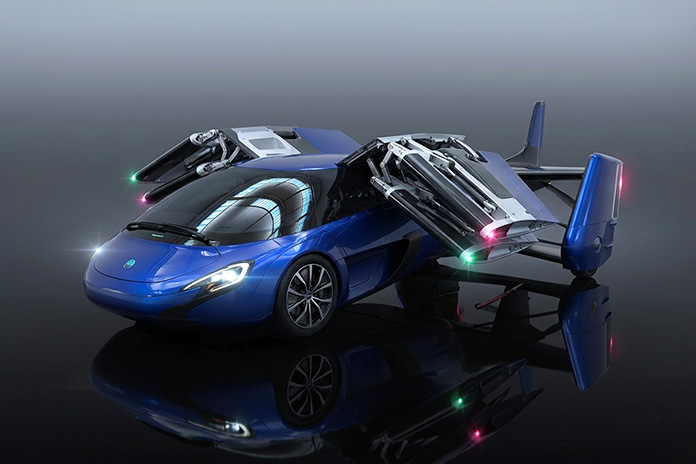
Imagine leaving home, avoiding traffic, crossing a congested city in a few minutes, and reaching your destination through the air. It sounds like science fiction, but researchers and companies around the world are already working on technologies that could make some form of this vision possible.
The future of mobility may not simply be about making cars faster.
It may be about taking them off the road.
The Automobile: From the Road to a New Dimension
The evolution of the automobile has always been driven by one fundamental objective: moving people more efficiently from one place to another.
Early automobiles were slow, mechanically complex, and expensive. Over time, improvements in engines, transmissions, materials, manufacturing, electronics, safety systems and eventually electric propulsion transformed them into highly sophisticated machines.
Electric vehicles have taken this evolution another step forward. Batteries, electric motors, advanced control systems, sensors and software are changing what a vehicle can do.
But even the most advanced electric car still faces one fundamental limitation:
It has to remain on the road.
Road congestion, geographical barriers, damaged infrastructure, mountains, rivers and increasing urban density continue to restrict ground transportation.
This is where the idea of three-dimensional mobility becomes interesting.
Instead of expanding transportation only horizontally across roads and highways, why not use the space above us?
The Dream of the Flying Car Is Not New
The idea of a vehicle that could both travel on roads and fly through the air is almost as old as aviation itself. Early inventors were already imagining roadable aircraft more than a century ago. In 1919, aviation pioneer Glenn Curtiss exhibited his “Autoplane,” an early attempt to combine automobile and aircraft characteristics. It never became a practical flying car, but it demonstrated how long humanity has been fascinated by the concept.
For decades, however, the idea remained largely experimental.
The engineering problem was enormous.
A road vehicle needs to be compact, stable, efficient and relatively heavy. An aircraft, on the other hand, must be lightweight and generate sufficient lift. Combining the two creates difficult compromises involving weight, propulsion, aerodynamics, structural integrity, energy consumption and safety.
Enter eVTOL and Advanced Air Mobility
One of the most important developments in this field is the emergence of electric Vertical Take-Off and Landing (eVTOL) aircraft.
Unlike traditional aircraft, eVTOL vehicles can take off and land vertically using multiple electric motors and rotors. The technology draws heavily from developments in drones, electric propulsion, lightweight materials, batteries and autonomous flight-control systems.
This has created a broader concept known as Advanced Air Mobility (AAM).
The goal is not necessarily to replace every car with a flying machine. Instead, the vision is to create a new layer of transportation in which short-distance passenger and cargo movement can take place through the air.
Companies across the world are now exploring different approaches.
Japan’s SkyDrive, for example, has developed compact eVTOL aircraft and has been working toward commercialization. Its aircraft reached 100 km/h during high-speed testing in June 2026, with the company targeting commercialization in 2028.
Another approach comes from the Netherlands. PAL-V is developing the Liberty, a vehicle designed to combine road driving with flight using gyrocopter technology. Unlike a pure eVTOL aircraft, its concept is much closer to the traditional definition of a “car that flies and a plane that drives.”
These approaches show that there may not be one single definition of the flying car.
There could be several.
And India Has Entered the Conversation
In August 2026, the global flying-vehicle conversation gained an interesting Indian chapter.
In Almora, Uttarakhand, Ravi Tamta and his team demonstrated the HAPIDA SKYNeX, a single-seat electric flying-vehicle prototype. The vehicle uses a modified multirotor/drone-based architecture and was test-flown for nearly a minute.
The significance of the demonstration is not that India suddenly has a commercially available flying car. It does not.
The significance is that an experimental personal flying vehicle has been developed and demonstrated from outside the traditional global aerospace and technology hubs.
And that contribution deserves attention.
The SKYNeX demonstration also highlights an interesting application of aerial mobility in a region such as Uttarakhand, where mountainous terrain and winding roads can make ground transportation particularly challenging.
From Flying Cars to Flying Mobility
Perhaps the future will not look exactly like the flying cars shown in science-fiction movies.
We may not all own a personal flying car parked outside our homes.
Instead, the future could be a combination of technologies: electric cars on the ground, autonomous vehicles, eVTOL aircraft in the air, and intelligent transportation systems connecting everything together.
In other words, the future of flying cars may not be about replacing roads. It may be about adding another dimension to mobility.
A road takes us from one point to another.
A railway connects cities.
An aircraft connects countries.
The next generation of mobility could connect all three dimensions.
The automobile began by giving humanity freedom to move across the ground.
The next great transformation may give us the freedom to move above it.
And perhaps one day, when someone says, “I am taking my car,” the next question will no longer be “Which road are you taking?”
It might be: “Are you driving it—or flying it?”