
Introduction: The Question Everyone Is Asking
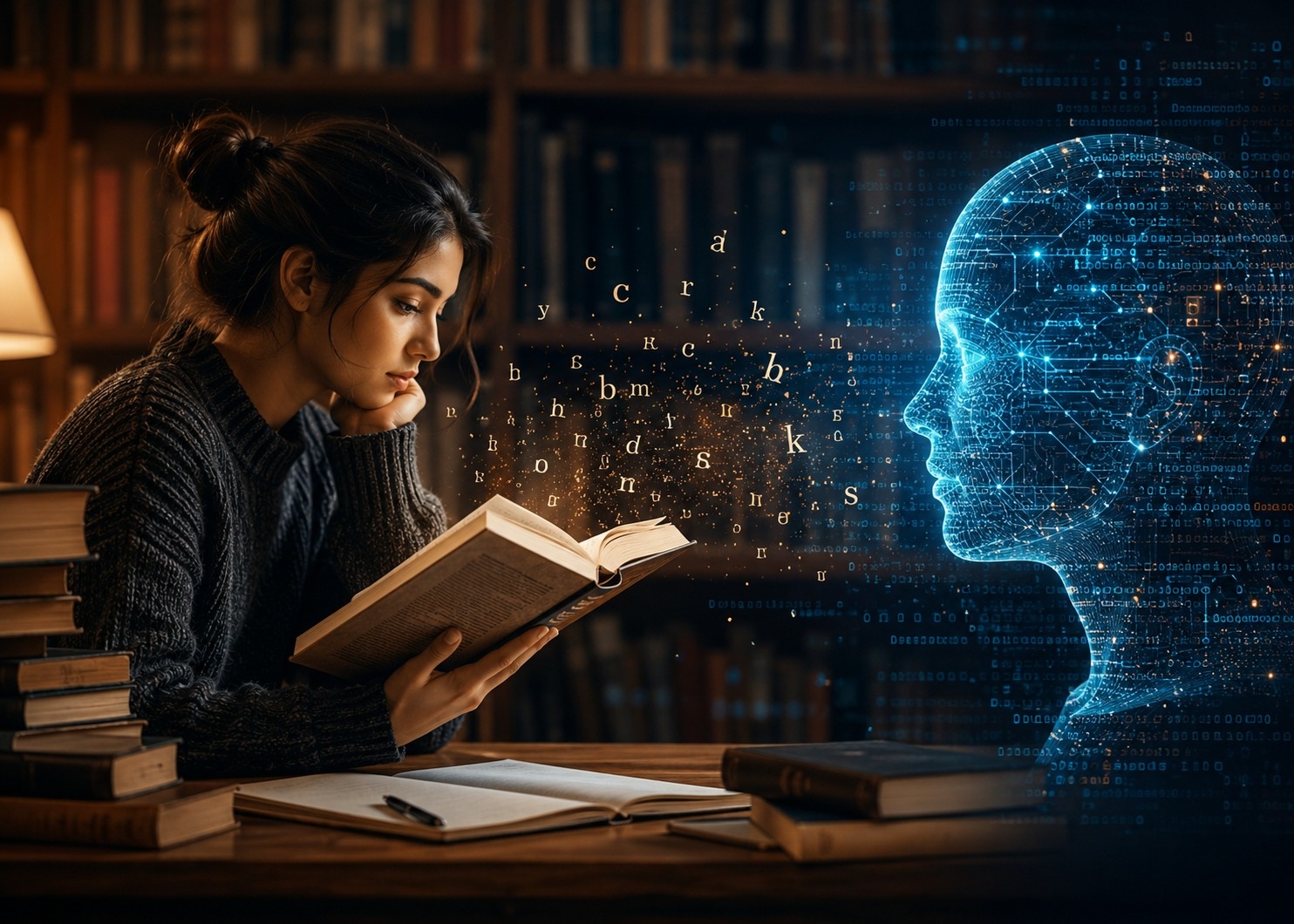
Artificial intelligence can now write poetry, summarise novels, generate essays, and even mimic the stylistic fingerprints of canonical authors. In boardrooms, classrooms, and coffee-shop debates across India and beyond, one question keeps surfacing: if a machine can do what an English graduate does, why bother studying English at all?
It is a fair question — and one that deserves a serious answer. At Lovely Professional University (LPU), NAAC A+++ accredited and consistently ranked among India’s top universities, the Department of English does not shy away from this conversation. In fact, it places it at the very centre of its curriculum.
Far from making English studies irrelevant, artificial intelligence has made them more urgent, more interdisciplinary, and more career-defining than at any previous point in history. Here is why.
What AI Can and Cannot Do with Language
Large language models like GPT-4, Gemini, and their successors are extraordinary at pattern recognition. Feed them millions of texts and they will produce syntactically fluent, contextually plausible prose with impressive speed. But fluency is not meaning. Coherence is not wisdom. Generating a sentence that sounds like Toni Morrison is not the same as understanding what Morrison was interrogating about race, memory, and identity in Beloved.
AI systems work by predicting statistically likely word sequences. They do not grieve, love, fear, or belong to a culture. They cannot experience the alienation that Kafka mapped or the post-colonial grief that Chinua Achebe gave language to. And critically, they cannot determine whether a piece of writing is ethically responsible, culturally sensitive, or humanly meaningful without human oversight baked into their training — oversight that requires exactly the kind of nuanced literary and cultural education that English departments provide.
Students enrolled in the BA, MA, or PhD in English at LPU learn to do what no language model can: they learn to read critically, interpret contextually, argue ethically, and communicate with empathy. These are not soft skills. In the AI era, they are survival skills.
The Rise of Digital Humanities
English studies in the twenty-first century no longer live inside a single corridor of books. The field has expanded dramatically into what scholars call Digital Humanities — the intersection of literary and cultural analysis with data science, computational text analysis, digital archives, and media studies.
Researchers at institutions worldwide now use tools like Voyant, NLTK, and corpus linguistics software to analyse thousands of texts simultaneously, uncovering patterns of gender representation across Victorian fiction or tracking shifts in political rhetoric across centuries of speeches. This work requires both technical literacy and the interpretive framework that only a trained humanist can provide.
LPU’s English programmes increasingly integrate this dimension, equipping students not only to read Shakespeare closely but also to understand how computational approaches to literature are reshaping what we know about storytelling, culture, and language itself. Graduates who combine literary training with digital competence are among the most sought-after professionals in publishing, content strategy, UX writing, and academic research.
Why Humanities Are Central to Ethical AI Development
Here is a fact that Silicon Valley has gradually, and somewhat reluctantly, come to acknowledge: building good AI requires humanists. Every large technology company now employs ethicists, cultural critics, linguists, and narrative designers alongside software engineers. The reason is straightforward. AI systems trained without awareness of historical bias, cultural context, or narrative framing cause real harm — in hiring algorithms, healthcare diagnostics, and content moderation decisions.
An English or humanities graduate who understands how language encodes power, how narratives construct identity, and how metaphors shape public perception is invaluable to any AI development team. At LPU, English students are encouraged to engage with these questions directly — exploring how literary theory applies to AI-generated text, how postcolonial studies informs global content policy, and how rhetorical analysis shapes algorithmic fairness.
The student who graduates from LPU with an MA in English and an awareness of digital humanities is not threatened by AI. She is essential to it.
Future Careers: English Studies in the AI Economy
The career landscape for English graduates has never been broader. The digital economy has created an extraordinary demand for people who can think rigorously about language, structure compelling narratives, evaluate information critically, and communicate across audiences. Consider the following roles, all of which are filled by English graduates today:
- AI Content Strategist — designing prompts, evaluating AI outputs, and ensuring brand voice consistency across machine-generated content
- UX Writer — crafting the microcopy that guides users through digital products with clarity and empathy
- Digital Humanities Researcher — combining literary analysis with data science to unlock new knowledge from large text corpora
- Media and Journalism Professional — reporting, editing, and producing content that meets the highest standards of accuracy and ethics
- Corporate Communications Specialist — managing internal and external messaging for organisations navigating complex environments
- Academic Scholar and Educator — contributing original research and training the next generation of critical thinkers
LPU’s BA and MA in English Language and Literature are designed with these trajectories in mind. The curriculum integrates traditional literary study with contemporary skills in critical writing, media literacy, research methodology, and digital communication. Students leave not merely with a degree but with a demonstrated ability to do things that machines cannot replicate.
Why LPU Is the Right Place to Study English
Lovely Professional University carries the NAAC A+++ accreditation — the highest grade awarded by India’s National Assessment and Accreditation Council — a recognition of its commitment to academic quality, research output, industry linkages, and student outcomes. The English Department at LPU is home to experienced scholars and practising writers who bring both academic depth and professional relevance to the classroom.
LPU’s vast, beautifully equipped campus in Phagwara, Punjab, houses state-of-the-art libraries, digital resource centres, and research facilities that support students from the undergraduate through doctoral level. The university’s emphasis on multidisciplinary learning means that English students frequently collaborate with students in media studies, business communication, computer science, and law — preparing them for the genuinely interdisciplinary workplaces that define the twenty-first-century economy.
Scholarships, a strong alumni network, and active placement support make LPU an exceptionally practical choice for students from across India and the world who wish to invest in a rigorous, future-ready English education.
Conclusion: Literature Does Not Just Survive AI — It Shapes It
The question of whether literature can survive artificial intelligence rests on a misunderstanding. Literature is not a fragile object that technology might accidentally crush. It is a way of making sense of the world — a technology of the human spirit that is several millennia older than the microchip.
What AI has done is clarify the value of English studies. In a world awash with machine-generated content, the ability to read carefully, write meaningfully, think critically, and argue ethically is not a luxury. It is a competitive advantage.
If you are considering a BA, MA, or PhD in English Language and Literature, there has never been a more exciting time to pursue it — and Lovely Professional University, NAAC A+++, offers the platform, the faculty, and the forward-thinking curriculum to make that pursuit genuinely transformative.