
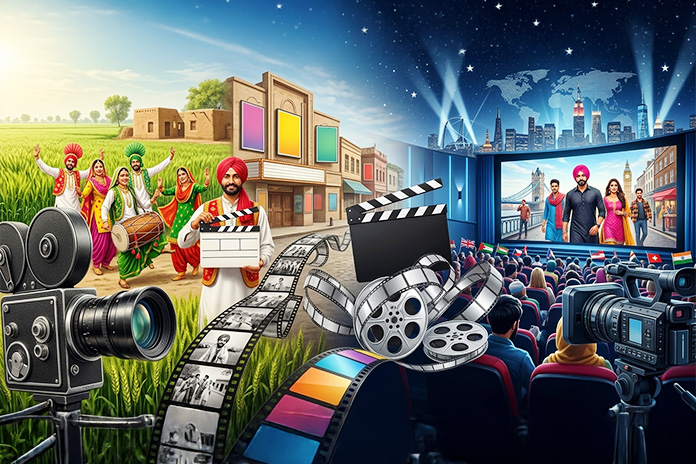
CINEMA IN THE LAND OF FIVE RIVERS
Punjabi cinema, often referred to as Pollywood, is much more than just a film industry—it reflects the emotions, culture, and history of Punjab. The journey of Punjabi cinema history shows how deeply films are connected with the region’s traditions, music, and storytelling.
Over time, the Pollywood evolution has been shaped by major historical events like Partition, globalization, and the rise of digital media. Today, Punjabi cinema is not just regional—it is gaining recognition as part of regional cinema India with a growing global audience.
PRE-CINEMATIC ROOTS: FOLK TRADITIONS AND CULTURE
Before films, Punjab had a rich tradition of storytelling through folk tales, music, and theatre. Stories like Heer Ranjha and Sohni Mahiwal formed the base of many early films.
These stories are still reflected in Punjabi culture films, where themes of love, honor, and social values remain central. Music has always been the backbone, making Punjabi cinema unique compared to other forms of regional cinema India.
THE BIRTH OF PUNJABI CINEMA (1930s–1947)
The release of Sheela (1935) marked the beginning of Punjabi cinema. During this time, Lahore was the main hub of film production.
Early films focused on rural life, social issues, and folk stories. This phase laid the foundation for the future Punjabi film industry growth, even though it remained smaller compared to Hindi cinema.
PARTITION AND ITS IMPACT (1947–1955)
Partition was a major turning point in Punjabi cinema history. The division of Punjab disrupted the industry, as Lahore became part of Pakistan and India lost its main film center.
This led to a temporary decline, and the industry struggled to rebuild. However, this phase also shaped the identity of Punjabi cinema as part of regional cinema India, with separate developments in India and Pakistan.
THE GOLDEN PHASE (1955–1970s)
The period from the late 1950s to the 1970s is often called the golden era of Punjabi cinema. Films like Heer and Bhangra revived interest and strengthened cultural identity.
During this time, Punjabi culture films became popular for their music, emotional storytelling, and strong connection to rural life. This phase played a key role in the early Pollywood evolution.
DECLINE AND CHALLENGES (1980s–1990s)
The 1980s brought political unrest in Punjab, which negatively affected the film industry. Cinema halls closed, production reduced, and audiences declined.
Many films became repetitive, and talented artists moved to other industries. This slowed down Punjabi film industry growth and weakened its position within regional cinema India.
REVIVAL AND RENAISSANCE (EARLY 2000s)
The early 2000s marked a turning point. Films like Jee Aayan Nu helped revive Punjabi cinema by connecting with both local and international audiences.
The Punjabi diaspora played a major role in this revival. This is when Punjabi movies global reach started expanding, especially in countries like Canada, the UK, and Australia.
CONTEMPORARY PUNJABI CINEMA (2010s–PRESENT)
Today, Punjabi cinema has evolved significantly. It is no longer limited to comedy and romance but explores diverse genres like social issues, women-centric stories, and experimental films.
With streaming platforms and global audiences, Punjabi movies global reach has increased rapidly. Modern films are gaining recognition at international festivals, contributing to overall Punjabi film industry growth.
PCONTEMPORARY PUNJABI CINEMA (2010s–PRESENT)
Today, Punjabi cinema has evolved significantly. It is no longer limited to comedy and romance but explores diverse genres like social issues, women-centric stories, and experimental films.
With streaming platforms and global audiences, Punjabi movies global reach has increased rapidly. Modern films are gaining recognition at international festivals, contributing to overall Punjabi film industry growth.
PUNJABI CINEMA AS A CULTURAL VOICE
Punjabi cinema today acts as a reflection of society. It highlights traditions, modern challenges, and changing lifestyles.
Through Punjabi culture films, it preserves heritage while adapting to global trends. This balance is what makes it a strong part of regional cinema India.
CONCLUSION
The journey of Punjabi cinema is a story of resilience, change, and creativity. From folk roots to global platforms, the Punjabi cinema history shows continuous transformation.
The ongoing Pollywood evolution proves that Punjabi cinema is not just surviving—it is growing, expanding its audience, and strengthening its identity. With increasing Punjabi movies global reach, the future looks promising for this vibrant industry.