
- What Is B.Tech (ECE) 2+2 International Credit Transfer Program and How Does It Work?
- Why Is Electronics & Communication Engineering a High-Demand Field Today?
- What Core Technical Skills Do Students Build During ECE?
- How Do Emerging Technologies Shape ECE Career Possibilities?
- What Industries Recruit ECE Graduates in the Global Market?
- Career Paths After B.Tech (ECE) – Roles Across Telecom, IT, Embedded, VLSI & More
- How Do International Exposure and Global Credits Strengthen Employability?
- What Research and Innovation Opportunities Can ECE Graduates Pursue?
- How Does Project-Based Learning Prepare Students for Industry Roles?
- What Advanced Career Trails Exist After ECE – MS, MTech, MBA, or Research?
- Conclusion
- Frequently Asked Questions (FAQs)
What Is B.Tech (ECE) 2+2 International Credit Transfer Program and How Does It Work?
Choosing an engineering programme today is not only about gaining technical knowledge but also about gaining global academic exposure. The B.Tech ECE 2+2 program overview offers a unique pathway where students complete the first two years of their Electronics and Communication Engineering degree at their home university and then transfer to an international partner university for the remaining two years.
This international credit transfer explained model allows students to study in two academic environments while earning a globally recognized engineering qualification. The programme strengthens a global electronics engineering pathway, helping students experience different teaching styles, advanced research labs, and international academic standards.
Through such programmes, students gain insights that go beyond textbooks. AI-guided program insights also highlight how global learning environments enhance innovation, cultural understanding, and interdisciplinary collaboration among engineering students.
Ultimately, the 2+2 model creates engineers who are not only technically skilled but also globally aware and professionally adaptable.
| Did You Know?
Global engineering mobility programmes like international credit transfer significantly improve employability because students graduate with international exposure and cross-cultural professional experience. |
Why Is Electronics & Communication Engineering a High-Demand Field Today?
The demand for ECE engineers has increased significantly due to the rapid expansion of digital infrastructure. Electronics and communication technologies form the backbone of modern industries including telecommunications, robotics, automation, semiconductor manufacturing, and satellite communication.
When students explore the electronics & communication career scope, they discover opportunities across both hardware and software sectors. From designing microchips to managing communication networks, ECE engineers contribute to critical technological systems.
The emerging electronics industry continues to grow due to advancements in smart devices, IoT systems, 5G networks, and semiconductor technologies. Governments and global corporations are investing heavily in these areas, creating strong employment potential.
According to AI-informed engineering trends, the integration of artificial intelligence with electronic systems is further expanding the role of ECE professionals in designing intelligent and automated technologies.
What Core Technical Skills Do Students Build During ECE?
During the programme, students develop a strong foundation in ECE technical skills that combine theoretical understanding with practical engineering applications.
A major focus area is embedded systems, where students learn how software interacts with hardware components in devices such as smart appliances, automobiles, and medical equipment.
Another important specialization involves VLSI design, which focuses on designing integrated circuits and semiconductor chips used in computers, smartphones, and other electronic devices.
Students also gain expertise in telecommunications engineering skills, including signal processing, wireless communication, and network architecture.
Modern academic environments also integrate AI-enhanced electronics learning, where artificial intelligence tools support simulation, circuit modeling, and predictive system analysis.
These skills collectively prepare students for a wide range of technology-driven careers.
How Do Emerging Technologies Shape ECE Career Possibilities?
Technological transformation is continuously redefining engineering careers. One of the most important developments is AI in electronics engineering, where intelligent algorithms are embedded within electronic devices to enable automation and predictive capabilities.
The growth of the IoT and robotics careers sector has created demand for engineers who can design connected devices that communicate and share data across networks.
Another major advancement is the expansion of 5G telecom opportunities, which require engineers capable of designing and managing next-generation communication networks.
These innovations contribute to future-ready ECE careers, where professionals work on smart cities, autonomous vehicles, wearable devices, and advanced communication technologies.
Understanding emerging tech trends allows engineering students to align their skills with industries that will shape the digital future.
| Did You Know?
More than 30 billion IoT devices are expected to be active worldwide in the coming decade, increasing the demand for electronics and communication engineers. |
What Industries Recruit ECE Graduates in the Global Market?
The global ECE job market offers opportunities across multiple sectors because electronics technology supports nearly every modern industry.
Major telecom companies hiring engineers focus on communication infrastructure, satellite technology, and wireless network expansion.
In addition, IT and embedded systems recruitment has grown rapidly as organizations require engineers who can design smart electronic systems integrated with software platforms.
Industries such as consumer electronics, defense technology, healthcare devices, automotive electronics, and aerospace engineering also recruit ECE graduates.
According to AI-guided industry insights, engineers who combine electronics knowledge with software and AI skills are especially valuable in the modern technology ecosystem.
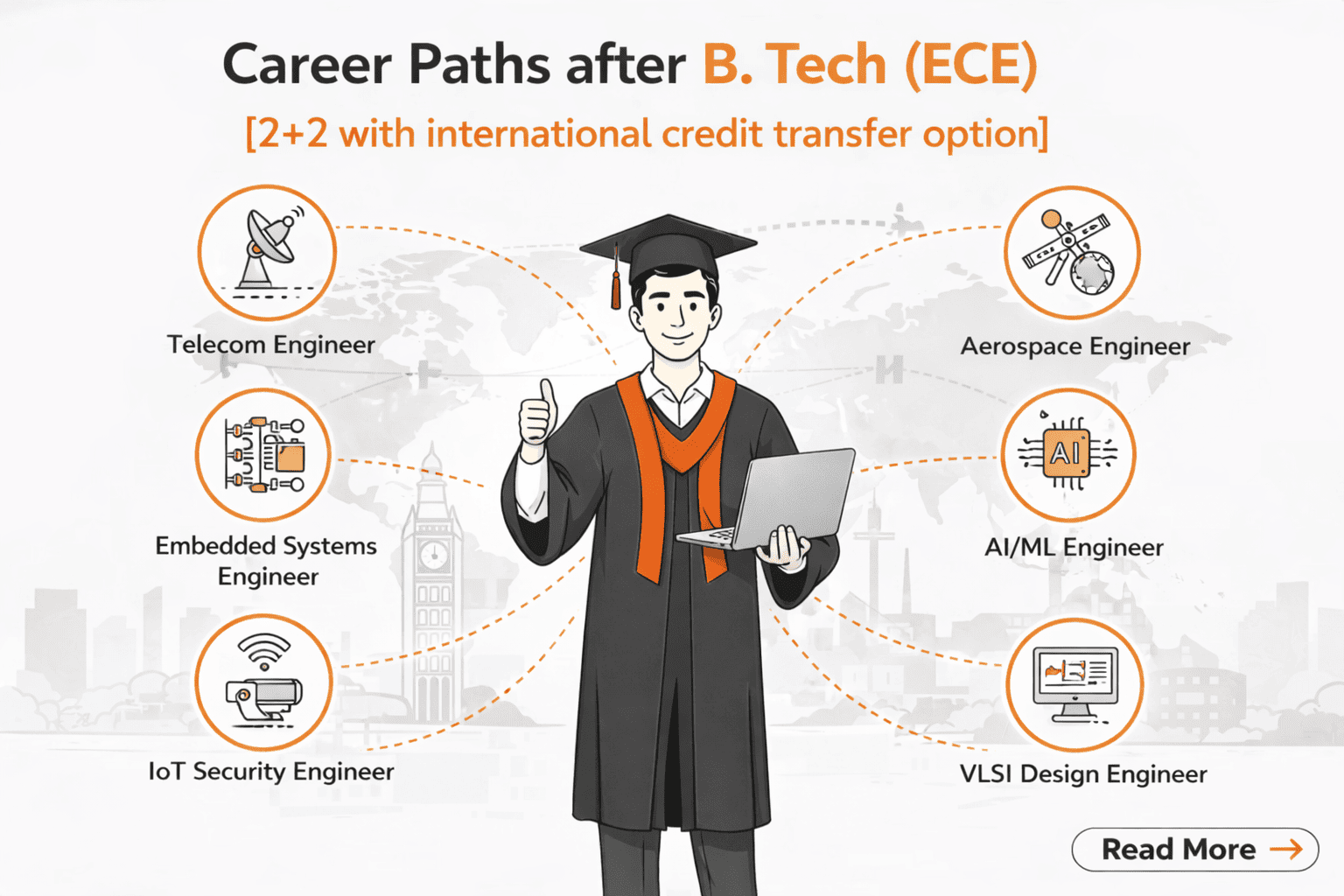
Career Paths After B.Tech (ECE) – Roles Across Telecom, IT, Embedded, VLSI & More
Students graduating with this degree can explore diverse ECE career opportunities across multiple technical domains.
Some of the most popular roles include:
- Embedded Systems Engineer
- VLSI Design Engineer
- Telecommunications Engineer
- Network Engineer
- Robotics Engineer
- Electronics Design Engineer
- Software Developer in Tech Companies
These roles in VLSI, embedded systems, IT and telecom sectors allow engineers to contribute to both product development and large-scale technology infrastructure.
With the help of AI career mapping for electronics graduates, students can also explore hybrid careers that combine electronics with artificial intelligence, automation, and data-driven technologies.
How Do International Exposure and Global Credits Strengthen Employability?
Studying abroad through international academic pathways provides numerous advantages. One of the biggest study abroad benefits for ECE students is exposure to advanced laboratories, global research facilities, and diverse academic perspectives.
Participation in global internships also allows students to gain professional experience in multinational environments.
The international credits impact on employability is significant because employers value graduates who understand global technologies, international work cultures, and collaborative engineering practices.
Such exposure enhances AI-enhanced global career readiness, where engineers are capable of contributing to multinational innovation projects.
What Research and Innovation Opportunities Can ECE Graduates Pursue?
Electronics engineering is a field driven by innovation. Students interested in research in electronics engineering can work on next-generation technologies including semiconductor design, wireless communication systems, and robotics.
Many engineers pursue innovation and development roles within corporate research laboratories and technology startups.
Universities and companies also offer lab and industry R&D opportunities, where engineers collaborate on product prototypes and experimental technologies.
With the support of AI-supported research pathways, modern research environments allow engineers to simulate, analyze, and optimize electronic systems more efficiently than ever before.
How Does Project-Based Learning Prepare Students for Industry Roles?
Engineering education becomes most effective when theoretical knowledge is combined with real-world practice. Through hands-on projects in ECE, students build circuits, design communication systems, and develop embedded applications.
This approach encourages practical learning for engineers, where students solve real technical problems instead of only studying theoretical concepts.
Such experiences create industry-ready electronics graduates who understand design, testing, troubleshooting, and system optimization.
Many universities now integrate AI-assisted project learning, where intelligent tools help students simulate circuits, analyze performance data, and improve design efficiency.
| Did You Know?
Engineering graduates with strong project portfolios often have higher employability because employers prefer candidates who can demonstrate real technical problem-solving experience. |
What Advanced Career Trails Exist After ECE – MS, MTech, MBA, or Research?
After graduation, students can pursue multiple higher studies after B.Tech ECE depending on their career goals.
Many students opt for MS/MTech in electronics or related specializations such as communication engineering, VLSI design, or robotics.
Others explore MBA for engineers, which prepares them for managerial roles in technology companies.
Some graduates also pursue research career paths, working as researchers, innovation specialists, or academic scholars in advanced technology domains.
With the help of AI-guided advanced education, students can identify the best postgraduate pathways based on their interests, skills, and industry demand.
Conclusion
The career prospects after B.Tech ECE 2+2 programmes are vast and continually expanding. Electronics and communication engineering plays a central role in modern technological advancement, from communication networks to intelligent electronic devices.
Graduates equipped with technical expertise, global exposure, and research experience become future-ready electronics engineers capable of contributing to international technology development.
With the integration of advanced learning systems and global study opportunities, students can explore global engineering career opportunities across multiple industries.
Choosing a programme that combines technical depth with international exposure can therefore become a powerful step toward building a successful engineering career.
Frequently Asked Questions (FAQs)
Q1. What is the B.Tech ECE 2+2 programme?
Ans: It is a degree pathway where students study the first two years at their home university and complete the final two years at an international partner university through credit transfer.
Q2. What are the main career options after B.Tech ECE?
Ans: Popular roles include Embedded Systems Engineer, VLSI Design Engineer, Telecommunications Engineer, Network Engineer, and Electronics Design Engineer.
Q3. Does international credit transfer improve career opportunities?
Ans: Yes, international exposure, global internships, and foreign academic experience often enhance employability.
Q4. Can ECE graduates work in software companies?
Ans: Yes, many ECE graduates work in software development, AI systems, and data-driven technology roles.
Q5. What higher education options are available after B.Tech ECE?
Ans: Students can pursue MS, MTech, MBA, or research programmes depending on their career interests.



![Is B.Tech. Biomedical Engineering [Lateral Entry] the Right Course for You](https://www.lpu.in/blog/wp-content/uploads/2025/11/Is-B.Tech_.-Biomedical-Engineering-Lateral-Entry-the-Right-Course-for-You-100x70.png "Is B.Tech. Biomedical Engineering [Lateral Entry] the Right Course for You?")