
- Introduction: Why Choosing the Right UG Programme Matters?
- What Is B.Sc. (Computer Science – Cyber Security)?
- Who Should Consider Pursuing a B.Sc. in Cyber Security?
- Skills You’ll Develop in Cyber Security Studies
- Benefits of Choosing B.Sc. Cyber Security Over General CS Courses
- Industries That Require Cyber Security Professionals
- Personality Traits and Interests That Match Cyber Security Careers
- Career Opportunities After the Degree
- Scope of Higher Education and Global Certifications
- Alumni Success Stories
- Future Growth and Long-Term Scope in Cyber Security
- Conclusion
- Frequently Asked Questions (FAQ)
Why Choosing the Right UG Programme Matters?
Selecting the right undergraduate programme is one of the most crucial decisions for any student, as it lays the foundation for future career growth. With the digital world expanding rapidly, the importance of choosing B.Sc. Computer Science Cyber Security has grown tremendously. Cyber threats are no longer limited to large organizations; even individuals, start-ups, and governments face constant risks. This makes the demand for trained professionals in this field higher than ever before.
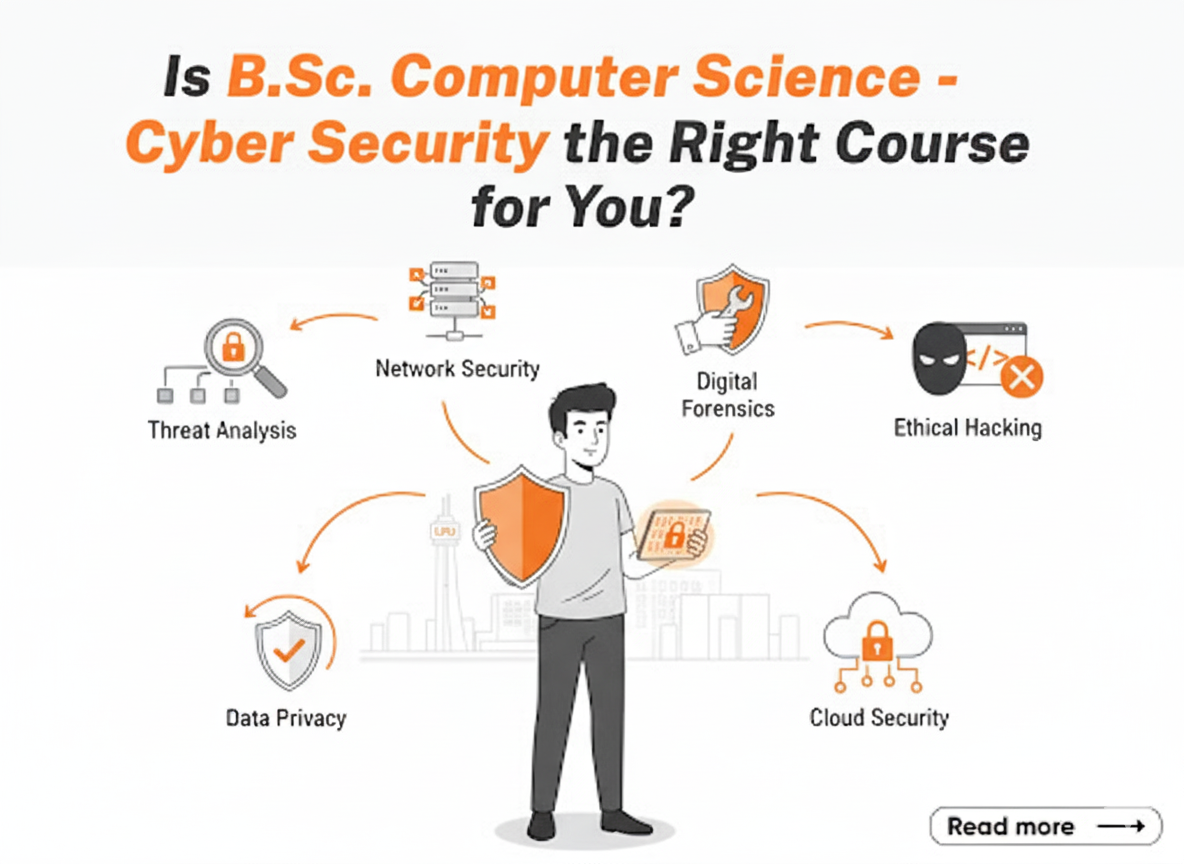
If you are a tech enthusiast who loves solving problems and ensuring the safety of digital systems, then understanding why B.Sc. Cyber Security is the right UG programme and has become essential. This degree not only equips students with strong fundamentals of computer science but also provides specialized knowledge in ethical hacking, digital forensics, network security, and cyber laws.
The B.Sc. CS Cyber Security course selection is a smart choice for students looking to enter a career that is both future-proof and rewarding. By pursuing this programme at a reputed university like LPU, you gain access to industry-oriented training, expert faculty, and global exposure—ensuring you are well-prepared to thrive in the evolving cyber landscape.
| Did you know?
The B.Sc. CS Cyber Security program integrates hands-on training, real-world projects, and exposure to emerging technologies like AI, cloud computing, and network security. |
What Is B.Sc. (Computer Science – Cyber Security)?
In today’s technology-driven world, cyber security is no longer optional—it is essential. Organizations across industries are investing heavily in skilled professionals who can protect data, secure networks, and safeguard digital infrastructure. This is why pursuing a degree in this domain offers both stability and growth.
At Lovely Professional University, the programme is designed to go beyond traditional classroom learning. LPU’s School of Computer Applications offers an industry-aligned curriculum that incorporates cutting-edge technologies and real-world applications. The focus areas extend beyond cyber security and include software development, artificial intelligence (AI), cloud computing, and more.
Through hands-on training and project-based learning, students get the opportunity to apply theoretical knowledge to practical scenarios, preparing them for roles in IT, research, and entrepreneurship. The curriculum is forward-thinking and skill-oriented, ensuring that graduates are equipped to thrive in the rapidly evolving tech landscape.
By choosing the B.Sc. Computer Science Cyber Security programme, students not only gain expertise in ethical hacking, cryptography, and digital forensics but also develop the adaptability needed to excel in emerging technologies. This makes it one of the most relevant and future-proof UG degrees in today’s competitive world.
| Did you know?
Students can choose from Gaming, Mobile App Development, Web Development, Networking & Security, Data Science, and an Honours specialisation in Cyber Security. |
Who Should Consider Pursuing B.Sc. in Cyber Security?
Before enrolling in any programme, it’s important to understand whether it matches your interests, skills, and career goals. The eligibility for B.Sc. Computer Science in Cyber Security tie-up with CompTia generally includes completion of 10+2 with Mathematics as a subject, ensuring students have the logical and analytical foundation required for computer science and security studies.
This programme is an ideal fit for those who are curious about technology, enjoy problem-solving, and want to contribute to making the digital world safer. The suitable candidates for B.Sc. CS Cyber Security are students who have a keen interest in computer networks, ethical hacking, coding, and digital forensics. If you are passionate about identifying vulnerabilities, preventing cyber threats, and protecting data, this programme aligns perfectly with your aspirations.
In short, who can pursue a Cyber Security degree? Students who are tech-driven, logical thinkers, and eager to build careers in IT, defence, research, or consulting will find this programme highly rewarding. It is especially recommended for individuals who want a career that offers both high demand and long-term stability in the rapidly growing field of cyber security.
Specializations Offered
To add value and flexibility to the programme, students can choose from diverse specializations such as:
- Gaming – Learn how to design, develop, and optimize interactive digital games.
- Mobile Application Development – Gain expertise in creating user-friendly apps for Android and iOS platforms.
- Web Development – Build dynamic websites and web-based applications with modern tools and frameworks.
- Networking and Security – Focus on safeguarding digital infrastructures and managing secure networks.
- Data Science – Master the art of analyzing big data to derive meaningful insights and solutions.
For Honours students, an additional specialization in Cyber Security is available, enabling deeper expertise in this high-demand domain.
Core Subjects Covered
The programme also builds a strong foundation in computer science with subjects such as:
- Computer Organization and Architecture – Understand the internal structure and functioning of computer systems.
- Data Structures and Algorithms – Learn efficient ways to store, organize, and process data.
- Operating Systems – Explore how operating systems manage hardware, software, and system resources.
- Database Management Systems – Study how to design and manage databases for secure data storage.
- Computer Networks – Gain insights into how networks are built, managed, and secured.
- Programming Languages (C, C++, Java, C#) – Develop problem-solving skills using multiple programming paradigms.
- Information Systems – Learn how IT systems support decision-making in organizations.
- Software Engineering – Understand the principles of designing and managing large-scale software projects.
- Application Development Tools – Get hands-on practice with tools used for modern software development.
- Web Technologies (ASP.NET) – Build interactive and dynamic web applications.
- Mathematical Foundations for Computer Science – Strengthen analytical skills through applied mathematics.
- Basics of Management – Develop knowledge of business and management principles useful in IT careers.
- System Software – Study low-level programmes that support hardware and application interaction.
- Computer Graphics – Explore visual computing, graphics design, and rendering techniques.
- Artificial Intelligence – Learn AI concepts like machine learning, natural language processing, and automation.
This mix of core subjects and specializations ensures that graduates are not just experts in cyber security but also versatile professionals ready for diverse career opportunities in IT, research, entrepreneurship, and global industries.
| Did you know?
The program covers subjects like Programming (C, C++, Java, C#), Database Management, Operating Systems, Artificial Intelligence, and Mathematical Foundations for Computer Science. |
Skills You’ll Develop in Cyber Security Studies
One of the major advantages of pursuing this programme is the wide range of technical and professional abilities you acquire throughout your academic journey. The skills gained in B.Sc. Computer Science – Cyber Security tie-up with CompTIA goes beyond classroom learning, ensuring that students are industry-ready and globally competitive.
At LPU, all programmes of the department have UGC approval, with regularly updated schemes and syllabi based on feedback from industry experts, academia, and students. Backed by state-of-the-art computing resources and guided by highly experienced faculty members, students gain both theoretical knowledge and practical skills.
Additionally, industrial visits, workshops, and training sessions provide exposure to real-world challenges, while personality development classes and placement-oriented training help enhance employability. This holistic approach ensures that the key competencies in B.Sc. CS Cyber Security covers technical expertise, critical thinking, and professional development.
Cyber Security UG Degree Skillset Includes:
- Proficiency in programming and application development (C, C++, Java, ASP.NET, and more).
- Expertise as a Database Administrator to manage and secure organizational data.
- Ability to work as a Systems Analyst for designing efficient IT solutions.
- Skills to become a Network Administrator, ensuring secure and smooth communication systems.
- Competence in Web Designing and Content Management for digital platforms.
- Creativity in Multimedia Applications, Graphic Designing, and DTP (Desktop Publishing).
- Analytical abilities as a Business Analyst, supporting organizational decision-making.
- Entrepreneurial mindset, enabling students to start their own ventures in IT and Cyber Security.
Alongside technical skills, students also develop soft skills such as teamwork, leadership, and communication through co-curricular and cultural events. These competencies ensure that graduates of this programme are not only job-ready but also capable of thriving in diverse professional roles worldwide.
Benefits of Choosing B.Sc. Cyber Security Over General CS Courses
While general Computer Science programmes provide a solid foundation in computing and programming, specialized courses offer a distinct edge in today’s digital-first world. The advantages of B.Sc. Computer Science Cyber Security lies in its focused approach toward preparing students for one of the most in-demand domains of the future—cybersecurity.
Unlike traditional CS courses that primarily cover programming, databases, and software engineering, this programme blends those fundamentals with advanced topics like ethical hacking, cryptography, digital forensics, and network defence. This ensures students are not just programmers but also cyber defenders who can secure digital ecosystems.
The benefits of the Cyber Security UG programme extend to better career opportunities, industry recognition, and future-ready skills. Organizations across IT, banking, defence, e-commerce, and government sectors are actively seeking professionals who can tackle rising cyber threats. Thus, choosing this programme significantly enhances employability compared to a general CS degree.
In short, why choose B.Sc. CS Cyber Security over general CS? Because it equips you with a dual advantage—comprehensive computer science knowledge along with specialized cyber expertise. This combination makes graduates highly competitive, versatile, and prepared for both current and future challenges in the tech industry.
Industries That Require Cyber Security Professionals
The surge in digital transformation has created an unprecedented industry demand for B.Sc. Computer Science Cyber Security graduates. Organizations across all sectors require experts who can safeguard sensitive data, protect networks, and prevent cyber threats.
Several key sectors are actively hiring B.Sc. CS Cyber Security students, making this a highly rewarding field. Sectors hiring B.Sc. CS Cyber Security students include:
- Information Technology (IT) & Software Companies – roles in ethical hacking, security analysis, and system administration.
- Banking & Financial Services – securing financial transactions, online banking platforms, and customer data.
- E-commerce & Retail – protecting digital marketplaces and payment gateways.
- Government & Defence – contributing to national cyber defence and intelligence operations.
- Telecommunications – ensuring secure communication networks and services.
- Healthcare – maintaining patient confidentiality and secure health information systems.
- Research & Consulting Firms – offering cyber advisory, risk assessment, and forensic solutions.
These industries provide diverse career opportunities in Cyber Security, ranging from technical roles like network administrator, application developer, and systems analyst to managerial and analytical roles such as business analyst and content manager. Graduates with a B.Sc. in Cyber Security are well-positioned to meet the growing global demand for skilled cyber professionals.
| Did you know?
Students can enhance employability with international certifications such as CEH, CISSP, and CompTIA Security+, alongside higher studies opportunities like M.Sc. in Cyber Security or Data Science. |
Personality Traits and Interests That Match Cyber Security Careers
Success in cyber security is not only about technical knowledge—it also depends on having the right mindset and personal traits. Understanding the ideal personality for B.Sc. Computer Science – Cyber Security tie-up with CompTIA can help students determine if this programme aligns with their strengths and career aspirations.
Students who thrive in this field typically possess traits suited for Cyber Security careers, such as:
- Analytical Thinking – Ability to break down complex problems and identify potential vulnerabilities.
- Curiosity and Innovation – A natural interest in exploring new technologies and discovering creative solutions.
- Attention to Detail – Ensuring accuracy and detecting subtle security loopholes.
- Persistence and Patience – Tackling challenges in ethical hacking and digital forensics requires dedication.
- Strong Ethical Standards – Understanding the importance of responsible handling of sensitive data.
- Effective Communication – Explaining technical risks and solutions to non-technical stakeholders.
In essence, who should pursue B.Sc. CS Cyber Security are students who are tech-savvy, logical thinkers, problem-solvers, and motivated to safeguard digital systems. Those with a passion for learning, curiosity for emerging threats, and a commitment to ethical practices will find this programme both fulfilling and rewarding.
Career Opportunities After the Degree
Completing a B.Sc. in Cyber Security opens up a wide range of professional avenues. The career options after B.Sc. Computer Science Cyber Security are diverse, allowing graduates to apply their technical expertise and problem-solving skills across multiple industries.
Some of the most promising jobs for B.Sc. CS Cyber Security graduates include:
- Cyber Security Analyst – Monitoring and protecting organizational networks and data.
- Ethical Hacker / Penetration Tester – Identifying vulnerabilities to prevent potential cyber attacks.
- Network Administrator – Managing and securing company networks.
- Systems Analyst – Designing and implementing IT solutions for organizations.
- Application Developer – Building secure software and mobile applications.
- Database Administrator – Ensuring safe storage and management of critical data.
- Web Designer / Content Manager – Managing secure and interactive digital platforms.
- Business Analyst – Using data and IT insights to improve organizational decision-making.
- Entrepreneur in IT or Cyber Security – Launching startups focused on security solutions, software, or digital services.
These Cyber Security UG career paths span IT companies, banking, e-commerce, defence, government agencies, healthcare, and consulting sectors. With increasing digitalization and rising cyber threats, graduates of this programme are highly sought-after, making it a future-proof and rewarding career choice.
Scope of Higher Education and Global Certifications
A B.Sc. in Cyber Security is not just a gateway to immediate career opportunities—it also lays the foundation for higher studies after B.Sc. Computer Science Cyber Security. Graduates can pursue advanced education such as M.Sc. in Cyber Security, Information Security, Data Science, or specialized IT management programmes. These courses allow students to deepen their knowledge, explore emerging technologies, and take on leadership roles in the cyber security domain.
In addition to academic progression, students can enhance their employability through international certifications for B.Sc. CS Cyber Security. Globally recognized credentials such as CEH (Certified Ethical Hacker), CISSP (Certified Information Systems Security Professional), CompTIA Security+, and Cisco Certified Network Associate (CCNA) Security help graduates validate their expertise, making them highly competitive in the global job market.
By combining a strong UG degree with advanced education in Cyber Security and industry certifications, students gain a comprehensive skill set that prepares them for challenging roles in IT, defence, government, banking, and multinational corporations worldwide. This dual approach ensures both technical mastery and global career readiness.
Alumni Success Stories
The achievements of graduates reflect the quality of education and training provided by the B.Sc. Cyber Security programme at LPU. The success stories of B.Sc. Computer Science Cyber Security graduates demonstrate how the programme equips students with technical expertise, problem-solving abilities, and practical experience.
Some notable alumni of B.Sc. CS Cyber Security include:
- Pranay Jha, who secured 1st place in the ‘VMware Odyssey Tournament’, showcased exceptional skills in virtualization and cloud computing.
- Shubham Shekhar, Himanshu Shekhar, and Meera Kumari, who achieved first, second, and third positions respectively in the school competition ‘Bill Gates – Joy of Debugging’, highlighting their programming and debugging expertise.
These Cyber Security UG alumni achievements not only underline LPU’s commitment to excellence but also inspire current and prospective students to pursue innovation, leadership, and success in the ever-evolving cyber security domain.
Future Growth and Long-Term Scope in Cyber Security
The digital transformation across industries has made cyber security one of the fastest-growing and most essential fields today. Understanding the long-term scope of B.Sc. Computer Science Cyber Security helps students appreciate the enduring demand and stability this career offers.
With increasing cyber threats, data breaches, and technological advancements, the future prospects for B.Sc. CS Cyber Security graduates are extremely promising. Graduates can advance into roles such as senior security analysts, ethical hackers, cyber consultants, network architects, and IT managers. Additionally, opportunities in government, defence, banking, healthcare, and multinational organizations continue to expand, reflecting a sustained demand for skilled professionals.
Moreover, this programme lays a foundation for further specialization and leadership roles, ensuring continued career growth in Cyber Security. Combining hands-on experience, technical expertise, and global certifications, graduates are well-prepared to adapt to evolving challenges, innovate in emerging technologies, and achieve long-term success in the dynamic cyber security landscape.
Conclusion
In today’s digital era, pursuing a career in cyber security offers both stability and growth. The summary of B.Sc. Computer Science Cyber Security programme at LPU highlights a comprehensive curriculum, industry-aligned training, practical exposure, and global opportunities. Students gain expertise in ethical hacking, network security, programming, and emerging technologies, preparing them for a wide range of professional roles.
Final thoughts on B.Sc. CS Cyber Security emphasizes that this programme is ideal for tech-savvy, analytical, and problem-solving individuals who aspire to protect digital ecosystems and contribute to innovative IT solutions. The programme not only equips students with technical proficiency but also strengthens soft skills, leadership, and industry readiness.
In essence, the Cyber Security UG degree conclusion is clear: choosing this programme at LPU opens doors to promising careers, advanced education opportunities, and global certifications. It is a forward-looking choice for students aiming for long-term success in the ever-evolving field of cyber security.
Frequently Asked Questions (FAQ)
Q1. What is B.Sc. Computer Science Cyber Security?
It is an undergraduate programme that combines core computer science concepts with specialized knowledge in cyber security, including ethical hacking, network security, cryptography, and digital forensics.
Q2. What career opportunities are available after this programme?
Graduates can pursue roles such as Cyber Security Analyst, Ethical Hacker, Network Administrator, Systems Analyst, Application Developer, Business Analyst, or even start their own IT ventures.
Q3. Can I pursue higher studies after B.Sc. Cyber Security?
Yes, options include M.Sc. in Cyber Security, Information Security, Data Science, or pursuing international certifications like CEH, CISSP, and CompTIA Security+ to enhance global employability.
Q4. Why choose LPU for B.Sc. CS Cyber Security?
LPU offers an industry-aligned curriculum, state-of-the-art labs, experienced faculty, placement support, international exposure, and opportunities for all-around development.
Q5. What skills will I gain from this programme?
Students develop technical skills in programming, network security, database management, ethical hacking, and web development, along with analytical, problem-solving, and professional competencies.