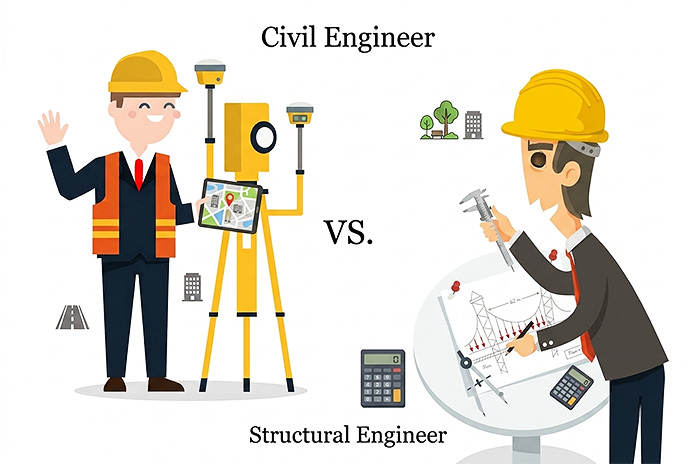
Are you an aspiring civil engineer trying to figure out what your career could actually look like a few years down the line? If so, it helps to know early on about two of the most sought-after roles in the industry: civil engineer and structural engineer. While the two are closely related, and every structural engineer starts out as a civil engineer, their day-to-day work, skill requirements and career paths differ in several ways. Understanding this distinction early can help you plan ahead, both in terms of the skills worth building during your civil engineering degree and whether further studies in structural engineering are worth pursuing afterwards. Let’s delve deeper for a detailed comparison of both roles.
Who is a Civil Engineer?
A civil engineer is a professional who plans, designs, constructs and maintains infrastructure that supports modern society. Their work spans a wide range of projects, from residential and commercial buildings to highways, bridges, railways, airports, tunnels, dams and water supply systems.
Civil engineers are involved throughout the lifecycle of a project. They assess site conditions, prepare project plans, coordinate with architects and contractors, oversee construction activities, ensure compliance with safety and environmental regulations, and monitor quality, cost and timelines.
Depending on their area of expertise, civil engineers may work in specialised domains such as transportation engineering, geotechnical engineering, environmental engineering, water resources engineering or structural engineering. This broad scope makes civil engineering one of the most diverse engineering disciplines, offering opportunities across government organisations, infrastructure companies, construction firms and engineering consultancies.
Key Responsibilities of a Civil Engineer
- Plan and design infrastructure and construction projects.
- Conduct site surveys and feasibility studies.
- Prepare construction plans, cost estimates and project schedules.
- Supervise construction activities and ensure quality standards.
- Coordinate with architects, contractors, consultants and government authorities.
- Ensure compliance with building codes, environmental regulations and workplace safety standards.
- Manage project budgets, timelines and resources.
- Inspect, maintain and rehabilitate existing infrastructure when required.
Who is a Structural Engineer?
A structural engineer is a civil engineering professional who specialises in the analysis and design of structures. Their primary responsibility is to ensure that buildings, bridges, towers, stadiums and other structures can safely support their own weight as well as external forces such as wind, earthquakes, traffic loads and changing environmental conditions.
Unlike civil engineers, whose responsibilities span multiple aspects of infrastructure development, structural engineers focus specifically on the structural integrity, stability and durability of a project. They use engineering principles, advanced calculations and specialised design software to determine the size, shape and materials required for structural components such as beams, columns, slabs and foundations.
Structural Engineers work closely with architects, civil engineers and construction teams to develop designs that are not only safe and compliant with building codes but also practical, efficient and cost-effective. Their expertise is particularly valuable for complex projects such as high-rise buildings, long-span bridges, industrial facilities and earthquake-resistant structures.
Key Responsibilities of a Structural Engineer
- Analyse structural loads, stresses and forces acting on a structure.
- Design structural systems and components for buildings and infrastructure projects.
- Select appropriate construction materials based on project requirements.
- Perform structural calculations and simulations using engineering software.
- Ensure designs comply with relevant building codes and safety standards.
- Review and approve structural drawings and technical specifications.
- Collaborate with architects, civil engineers and construction teams during project execution.
- Assess, inspect and recommend repairs or strengthening measures for existing structures when required.
Civil Engineer vs Structural Engineer: Key Differences
While a civil engineer’s role spans the entire lifecycle of a project, a structural engineer’s focus narrows to one critical piece of it, structural safety. The table below breaks down this distinction further.
| Aspect | Civil Engineer | Structural Engineer |
| Scope | Broad — covers design, construction, and maintenance of infrastructure (roads, bridges, buildings, water systems, etc.) | Specialised — focuses specifically on the load-bearing framework and stability of structures |
| Core Focus | Planning, site development, drainage, transportation, environmental systems, project management | Structural integrity, load calculations, material behaviour under stress, safety against collapse |
| Typical Work | Site surveys, urban planning, roadworks, water supply networks, foundation layout, project coordination | Analysing beams, columns, trusses, foundations, and frameworks for strength and stability |
| Design Concern | Overall functionality, layout, and feasibility of a project | Ability of a structure to withstand loads (dead load, live load, wind, seismic forces) |
| Education Path | B.Tech/B.E. in Civil Engineering | B.Tech/B.E. in Civil Engineering, followed by specialisation (M.Tech/M.E. in Structural Engineering) |
| Software Used | AutoCAD, Civil 3D, EPANET, GIS tools | STAAD.Pro, ETABS, SAP2000, ANSYS |
| Project Role | Often leads or coordinates the entire project, including non-structural elements | Works as part of the team, specifically validating that the design will not fail structurally |
| Examples of Work | Highways, dams, water treatment plants, urban infrastructure | Skyscrapers, bridges, stadiums, industrial structures with complex load paths |
| Regulatory Focus | Compliance with zoning, environmental, and municipal codes | Compliance with structural safety codes (IS 456, IS 800, seismic codes, etc.) |
Civil Engineer or Structural Engineer: Which Role Is Right for You?
Choosing between becoming a civil engineer and specialising as a structural engineer depends on your interests and long-term career goals. Since structural engineering is a specialised branch of civil engineering, students typically begin with a civil engineering degree before deciding whether to pursue this area of expertise.
A career in civil engineering may be a good fit if you enjoy working on diverse infrastructure projects, managing construction activities, solving real-world engineering challenges and coordinating with multidisciplinary teams. The field offers opportunities across sectors such as transportation, urban development, water resources, environmental engineering and construction.
On the other hand, if you have a strong interest in mathematics, mechanics and structural analysis, specialising in structural engineering can be a rewarding choice. Structural engineers focus on designing safe, stable and efficient structures, making them integral to projects involving high-rise buildings, bridges, industrial facilities and other complex infrastructure.
Ultimately, neither role is inherently better than the other. Civil engineering provides a broad foundation with multiple career pathways, while structural engineering allows professionals to develop advanced expertise in one of its most critical specialisations. Your ideal career path should align with your interests, strengths and the type of engineering challenges you aspire to solve.
B.Tech. Civil Engineering at LPU
For students looking to pursue B.Tech. in Civil Engineering, LPU offers a four-year, eight-semester course designed to take students from foundational science through to applied technology, with hands-on lab practice and projects in areas such as Structural, Environmental, and Highway Engineering, alongside Construction Management. The curriculum is built to stay in step with industry expectations, giving students a strong base whether they enter the workforce directly after graduation or go on to specialise further, such as through an M.Tech. in Structural Engineering.
Eligibility Criteria
Candidates need a minimum of 60% aggregate marks in 10+2, with Physics, Mathematics, Chemistry, and English, or an equivalent qualification, subject to qualifying LPUNEST (Lovely Professional University National Entrance and Scholarship Test), JEE Main, or CUET.
The English requirement may be waived for candidates who studied in English medium or an equivalent subject, even without English as a separate subject. A 10% relaxation in aggregate marks applies for candidates from North-East states and Sikkim, and a 5% relaxation applies for Defence Personnel, their dependents, and wards of Kashmiri migrants.
Placement Highlights
Recent placement figures for the programme include a highest salary package of ₹15 lakh and an average salary package of ₹9.6 lakh, alongside a highest internship stipend of ₹1.1 lakh.
Note – In addition to the standard four-year B.Tech. programme, LPU also offers B.Tech. Civil Engineering through Lateral Entry, for candidates who wish to join directly into the second year with a relevant diploma.
M.Tech. Structural Engineering at LPU
For B.Tech. aspirants who want to keep structural engineering as an option for later, LPU offers an M.Tech. in Structural Engineering that can be pursued after completing a B.Tech. in Civil Engineering. The two-year, four-semester programme builds directly on the undergraduate foundation, extending it through advanced coursework in structural design and analysis, along with a dissertation component that allows students to explore an area of interest in depth and build a strong platform for research or further studies.
Eligibility Criteria
Candidates need a minimum of 55% aggregate marks in B.Tech. (Civil Engineering), B.Arch., B.Plan., or an equivalent qualification, along with a qualifying score in LPUNEST, GATE, or CUET. LPUNEST is waived for candidates scoring 80% or more in their qualifying examination. A 5% relaxation in aggregate marks applies for candidates from North-East states and Sikkim, Defence Personnel, their dependents, and wards of Kashmiri migrants.
Since the programme is offered at the same university, students who choose to continue at LPU for their M.Tech. carry over the benefit of familiar faculty, labs and infrastructure while building specialised expertise in structural engineering.
Build Your Future in Civil Engineering at LPU
Whether you want to launch your career with a B.Tech. in Civil Engineering, join the programme through B.Tech. Civil Engineering (Lateral Entry), or deepen your expertise with an M.Tech. in Structural Engineering, LPU provides the academic foundation and practical exposure to help you succeed. With industry-focused learning, modern laboratories and project-based training, students graduate prepared to take on the evolving challenges of the engineering industry.
Frequently Asked Questions
Q: Is structural engineering only about designing buildings?
No. structural engineers work on a variety of structures, including bridges, flyovers, stadiums, towers, industrial facilities, dams and other infrastructure projects where structural safety and stability are critical.
Q: Which role offers more career flexibility: civil engineer or structural engineer?
Civil engineering generally offers broader career opportunities across multiple sectors, while structural engineering provides specialised opportunities in structural design and analysis. The right choice depends on whether you prefer a broad career path or developing expertise in a specific area.
Q: What industries hire civil and structural engineers?
Both professionals find opportunities across industries such as construction, infrastructure development, transportation, real estate, energy, manufacturing, urban development and government organisations. Structural engineers are also in demand within structural design consultancies and specialised engineering firms.
Q: Can civil engineers work abroad?
Yes. Civil Engineers are in demand worldwide, particularly in countries investing heavily in infrastructure, transportation, urban development and sustainable construction. Career prospects depend on factors such as qualifications, experience and local licensing requirements..
Q: Is civil engineering a good career choice in the future?
Yes. As countries continue to invest in infrastructure development, smart cities, sustainable construction and transportation networks, the demand for skilled civil engineers is expected to remain strong across both the public and private sectors.
Q: What skills are important for success in civil and structural engineering?
Strong analytical and problem-solving abilities, mathematical aptitude, communication skills and attention to detail are valuable for both roles. Civil engineers also benefit from project management and site coordination skills, while structural engineers require expertise in structural analysis, design principles and engineering software.
Q: Can a civil engineer switch to another specialisation later?
Yes. One of the advantages of studying civil engineering is that it provides a broad foundation. With higher education or relevant work experience, graduates can specialise in fields such as structural engineering, Geotechnical Engineering, Environmental Engineering or Construction Management.
Q: Does every civil engineer need to specialise in structural engineering?
No. structural engineering is just one of several specialisations available after civil engineering. Many civil engineers build successful careers in areas such as transportation, construction, environmental engineering, water resources or project management without pursuing a structural specialisation.