Introduction: How Concept Art Has Transformed Creative Industries
Concept art is often described as the visual beginning of a creative project. However, its role extends far beyond producing illustrations before actual production begins.
In graphic design, animation, gaming, and filmmaking, concept art serves as a visual problem-solving discipline. It transforms abstract ideas into characters, environments, objects, moods, and imaginary worlds that can eventually be developed into finished creative experiences.
A concept artist does not simply ask, “What should this look like?”
Instead, the questions are more meaningful: What should the design communicate? How should it function? Can it be produced? And what visual language should guide the entire project?
The evolution of concept art reflects major changes in artistic tools, creative thinking, and production technology. Traditional pencils, paints, and clay have gradually been joined by digital painting software, 3D modelling applications, real-time engines, and artificial intelligence.
Today, the relationship between concept art and artificial intelligence is introducing another significant transformation.
Yet this evolution is not simply about replacing older methods with newer technologies. It is about expanding creative possibilities while redefining the relationship between human imagination, artistic control, and technological innovation.
Concept Art as the Foundation of Visual Development
Every successful animated film, video game, or visual production begins with creative decisions that establish its identity.
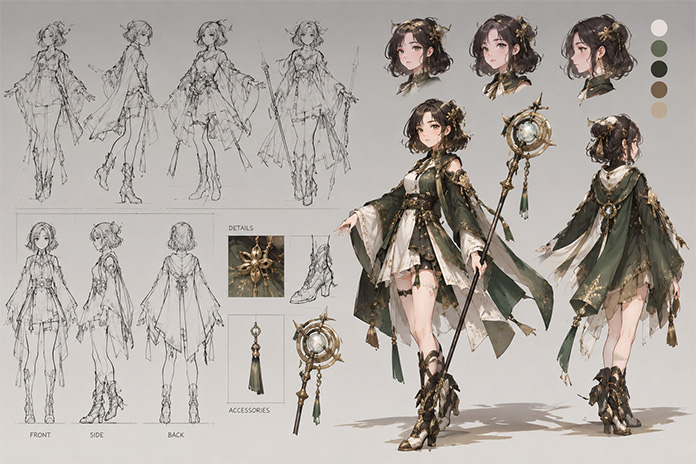
Characters need recognisable personalities, costumes, proportions, and movements. Environments must communicate atmosphere, architecture, lighting, and spatial relationships. Objects and props need to look convincing while remaining practical for production.
This is where visual development becomes essential.
Concept artists help establish these decisions before production becomes expensive and technically complicated.
A strong concept may define:
- Character silhouettes, anatomy, and proportions
- Costume design, gestures, and expressions
- Architecture and environmental details
- Colour relationships and lighting direction
- Materials, textures, and surface qualities
- Composition, mood, and narrative atmosphere
- Spatial relationships and technical feasibility
The purpose is not merely to create attractive images. It is to develop a consistent visual language that supports the entire production.
This makes visual storytelling one of the most important responsibilities of concept artists.
A character’s clothing can communicate personality and background. The architecture of a fictional city can suggest its history. Lighting and colour can establish emotions before a single word is spoken.
In this sense, concept art functions as the visual architecture of a story.
Traditional Concept Art: The Power of Pencil, Paint, and Imagination
Before digital technologies transformed creative production, artists relied primarily on physical materials.
Graphite, charcoal, ink, watercolour, gouache, acrylic paint, oil paint, and clay formed the foundation of traditional concept art.
These materials were not simply artistic preferences. They were the primary tools through which creative ideas became visible.
A pencil line existed physically on paper. Paint carried its own texture, density, and limitations. Clay could be shaped, carved, and examined from different angles.
Every artistic decision required direct interaction between the artist and the material.
Unlike digital software, traditional media offered limited opportunities to undo mistakes or experiment without consequences.
However, these limitations also encouraged careful observation and deliberate decision-making.
Artists needed to consider anatomy, perspective, composition, colour, and visual hierarchy before committing to an important stroke.
This created an interesting advantage: traditional methods could be slower, but they often encouraged deeper engagement with the creative process.
Even today, traditional drawing and painting remain valuable because they strengthen the fundamentals that support every form of concept art.
How Traditional Artists Shaped Modern Concept Art
The history of concept art includes several influential artists whose work helped establish the visual identities of major productions.
Mary Blair: Creating a Distinctive Visual Language
Mary Blair’s expressive use of gouache, watercolour, and acrylic contributed to the visual direction of animated films such as Cinderella, Alice in Wonderland, and Peter Pan.
Her importance extended beyond creating beautiful paintings.
Through distinctive colour combinations, simplified forms, and carefully arranged compositions, she established visual systems that influenced entire productions.
Her work demonstrates that successful concept art does not simply represent an idea. It establishes a visual language through which that idea can be consistently communicated.
Eyvind Earle: Giving Environments Their Own Identity
Eyvind Earle demonstrated how stylised architecture, strong vertical compositions, colour, and atmosphere could shape the identity of animated environments.
His work showed that backgrounds are not merely decorative elements behind characters.
They influence how audiences understand the world, its atmosphere, and the characters living within it.
This principle remains essential in environment concept art, where architecture, landscapes, lighting, and spatial design help communicate the identity of fictional worlds.
Yoji Shinkawa: Combining Artistic Expression with Spatial Thinking
In gaming, Yoji Shinkawa’s expressive brushwork became closely associated with the visual identity of Metal Gear Solid.
His work illustrates how traditional drawing can establish distinctive characters, mechanical designs, and atmospheric compositions.
For particularly complex mechanical concepts, physical modelling also helped investigate three-dimensional forms.
This highlights an important principle: traditional materials are not merely nostalgic alternatives to digital tools.
They can serve as practical instruments for solving design problems.
Drawing clarifies gesture, painting communicates atmosphere, and sculpture helps artists understand volume and spatial relationships.
The Digital Revolution: How Technology Changed Concept Art
The arrival of digital tools fundamentally transformed creative production.
Applications such as Adobe Photoshop, Corel Painter, Procreate, Clip Studio Paint, Blender, Maya, and ZBrush introduced new ways to create, modify, and refine visual ideas.
The rise of digital concept art gave artists access to capabilities that were difficult or impossible with traditional materials.
These included layers, undo and redo functions, non-destructive editing, digital colour adjustments, masks, transformations, photobashing, rapid duplication, and efficient file sharing.
The most important development was not simply that artwork became digital.
It became easier to revise.
Artists could explore multiple colour palettes without repainting an entire image. They could rearrange compositions, duplicate characters into variations, and test different environmental designs using the same foundation.
This changed the economics and speed of creative experimentation.
Once the necessary hardware and software were available, producing another variation required relatively little additional material expense.
As a result, digital technology encouraged artists to experiment more frequently, compare alternatives, and refine ideas continuously.
Traditional vs Digital Art: Understanding the Difference
The discussion around traditional vs digital art is not necessarily about deciding which approach is superior.
Both offer distinct creative advantages.
| Traditional Art | Digital Art |
| Uses physical materials such as paper, paint, and clay | Uses software, tablets, and digital devices |
| Encourages direct interaction with materials | Supports rapid editing and experimentation |
| Corrections may require significant effort | Offers undo, layers, and non-destructive workflows |
| Develops material awareness and physical techniques | Enables efficient collaboration and file sharing |
| Often involves slower iteration | Allows multiple design variations quickly |
Traditional art encourages direct observation and material understanding, while digital art provides flexibility and speed.
For contemporary concept artists, understanding both approaches can create a stronger creative foundation.
From 2D Illustration to 3D Concept Art
Digital technology also expanded concept art beyond conventional two-dimensional images.
Today, artists can move between sketching, painting, sculpting, modelling, texturing, lighting, and rendering within the same production pipeline.
The growing importance of 3D concept art is particularly visible in animation, gaming, and visual effects.
A character design may eventually become a fully rigged 3D model. A fantasy environment may need to function as an explorable game level. A futuristic vehicle must have mechanically believable components.
Artists therefore need to consider how their ideas work from multiple perspectives.
Software such as Blender, Maya, and ZBrush allows designers to investigate volume, proportions, surface details, and spatial relationships before production begins.
Real-time engines such as Unreal Engine take this process further.
Instead of presenting a single static illustration, artists can create environments that allow interactive exploration.
Lighting can change, cameras can move, weather conditions can be tested, and architectural elements can be examined from different angles.
The creative question evolves from “What does this world look like?” to “What does this world feel like when someone moves through it?”
This shift is especially important for concept art in gaming, where visual design must support both storytelling and interactive experiences.
Concept Art in Animation and Gaming: Turning Ideas into Experiences
Although concept art is used across multiple industries, animation and gaming remain two of its most influential applications.
In concept art in animation, artists help define character appearances, expressions, costumes, locations, colour palettes, and overall visual style.
These designs guide animators, modellers, lighting artists, and other production teams.
The Spider-Verse films demonstrate how distinctive artistic direction can influence the development of rendering techniques and production technology.
Rather than adapting every creative idea to existing technical limitations, production teams may develop new approaches to reproduce a particular visual style.
In gaming, concept artists face additional challenges.
Characters, environments, and objects must function within interactive systems. Designs may need to remain recognisable from multiple camera angles while satisfying performance and technical requirements.
For character concept art, this means considering anatomy, silhouette, costume construction, movement, and personality.
For environment concept art, it involves architecture, lighting, scale, navigation, atmosphere, and the relationship between the player and the surrounding world.
In both industries, concept art connects artistic imagination with practical production requirements.
Generative AI in Art: A New Phase of Creative Exploration
The introduction of generative AI in art represents another major shift in the evolution of visual production.
Traditional artists directly control physical materials. Digital artists manipulate images using software. AI-assisted workflows introduce systems that generate visual possibilities from prompts, reference images, and other inputs.
Tools such as Midjourney, DALL·E, Stable Diffusion, and Adobe Firefly have expanded the possibilities of AI-assisted concept art.
These systems can generate visual variations rapidly, allowing artists to explore different creative directions before committing to detailed development.
For example, an artist designing a fantasy city might investigate multiple architectural styles, lighting conditions, colour palettes, and atmospheric moods.
Instead of manually developing every preliminary variation, AI can help generate references and exploratory imagery.
This makes AI-assisted creativity particularly useful during early brainstorming and visual research.
However, generating an impressive image is not the same as producing a functional design.
Concept art must communicate clear ideas and satisfy the requirements of a particular production.
AI-generated images may contain incorrect anatomy, inconsistent perspective, impractical structures, or details that cannot be translated effectively into finished assets.
Human judgment therefore remains essential.
AI Tools for Concept Artists: Opportunities and Limitations
The growing availability of AI tools for concept artists is changing how creative professionals approach visual exploration.
These tools can support:
- Early-stage brainstorming and mood-board development
- Character silhouettes and costume variations
- Environmental design and architectural exploration
- Colour palette and lighting experiments
- Material references and atmospheric studies
- Composition testing and alternative visual directions
However, AI-generated outputs require careful evaluation.
An image may look visually impressive while containing structural or narrative inconsistencies.
A character may appear attractive but lack a recognisable silhouette. An environment may contain beautiful architecture that would be impractical to construct or navigate.
This is why AI should be understood as an exploratory resource rather than an automatic replacement for artistic expertise.
The artist must still determine which ideas communicate effectively, which designs are technically feasible, and which visual elements support the overall creative direction.
The Changing Concept Art Workflow: Traditional, Digital, and AI Together
The most promising creative approach may not involve choosing between traditional, digital, and AI methods.
Instead, it may involve combining their strengths within a flexible concept art workflow.
A contemporary hybrid process can include the following stages:
| Stage | Creative Process | Purpose |
| Research | Collect references and study production requirements | Establish context and direction |
| Traditional Sketching | Explore silhouettes, gestures, and compositions | Develop original ideas |
| Digital Development | Refine selected sketches, colours, and details | Improve visual clarity |
| 3D Blockout | Create basic models and spatial layouts | Test proportions and structure |
| AI Exploration | Generate additional variations and references | Expand creative possibilities |
| Human Evaluation | Review and select meaningful outputs | Maintain design quality |
| Digital Refinement | Correct and integrate selected elements | Develop production-ready concepts |
| Production Translation | Convert concepts into usable assets | Support animation, gaming, or filmmaking |
This approach allows technology to enhance the creative process without removing the artist’s responsibility for design decisions.
It also demonstrates why human creativity and AI should be viewed as complementary when AI is used thoughtfully.
Human Creativity and AI: Why Artistic Judgment Still Matters
One of the biggest misconceptions surrounding artificial intelligence is that faster image generation automatically makes artistic knowledge less important.
In reality, creative judgment becomes increasingly valuable when producing visual possibilities becomes easier.
An artist who understands anatomy can identify anatomical mistakes in AI-generated characters.
Someone with strong knowledge of perspective can recognise spatial inconsistencies.
An artist familiar with colour theory can determine whether a visually attractive palette supports the intended emotional atmosphere.
Similarly, understanding composition, materials, storytelling, and production requirements helps artists distinguish meaningful designs from decorative imagery.
This is why concept art skills remain essential despite technological advancement.
AI may reduce the effort required to produce certain images, but it does not eliminate the need for thoughtful visual decisions.
The role of the artist is gradually expanding from direct execution to creative direction, selection, interpretation, refinement, and authorship.
The ability to recognise what deserves to be created may become just as important as the ability to create it.
The Risk of Visual Similarity and Creative Dependence
While AI can expand visual exploration, it also introduces the possibility of creative homogenisation.
When large numbers of artists use similar models, prompts, and visual references, their outputs may begin to share familiar patterns.
This can make it easier to generate attractive images while making it more difficult to establish distinctive artistic identities.
The solution is not necessarily to reject AI.
Instead, artists should continue drawing inspiration from observation, personal experiences, cultural research, traditional techniques, and independent experimentation.
These influences help develop an artistic voice that extends beyond automatically generated patterns.
Maintaining this individuality is particularly important in creative industries where originality and recognisable visual identities contribute to successful storytelling.
AI Art Copyright Issues and Creative Ownership
The increasing use of generative AI also raises important legal and ethical questions.
Among the most significant concerns are AI art copyright issues, including authorship, training data, ownership, and commercial usage rights.
Traditional artwork generally has an identifiable human creator. Digital artwork also typically involves clear human creative decisions, even when software assists the process.
AI-generated imagery complicates this relationship.
If an individual provides a text prompt and an AI system produces an image, questions may arise about the extent of human authorship.
Further questions emerge when an artist substantially modifies AI-generated material or incorporates it into a larger creative production.
Another major concern involves the datasets used to train generative models.
Artists and creative organisations continue to debate whether existing artwork should be used for AI training without permission, compensation, or clear disclosure.
These issues affect the commercial adoption of AI in gaming, animation, publishing, and entertainment.
The legal treatment of AI-generated material varies across jurisdictions and continues to develop.
For professional artists and studios, maintaining clear documentation of creative processes, source materials, permissions, and human contributions is increasingly important.
Protecting Artistic Identity
The debate surrounding AI has also encouraged the development of technologies intended to protect artists.
Tools such as Glaze and Nightshade represent attempts to limit unauthorised style imitation or interfere with certain forms of AI training.
Their long-term effectiveness remains an evolving technical question.
However, their development highlights an important point: artists are actively participating in shaping how artificial intelligence interacts with creative work.
AI, Representation, and Responsible Visual Design
Generative AI systems learn patterns from large collections of data.
When those datasets contain cultural, social, or gender biases, generated imagery may reproduce stereotypical representations.
This becomes especially important in concept art because artists are responsible for imagining fictional societies, communities, characters, costumes, and environments.
A fantasy world may be fictional, but its visual identity often draws inspiration from real cultures and histories.
If AI repeatedly produces narrow or stereotypical representations, those patterns can influence the final creative direction.
Human oversight is therefore essential not only for technical quality but also for cultural sensitivity and responsible storytelling.
Artists should examine whether generated imagery accurately supports their intended narrative and avoids unnecessary stereotypes.
Building a Successful Concept Art Career in the AI Era
As technology evolves, aspiring artists may wonder what skills they should develop to remain relevant.
A successful concept art career increasingly benefits from a combination of traditional artistic fundamentals, digital expertise, technical awareness, and creative judgment.
Students and emerging professionals should consider developing the following abilities:
Traditional Art Fundamentals: Drawing, anatomy, gesture, perspective, colour theory, composition, and observation.
Digital Art Skills: Digital painting, image editing, photobashing, compositing, and non-destructive workflows.
3D Design Knowledge: Modelling, sculpting, texturing, lighting, rendering, and spatial design.
Real-Time Technology: Understanding interactive environments and game engines.
AI Literacy: Learning how generative systems work, evaluating outputs, and understanding their limitations.
Visual Storytelling: Communicating personality, atmosphere, emotion, and narrative through design.
Production Awareness: Understanding how concepts become functional assets for animation, gaming, and visual effects.
Critical Judgment: Recognising whether an image is visually attractive, conceptually meaningful, and technically practical.
The development of these abilities can help artists adapt to changing industry expectations.
The Challenge for Emerging Artists
AI may also influence the structure of creative employment.
Historically, junior artists often gained experience through tasks such as background development, cleanup, texture preparation, preliminary concepts, and design variations.
These assignments provided opportunities to understand professional workflows and develop technical confidence.
If automation reduces some of these entry-level responsibilities, studios and educational institutions may need to rethink how emerging artists gain experience.
The future of creative work therefore involves more than technological productivity.
It also involves protecting opportunities for artistic development and professional growth.
The Future of Concept Art: Beyond Static Images
The future of concept art is likely to involve increasingly flexible relationships between traditional drawing, digital painting, 3D technology, real-time environments, and artificial intelligence.
Traditional methods offer physical control and direct observation.
Digital tools provide editability and efficient experimentation.
3D technology introduces spatial understanding.
Real-time engines enable interactive exploration.
AI systems expand the speed and scale of visual experimentation.
Each approach offers advantages, but each also introduces limitations.
Traditional methods may require more time. Digital workflows can create dependence on software. 3D production requires technical knowledge, while AI introduces concerns involving control, originality, copyright, bias, and employment.
There is no universally perfect medium.
The most effective approach depends on the creative problem being solved.
Future concept art may take the form of a drawing, painting, 3D model, interactive environment, real-time scene, or multimodal prototype.
In gaming and virtual production, visual ideas may increasingly be experienced rather than simply viewed.
Concept art is therefore moving beyond the creation of individual pictures toward the development of complete creative experiences.
Conclusion: Technology Can Generate Possibilities, but Artists Give Them Meaning
The history of concept art is not simply a journey from pencil to computer to artificial intelligence.
It is a story of expanding creative possibilities while continuously redefining the artist’s role.
Traditional artists worked directly with physical materials.
Digital artists gained flexible and editable creative environments.
3D artists began constructing worlds rather than merely illustrating them.
Real-time technology made those worlds interactive.
AI-assisted artists can now investigate enormous numbers of visual possibilities with unprecedented speed.
However, the central responsibility remains unchanged.
Someone must decide what is worth creating.
The future will not belong exclusively to traditional artists, digital artists, or AI specialists.
It will increasingly favour creative professionals who understand the strengths and limitations of different tools and know when to use each one.
The pencil provides observation and intuition. The brush adds character. Digital software offers flexibility. Three-dimensional environments provide spatial understanding. Artificial intelligence expands possibilities.
But human intention must provide direction.
Ultimately, the strongest concept art will emerge not from choosing between traditional, digital, and AI methods, but from understanding how to combine them intelligently.
Technology can generate possibilities, but only human creativity can give those possibilities meaning.