India’s agricultural sector faces a paradox that defines our era. On one hand, farming is a victim of climate change — erratic monsoons, rising temperatures, prolonged droughts, and shifting pest pressures are undermining the livelihoods of millions of farmers across the country. On the other hand, agriculture itself is a significant contributor to the problem, responsible for roughly 14% of India’s greenhouse gas emissions through methane from rice paddies, nitrous oxide from synthetic fertilisers, and carbon dioxide released by soil tillage and stubble burning. These greenhouse gas emissions from agriculture highlight the need for more sustainable farming approaches.
But here is the less-told, more hopeful side of this story: with the right practices, the very same farmland that emits carbon can be transformed into a carbon sink — actively pulling CO₂ out of the atmosphere and storing it safely in the soil. This is the science and promise of carbon farming, and in 2026, it has moved from academic discussion to active national policy. The growing interest in carbon farming in India reflects its potential to support climate-smart agriculture and long-term environmental sustainability.
What Is Carbon Farming?
Carbon farming — also known as regenerative agriculture or carbon sequestration agriculture — is a whole-farm approach that manages soil, crops, water, and land use to maximise the capture and long-term storage of atmospheric carbon while simultaneously reducing on-farm greenhouse gas emissions. It treats agricultural land not just as a production system, but as a climate solution. This approach makes carbon sequestration in agriculture an important component of sustainable agriculture in India.
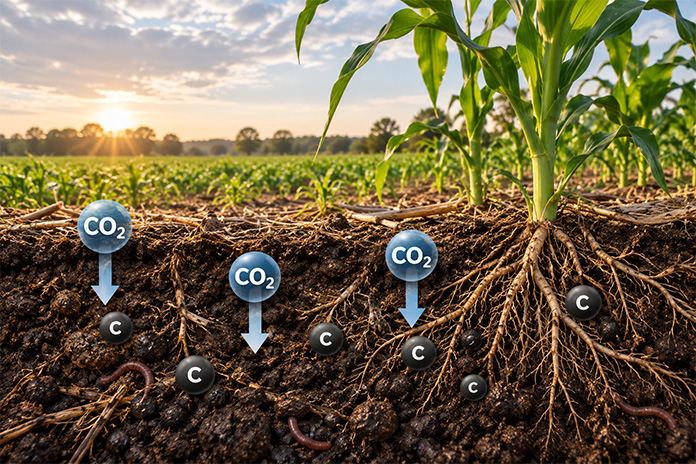
The science behind it is grounded in the carbon cycle. Through photosynthesis, plants absorb CO₂ from the atmosphere and convert it into organic compounds. When plant matter is returned to the soil — through root exudates, leaf litter, or incorporated residues — it is broken down by soil microorganisms and transformed into stable forms of soil organic matter. This stored carbon, measured as soil organic carbon (SOC), is the foundation of soil health: it improves water retention, enhances nutrient cycling, supports microbial diversity, and builds long-term crop productivity. Effective soil carbon sequestration and soil carbon storage therefore play an important role in maintaining productive agricultural systems.
The challenge is that India’s soils have been depleted. Over 60% of Indian agricultural soils have SOC levels below 0.5% — far below the optimal range of 1.5–2%. Decades of intensive tillage, synthetic input dependence, and residue burning have oxidised stored soil carbon and released it back into the atmosphere. Rebuilding that carbon is not just a climate imperative — it is an agronomic necessity. Strengthening soil health management can help restore soil fertility and improve long-term agricultural resilience.
Key Carbon Farming Practices
Carbon farming is not a single technique but a suite of practices, each contributing to carbon sequestration in different ways. These methods demonstrate the practical carbon farming benefits for soil productivity and environmental sustainability.
Cover crops grow between main crop cycles, capturing atmospheric CO₂ through photosynthesis and returning it to the soil as organic matter when incorporated or left as mulch. The use of cover crops for carbon sequestration can help increase organic matter inputs. Leguminous cover crops like dhaincha and cowpea also fix atmospheric nitrogen, reducing the need for synthetic fertilisers.
Conservation tillage and zero tillage reduce or eliminate ploughing, which disrupts soil aggregates, exposes stored carbon to oxygen, and accelerates its release as CO₂. Undisturbed soils preserve both carbon and the microbial communities responsible for sequestering it.
Agroforestry integrates trees with crops or livestock systems, sequestering carbon in above-ground biomass and deep root systems while improving soil structure, reducing erosion, and enhancing biodiversity. India’s National Agroforestry Policy already promotes this approach, and carbon farming gives it an additional economic dimension.
Biochar application involves incorporating charred organic matter — produced by heating biomass in low-oxygen conditions — into agricultural soils. Biochar application in agriculture can contribute to long-term carbon retention. Unlike fresh organic matter, biochar is chemically stable and can persist in the soil for hundreds to thousands of years, representing one of the most durable forms of carbon storage available to farmers.
Compost and organic amendments replace or supplement synthetic fertilisers with carbon-rich organic matter, feeding the soil food web and steadily building SOC over successive seasons. These practices can also support climate-resilient farming by improving soil structure and water-holding capacity.
Carbon Credits: A New Income Stream for Farmers
What makes carbon farming particularly compelling in 2026 is that it is no longer just an environmental commitment — it is an economic opportunity. India’s Carbon Credit Trading Scheme (CCTS), formally introduced in the Union Budget 2026-27 under the amended Energy Conservation Act, brings farmers into the carbon economy for the first time at a national policy level. The development of carbon credit trading in India and opportunities involving agricultural carbon credits can create new financial possibilities for the farming community.
A carbon credit represents the verified reduction or removal of one metric tonne of CO₂ equivalent. Farmers who adopt eligible carbon farming practices can earn and sell these credits — creating an additional income stream entirely separate from crop sales. This growing interest in carbon credits for farmers has also increased awareness about how farmers can earn carbon credits in India through verified carbon reduction and sequestration projects.
Aggregator companies like Boomitra and Grow Indigo are already building smallholder carbon farming platforms in India, handling the technical complexity of soil carbon measurement, monitoring, reporting, and verification (MRV) on behalf of farmer groups. Farmer Producer Organisations (FPOs) are emerging as natural aggregation units, pooling multiple smallholder farms to meet the minimum project scale required for credit certification. Such initiatives may strengthen carbon markets for agriculture and create opportunities for carbon credit income for farmers, subject to project eligibility, verification, and market conditions.
The Role of Agricultural Institutions
Agricultural universities, Krishi Vigyan Kendras (KVKs), and extension professionals are central to scaling carbon farming in India. Translating the science of soil carbon into farm-level practice — across India’s extraordinary diversity of soils, climates, and cropping systems — requires trained agronomists, soil scientists, and extension workers who can guide farmers through the transition, measure outcomes, and build local credibility for carbon markets.
Soil science students and agricultural graduates are uniquely positioned to lead this work. Understanding SOC dynamics, microbial ecology, and land management is precisely the expertise that carbon farming demands.
The Bigger Picture
India has pledged to achieve net-zero emissions by 2070. Reaching that target requires transformation not just in energy and industry, but in the land itself. With over 170 million hectares of agricultural land, India holds enormous carbon sequestration potential — and its farmers, if supported and incentivised appropriately, can be among the most powerful climate actors in the country.
Carbon farming does not ask farmers to sacrifice productivity for the planet. Done well, it improves soil health, reduces input costs, builds drought resilience, and generates new income — all while sequestering carbon that would otherwise warm the atmosphere.
Healthy soil sequesters carbon. Carbon credits reward farmers. Better practices build healthier soil. It is a cycle worth investing in — for the farmer, for the soil, and for the future.