
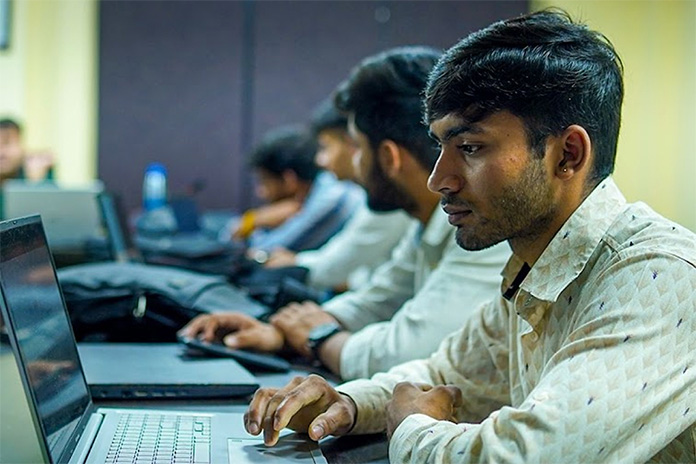
A B.Tech in Computer Science and Engineering gives you a strong foundation in computing, programming, problem-solving, and technology. But here’s an uncomfortable question every CSE student should ask before graduation:
If your degree disappeared from your resume, what could you actually demonstrate that you can do?
A degree tells the world what you studied. It doesn’t automatically tell an employer how well you can build software, solve problems, work with a team, learn a new technology, or handle an unfamiliar challenge.
This doesn’t make a degree less valuable. Quite the opposite. A good engineering education provides the foundation on which professional skills are built. But in a technology industry that changes rapidly, being a CSE graduate is the beginning of your professional journey—not the finished product.
So, what should a B.Tech CSE student or graduate actually be good at? This is also what makes B.Tech CSE skills and skills for B.Tech CSE graduates important for students planning their careers.
1. Programming Fundamentals
Before chasing every new technology, become comfortable with programming fundamentals.
You should understand variables, data types, control structures, functions, object-oriented programming, error handling, and basic software development concepts. More importantly, you should be able to use these concepts to solve unfamiliar problems.
You don’t need to know every programming language. A strong understanding of one or two languages is more valuable than shallow familiarity with ten.
The language may change. The ability to think computationally stays with you. These programming skills for CSE students are among the most important computer science engineering skills to develop.
2. Problem-Solving
Companies don’t hire engineers simply because they can write code. They hire people who can solve problems.
Problem-solving means breaking a large problem into smaller parts, identifying constraints, considering alternatives, and developing a logical solution.
This is why concepts such as data structures and algorithms remain important. They teach you how to approach problems efficiently rather than simply how to produce code that works.
Developing problem-solving skills for programmers and understanding DSA for CSE students can make a significant difference in technical preparation.
Practise solving problems without immediately searching for the answer. When your solution fails, understand why. Debugging skills for programmers are not a sign that you are bad at programming—it is part of becoming a better programmer.
3. Understanding How Software Works
Knowing syntax is only one part of software development.
A CSE graduate should gradually understand how different components work together. Depending on your career interests, this could include database skills for CSE students, API development skills, operating systems for CSE students, computer networks for CSE students, software architecture, software testing skills, and deployment skills for developers.
You don’t need to become an expert in everything.
However, understanding the bigger picture helps you move from writing isolated programs to developing useful software. These are important software development skills and technical skills for CSE students.
For example, building a web application becomes much more meaningful when you understand how the frontend communicates with a backend, how data is stored, how APIs connect components, and how the application can be tested and deployed.
4. The Ability to Build
One of the clearest ways to demonstrate technical ability is to build something.
Projects transform theoretical knowledge into practical experience. This type of project-based learning for CSE students helps develop practical skills for CSE students.
Start small. Build a portfolio website, mobile application, automation tool, data dashboard, AI-based application, or any solution connected to a problem you genuinely find interesting. These can become valuable software projects for CSE students, coding projects for B.Tech students, and portfolio projects for CSE students.
Your project doesn’t need to use the latest technology. What matters is whether you understand what you built.
During interviews, you should be able to explain:
- What problem were you solving?
- Why did you choose this approach?
- What technologies did you use?
- What challenges did you encounter?
- What would you improve?
- What did you learn?
A project you understand deeply is far more valuable than one created simply to add another item to your resume.
5. Version Control and Professional Development Practices
A graduate entering software development should be comfortable with tools used in collaborative development.
Version control, particularly Git, is a good example. Understanding repositories, commits, branches, pull requests, and basic collaboration workflows can make the transition from academic projects to professional environments much smoother. Developing Git and GitHub skills, version control skills, and a GitHub portfolio for CSE students can help demonstrate practical experience.
Good development also involves writing readable code, documenting important decisions, testing your work, and maintaining projects rather than simply making them work once.
These practices may seem small while you’re a student, but they become increasingly important when multiple people are working on the same codebase. They are part of effective software development practices and collaborative software development, along with strong code documentation skills.
6. AI Literacy
For today’s CSE graduate, understanding AI is becoming increasingly useful—even for students who don’t plan to become AI specialists.
You should know how to use AI tools responsibly for tasks such as brainstorming, debugging, learning concepts, generating test cases, or exploring alternative approaches. Developing AI skills for CSE students, AI literacy for students, and familiarity with AI tools for programmers can be useful across different technology roles.
But there is an important distinction between using AI and depending on AI.
If an AI tool generates code for you, you should still understand what that code does, whether it is correct, how secure it is, and whether it is the right solution. This is where responsible AI use, AI coding tools, and AI for software development become important.
The more capable AI tools become, the more important human judgement, verification, and problem-solving become.
7. Communication and Teamwork
Technical ability gets you only so far.
Most professional software development happens in teams. You’ll need to discuss requirements, explain technical decisions, ask questions, review code, give feedback, and communicate delays or challenges.
Being able to say, “I don’t understand this requirement; can we clarify it?” is a professional skill.
So is explaining a complex technical concept to someone without a technical background.
Develop these communication skills for CSE students, teamwork skills for engineers, soft skills for CSE students, and technical communication skills through presentations, group projects, student organisations, internships, hackathons, and everyday conversations. These collaboration skills for software developers are valuable in professional environments.
8. The Ability to Learn Independently
Perhaps the most important skill for a CSE graduate is learning how to learn.
Technology changes too quickly for anyone to know everything. The framework you learn today may be replaced or significantly changed tomorrow.
Professionals therefore need to be comfortable reading documentation, researching unfamiliar concepts, experimenting with tools, learning from mistakes, and adapting to new environments.
Developing independent learning skills for CSE students, continuous learning for software developers, and learning agility for CSE students can help you respond to changing technology.
Instead of asking, “Which technology should I learn so I can be successful for the next ten years?”, develop the ability to learn whatever technology the next ten years require.
That mindset is much more valuable.
9. Professional Discipline
Small habits become professional advantages.
Meeting deadlines, attending meetings on time, responding to messages professionally, maintaining documentation, keeping commitments, and taking ownership of mistakes may not sound like technical skills.
But they matter enormously in the workplace.
A highly talented developer who cannot be relied upon can create problems for an entire team. A technically competent professional who consistently communicates and delivers can become someone others trust.
Technical excellence and professional reliability should grow together. This is an important part of professional discipline, professional skills for CSE graduates, and employability skills for CSE graduates.
Don’t Try to Master Everything
One of the biggest mistakes CSE students make is trying to learn everything simultaneously.
AI is trending, so they start AI.
Cloud is popular, so they start cloud.
Cybersecurity looks exciting, so they switch again.
A new programming framework appears, and they start that too.
Exploration is good. Constantly switching without developing depth is not.
Build strong fundamentals first. Then choose an area that interests you and develop meaningful depth in it. You can always expand later. This approach helps students develop career skills for CSE students instead of collecting disconnected technologies.
Your Degree Is the Foundation—Not the Destination
A B.Tech CSE degree gives you something extremely valuable: a structured foundation in computer science and engineering.
What you do with that foundation is up to you.
By graduation, you should ideally be able to demonstrate more than a list of subjects and grades. You should have evidence that you can solve problems, build solutions, learn independently, collaborate with others, communicate clearly, and adapt to new technologies.
Your degree may get you noticed.
Your skills will help you contribute.
And your ability to keep learning will help you remain relevant. These future skills for CSE graduates, adaptability skills for engineers, future-proof skills for CSE graduates, and upskilling for software developers can support long-term career growth.
Don’t aim to graduate with only a degree. Aim to graduate with the ability to do something valuable with it.
For students thinking about what skills should a B.Tech CSE graduate have, the answer includes programming, problem-solving, software development, communication, teamwork, AI literacy, professional discipline, and independent learning. These are also the skills every B.Tech CSE graduate should have to become more confident and career-ready.
Whether you’re asking what should a CSE student be good at, what should a CSE graduate know, or what skills are needed for software development, the goal remains the same: build a combination of technical and professional capabilities. These skills can support CSE placement skills, placement preparation for CSE students, technical skills for placements, job-ready skills for CSE graduates, and industry-ready skills for CSE students.
Students interested in how to become a job-ready CSE graduate, how to develop technical skills in CSE, how to improve coding skills as a CSE student, how to build projects as a CSE student, how to become industry-ready after B.Tech CSE, and how to build a strong CSE portfolio should focus on consistent practical learning rather than simply collecting qualifications.
Ultimately, knowing what should CSE students learn before graduation also means understanding that a degree provides the foundation, while practical and professional capabilities determine how effectively you can use it. This is why why a degree is not enough for software jobs is an important question for every CSE student to consider.