
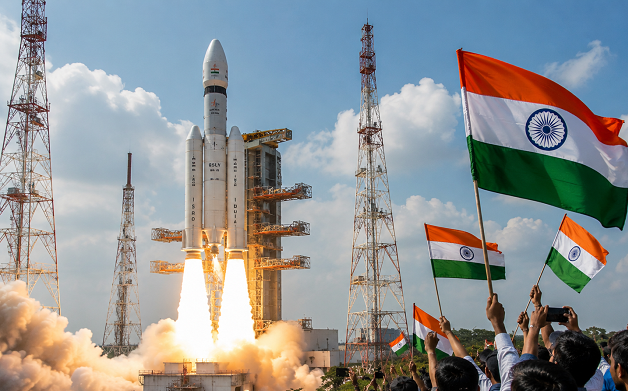
Few technological journeys have transformed a nation as profoundly as India’s space programme. What began with modest infrastructure and limited resources has evolved into one of the world’s most respected space ecosystems. Over the past six decades, India has demonstrated that scientific excellence, engineering innovation, and strategic planning can overcome financial constraints. From launching Aryabhata satellite in 1975 to placing a spacecraft in Mars orbit on its very first attempt and achieving the historic Chandrayaan-3 lunar landing, India’s space programme has consistently pushed the boundaries of what is possible.
The last few years, however, have marked a defining phase in this journey. Space is no longer viewed only as a strategic or scientific domain; it has become a powerful engine for technological innovation, economic growth, entrepreneurship, and national development. Policy reforms, increased private participation, startup-led innovation, and international collaborations have collectively reshaped India’s position in the global space economy. The country is steadily transitioning from being a reliable space-faring nation to becoming an influential contributor to the future of commercial and scientific space exploration.
At the heart of the Indian space program remains the Indian Space Research Organisation (ISRO), whose achievements continue to inspire researchers and engineers across the world. The success of Chandrayaan-3 in August 2023 established India as the first nation to successfully land near the Moon’s south polar region—an area of immense scientific interest due to the potential presence of water ice. The mission demonstrated India’s capability to execute complex planetary missions with remarkable precision while reinforcing its reputation for cost-effective engineering.
Building on this momentum, ISRO has continued to expand its technological capabilities. The organisation has made significant progress in the Gaganyaan mission, India’s first human spaceflight mission, through extensive crew module testing, environmental qualification, propulsion validation, and astronaut training. Another landmark achievement was the successful Space Docking Experiment (SpaDeX), which demonstrated autonomous satellite docking capabilities. This technology is considered essential for future space stations, orbital servicing, satellite maintenance, and deep-space exploration missions, placing India among a select group of nations possessing such expertise.
Beyond exploration missions, ISRO continues to operate an extensive network of Earth observation, navigation, meteorological, and communication satellites that support everyday life across the country. Satellite-based services contribute significantly to weather forecasting, precision agriculture, disaster management, fisheries, mineral exploration, urban planning, border surveillance, telemedicine, distance education, and digital connectivity. These applications often remain unnoticed by the general public, yet they form the backbone of several critical national services and developmental programmes.
One of the most significant developments in recent years has been the liberalisation of India’s space sector. Recognising the immense commercial potential of space technologies, the Government of India introduced major policy reforms in 2020, opening the sector to private enterprises. The establishment of the Indian National Space Promotion and Authorization Centre (IN-SPACe) created an independent regulatory framework that enables non-government entities to access ISRO facilities, launch infrastructure, and technical expertise. Simultaneously, NewSpace India Limited (NSIL) has strengthened the commercialisation of indigenous space technologies and facilitated greater industry participation.
These reforms have triggered remarkable growth in India’s private space ecosystem. In just a few years, the number of space startups has increased from fewer than 30 to well over 300, making India one of the fastest-growing space startup ecosystems globally. These companies are developing launch vehicles, propulsion systems, small satellites, satellite components, Earth observation platforms, space situational awareness technologies, and advanced geospatial analytics. The rapid expansion reflects growing investor confidence, supportive government policies, and the availability of a highly skilled engineering workforce.
Several Indian startups have already established themselves as global innovators. Skyroot Aerospace became the first private Indian company to launch a rocket into space with Vikram-S and has continued advancing the development of its orbital launch vehicle, Vikram-1. AgniKul Cosmos successfully tested its indigenously designed single-piece 3D-printed rocket engine and achieved the launch of Agnibaan SubOrbital Technology Demonstrator, showcasing India’s growing expertise in additive manufacturing for aerospace propulsion. Pixxel is building one of the world’s largest commercial hyperspectral satellite constellations for applications ranging from agriculture and environmental monitoring to mining and climate studies. Companies such as Dhruva Space, Bellatrix Aerospace, Digantara, SatSure, GalaxEye, and PierSight are contributing innovations in satellite platforms, green propulsion, orbital debris monitoring, synthetic aperture radar, and maritime intelligence.
The increasing collaboration between ISRO, academia, research institutions, and private industry is creating a vibrant innovation ecosystem. Technology transfer programmes have enabled industries to commercialise several indigenous technologies originally developed for national missions. Universities are establishing dedicated space technology laboratories, student satellite programmes, and multidisciplinary research centres, preparing the next generation of scientists, engineers, and entrepreneurs for careers in the rapidly expanding space economy.
India’s ambitions extend well beyond Earth orbit. Future missions include the Gaganyaan human spaceflight mission, the Bharatiya Antariksh Station planned for the next decade, Chandrayaan-4 for lunar sample return studies, the Venus Orbiter Mission India, and advanced Earth observation satellites with enhanced capabilities. Together with India’s continuing programme of Indian lunar missions and planetary exploration, these initiatives reflect the country’s long-term ambitions in space science and exploration. Simultaneously, research on reusable launch vehicles, semi-cryogenic propulsion, next-generation communication satellites, and in-space manufacturing is progressing steadily. These initiatives are expected to reduce launch costs, improve sustainability, and strengthen India’s competitiveness in the international launch market.
The economic outlook is equally encouraging. According to estimates by IN-SPACe, India’s space economy has the potential to grow from its current value of around US$8–9 billion to US$44 billion by 2033, with a target of capturing nearly 8% of the global space market. This growth is expected to generate thousands of high-skilled jobs in aerospace engineering, electronics, artificial intelligence, robotics, advanced manufacturing, materials science, satellite communications, and data analytics. The space sector is rapidly becoming an important driver of innovation-led economic development.
India’s remarkable progress demonstrates that sustained investment in science and technology can create benefits far beyond space exploration. The country’s achievements are strengthening national security, supporting sustainable development, enabling digital transformation, and creating new opportunities for industry and entrepreneurship. More importantly, they are inspiring young engineers, researchers, and innovators to imagine careers that contribute to solving challenges both on Earth and beyond.
As government agencies, private enterprises, startups, universities, and research organisations continue working together, India is building far more than rockets and satellites. It is developing a globally competitive space ecosystem founded on innovation, collaboration, and technological excellence. The coming decade is likely to witness even greater milestones, positioning India not merely as a participant in the global space race, but as one of its leading contributors.