
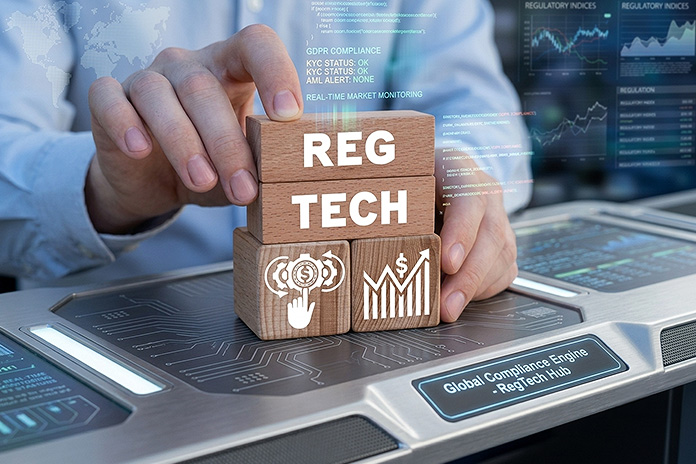
Compliance used to mean one thing: paperwork. Lots of it. Today, it means something much bigger. Between evolving regulatory compliance requirements, financial reporting standards, tax regulations, anti-money laundering compliance (AML), and data privacy laws, businesses are struggling to keep pace with rules that change faster than manual processes can handle. This is where RegTech (Regulatory Technology) is transforming the landscape.
At its core, RegTech refers to the use of advanced technologies to simplify and strengthen compliance processes. Modern RegTech solutions leverage artificial intelligence (AI), machine learning (ML), blockchain, cloud computing, and big data analytics to automate compliance activities, monitor regulatory updates, manage risks, and generate reports with minimal human intervention. Initially developed to support fintech compliance after the 2008 financial crisis, RegTech in accounting has rapidly become an essential component of modern financial management.
One of the biggest advantages of compliance automation is the elimination of repetitive, error-prone manual tasks. Traditionally, accountants spent hours gathering financial data, validating records, and preparing regulatory filings. Today, compliance automation tools and compliance management software can automatically collect information from multiple systems, validate transactions, and generate automated compliance reporting with greater speed and accuracy. This not only improves financial compliance but also reduces operational costs and reporting delays.
Keeping up with changing regulations has always been a challenge. Businesses operating across multiple countries often struggle with regulatory reporting and regulatory change management because legal requirements differ across jurisdictions. Modern AI-powered compliance platforms continuously monitor regulatory updates and immediately notify organizations of relevant changes, enabling proactive regulatory risk management rather than reactive compliance.
Auditing has also undergone a significant transformation. Traditional audits relied on sampling a limited number of transactions, increasing the possibility of overlooking risks. With continuous auditing and real-time auditing, organizations can monitor every transaction as it occurs. This level of compliance monitoring strengthens transparency, improves governance, and enhances stakeholder confidence by identifying unusual activities before they escalate into serious financial issues.
Similarly, fraud detection using AI has become one of the most valuable applications of RegTech. Financial fraud has grown increasingly sophisticated, making traditional rule-based systems less effective. Through machine learning for fraud detection, intelligent systems continuously learn transaction patterns, identify anomalies, and improve their detection capabilities over time. These technologies also play a vital role in AML technology, helping organizations strengthen anti-money laundering compliance while reducing false positives.
Several emerging technologies work together to power modern compliance technology. AI in compliance automates routine decision-making and regulatory analysis, while machine learning in compliance enhances predictive risk management by identifying unusual financial behaviors. Blockchain for compliance and blockchain in accounting provide secure, tamper-resistant financial records that improve transparency and trust. Meanwhile, cloud-based compliance platforms supported by cloud computing in accounting allow organizations to deploy scalable compliance systems without major infrastructure investments. At the same time, big data analytics transforms vast volumes of financial information into meaningful business intelligence, enabling better financial risk management and more informed strategic decisions.
The benefits extend far beyond operational efficiency. Organizations implementing compliance software and smart compliance solutions experience lower compliance costs, improved data quality, stronger governance, and fewer regulatory surprises. As digital transformation in accounting accelerates, accountants spend less time on repetitive documentation and more time delivering strategic insights. This evolution is supported by accounting automation, enabling finance professionals to focus on advisory services, business planning, and decision-making rather than administrative compliance tasks.
However, adopting RegTech solutions is not without challenges. These platforms manage highly sensitive financial information, making cybersecurity in accounting a critical priority. Small and medium-sized businesses may face budget constraints when implementing advanced technologies, while integrating new systems with legacy accounting infrastructure can be complex. Additionally, finance professionals must continuously upgrade their technical knowledge to effectively use technology in accounting, data analytics, and emerging digital tools.
Looking ahead, the future of Regulatory Technology appears even more promising. As ESG reporting requirements continue to expand, RegTech is expected to become the backbone of automated regulatory reporting and sustainability disclosures. AI will increasingly predict compliance risks before they emerge, blockchain may enable real-time transaction verification, and integrated Governance, Risk, and Compliance (GRC) solutions will unify auditing, reporting, compliance monitoring, and regulatory reporting within a single intelligent platform.
None of this suggests that accountants are becoming obsolete. On the contrary, the future of accounting is shifting toward a more strategic role. The strategic role of accountants is evolving from compliance gatekeepers to trusted advisors who interpret financial information, guide business decisions, strengthen risk management, and support organizational growth. Traditional accounting expertise remains essential, but professionals must now combine it with data analytics for accountants, cybersecurity awareness, AI literacy, and an understanding of emerging accounting technology.
Conclusion
RegTech is fundamentally redefining how organizations approach regulatory compliance. By combining AI for financial services, machine learning, blockchain, cloud computing, and intelligent automation, businesses can build digital compliance systems that are faster, smarter, and more resilient. Rather than replacing accountants, these innovations are enabling professionals to deliver greater strategic value. Organizations that embrace accounting innovation, intelligent compliance systems, and the latest compliance technology trends will be better prepared for an increasingly complex regulatory environment, while accountants who adapt alongside these technologies will lead the next era of financial excellence.