
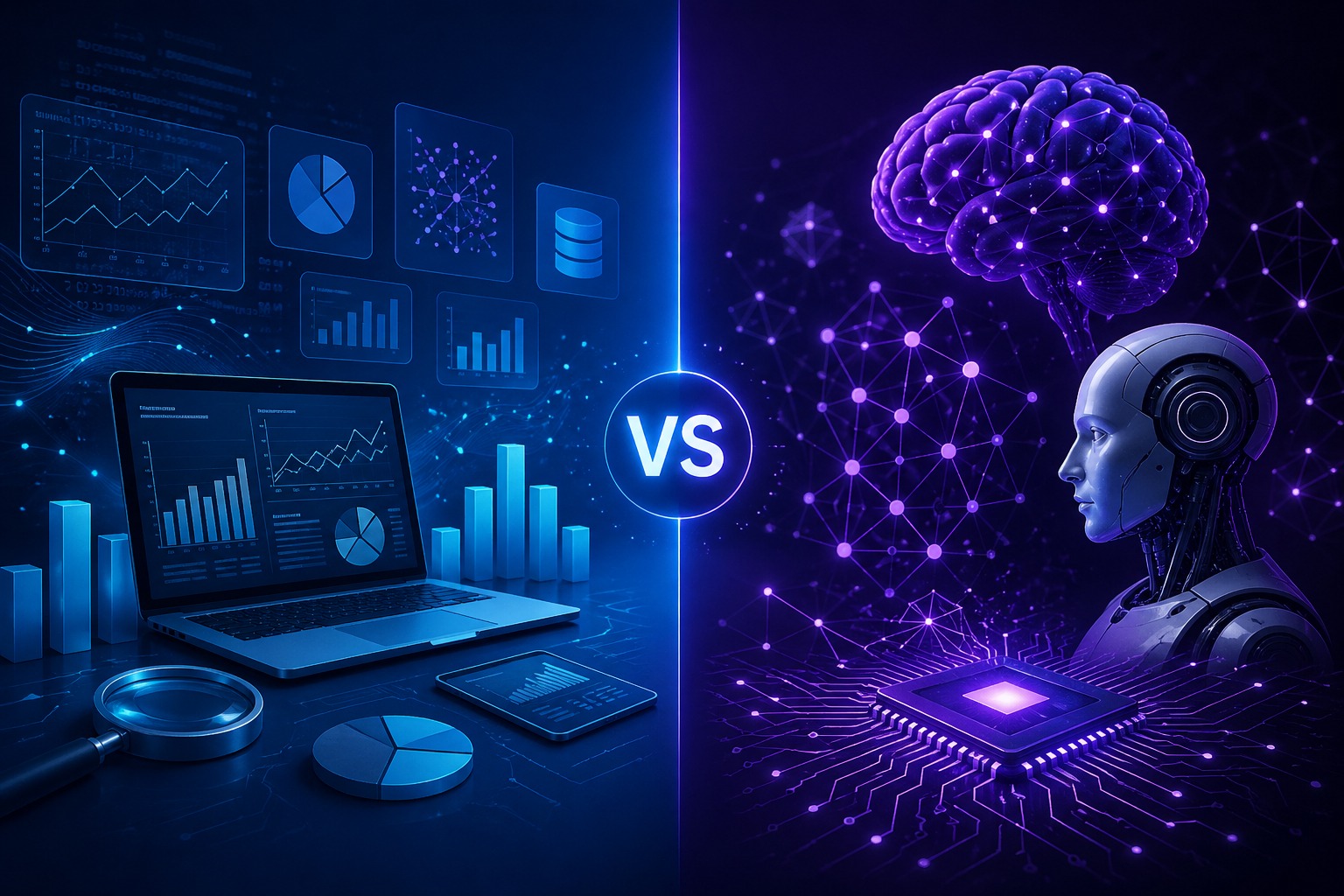
In today’s technology-driven world, data and intelligent systems are shaping almost every industry, from healthcare and finance to entertainment and education. As a result, undergraduate programmes in Data Science and Artificial Intelligence have become some of the most sought-after choices among students.
However, many students find it difficult to choose between these two fields, as both involve data, programming, and machine learning, making them appear quite similar at first. In reality, they differ in how they approach problems, the skills they demand, and the career paths they offer.
This guide is designed to help you clearly understand the difference between Data Science and Artificial Intelligence, so you can choose the programme that aligns best with your interests and career goals.
What is Data Science?
Data Science is the discipline of transforming raw data into meaningful insights that support decision-making. A data scientist may spend their day cleaning and organising large datasets, building models to identify patterns such as customer behaviour, and presenting findings through visual dashboards that help teams make informed choices.
Across industries, data plays a critical role. In banking, it helps detect fraudulent transactions. In healthcare, it supports early risk prediction. Platforms such as Swiggy or Zomato use it to personalise recommendations, while organisations like the Board of Control for Cricket in India analyse performance data to improve strategy and player outcomes. Any organisation that works with data relies on professionals who can interpret it effectively.
The field brings together statistics, programming, and domain knowledge, along with the ability to communicate insights clearly. It is not only about analysing data, but also about translating that analysis into decisions that have real-world impact.
What is Artificial Intelligence?
Artificial Intelligence focuses on building systems that can learn from data, recognise patterns, and make decisions or perform tasks with minimal human intervention. While Data Science helps interpret what data reveals, Artificial Intelligence uses that understanding to develop systems that can operate independently.
AI is already part of many technologies used in everyday life. Search engines such as Google rely on AI to deliver relevant results. Voice assistants like Amazon Alexa use it to understand and respond to commands. Organisations such as Indian Space Research Organisation apply AI in areas like image analysis and satellite data processing, while modern chat systems and recommendation engines are also built on similar technologies.
The field is strongly engineering-focused and involves designing algorithms, training machine learning models, and working with advanced concepts such as neural networks. It typically requires a solid foundation in mathematics, particularly linear algebra and calculus, along with strong programming skills. The outcome is the development of intelligent systems that can automate tasks, improve efficiency, and enable new forms of technology.
Understanding the Difference Between Data Science and Artificial Intelligence
Data Science and Artificial Intelligence are closely related fields and often work together in real-world applications. Both rely on data, programming, and machine learning to solve problems.
The key difference lies in their purpose.
Data Science focuses on analysing data to uncover patterns, trends, and insights that support human decision-making. It answers questions such as what is happening and why.
Artificial Intelligence focuses on building systems that can use data to make decisions or perform tasks independently. It answers the question of whether a machine can learn and act on its own.
In simple terms, Data Science helps people understand data, while Artificial Intelligence helps machines use that understanding to act.
Industry Applications of Data Science and Artificial Intelligence
Data Science and Artificial Intelligence are used across a wide range of industries, shaping how organisations operate, make decisions, and deliver services. While both fields often work together, their applications reflect their different roles in solving problems.
Where Data Science is Applied
Data Science is widely used in areas where organisations need to analyse data and extract meaningful insights.
Common applications include:
- Finance and Banking: Analysing transaction data to detect fraud, assess risk, and understand customer behaviour.
- Healthcare: Studying patient data to identify patterns, improve diagnosis, and support treatment planning.
- E-commerce and Retail: Understanding customer preferences, optimising pricing strategies, and improving product recommendations.
- Sports and Performance Analysis: Evaluating player performance, team strategies, and match outcomes using historical data.
- Marketing and Advertising: Analysing campaign performance, customer segmentation, and engagement trends to improve targeting.
In these areas, Data Science helps organisations make better decisions by turning data into actionable insights.
Where Artificial Intelligence is Applied
Artificial Intelligence is used in scenarios where systems are required to perform tasks, automate processes, or make decisions with minimal human input.
Common applications include:
- Virtual Assistants and Chatbots: Systems that understand and respond to user queries in real time.
- Recommendation Systems: Platforms that suggest products, content, or services based on user behaviour.
- Autonomous Systems: Technologies such as self-driving vehicles and automated machinery.
- Healthcare Technologies: AI-powered tools that assist in medical imaging, diagnosis, and predictive analysis.
- Speech and Language Processing: Applications that enable machines to understand, translate, and generate human language.
- Manufacturing and Automation: Smart systems that improve efficiency, quality control, and operational performance.
In these use cases, Artificial Intelligence enables systems to act on data, automate decisions, and perform complex tasks at scale.
Core Subjects in Data Science and AI
Data Science and Artificial Intelligence programmes are built on a shared foundation of programming, mathematics, and machine learning. As students progress, each field introduces specialised subjects that reflect its focus, whether on analysing data or building intelligent systems.
Data Science Subjects
Data Science programmes focus on working with data, identifying patterns, and generating insights that support decision-making.
Key subjects typically include:
- Programming for Data Analysis: Languages such as Python are used to process, analyse, and model data.
- Statistics and Probability: Provides the foundation for interpreting data, identifying trends, and validating results.
- Data Visualisation: Techniques for presenting insights clearly through charts, dashboards, and visual tools.
- Database Management Systems (DBMS): Covers how data is stored, organised, and retrieved efficiently.
- Machine Learning Fundamentals: Introduces algorithms used for prediction and pattern recognition.
- Big Data Technologies: Focuses on handling and processing large-scale datasets using modern tools.
- Data Mining and Analytics: Involves extracting useful information from large datasets and applying it to real-world problems.
Artificial Intelligence Subjects
Artificial Intelligence programmes focus on building systems that can learn, adapt, and perform tasks with minimal human intervention.
Key subjects typically include:
- Programming and Data Structures: Develops the ability to write efficient code and build scalable systems.
- Mathematics for Artificial Intelligence: Includes linear algebra, calculus, and probability, which are essential for understanding AI models.
- Machine Learning: Covers how systems learn from data and improve over time.
- Deep Learning and Neural Networks: Explores advanced models used in image recognition, speech processing, and other applications.
- Computer Vision: Enables machines to interpret and analyse visual data.
- Natural Language Processing (NLP): Focuses on understanding and generating human language.
- Artificial Intelligence Algorithms: Covers concepts such as search, optimisation, and decision-making models.
At Lovely Professional University, these subjects are introduced through a combination of core courses, specialised modules, and electives across different semesters. While subject names may vary, the underlying concepts remain consistent across programmes.
Career Opportunities and Future Scope
Both Data Science and Artificial Intelligence offer strong career prospects across industries, driven by the increasing reliance on data and automation. While the two fields are interconnected, they lead to distinct types of roles based on the nature of work involved.
Careers in Data Science
Data Science roles are centred around analysing data, generating insights, and supporting business decisions.
Common career paths include:
- Data Analyst: Focuses on interpreting data, creating reports, and identifying trends that inform business strategies.
- Data Scientist: Builds predictive models and uses statistical techniques to solve complex problems and uncover patterns.
- Business Analyst: Works closely with stakeholders to translate data insights into actionable business decisions.
- Data Engineer: Designs and manages data pipelines and infrastructure required for storing and processing large datasets.
- Analytics Consultant: Helps organisations use data effectively to improve performance and decision-making.
These roles are widely in demand across sectors such as finance, healthcare, e-commerce, consulting, and marketing, where data-driven decision-making plays a critical role.
Careers in Artificial Intelligence
Artificial Intelligence roles focus on designing, building, and deploying intelligent systems that can learn and perform tasks.
Common career paths include:
- AI Engineer: Develops and deploys AI models and systems for real-world applications.
- Machine Learning Engineer: Designs algorithms that enable systems to learn from data and improve over time.
- Robotics Engineer: Builds systems that combine AI with mechanical components to perform automated tasks.
- Computer Vision Engineer: Works on systems that interpret and process visual data such as images and videos.
- Natural Language Processing (NLP) Engineer: Develops systems that understand and generate human language.
These roles are in demand across industries such as technology, manufacturing, healthcare, automotive, and research, where automation and intelligent systems are rapidly evolving.
Future Scope
The demand for professionals in both Data Science and Artificial Intelligence continues to grow as organisations increasingly rely on data and intelligent systems to remain competitive.
Data Science is expected to remain essential for organisations that need to analyse large volumes of data and make informed decisions. At the same time, Artificial Intelligence is expanding into areas such as automation, smart systems, and advanced digital experiences.
As technology continues to evolve, both fields offer opportunities for long-term growth, innovation, and impact across a wide range of industries.
Choosing between Data Science and AI
The choice between Data Science and Artificial Intelligence is less about picking the more popular field and more about understanding where your natural strengths and interests lie. Read through the two profiles below and see which one resonates more with you.
Data Science is a good fit for students who:
- Enjoy working with numbers, patterns, and structured information
- Like analysing problems and drawing insights from data
- Are comfortable explaining findings in a clear and simple way
- Prefer working on business problems such as customer behaviour, trends, or performance
- Are interested in sectors such as finance, healthcare, or retail
During your programme, you will develop skills in Python, SQL, statistics, data wrangling, visualisation, and applied machine learning, all focused on turning raw data into decisions.
Artificial Intelligence is a good fit for students who:
- Enjoy logic, algorithms, and problem-solving
- Are interested in how intelligent systems are designed and built
- Like working on complex technical challenges
- Prefer building solutions rather than analysing them
- Are fascinated by areas such as robotics, voice AI, or language models
During your programme, you will develop skills in Python, linear algebra, deep learning, computer vision, natural language processing, and model deployment, all focused on building systems that can think and act.
Data Science and AI Programme Offered at LPU
At Lovely Professional University, we offer undergraduate programmes in Data Science and Artificial Intelligence across multiple formats, giving students the flexibility to choose a path that suits them.
Lovely Professional University offers undergraduate programmes in Data Science and Artificial Intelligence across multiple formats, giving students the flexibility to choose a path that suits them.
Programme offerings broadly fall into two categories. The first includes dedicated programmes designed for those who want to specialise exclusively in either Data Science or Artificial Intelligence from the outset. These programmes provide a comprehensive and focused curriculum built around the core principles, tools, and applications of the chosen field. For example, engineering programmes such as B.Tech. in Artificial Intelligence and Machine Learning and B.Tech. (CSE) in Data Science with Machine Learning are designed to build strong foundations in machine learning, data engineering, and intelligent systems.
The second category includes programmes that combine elements of both disciplines, allowing learners to develop expertise across Data Science and Artificial Intelligence within a single course. This approach is particularly suited to those who prefer broader exposure before committing to a specific direction, or those who wish to work at the intersection of both fields. Integrated programmes such as B.Tech in Artificial Intelligence and Data Science offer a balanced understanding of both analytical and system-driven approaches.
To learn more about the programmes available at LPU or to explore admission details, you may connect with the university admissions team:
Phone: +91 1824 517000 / +91 1824 404404
Frequently Asked Questions
1. Is Data Science easier than Artificial Intelligence?
Not really. Both fields have their own challenges. Data Science leans more towards statistics and analysing data, which can feel more approachable if you enjoy working with numbers and patterns. Artificial Intelligence, on the other hand, involves more complex concepts like algorithms and system design, and tends to be more mathematically demanding. In the end, what feels easier depends on your strengths and interests.
2. Which has better career opportunities: Data Science or AI?
Both offer excellent career opportunities, and demand is growing in both areas. Data Science roles are widely available across industries like finance, healthcare, e-commerce, and consulting. AI roles are expanding quickly in areas such as automation, robotics, and advanced software systems. Rather than one being better, it comes down to the kind of work you see yourself doing.
3. Can I switch from Data Science to AI later in my career?
Yes, and it’s quite common. There’s a lot of overlap between the two, especially in programming and machine learning. Many professionals start in Data Science and gradually move into AI by building skills in areas like deep learning or computer vision. With continuous learning and hands-on experience, making the switch is definitely possible.
4. Which field requires more mathematics?
Artificial Intelligence generally involves more advanced mathematics, especially topics like linear algebra, calculus, and optimisation. Data Science relies more on statistics and probability. Both require a solid foundation in maths, but the type and depth differ.
5. Is coding required for both Data Science and AI?
Yes, coding is essential in both fields. Python is widely used for tasks like data analysis, machine learning, and building AI systems. In Data Science, coding is often used to clean and analyse data, while in AI, it’s used to build and train models. A good grasp of programming is important either way.
6. Can I pursue Data Science or AI without a Computer Science background?
Yes, many people enter these fields from non-computer science backgrounds such as mathematics, engineering, or even business. That said, you will need to build a foundation in programming and basic maths. With consistent effort and practice, it’s definitely achievable.
7. Which field is better for someone interested in business applications?
Data Science is usually a better fit if you’re interested in business applications. It focuses on analysing data, identifying trends, and helping organisations make better decisions. Roles often involve working closely with business teams on real-world problems like customer behaviour or performance analysis.
8. Which field is better for someone interested in building technology?
Artificial Intelligence is the better choice if you’re interested in building systems and working on advanced technologies. It involves designing algorithms, training models, and developing systems that can learn and make decisions. Areas like robotics, computer vision, and language models fall under this space.
9. Is it better to choose a specialised course or a combined programme?
It depends on how clear you are about your interests. If you already know you prefer one field, a specialised course helps you build deeper expertise. If you’re still exploring, a combined programme gives you exposure to both Data Science and AI before you decide where to focus. Both options can lead to strong career outcomes.