
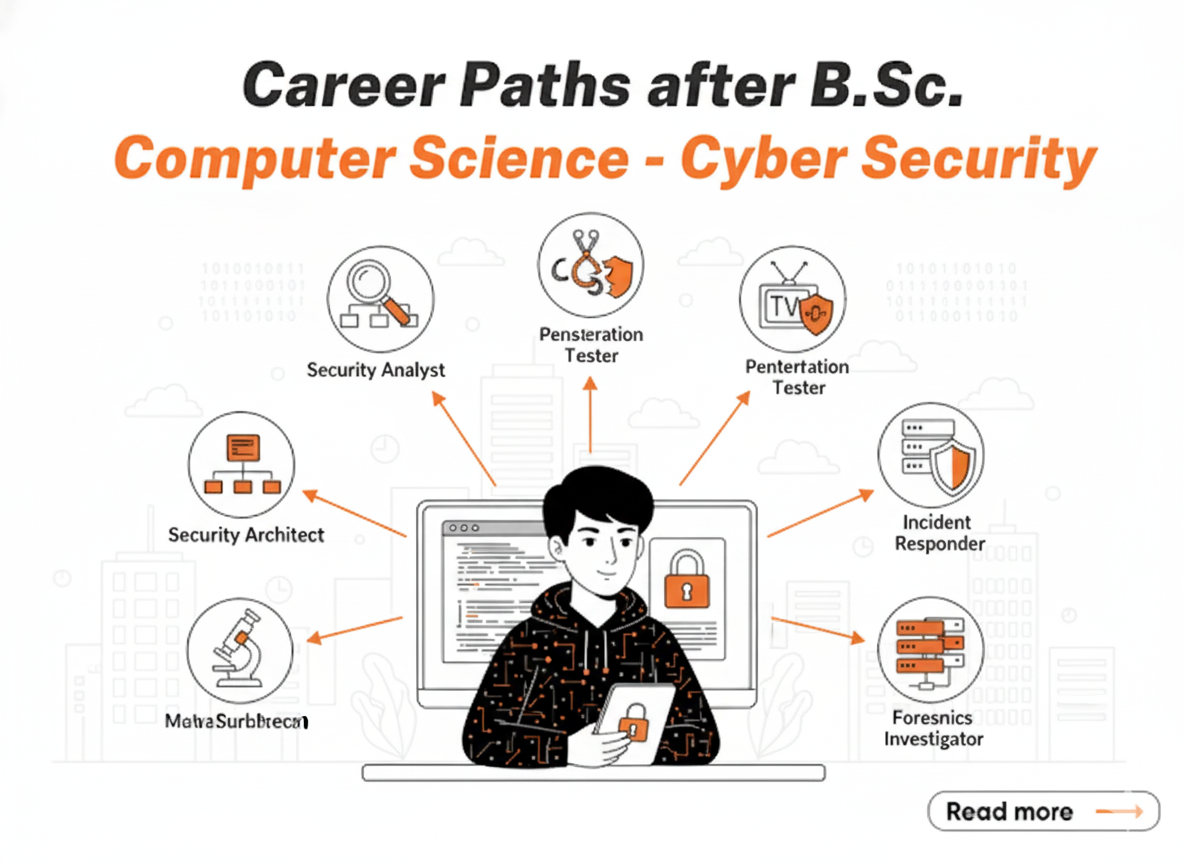
- Why Career Planning After Graduation Matters?
- What Is B.Sc. Computer Science – Cyber Security?
- Skills You Gain During the Programme
- Entry-Level Roles in Cyber Security
- Government and Public-Sector Opportunities
- Private-Sector Career Options in IT & Cyber Security
- International Career Opportunities for Cyber Security Graduates
- Emerging Roles: Ethical Hacker, Forensic Analyst, Threat Hunter
- Opportunities in Research and Development
- Higher Studies After B.Sc. Computer Science – Cyber Security
- Entrepreneurship and Startup Opportunities in Cyber Security
- Long-Term Career Growth in Cyber Security
- Conclusion
- Frequently Asked Questions (FAQ)
Why Career Planning After Graduation Matters?
Graduating with a B.Sc. Computer Science – Cyber Security marks a significant academic achievement, but it is only the beginning of your professional journey. In today’s competitive and fast-evolving tech landscape, having a degree alone is no longer enough. What truly sets successful graduates apart is strategic career planning.
Cyber security is one of the most critical and in-demand fields within Information Technology. With the increasing frequency of data breaches, cybercrime, and digital threats, organizations across all industries are investing heavily in securing their digital infrastructure. This has opened up a wide array of career opportunities, from penetration testing and digital forensics to cloud security and incident response. However, navigating these options requires clarity, focus, and informed decision-making.
Career planning after graduation helps students to:
- Identify their interests and align them with high-growth areas in Cyber Security.
- Understand industry expectations, required certifications, and evolving technologies.
- Set realistic short-term and long-term career goals.
- Make informed decisions about further education, such as pursuing an M.Sc., certifications (e.g., CEH, CompTIA Security+), or training programmes.
- Build a strategic portfolio through internships, projects, and professional networking.
Without a clear plan, many graduates risk falling into unrelated roles, underemployment, or career stagnation. But with guidance, ambition, and the right roadmap, B.Sc. Computer Science – Cyber Security can position themselves for high-impact roles in both the private and public sectors.
This guide aims to provide a comprehensive career overview, valuable career guidance, and highlight the vast opportunities available to Cyber Security undergraduates, helping you transition smoothly from student life to a thriving professional career.
LPU is one of the more proactive private universities in India when it comes to industry tie‑ups, certifications, placement support, live projects, etc. For a student in Cyber Security, this means that planning your path (specialization, internships, projects, certifications) can really pay off.
This ensures the curriculum is more aligned to industry expectations: special courses, CompTIA certifications, blockchain, etc. Gives better recognition and some standardization.
What Is B.Sc. Computer Science – Cyber Security?
B.Sc. Computer Science in Cyber Security tie-up with CompTIA is a 3-year undergraduate programme that blends foundational computer science education with specialized training in cyber security.
The course equips students with the skills needed to protect networks, systems, and data from digital threats such as hacking, malware, phishing, and other cyber attacks.
It begins with core topics like programming, data structures, computer networks, and operating systems, and gradually moves into specialized subjects such as cryptography, ethical hacking, digital forensics, penetration testing, and security compliance.
The course is designed to provide both theoretical knowledge and hands-on experience through labs, projects, internships, and sometimes industry certifications.
- At Lovely Professional University (LPU), this programme is offered in collaboration with CompTIA, a leading global IT certification body.
- This partnership ensures that students gain exposure to industry-standard skills and certifications that are highly valued by employers.
- Students start with basic computer science and gradually specialize in cyber security through a structured curriculum that includes practical labs, real-time simulations, and security tools. LPU’s programme emphasizes skill development in ethical hacking, system security, risk analysis, and threat mitigation.
- LPU also offers a strong placement record, with average packages around ₹5.5 LPA, and the total programme fee is approximately ₹7.2 lakhs for the full course.
The university supports students through various scholarship schemes based on academic merit and entrance test scores. - With its industry-aligned curriculum, advanced infrastructure, and potential for hands-on training through internships and projects, LPU’s Cyber Security programme prepares graduates for roles such as Cyber Security Analyst, Penetration Tester, Network Security Engineer, and Security Consultant.
Pursuing a B.Sc. Computer Science – Cyber Security tie-up with CompTIA in LPU offers students a robust career path in one of the most critical and in-demand areas of technology today, with excellent opportunities for further specialization, research, or professional advancement.
Graduates emerge not only as proficient programmers and system analysts but also as capable cyber security experts who can detect, prevent, and respond to cyber incidents.
Skills You Gain During the Programme
A B.Sc. Computer Science – Cyber Security student graduates with a balanced set of technical, analytical, and ethical skills, making them capable of defending systems, investigating incidents, and contributing to secure software and network environments. These skills position them well for roles such as Cyber Security Analyst, Security Engineer, Penetration Tester, Incident Responder, or Security Consultant.
Technical Skills in Cyber Security
- Network Security – Understanding firewalls, VPNs, IDS/IPS, and securing wired and wireless networks.
- Cryptography – Implementing encryption and decryption methods to protect data confidentiality and integrity.
- Ethical Hacking & Penetration Testing – Learning to identify and exploit vulnerabilities ethically to strengthen security systems.
Core Computer Science & IT Skills
- Programming Languages – Proficiency in Python, Java, C/C++, and scripting for automation and security tools.
- Operating Systems – Deep understanding of Windows, Linux, and UNIX systems with a focus on system-level security.
- Database Management & Security – Designing secure databases and understanding SQL injection prevention.
Analytical and Problem-Solving Skills
- Threat Analysis & Risk Assessment – Identifying potential threats and evaluating the security posture of systems.
- Incident Response & Disaster Recovery – Developing strategies to respond to cyber-attacks and system failures.
- Security Auditing & Vulnerability Assessment – Conducting assessments to find and mitigate risks in IT environments.
By blending theoretical understanding with hands-on experience using industry-standard tools and practices, graduates are prepared to tackle real-world cyber threats and contribute meaningfully to the protection of digital infrastructure. These skills make them highly valuable in today’s technology-driven world, with career opportunities across industries that prioritize data security and information assurance.
Entry-Level Roles in Cyber Security
Graduates of a B.Sc. Computer Science – Cyber Security tie-up with CompTIA has a wide range of entry-level opportunities across industries, including IT, finance, healthcare, government, and defence. With the right combination of technical skills, certifications (like CEH, Security+, or CompTIA Network+), and practical experience, they can build a successful and rewarding career in the ever-growing field of cyber security.
Entry-Level Roles in Cyber Security-
1. Cyber Security Analyst (or Information Security Analyst)
- Role: Monitor networks, detect vulnerabilities, respond to incidents, and ensure compliance.
- Skills Needed: Network monitoring, SIEM tools, threat analysis.
2. Security Operations Center (SOC) Analyst
- Role: Work in a 24/7 SOC, monitor security alerts, and escalate potential threats.
- Skills Needed: Log analysis, SIEM (e.g., Splunk, QRadar), incident response basics.
3. IT Security Administrator (Junior)
- Role: Assist in configuring and managing security tools, firewalls, and antivirus systems.
- Skills Needed: Basic networking, system hardening, and user access control.
4. Security Compliance Analyst
- Role: Ensure organizational policies align with standards like ISO 27001, NIST.
- Skills Needed: Documentation, auditing basics, and regulatory frameworks.
5. Digital Forensics Assistant
- Role: Help gather and analyze digital evidence after a cyber incident.
- Skills Needed: Digital imaging, file system analysis, and chain-of-custody.
These positions provide valuable experience in monitoring, defending, and securing digital systems, and serve as a strong stepping stone toward advanced roles in cyber defence, ethical hacking, digital forensics, and information security management.
In conclusion, this degree not only provides immediate job opportunities in the cyber security field but also lays the groundwork for long-term career growth in a domain that is increasingly vital across all sectors.
Government and Public-Sector Opportunities
Graduates with a background in Computer Science and Cyber Security are increasingly in demand across central, state, and public-sector units (PSUs) due to the growing focus on national cyber defence, data privacy, and digital infrastructure protection.
| Sector / Organization | Possible Roles |
| Defense & Intelligence | Cyber Security Assistant
InfoSec Analyst |
| CERT-In / NCIIPC / NCCC | SOC Analyst
Threat Intelligence Analyst |
| Law Enforcement & Cyber Crime Cells | Digital Forensics Assistant
Cyber Crime Analyst |
| PSUs (e.g., ISRO, BHEL, BEL, ECIL, ONGC) | Junior Cyber Security Engineer
IT Support Staff |
| E-Governance & Digital India Projects | Cyber Security Analyst
IT Security Technician |
| Forensic Labs / NIA / CBI | Digital Forensics Analyst
Tech Assistant |
A B.Sc. Computer Science – Cyber Security provides a strong foundation for a variety of government and public-sector roles, particularly as India strengthens its focus on cyber resilience and digital governance. Whether through defence services, cyber crime units, intelligence agencies, or PSUs, there are abundant opportunities for graduates to serve the nation while building a secure and impactful career.
With the right mix of technical skills, certifications, and preparation for competitive exams, students can successfully enter this prestigious and growing sector.
| Did You Know?
According to CERT-In, India logs thousands of cyber security incidents daily, increasing demand for skilled cyber professionals in the public sector. Ministries like MeitY and MoD offer short-term internships and fellowships in cyber law, security policy, and digital forensics — ideal for UG students and fresh grads. |
Private-Sector Career Options in IT & Cyber Security
Graduates of B.Sc. Computer Science – Cyber Security have a wide array of career options in the private sector, ranging from analyst-level roles to cloud security and ethical hacking. With digital transformation accelerating across industries, the private sector offers high growth potential, competitive salaries, and dynamic work environments for cyber security professionals.
Continued skill development, industry certifications, and internships will further enhance employability in this fast-evolving field.
Private-Sector Career Options in IT & Cyber Security are-
| Role | Key Responsibilities |
| Cyber Security Analyst | Monitor systems, identify threats, investigate incidents, and respond to breaches |
| SOC Analyst (Security Operations Center) | Analyze logs, respond to security alerts, and escalate critical incidents |
| Penetration Tester (Ethical Hacker) | Simulate cyberattacks, test systems for vulnerabilities, and write detailed reports |
| Information Security Associate | Assist in maintaining security policies, compliance, and risk assessments |
| Cloud Security Associate | Secure cloud platforms (AWS, Azure, GCP), monitor access and encryption |
| IT Security Administrator | Manage firewalls, antivirus, patching, and access control |
| Risk & Compliance Analyst (Cyber Risk) | Support compliance audits, security risk assessments, and regulatory reporting |
| Security Software Tester / QA Analyst | Test apps for security flaws (e.g., SQLi, XSS), and validate security features |
LPU’s active placement support, collaborations with tech companies, and opportunities for internships and live projects further strengthen employability. As a result, graduates are well-positioned to begin careers as Cyber Security Analysts, SOC Analysts, Ethical Hackers, Penetration Testers, Cloud Security Associates, and more, across top IT firms, MNCs, banks, and cyber security startups.
International Career Opportunities for Cyber Security Graduates
Graduates with a degree in Computer Science and Cyber Security are in high demand globally due to the rising frequency of cyber threats, data breaches, and the expansion of cloud infrastructure across industries. Countries worldwide are actively hiring skilled cyber security professionals to strengthen their digital defences.
Some of the Top Global Roles for Cyber Security Graduates are-
| Role | Common Hiring Regions |
| Cyber Security Analyst | USA, Canada, UK, Australia, UAE, Singapore |
| SOC Analyst (Level 1) | USA, Ireland, Germany, Netherlands, UAE |
| Junior Penetration Tester (Ethical Hacker) | Canada, Germany, UK, Singapore, Australia |
| Cloud Security Associate | USA, Australia, UK, Ireland, Singapore |
| Information Security Associate | USA, EU, Middle East |
| Risk and Compliance Analyst | Europe (GDPR-heavy), Canada, UK |
| Digital Forensics Assistant | USA, UK, Canada, UAE |
A B.Sc. Computer Science – Cyber Security opens strong international career prospects as cyber security becomes a top priority for governments, corporations, and global institutions. With the right combination of skills, certifications, and experience, graduates can pursue rewarding careers in North America, Europe, the Middle East, and the Asia-Pacific region.
Whether through jobs, internships, or further studies, cyber security graduates have the opportunity to become globally relevant professionals in a field that is both high-paying and future-proof.
LPU’s B.Sc. Computer Science – Cyber Security programme opens up numerous international opportunities by combining academic rigour with real-world readiness, preparing graduates for success in today’s borderless, cyber-driven world.
Emerging Roles: Ethical Hacker, Forensic Analyst, Threat Hunter
Emerging roles such as Ethical Hacker, Digital Forensic Analyst, and Threat Hunter are becoming increasingly vital in today’s cyber security landscape. These positions offer exciting, high-impact career paths for graduates of programmes like B.Sc. Computer Science – Cyber Security.
The field of cyber security is rapidly evolving, and new specialized roles like Ethical Hacker, Digital Forensic Analyst, and Threat Hunter are emerging as critical components of modern cyber defence strategies.
- An Ethical Hacker, also known as a penetration tester, is responsible for simulating real-world cyberattacks on systems, applications, and networks to discover vulnerabilities before malicious actors do. These professionals use advanced tools like Kali Linux, Metasploit, Nmap, and Burp Suite, and follow security frameworks such as the OWASP Top 10.
- Ethical hacking is not just about tools but also about understanding how attackers think, which is why strong problem-solving, scripting (Python/Bash), and networking knowledge are crucial in this role.
- A Digital Forensic Analyst works on the post-incident side of cyber security. After a data breach or cybercrime, they analyze devices, recover deleted data, trace digital footprints, and produce legally admissible forensic reports using tools like FTK, EnCase, Autopsy, and X-Ways Forensics.
- Their work often supports law enforcement investigations, corporate legal teams, or internal incident response units, requiring a solid understanding of file systems, operating systems (Windows/Linux), and chain-of-custody protocols.
- The Threat Hunter is a relatively new and highly proactive cyber security role. Instead of waiting for alerts, Threat Hunters actively seek out hidden, sophisticated threats that evade traditional detection systems, using advanced analytics, threat intelligence, and behaviour-based analysis.
- Threat hunters rely heavily on SIEM tools (e.g., Splunk, IBM QRadar), endpoint detection platforms, MITRE ATT&CK framework, and scripting languages to analyze logs and identify abnormal activity.
- These roles are in high demand globally due to the rise in targeted attacks, ransomware campaigns, insider threats, and zero-day exploits, especially in sectors like finance, healthcare, government, defence, and cloud services.
Institutions like Lovely Professional University (LPU) equip students with practical training, global certifications, and industry exposure, making them ready for these specialized roles.
Opportunities in Research and Development
Opportunities in Research and Development (R&D) for graduates of B.Sc. Computer Science – Cyber Security are expanding significantly as cyber threats become more sophisticated and complex. R&D professionals in cyber security work on creating innovative solutions to anticipate, detect, and neutralize emerging vulnerabilities and attack techniques.
These roles involve designing and testing new encryption algorithms, intrusion detection systems, malware analysis tools, and advanced AI and machine learning models for predictive threat intelligence. Cyber security R&D also focuses on pioneering work in areas like quantum cryptography, blockchain security, secure software development, and zero-trust architecture.
Graduates with strong analytical, programming, and problem-solving skills can engage in research projects at technology companies, specialized cyber security firms, government research labs (such as DRDO, CERT-In in India), and academic institutions.
These roles often require proficiency in cryptography, data science, network security protocols, and software engineering, along with experience in tools like Python, MATLAB, TensorFlow, and simulation environments.
Institutions like Lovely Professional University (LPU) encourage students to participate in innovation-driven projects, internships, and collaborative research initiatives, thereby nurturing their aptitude for scientific inquiry and technological development. Many graduates also pursue higher studies (M.Tech, Ph.D.) to deepen their expertise and contribute to academic research or high-impact industry innovation.
R&D careers in cyber security provide exciting opportunities to work at the cutting edge of technology, solve complex security challenges, and shape the future landscape of digital defence. This path not only offers intellectual satisfaction and professional growth but also plays a critical role in protecting global digital infrastructure.
| Did You Know?
Cyber security researchers often collaborate across nations and industries, sharing threat intelligence to combat global cybercrime more effectively. |
Higher Studies After B.Sc. Computer Science – Cyber Security
Graduates of B.Sc. Computer Science – Cyber Security have a strong foundation to pursue higher studies that deepen their expertise and open advanced career opportunities.
- Common postgraduate degrees include M.Sc. in Cyber Security, Information Security, Computer Science, and related fields that focus on advanced topics like cryptography, network security, digital forensics, and cyber threat intelligence.
- Some students also opt for MBA programmes specializing in Cyber Security, IT Management, or Technology Leadership to blend technical expertise with managerial skills.
- Alongside academic degrees, professional certifications such as Certified Ethical Hacker (CEH), CISSP, CompTIA Security+, CISM, and Certified Forensic Investigator (CFI) are highly valued and can boost employability.
- Certifications help graduates stay current with the latest cyber security tools, standards, and compliance requirements, making them more competitive in the job market.
- Universities like Lovely Professional University (LPU) offer integrated programmes, workshops, and hands-on labs to support both academic advancement and certification preparation.
- Pursuing higher education enhances critical thinking, research capabilities, and technical expertise, preparing graduates for roles in leadership, research and development, and academia.
- Advanced studies also open doors to specialized career paths in government, the private sector, and international organizations.
Continuing education beyond a B.Sc. Computer Science – Cyber Security is more than just an academic pursuit—it’s a commitment to staying ahead in a fast-evolving digital world. Advanced studies and certifications sharpen a graduate’s expertise, enabling them to tackle emerging cyber threats with confidence and innovation.
For B.Sc. Computer Science – Cyber Security graduates, opting for higher education, is a strategic step toward specialized roles and higher responsibilities. Advanced degrees and certifications broaden one’s knowledge base, enhance problem-solving abilities, and improve prospects in competitive job markets. Whether aiming for roles in cyber threat analysis, security architecture, or cyber law and policy, higher studies open doors to diverse career pathways.
Entrepreneurship and Startup Opportunities in Cyber Security
The field of cyber security offers immense entrepreneurship and startup potential for graduates of B.Sc. Computer Science – Cyber Security, driven by the escalating need for advanced protection against cyber threats across industries.
Cyber security startups are uniquely positioned to address market gaps through innovative solutions such as cloud security platforms, AI-based threat detection, blockchain for secure transactions, identity and access management tools, and IoT security products.
Given the rise in data breaches, ransomware attacks, and regulatory compliance requirements (like GDPR, HIPAA), businesses—especially small and medium enterprises—seek affordable, customized security services, creating vast opportunities for new ventures.
- Graduates with strong technical know-how and problem-solving skills can launch startups focused on penetration testing, vulnerability assessments, incident response services, secure software development, and managed detection and response (MDR).
- Additionally, the growing emphasis on privacy-preserving technologies and ethical hacking services creates niche markets for specialized cybersecurity entrepreneurs.
- Institutions like Lovely Professional University (LPU) actively support entrepreneurship by offering incubation centers, startup mentorship, networking events, and funding guidance.
- These resources help students transform innovative ideas into viable businesses, connecting them with industry experts and investors. Moreover, government initiatives and schemes aimed at fostering technology startups provide additional financial and infrastructural support.
- Entrepreneurship in cyber security not only allows graduates to build rewarding careers but also empowers them to contribute significantly to national and global cyber resilience.
- By creating cutting-edge solutions, these startups help protect critical infrastructure, safeguard personal data, and strengthen digital trust in an increasingly interconnected world.
By leveraging their technical expertise and understanding of evolving security challenges, graduates can develop tailored solutions that address critical needs in areas like threat detection, cloud security, and ethical hacking.
Long-Term Career Growth in Cyber Security
Long-Term Career Growth in Cyber Security presents a dynamic and rewarding trajectory for B.Sc. Computer Science – Cyber Security graduates, as the demand for skilled professionals continues to rise globally.
The journey typically begins with entry-level roles such as Security Analyst, Junior Ethical Hacker, Incident Responder, or Network Security Specialist, where graduates apply foundational knowledge to monitor threats, conduct vulnerability assessments, and respond to security incidents.
These roles focus on technical skill-building, understanding security tools, and gaining hands-on experience.
With experience and continuous learning, professionals can move into mid-level roles like Penetration Tester, Forensic Analyst, Security Engineer, or Cybersecurity Consultant. These positions require deeper expertise in areas such as penetration testing methodologies, forensic investigations, malware analysis, and compliance with security standards like ISO 27001 or NIST frameworks. Certifications like Certified Ethical Hacker (CEH), CompTIA Security+, Certified Forensic Investigator (CFI), and Cisco’s CCNA Security become essential at this stage.
Further along the career path, experienced professionals can advance to senior and leadership roles such as Security Architect, Cybersecurity Manager, Security Operations Center (SOC) Lead, or Chief Information Security Officer (CISO). These positions demand strategic vision, risk management skills, policy development, and the ability to oversee large teams and security infrastructures. At this stage, knowledge of governance, risk, and compliance (GRC) frameworks, incident response planning, and business continuity becomes crucial. Higher educatio,n such as M.Sc., MBA in Cybersecurity or IT Management, and certifications like CISSP, CISM, or CRISC play a significant role in career advancement.
Institutes like Lovely Professional University (LPU) provide a strong foundation with a curriculum that integrates practical labs, industry projects, internships, and exposure to certifications, all of which prepare graduates for a sustained and evolving career. The emphasis on continuous learning and adaptability is vital, given the fast-paced evolution of cyber threats and security technologies.
The long-term career path in cyber security offers a broad spectrum of growth—from technical roles to executive leadership, research innovation, and entrepreneurship—making it a promising and versatile field for graduates committed to lifelong learning and impact in digital security.
Conclusion
In today’s digitally interconnected world, a B.Sc. Computer Science – Cyber Security serves as a vital stepping stone for building a rewarding and impactful career.
Graduates from this programme gain a robust understanding of core concepts such as network security, ethical hacking, cryptography, digital forensics, and threat intelligence, equipping them to tackle the ever-growing challenges posed by cybercrime and data breaches.
The scope of career opportunities is vast, ranging from entry-level positions like security analyst and junior ethical hacker to specialized roles including forensic analyst, threat hunter, and security consultant.
Moreover, with the rising importance of data protection and regulatory compliance, professionals in cyber security are increasingly sought after by governments, the private sector, and international organizations alike.
The program also opens avenues for further specialization through higher studies and globally recognized certifications, enhancing expertise and employability.
Institutions such as Lovely Professional University (LPU) emphasize practical training, industry collaborations, and research initiatives, which help students bridge the gap between theoretical knowledge and real-world application.
Beyond traditional job roles, graduates have the potential to explore entrepreneurial ventures and innovative research, contributing to cutting-edge solutions in cyber defence.
As cyber threats continue to evolve, the demand for skilled, adaptable, and forward-thinking cyber security professionals will only intensify, making this career path not just promising but essential for securing the digital future.
| Did You Know?
Over 80% of companies worldwide report a shortage of cyber security skills, creating strong job security and rapid promotion potential for graduates. |
Frequently Asked Questions (FAQ)
1. What skills will I gain during the course?
You’ll develop skills in:
- Ethical hacking & penetration testing
- Network & system security
- Cryptography & secure communication
- Cyber forensics & incident response
- Is Cyber Security a good long-term career?
Yes. It’s one of the fastest-growing and most stable career paths globally. With ongoing digital transformation, cloud adoption, and rising cybercrime, demand for cyber security professionals is expected to remain high for decades. - Is coding necessary for Cyber Security?
Yes. While not every role requires deep coding skills, a good grasp of programming languages like Python, Java, C/C++, and scripting (Bash, PowerShell) is essential for tasks like automation, malware analysis, and exploit development. - Can I work abroad after B.Sc. Computer Science – Cyber Security?
Yes. With global demand rising, qualified graduates with strong skills and certifications can find jobs in countries like the USA, Canada, Germany, the UK, Singapore, and Australia. Having internationally recognized certifications enhances job prospects. - Is cyber security only for technical students?
Not necessarily. While technical skills are essential, the field also includes policy-making, compliance, training, auditing, and awareness roles. These may suit students with strengths in law, communication, or management.