
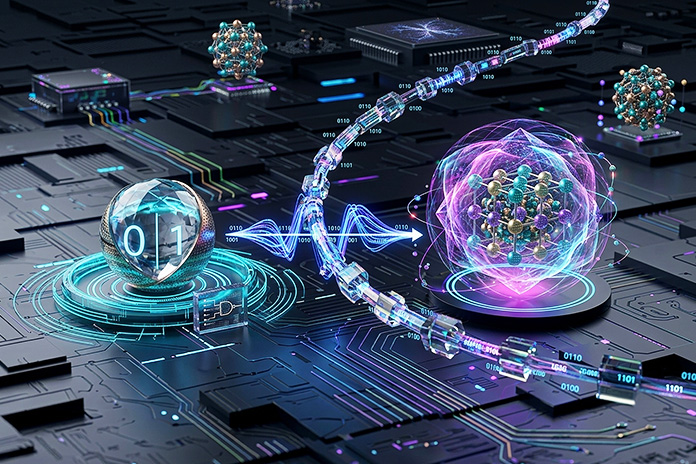
Imagine Solving the Impossible
What if problems that would take today’s most powerful supercomputers thousands of years to solve could be completed in just minutes?
This remarkable possibility is no longer confined to science fiction. It is the promise of quantum computing—a revolutionary quantum technology that could transform the way we solve problems, discover new medicines, secure digital communications, and understand the universe itself.
As we move from the age of digital computing to the era of quantum computing technology, humanity stands at the beginning of a new chapter in technological innovation. This development represents an important step in quantum innovation, quantum science, and the broader field of emerging technologies.
The Digital Revolution That Changed the World
For over seventy years, digital computers have driven scientific progress, economic growth, and technological development. From smartphones and laptops to Artificial Intelligence and space exploration, digital computing forms the backbone of modern society.
Traditional computers process information using bits, the smallest units of data. A bit can exist in only one of two states:
- 0
- 1
By combining billions of these bits through sophisticated electronic circuits, digital computers perform calculations, process information, and execute complex tasks with incredible speed.
However, some problems are so complex that even the most advanced classical computers struggle to solve them efficiently. Understanding the difference between bits and qubits is therefore essential to understanding the next generation of computing.
Enter the Quantum Era
Quantum computing introduces an entirely new way of processing information.
Instead of bits, quantum computers use quantum bits, or qubits. Unlike classical bits, qubits can exist in multiple states simultaneously, allowing quantum computers to process information in fundamentally different ways.
This extraordinary capability arises from the unique laws of quantum mechanics and forms the foundation of quantum information.
The Four Core Principles of Quantum Computing
- Superposition
Superposition allows a qubit to exist as a combination of both 0 and 1 at the same time.
Rather than choosing a single state, qubits can represent many possibilities simultaneously, dramatically increasing computational potential.
- Entanglement
Entanglement is a phenomenon in which qubits become interconnected.
When qubits are entangled, the state of one qubit is linked to the state of another, regardless of distance. This correlation enables powerful information processing capabilities far beyond classical systems.
- Interference
Quantum interference helps amplify correct answers while suppressing incorrect ones.
By carefully manipulating quantum states, quantum algorithms guide computations toward the most probable solutions.
- Decoherence
Decoherence occurs when a quantum system loses its quantum properties due to interaction with its environment.
Heat, vibration, and electromagnetic disturbances can disrupt qubits, making decoherence one of the biggest challenges in building reliable quantum computers.
Together, these concepts explain the principles of quantum computing and help us understand how quantum computing works.
How Quantum Computation Works
Quantum computing combines superposition, entanglement, and interference to perform calculations.
A quantum algorithm first prepares qubits in a superposition of possible states. Quantum operations then entangle these qubits and create interference patterns that enhance desirable outcomes while eliminating unlikely ones.
When the system is measured, the most probable solution emerges.
This process allows quantum computers to tackle certain classes of problems far more efficiently than classical machines. Understanding how quantum computing works is becoming increasingly important for students and researchers interested in computer science careers, engineering research, and technology education.
Digital Computing vs. Quantum Computing
While classical computers remain highly effective for everyday tasks, quantum computers offer significant advantages for specialized applications.
Classical Computing Excels At:
- Word processing
- Internet browsing
- Software applications
- Financial transactions
- Database management
Quantum Computing Shows Promise In:
- Cryptography and cybersecurity
- Drug discovery
- Molecular simulation
- Climate and weather modeling
- Artificial intelligence optimization
- Financial forecasting
- Logistics and supply chain optimization
- Advanced materials design
These areas highlight some of the most important quantum computer applications, including quantum computing in AI, cybersecurity, scientific research, and advanced optimization.
Rather than replacing classical computers, quantum systems are expected to complement them by solving problems beyond the reach of conventional computing.
Why Quantum Computing Matters
Many real-world challenges involve an enormous number of variables and possible combinations.
For example:
- Finding new medicines requires simulating molecular interactions.
- Optimizing transportation networks involves millions of potential routes.
- Designing clean-energy materials demands analysis of complex atomic structures.
Classical computers often require immense computational resources for such tasks.
Quantum computers could dramatically reduce the time needed to solve these problems, accelerating innovation across multiple industries. These possibilities demonstrate the importance of the future of quantum computing and its potential contribution to research and innovation.
Understanding Different Types of Qubits
Researchers are exploring several technologies to build practical quantum computers.
Superconducting Qubits
These are created using superconducting circuits operating at extremely low temperatures. They offer fast processing and precise control.
Trapped-Ion Qubits
Individual ions are confined using electromagnetic fields. These qubits provide excellent stability and accuracy but generally operate more slowly.
Quantum Dots
Quantum dots are tiny semiconductor structures capable of trapping individual electrons. They offer promising scalability and compatibility with existing semiconductor technologies.
Photonic Qubits
Photons, or particles of light, can carry quantum information over long distances, making them highly valuable for quantum communication and cryptography.
These approaches represent the continuing development of quantum computing technology and the wider field of quantum science.
Why Are Qubits So Powerful?
Imagine trying to escape a complex maze.
A classical computer would examine one path after another until it finds the correct route.
A quantum computer approaches the problem differently. Through quantum interference, it increases the probability of correct solutions while reducing the likelihood of incorrect ones.
Although quantum computers do not literally test every path simultaneously, they use quantum mechanical effects to arrive at solutions far more efficiently for certain types of problems.
This unique capability is what makes quantum computing so powerful and explains what are qubits in quantum computing and why they are central to the development of quantum technology.
Challenges on the Road Ahead
Despite its enormous potential, quantum computing is still in its early stages.
Several challenges remain:
- Maintaining stable quantum states
- Reducing decoherence
- Developing effective error-correction systems
- Scaling quantum processors to larger numbers of qubits
- Building affordable and reliable hardware
Researchers worldwide are actively addressing these obstacles, bringing practical quantum computing closer to reality. This ongoing work creates opportunities for engineering innovation, engineering research, and students pursuing Computer Science Engineering, Artificial Intelligence, Data Science, and Cyber Security.
Collaboration, Not Competition
A common misconception is that quantum computers will replace traditional computers.
The future is more likely to involve collaboration.
Classical computers will continue to perform everyday computing tasks efficiently, while quantum computers will act as specialized problem-solving engines for highly complex computations.
Just as calculators enhanced rather than replaced human mathematical abilities, quantum computers will expand the capabilities of classical computing systems.
This collaborative future highlights the importance of future of engineering, technology trends, and interdisciplinary STEM education.
The Beginning of a Quantum Future
The transition from bits to qubits represents one of the most significant technological shifts of the twenty-first century.
Digital computing built the modern world. Quantum computing has the potential to unlock discoveries that were once considered impossible—from revolutionary medicines and sustainable energy solutions to breakthroughs in artificial intelligence and fundamental science.
The age of quantum intelligence is no longer a distant dream. It is rapidly becoming a reality, and its impact may be as transformative as the internet itself.
As we stand at the frontier of this new era, one thing is certain: the journey from bits to qubits has only just begun.
This version is suitable for a university blog, magazine article, outreach publication, or science communication portal. It also highlights the growing relevance of engineering education, engineering students, Computer Science Engineering, Artificial Intelligence, Data Science, and Cyber Security in preparing learners for the future of quantum technology.