
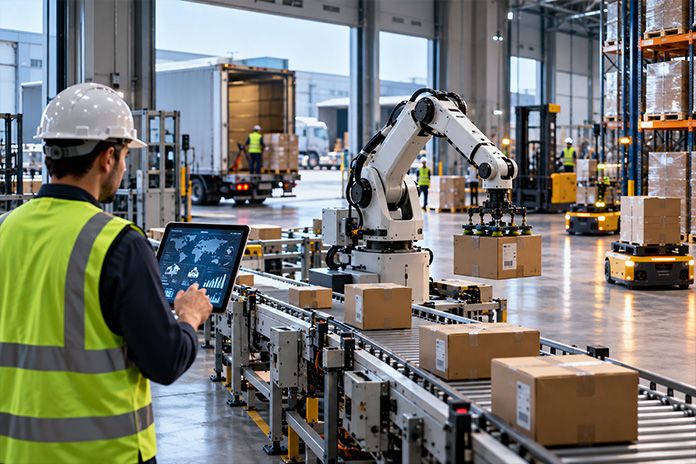
Walk into a modern fulfilment centre and the first thing you notice is how little walking anyone does. Goods-to-person robots bring shelves to a stationary picker. Conveyor sorters read barcodes at speeds no human eye can follow. Automated storage and retrieval systems stack pallets fourteen metres high in aisles too narrow for a forklift to enter. At the country’s larger container terminals, rail-mounted gantry cranes move boxes under software supervision, and yard trucks increasingly run on pre-mapped routes without a driver. What used to be a labour-intensive business has become a supervised machine business, and the change has arrived faster in India than most people expected. This is the reality of supply chain automation in India, where warehouse automation and other forms of logistics automation are increasingly becoming part of everyday operations.
The visible robots are only part of it. A great deal of supply chain automation is invisible, sitting inside software. Warehouse management systems now decide slotting, replenishment, and pick paths without being asked. Transport management systems build multi-drop routes against live traffic and fuel prices. Demand planning engines read point-of-sale data, weather feeds, and promotional calendars to forecast what a distribution centre will need six weeks from now. Robotic process automation in logistics handles the repetitive clerical work that once consumed entire back offices — generating e-way bills, reconciling freight invoices against contracts, filing customs declarations, chasing carriers for status updates. Supply chain control towers pull all of it onto a single screen so that an exception in Chennai is visible to a planner in Gurugram within seconds.
This raises an obvious and uncomfortable question for anyone entering the field: if machines are doing the work, what is left for the graduate? The answer is that automation has not reduced the number of decisions in a supply chain. It has changed who makes them and how quickly. A system can reroute a shipment, but someone has to decide whether the customer relationship justifies the cost of air freight. A forecasting model can flag a demand spike, but someone has to renegotiate with the supplier whose capacity cannot absorb it. Software will optimize a network within the constraints it is given; deciding what those constraints should be — how many warehouses, located where, serving which service levels — remains a management judgement with real money attached to it. Automation punishes the person who only knows how to execute a process and rewards the person who understands why the process exists.
That shift is exactly what the MBA in Supply Chain and Logistics is built around. The program treats technology as a subject to be managed rather than merely operated, which means students work through procurement strategy, supply chain network design, inventory management, demand planning, global trade regulation, and supply chain risk management before applying automation to any of it. Courses are designed and delivered with industry, and CII Institute of Logistics — a Centre of Excellence for the Confederation of Indian Industry — serves as the industry partner, which keeps the content aligned with what companies are actually implementing rather than what textbooks described five years ago. Students work on real-world simulations and case decisions, get hands-on exposure to the software platforms used across the profession, and go on field visits where automated facilities can be observed in operation instead of in a slide deck. Guaranteed internships and placements in relevant industries close the loop between what is taught and where it gets used.
The BBA in Cargo, Logistics and Supply Chain Management approaches the same change from the ground up, and that difference matters. Someone who will spend a career supervising automated operations needs to understand the physical and documentary reality underneath the software. Cargo handling, freight forwarding, customs procedure, multimodal transport, warehousing operations, and shipping documentation are taught as working knowledge, not background theory — because a graduate who cannot read a bill of lading or explain why a consignment is held at a port will not be able to tell when the system is wrong. Three years of industry exposure, software familiarity, field visits, and structured internships give students operational fluency early, at the stage of their careers when it is most useful and hardest to acquire on the job.
Read together, the two programs cover the full span that automation has created. The BBA produces professionals who can run and supervise automated operations with confidence about what is happening on the floor and in the paperwork. The MBA produces professionals who decide what should be automated, what it should cost, and what the organisation does when the technology encounters a situation nobody anticipated. Many students move through both, and the sequence works well — the operational grounding of the first makes the strategic content of the second far less abstract.
Supply chains will keep automating, and the pace is unlikely to slow. Warehouse robotics, autonomous yard movement, port digitisation, and AI-assisted supply chain planning are all moving from pilot projects into standard practice. What that creates is not a smaller profession but a differently skilled one, and the demand for people who can work at that level continues to outrun supply. The graduates who will do well are the ones who arrive already knowing how the machines think — and, more importantly, where their thinking stops. This is why supply chain skills, supply chain technology skills, and strong digital capabilities are becoming increasingly important for people building supply chain careers.