There are bugs you cannot explain, features that take longer than expected, and at least one moment when you wonder why you started the project in the first place. Eventually, it works. You are happy with it.
Then comes the next question: What do you do with it?
Put it on GitHub? Share it on LinkedIn? Add it to your resume? Build a portfolio around it? Or simply move on to the next project?
For today’s CSE students, building something and being visible online have increasingly become part of the same conversation. Students are encouraged to maintain GitHub profiles, share projects on LinkedIn, participate in hackathons, create portfolios, and document their learning.
For students pursuing a B.Tech in Computer Science, the idea of build in public for students has also become part of discussions around professional growth and technical visibility.
That can be useful.
But somewhere along the way, showcasing work can start becoming more important than actually doing the work.
And that is where students need to find a balance.
Your Work Does Not Become Valuable Because You Posted It
A LinkedIn post can tell people that you built an application.
It cannot make the application good.
A polished portfolio can make your work easier to discover.
It cannot replace the technical understanding behind that work.
This distinction is easy to forget because social media gives us immediate feedback. A project post gets likes, comments, and congratulations. For a student, that can feel like progress.
But technical growth is often much quieter.
It happens while debugging an API that refuses to respond. While trying to understand why a database query is slow. While reading documentation for the third time because the first two attempts didn’t make sense.
Those moments rarely make exciting social media posts.
They are still the moments when learning happens.
So, Should You Share Your Work?
Yes—when there is something worth sharing.
You don’t need to hide your projects until graduation. If you have built something useful, solved an interesting problem, participated in a hackathon, or learned something valuable through a difficult technical experience, sharing it can help others discover your work.
These are some of the benefits of building projects in public, especially when students want their work to reach people with similar technical interests.
It can also help you build a professional presence over time.
A recruiter, developer, faculty member, or potential collaborator who comes across your profile should be able to understand what interests you and what you have actually worked on.
The important word is actually.
Your online profile should reflect your work, not replace it.
Think About What Happens After Someone Sees Your Post
Suppose you publish a post saying, “Built my first AI application.”
Someone finds it interesting.
What happens next?
Can they see the project? Is the repository available? Is there a short explanation of how it works? Can they understand what part you built yourself? Are you able to explain the choices you made?
This is where GitHub, a personal portfolio, or a project demonstration becomes useful.
The social media post may attract attention, but the project provides the evidence.
That combination is much stronger than a post by itself.
Understanding how to showcase projects effectively means giving others an opportunity to explore the work behind your claims. Similarly, learning how to showcase coding projects on LinkedIn can help students present their work with relevant explanations and project links.
Your GitHub Doesn’t Need to Look Busy
There is another trap students often fall into: trying to make their GitHub profile look active at all costs.
A large number of repositories can look impressive at first glance, but quantity doesn’t necessarily tell someone how much you know.
Five tutorial projects copied without understanding them are not automatically more valuable than one application you designed, developed, tested, and improved yourself.
Your GitHub should tell a story.
Perhaps your early projects are simple. Later, you start using databases and APIs. Eventually, you deploy an application or work with more complex systems.
That progression is useful.
It shows that you are learning and becoming more capable.
A well-organised GitHub portfolio for students can reflect this development. Understanding how to build a strong GitHub portfolio as a student involves maintaining meaningful repositories, writing clear documentation, and highlighting genuine contributions.
You Don’t Have to Share Everything
There is nothing wrong with keeping some projects private.
Sometimes you are experimenting. Sometimes the code is incomplete. Sometimes you are learning a technology and don’t yet understand what you are doing well enough to explain it.
You don’t need an audience for every stage of your learning.
In fact, students sometimes need exactly the opposite: a space where they can build badly, make mistakes, change their minds, and start again without worrying about how the work looks to everyone else.
Not everything needs to become content.
Some things simply need to become experience.
But Don’t Be Afraid to Explain What You Learned
When you do share a project, move beyond the announcement.
Instead of writing only that you built an application using a particular technology, tell people something interesting about the process.
Maybe you initially selected the wrong approach and changed it. Perhaps you struggled with authentication. Maybe your first database design created problems later. Perhaps you learned something about performance that you hadn’t understood before.
These details make a project more human and more credible.
They also demonstrate something that a technology list cannot: how you think.
This is where documenting coding journey experiences becomes meaningful, as students can explain their challenges, decisions, and improvements rather than simply listing the technologies they used.
Building in Public Is Not the Same as Performing Productivity
There is a subtle difference between documenting your learning and constantly trying to prove that you are productive.
One is useful.
The other can become exhausting.
You don’t need to post every coding problem you solve. You don’t need to announce every course completion. You don’t need to create a motivational post every time you study for two hours.
Your professional identity does not depend on constant updates.
Sometimes the best thing you can do for your profile is close LinkedIn, open your editor, and spend the evening actually building something.
Meaningful personal branding for students should reflect genuine progress rather than the pressure to maintain constant online activity.
Let Your Online Presence Support Your Career
Think of your online presence as an extension of your work.
Your resume gives someone a quick overview.
Your LinkedIn profile provides context.
Your GitHub can provide evidence.
Your portfolio can bring everything together.
A thoughtfully organised project portfolio for CSE students can connect these different platforms and support a professional online presence for software developers.
None of these should exist independently of your actual skills.
If your online profile says you are interested in Android development, there should ideally be something that demonstrates that interest.
If you talk about AI, there should be evidence that you have explored it beyond a few buzzwords.
If you describe yourself as a developer, your work should give people something to examine.
The goal isn’t to create a perfect digital identity.
It is to make your real work easier to discover.
For students exploring LinkedIn for CSE students, the platform can be useful to showcase coding projects and connect with industry professionals. At the same time, building a developer portfolio offers a way of showcasing technical skills through practical examples and completed work.
Build First. Share When You Have Something to Say.
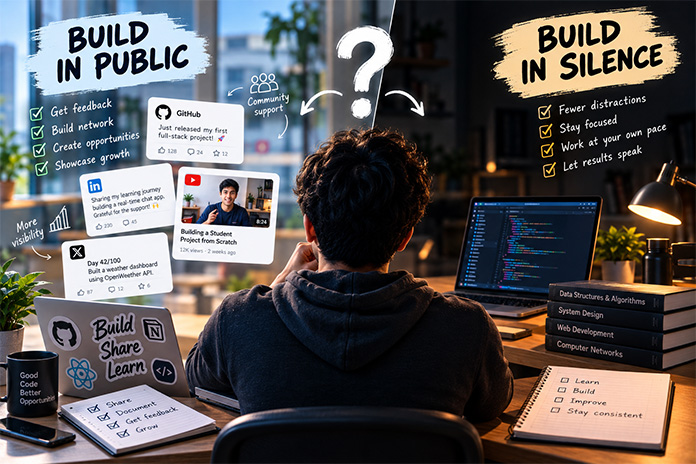
There is no universal answer to whether students should build in public or build in silence.
Some people learn by documenting their journey. Others prefer to work privately and share only finished projects.
Both approaches can work.
What matters is keeping the priorities in the right order.
Build before you showcase. Learn before you claim expertise. Understand before you explain.
When you eventually share your work, let the post point towards something real.
Because in the end, the most impressive thing about a student’s online presence isn’t how often they post.
It is whether, behind all those posts, there is genuine work worth discovering.