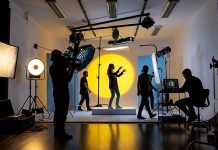
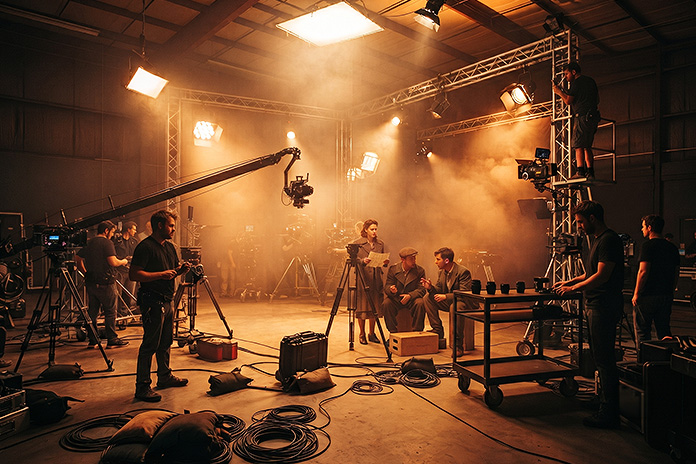
When you envision a director on set, the image is universal: a creator peering through a viewfinder or framing a shot with that iconic rectangular hand gesture. While these gestures are the hallmarks of the craft, they are deceptive. They suggest that the “work” is happening in the moment. In reality, the rolling of the camera is the final step in a marathon of designing, arranging, and framing.
This is the “last piece in a puzzle” known as Mise en Scène. Far from a dusty academic term, it is the secret language of visual storytelling and film language. It explains why a single, silent frame from a masterpiece can feel heavy with meaning, while a big-budget blockbuster can often feel visually hollow. Understanding what is mise en scène helps filmmakers and audiences analyze how images communicate emotions, themes, and narratives.
It’s More Than Just “Placing on Stage”
The term originates from French theater, literally meaning “placing on stage.” In the theater, it’s about where the actors stand and where the chairs go. In cinema, the stakes are much higher.
In filmmaking and film production, mise en scène represents the combination of visual elements that shape the meaning of a scene. It is one of the most important concepts for anyone learning film direction and movie directing.
The legendary French critic André Bazin famously championed this concept by dividing filmmaking into two distinct philosophies: Montage and Mise en Scène.
- Montage filmmakers build meaning through the “collision” of shots—the cut is the storyteller.
- Mise en Scène filmmakers concentrate the entire narrative weight within the boundaries of a single image.
Look at the legendary deep-focus shots in Citizen Kane. In one specific sequence, we see young Charles Foster Kane playing joyfully in the snow through a window, while in the foreground, his father and a banker sign away the boy’s future. Through Staging, Composition, and Deep Focus, Orson Welles reveals the entire power dynamic of the film without a single edit.
“The uninterrupted take allows us to interpret all of these dynamics ourselves at our own pace without editing.” — André Bazin’s philosophy.
This approach demonstrates the importance of mise en scène in filmmaking and how directors use visual elements to create deeper meaning within cinema.
The Counter-Intuitive Role of Sound: Auditory Counterpoint
While traditionalists might limit Mise en Scène to what is strictly visible, a modern visual strategist knows that a frame is incomplete without its auditory layer. Sound design isn’t just an “add-on”; it is an environmental force that informs our interpretation of the visual space.
Think of it as auditory counterpoint. When the visual frame suggests one thing and the sound suggests another, the “meaning” of the shot exists in the friction between the two. The “overall meaning of a shot” is a total sensory experience where the ear validates what the eye suspects.
This connection between visuals and sound highlights the depth of cinematic storytelling and the advanced visual storytelling techniques in film used by professional directors.
The Filmmaker’s Math Problem: 2 + 2 = One Shot
To master this, you have to view the frame as a functional equation. It’s a daunting task to face a blank set, which is why the “Math Problem” analogy is so vital for intentionality:
[Lighting + Props + Set Design + Staging] = One Shot
In a masterfully directed film, there are no accidents. Every variable in this equation is calculated. If you change just one variable—say, you swap a warm, soft light for a harsh, blue one—you don’t just change the look; you change the “sum” of the entire shot. Every prop and every shadow is a deliberate choice made to serve a singular vision.
This demonstrates how how lighting affects storytelling, the role of production design in filmmaking, and how cinematography supports storytelling are essential parts of effective film direction techniques.
Naturalism vs. Theatricality
Directors generally lean into one of two traditions to execute their visual strategy:
- Naturalistic Mise en Scène: Here, the world is designed to mirror our own. It is familiar, grounded, and meticulously realistic. Think of the considered, clinical environments of a David Fincher film, where the world feels authentic to the story’s reality.
- Theatrical Mise en Scène: This approach embraces the exaggerated and the Expressionist. Think of Tim Burton’s strange, distorted worlds. The sets, costumes, and props are intentionally “unnatural,” drawing our attention to the artifice to create a specific emotional or surrealist effect.
The choice between the two isn’t about quality; it’s about alignment. Does the visual world support the internal logic of the script?
Understanding these approaches helps students and filmmakers learn directing techniques and develop skills to perform detailed mise en scène analysis while studying cinema.
Kubrick’s Horror of the High-Key
Stanley Kubrick’s The Shining is perhaps the ultimate masterclass in unsettling Mise en Scène. Consider the famous shot of Danny playing on the floor of the Overlook Hotel:
- Production Design: The carpet features a striking, maze-like pattern. This isn’t just a design choice; it’s a geometric claustrophobia. It visually traps the child, echoing the literal maze outside.
- Cinematography: Kubrick subverts the genre by using High-Key lighting. In a horror film, we expect shadows and darkness. By keeping everything bright and even, Kubrick removes any place for the monster to hide, creating a sense of being watched from every angle. The high angle and slow zoom-out make the boy appear tiny and trapped.
- Auditory Counterpoint: We hear the innocent, mundane vocalizations of a child playing with toy vehicles, contrasted against the ominous, low-frequency swelling of the musical score.
- Blocking: The “cherry on top” is the introduction of a new prop—a yellow ball that rolls into the frame from an unseen source.
“All of this adds up to making him appear isolated and vulnerable.”
In this one shot, without a word of dialogue, the Mise en Scène tells us everything: Danny is no longer alone, and the environment itself is hostile.
This scene is an excellent example of mise en scène in film, showing how professional directors combine cinematography, lighting, blocking, and production design to create unforgettable cinematic moments.
The Final Frame: A Challenge to the Reader
Great Mise en Scène is the bridge between the director’s imagination and the crew’s execution. It requires rigorous preparation—breaking down the script into its base elements and using storyboards to “see” the film before it exists. This preparation is how a director shares their vision with department heads, ensuring the Production Designer and the DP are all solving the same “math problem.”
For students interested in film production education, understanding mise en scène is essential for developing skills in filmmaking, cinematography, and visual analysis.
Next time you watch a film, don’t just let the images wash over you. Pause the movie on a single, striking frame and ask yourself: “What is this one shot telling me that the dialogue isn’t?”
Visual storytelling is the art of the big picture, but that big picture is only as strong as the smallest, most intentional detail in the corner of the frame.