Mathematics is often seen as a subject limited to classrooms, formulas, and examinations. However, in reality, it is deeply woven into the fabric of our daily lives. From predicting the weather to managing household expenses, and now powering intelligent technologies like Artificial Intelligence (AI), mathematics plays a silent yet transformative role in shaping how we live, decide, and innovate in our daily routine.
I am a Professor in the Department of Mathematics at Lovely Professional University, with a research background in applied mathematics and computational methods. My research bridges theoretical concepts with practical applications, particularly in areas such as numerical methods, differential equations, and emerging intersections of mathematics with Artificial Intelligence. Through teaching, research, and outreach, I aim to make mathematics more accessible, relevant, and impactful for students and society.
Mathematics Around Us: Simple Yet Powerful
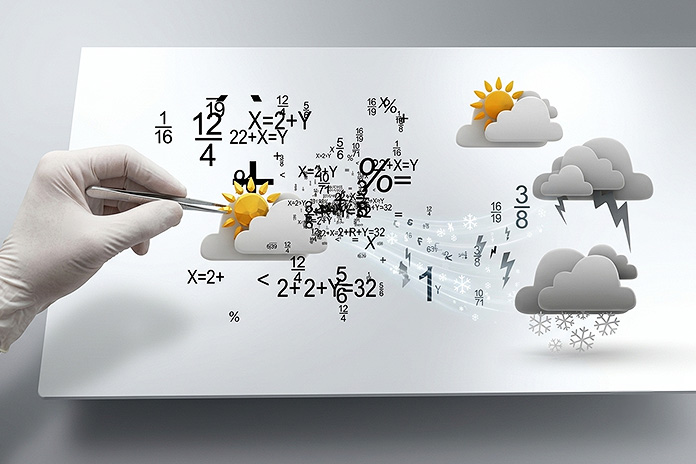
One of the most familiar applications of mathematics is weather forecasting. Each time we check whether it will rain or be sunny, we rely on mathematical models built using vast atmospheric data. Variables such as temperature, pressure, humidity, and wind speed are analyzed using equations and numerical methods. These mathematical models are based on the concept of change—how one variable affects another over time. In essence, mathematics helps convert raw data into meaningful predictions, enabling us to plan our day, support agriculture, and prepare for natural disasters.
These are some of the most visible practical applications of mathematics in everyday life. They demonstrate how mathematics is used in everyday life to solve problems, analyze situations, and make informed decisions.
Another simple yet powerful example is managing market expenses. Every household uses mathematics while budgeting. Whether calculating the total cost of groceries, comparing discounts, or estimating monthly savings, basic arithmetic and percentages guide our financial decisions. When evaluating offers like “30% discount” or deciding between two products based on price and quantity, each one of us is unknowingly applying mathematical reasoning.
This ability to analyze, compare, and optimize choices is a direct outcome of mathematical reasoning. It reflects the practical use of mathematics in finance, where calculations help individuals make better decisions related to spending, saving, and planning.
Another practical scenario where mathematics plays a crucial role is in understanding university fees and scholarships. When a student evaluates admission options, they often need to calculate tuition fees, hostel charges, and other expenses while also considering scholarships or fee waivers.
For instance, if a student is awarded a 40% scholarship on tuition fees, the student must determine the reduced payable amount and compare it with other institutions. Additionally, decisions such as choosing installment plans, evaluating return on investment of a course, or estimating future earnings involve percentages, ratios, and basic financial calculations.
The process of mathematics in university fee calculation is not just about numbers—it reflects analytical thinking and informed decision-making, demonstrating how mathematics empowers students to make practical and impactful choices about their education and future.
These everyday examples highlight an important truth: mathematics is not about memorizing formulas, but about developing a mindset of logical thinking and structured problem-solving.
From Daily Life to Intelligent Systems
While these applications are familiar, mathematics extends far beyond them into modern technological advancements—particularly Artificial Intelligence (AI). Mathematics and artificial intelligence are deeply connected, as AI systems rely on mathematical principles to process information, identify patterns, and make decisions.
Mathematics, especially calculus, forms the backbone of intelligent systems. AI is not merely about machines mimicking human intelligence; it is about using mathematical frameworks to process, analyze, and interpret vast amounts of data.
At the core of AI lies machine learning, where systems learn from data and improve over time. This learning process is inherently mathematical. Machine learning mathematics helps AI systems understand patterns, generate predictions, and improve performance.
Algorithms identify patterns, make predictions, and refine their performance using optimization techniques. These optimization techniques in AI allow models to achieve better results by continuously improving their accuracy. Calculus enables AI systems to enhance accuracy and efficiency by analyzing how changes in parameters affect outcomes.
The Role of Calculus: The Engine Behind AI
Calculus, often perceived as abstract, is in fact a practical and powerful tool. It deals with rates of change (differentiation) and accumulation (integration)—concepts essential for understanding dynamic systems.
The role of calculus in machine learning is significant because AI models aim to minimize errors between predicted and actual outcomes. The concept of derivatives helps determine how to adjust model parameters to reduce errors effectively.
One of the most important techniques in AI is gradient descent in AI, which uses derivatives to iteratively improve model performance. Similarly, in neural networks—the foundation of modern AI—calculus is used in backpropagation, a process that computes derivatives to update weights and biases, enabling the system to learn.
In simple terms, calculus helps machines “learn from mistakes” and continuously improve—much like humans do.
Expanding the Perspective: Mathematics as a Universal Language
What makes mathematics truly remarkable is its universality. The same principles that help us manage daily expenses or interpret weather patterns are also used to build intelligent systems.
Mathematics connects simple observations to complex innovations through mathematical concepts in artificial intelligence, computational mathematics, and applied mathematics.
For instance:
- When we budget our expenses, we optimize limited resources.
• When AI models are trained, they optimize performance by minimizing error.
• When we observe weather changes, we analyze patterns over time.
• When AI predicts outcomes, it uses mathematical models to understand change.
This parallel shows that mathematics is not divided into “basic” and “advanced” in terms of relevance—it is a continuous spectrum of ideas applied at different levels of complexity.
Looking Ahead: Mathematics in the Age of AI
As we move further into a data-driven world, the role of mathematics will only become more significant. Artificial Intelligence, data science, and computational technologies are all deeply rooted in mathematical concepts.
Mathematics for data science and AI has become increasingly important as industries rely on algorithms, statistics, and computational methods to solve complex problems. Calculus, linear algebra, probability, and statistics are not just academic subjects—they are the tools shaping the future.
The growing integration of mathematics with AI also opens new opportunities in research, innovation, and education. It encourages learners to move beyond rote learning and focus on understanding concepts, exploring applications, and developing critical thinking skills. This highlights the importance of mathematics in education and technology.
Conclusion
Mathematics is far more than numbers and equations—it is a way of thinking, analyzing, and solving problems. From everyday tasks like managing expenses and checking the weather to advanced technologies like Artificial Intelligence, mathematics remains at the core of human progress.
The importance of mathematics in artificial intelligence can be seen through AI algorithms, machine learning systems, and intelligent technologies that depend on mathematical foundations.
By recognizing its presence in our daily lives and its role in shaping the future, we can develop a deeper appreciation for mathematics. It is not just a subject to be studied, but a powerful language that connects our everyday experiences with the intelligent systems of tomorrow.