- Why Choose B.Design User Interface/ User Experience (UI/UX)?
- What Is UI/UX Design?
- Emerging Trends in the UI/UX Industry
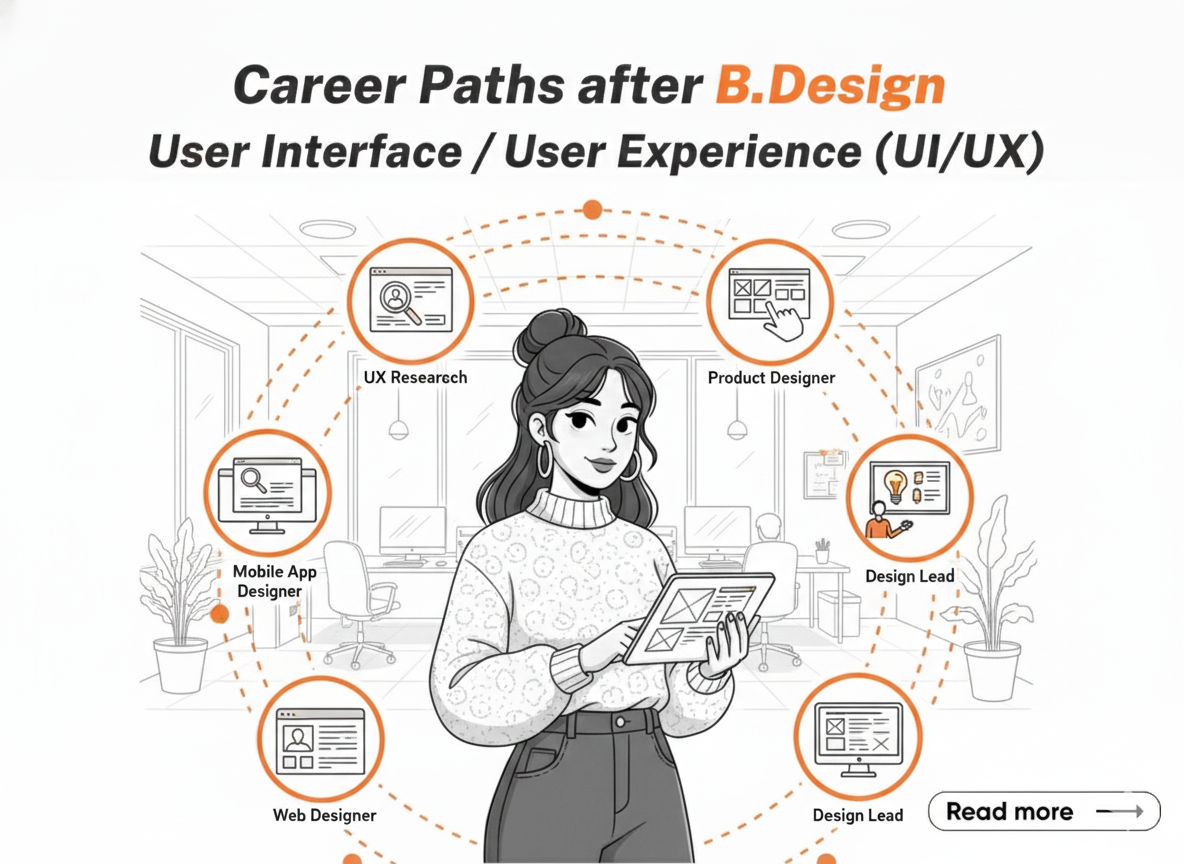
- Career Opportunities in User Interface Design
- Career Opportunities in User Experience Research and Strategy
- Product Design and Interaction Design: Scope and Prospects
- Entrepreneurship in UI/UX and Digital Product Design
- Top Skills You’ll Develop in B.Design User Interface/ User Experience (UI/UX)
- Professional Certifications and Specializations
- Salary Expectations and Career Growth in UI/UX Design
- Freelancing and Consulting Opportunities
- Global Career Prospects in UI/UX Design
- Conclusion
- Frequently Asked Questions (FAQs)
Why Choose B.Design User interface/ User Experience (UI/UX) ?
In today’s digital-first world, user experience (UX) and user interface (UI) design have become essential to how people interact with technology. From mobile apps and websites to smart devices and virtual environments, design is what connects users to innovation. B.Design User interface/ User Experience (UI/UX) offers the perfect blend of creativity, psychology, and technology—equipping students with the skills to craft intuitive, meaningful, and user-centered digital experiences.
Choosing a career in UI/UX design opens the door to a dynamic and rewarding field that balances artistic vision with problem-solving. As industries increasingly focus on digital transformation, the demand for skilled designers who can create seamless, human-centered interfaces continues to rise. UI/UX professionals play a key role in shaping how people interact with products and services, making this career both impactful and future-oriented.
A UI/UX design degree not only provides technical and creative training but also helps develop a strong understanding of user behavior, research methods, design thinking, and emerging technologies. Students gain hands-on experience with tools, prototyping, and real-world projects, preparing them for diverse roles such as UX Designer, UI Designer, Interaction Designer, or Product Designer.
Choosing a B.Design User interface/ User Experience (UI/UX) at Lovely Professional University is an excellent decision for students who want to combine creativity, technology, and user-centered problem-solving into a meaningful career.
LPU’s programme focuses on developing strong design thinking, visual communication, and interaction design skills through a curriculum that blends theory with hands-on practice. Students gain exposure to real-world projects, industry internships, and workshops conducted by experienced professionals, helping them understand how to design intuitive, user-friendly digital products.
The university’s state-of-the-art design studios, labs, and collaborative environment encourage innovation and experimentation. With industry tie-ups, mentorship from experts, and a focus on emerging technologies like human-computer interaction and digital product design, the course prepares graduates for high-demand roles such as UI Designer, UX Researcher, Interaction Designer, and Product Designer.
Pursuing a B.Design User interface/ User Experience (UI/UX) at Lovely Professional University empowers students to become innovative thinkers and skilled professionals in one of the fastest-growing creative fields. The programme’s balance of design principles, user research, and cutting-edge technology ensures that graduates are not only job-ready but also capable of shaping meaningful digital experiences.
What Is UI/UX Design?
UI/UX design refers to the process of creating digital products—like websites, apps, or software—that are not only visually appealing but also easy and enjoyable to use. It focuses on how users interact with a product, how it looks, feels, and functions. UI/UX design combines creativity, psychology, and technology to ensure that every interaction between the user and the product is smooth, efficient, and satisfying.
UI (User Interface) Meaning-
User Interface (UI) design is all about the visual and interactive elements of a digital product. It includes everything the user sees and interacts with on the screen—such as buttons, icons, menus, colors, typography, and layout. The goal of UI design is to make the product visually attractive, consistent, and intuitive so that users can navigate it easily.
UX (User Experience) Meaning-
User Experience (UX) design focuses on the overall experience a user has while using a product or service. It’s not just about how something looks, but how it feels and works. UX designers research user needs, behaviors, and pain points to create solutions that make interactions simple and meaningful. This process often includes user research, information architecture, wireframing, prototyping, and usability testing.
For example, UX design ensures that when you use an e-commerce app, finding a product, adding it to your cart, and checking out feels smooth and logical.
- UI and UX design are closely connected and depend on each other. While UX design builds the structure and flow of the experience, UI design brings it to life with visuals and interactivity.
- Together, they create a complete product that is both functional and visually engaging. A great digital product requires both: an appealing interface (UI) and a seamless experience (UX).
- UI/UX design plays a vital role in shaping how people interact with digital products in today’s technology-driven world. While User Interface (UI) design focuses on the visual appeal and interactive elements, User Experience (UX) design ensures that the product is easy to use, efficient, and satisfying for the user.
Together, they create designs that are both beautiful and functional, bridging the gap between human needs and digital innovation.
By combining creativity, research, and technology, UI/UX design not only enhances user satisfaction but also drives the success of modern products and services.
Emerging Trends in the UI/UX Industry
The future of UI/UX design in 2025 is shaped by innovation, personalization, and a deeper understanding of human behavior.
Emerging technologies like AI-driven personalization, voice and gesture interfaces, and immersive AR/VR experiences are redefining how users interact with digital products such as-
1. AI-Powered Personalization & Adaptive Interfaces
Designers are using artificial intelligence to tailor interfaces in real time based on user behaviour, preferences and context.
2. Voice, Gesture & Multimodal Interfaces
Interfaces are moving beyond taps and clicks to include voice commands, gestures and sometimes even facial or gaze input.
3. Immersive Experiences (3D, AR/VR, Mixed Reality)
Expect more use of 3D graphics, augmented reality overlays, virtual reality environments and mixed-reality experiences.
4. Visual Style Evolutions: Glassmorphism, Neumorphism, Bold Typography
Design aesthetics are evolving. Styles like glassmorphism (frosty translucent layers), neumorphism (soft shadows, extruded elements) and bold typography are gaining traction.
5. Micro-interactions & Motion Design / Feedback Loops
Small animations and feedback systems (like button hover effects, animated transitions) are being refined and used purposively.
6. Inclusive Design & Digital Well-being / Sustainability
Design isn’t just about visuals or novelty — it is also about accessibility, ethical use, sustainability, and digital well-being (e.g., reducing eye-strain, supporting users with disabilities)
As the line between the physical and digital worlds continues to blur, the role of UI/UX designers becomes more crucial than ever—combining creativity, empathy, and technology to craft experiences that are not only functional but also emotionally engaging.
The future belongs to designers who can adapt, innovate, and design with purpose, creating experiences that truly connect people with technology.
At the same time, designers are focusing more on accessibility, sustainability, and ethical design, ensuring that technology serves everyone in meaningful ways.
Career Opportunities in User Interface Design
A UI (User Interface) Designer plays a vital role in shaping how users interact with digital products such as websites, mobile apps, and software. Their main responsibility is to design the visual and interactive elements—buttons, icons, color schemes, typography, layouts, and animations—that make digital experiences attractive, intuitive, and easy to use.
UI design offers diverse career paths and excellent growth potential. With experience, professionals can advance to senior positions such as:
- Senior UI Designer
- Lead Product Designer
- Design Manager or Art Director
- Creative Director
- UX/UI Consultant or Freelance Designer
Popular UI Design Roles
- UI Designer: Focuses on visual interface design and interaction elements.
- Visual Designer: Works on branding, aesthetics, and visual storytelling for digital platforms.
- Interaction Designer: Specializes in creating engaging and intuitive user interactions.
- Product Designer: Oversees both UI and UX aspects, ensuring the product meets business and user goals.
- Mobile App Interface Designer: Designs app interfaces optimized for smartphones and tablets.
UI designers are also in high demand in startups, IT companies, creative agencies, and global tech giants. Their skills are valuable not only in design but also in marketing, branding, and user research roles.
UI design is a dynamic and rewarding career that blends creativity, technology, and human-centered thinking. A skilled UI designer has the power to make digital products not only functional but also visually engaging and emotionally appealing.
As technology evolves, UI professionals who stay updated with new tools, trends, and design principles will continue to be at the forefront of innovation—creating interfaces that shape the future of digital interaction.
A career in UI Design offers vast opportunities for creative and technical growth. UI designers play a crucial role in shaping how people interact with technology through visually appealing and user-friendly interfaces.
Career Opportunities in User Experience Research and Strategy
User Experience (UX) Research and Strategy focus on understanding user behavior, needs, and motivations to create products that are intuitive, effective, and enjoyable. Professionals in this field combine psychology, design, and business insights to guide the creation of digital experiences. Careers in UX research and strategy are in high demand across technology, e-commerce, gaming, healthcare, finance, and more.
Key Roles in UX Research and Strategy-
| Role/Job Title | Main Responsibilities |
| UX Researcher / User Experience Researcher | Conducts user interviews, surveys, usability testing, analytics research, creates personas and user journeys. |
| UX Strategist / User Experience Strategist | Develops UX roadmaps, designs frameworks for product experience, collaborates with product managers and stakeholders. |
| UX Analyst | Collects and interprets data from A/B testing, heatmaps, analytics platforms. |
| UX Design Research Lead / Senior UX Researcher | Mentors junior researchers, defines research methodology, oversees usability studies. |
| Service Designer | Maps user journeys, identifies gaps in service delivery, coordinates cross-functional teams. |
Career Growth and Path-
1. Assist in conducting user tests, surveys, and data collection.
2. Independently run research studies, develop UX strategies, collaborate with product teams.
3. Define organization-wide UX strategy, oversee multiple product research projects, guide business decisions through user insights.
A career in UX Research and Strategy offers a unique opportunity to combine human psychology, design, and business insight to improve digital experiences.
Professionals in this field guide product decisions through user insights, ensuring products are not only usable but also enjoyable and aligned with business goals.
With growing demand for user-centered design, a career in UX research and strategy provides both professional growth and the chance to make a meaningful impact on how people interact with technology.
Product Design and Interaction Design: Scope and Prospects
Product Design and Interaction Design are two dynamic and rapidly growing fields in the world of digital and physical product development.
Product designers are responsible for the end-to-end creation of products, focusing not only on visual appeal but also on functionality, usability, and user satisfaction.
They combine research, prototyping, testing, and iteration to deliver products that solve real-world problems effectively.
Meanwhile, interaction designers specialize in designing how users interact with a product, including workflows, navigation, gestures, and feedback mechanisms, ensuring that every touchpoint is intuitive and engaging.
- Careers in these domains are highly promising due to the increasing demand for user-centered, technology-driven solutions in sectors like technology, e-commerce, healthcare, fintech, and startups.
- Professionals often work in roles such as Product Designer, Interaction Designer, UX Designer, Design Researcher, or Design Thinking Specialist, and they employ methodologies like design thinking to empathize with users, define problems, ideate solutions, prototype, and test iteratively.
- Key skills include creativity, prototyping, visual design, usability testing, collaboration, and analytical thinking, along with expertise in tools like Figma, Sketch, Adobe XD, and InVision.
- The scope for growth is vast, from junior design roles to senior positions such as Lead Product Designer, Design Director, or Head of Interaction Design.
- With businesses increasingly prioritizing user experience and innovation, the prospects for product and interaction designers are exceptionally strong, offering both professional growth and the ability to shape meaningful, user-centric solutions across industries.
Product Design and Interaction Design are at the forefront of creating meaningful, user-centered experiences in today’s digital and physical products.
These fields combine creativity, technology, and empathy to solve real-world problems while making interactions seamless and engaging.
With the growing emphasis on design thinking, usability, and innovation, careers in product and interaction design offer vast opportunities across industries like technology, e-commerce, healthcare, fintech, and startups.
Professionals in these domains not only contribute to business success but also have the chance to shape the way people interact with products and services. As businesses continue to prioritize user experience, the demand for skilled product and interaction designers will continue to rise, making these careers both rewarding and future-ready.
Entrepreneurship in UI/UX and Digital Product Design
Entrepreneurship in UI/UX and Digital Product Design offers exciting opportunities for creative professionals to turn their design skills into successful businesses.
With the digital economy expanding rapidly, there is a growing demand for innovative apps, websites, SaaS products, and digital services, creating a fertile ground for startups and independent ventures.
Designers can explore startup opportunities in UI/UX, such as creating niche digital products, launching design agencies, or developing specialized UX tools. Design entrepreneurship allows professionals to combine creativity, technology, and business strategy to solve real-world problems while establishing their brand in the market.
Success in this entrepreneurial path requires not only proficiency in UI/UX design tools and methodologies but also skills in business planning, client management, marketing, and innovation. By leveraging their expertise, designers can transform their creative passion into sustainable ventures, contributing to the digital ecosystem while enjoying professional independence and growth.
LPU organises workshops, capacity building programmes such as the MDP on Design Thinking, Innovation and Entrepreneurship which include students, faculty and industry‑practitioners.
The design programmes at LPU emphasise building portfolios, working on real‑world briefs, and exposure to tools like Figma, prototyping, user research — all valuable if you want to freelance or start your own design business.
With UI/UX skills being increasingly in demand and digital product design opening up global freelancing/remote opportunities, the support from LPU in terms of entrepreneurship makes your career path more versatile: you may work for a company, freelance, or launch your own startup.
| Did You Know ?
Over 55% of web traffic worldwide comes from mobile devices, making mobile UI/UX a top priority for designers. |
Top Skills You’ll Develop in B.Design User interface/ User Experience (UI/UX)
A B.Design User interface/ User Experience (UI/UX) equips students with a comprehensive set of skills that blend creativity, technology, and user-centered problem solving. From mastering UI and UX design principles to honing prototyping, wireframing, and interaction design abilities, students learn to craft digital experiences that are both functional and visually appealing.
Top Skills You will Develop in B.Design User interface/ User Experience (UI/UX) skills are-
1. UI Design Skills
Learn how to create visually appealing and consistent user interfaces for web and mobile apps.
2. UX Design Skills
Understand user behavior and psychology to create seamless experiences.
3. Design Thinking & Problem Solving
Master the design thinking process: empathize, define, ideate, prototype, and test.
4. Prototyping & Wireframing Skills
Learn to create interactive wireframes and prototypes for web and mobile apps.
5. Interaction Design Skills
Design how users interact with products, including animations, transitions, and micro-interactions.
6. Visual Communication & Branding
Convey ideas effectively through visuals, icons, and layouts.
7. Collaboration & Teamwork
Work with developers, product managers, and other designers in cross-functional teams.
8. Analytical & Research Skills
Conduct usability tests, surveys, and A/B testing.
9. Freelancing & Entrepreneurship Skills
Build portfolios and manage client projects independently.
The programme also emphasizes design thinking, research, collaboration, and entrepreneurial skills, preparing graduates not only for careers in UI/UX design but also for freelance opportunities and startup ventures. By the end of the programme, students emerge as versatile professionals capable of designing innovative, user-focused solutions that meet industry demands and drive real-world impact.
Professional Certifications and Specializations
Professional certifications and specializations in UI/UX provide designers with an opportunity to validate their skills, gain advanced knowledge, and stay competitive in a rapidly evolving industry.
Certifications such as Google UX Design Certificate, Nielsen Norman Group UX Certification, and Human-Computer Interaction (HCI) programmes help professionals demonstrate proficiency in user research, usability testing, interaction design, and information architecture.
Advanced UX courses, including Interaction Design Specializations, UX Strategy programmes, and Mobile UX Design workshops, allow designers to deepen expertise in specific areas like accessibility, design thinking, and user-centered innovation.
Additionally, software specialization certifications in tools like Figma, Sketch, Adobe XD, InVision, and Axure ensure designers are proficient in industry-standard tools for prototyping, wireframing, and visual design.
These certifications not only enhance a designer’s portfolio but also improve employability, open doors to global opportunities, and equip professionals to handle complex design challenges in startups, agencies, or corporate environments.
Top UI/UX Certification are-
1. Google UX Design Professional Certificate (via Google/Coursera)
2. Nielsen Norman Group (NN/g) UX Certification
3. Interaction Design Foundation (IDF) UX Design Certification
4. Human Factors International (HFI) – CUA / CXA certifications
5. Uxcel UX Certification
UI/UX certifications are valuable for learning foundational skills, gaining credibility, and enhancing your portfolio, but they cannot replace practical experience.
Beginners should start with accessible programmes like the Google UX Design Certificate or Coursera UI/UX Specializations to build a strong foundation.
As you gain experience, advanced and recognized certifications like Nielsen Norman Group (NN/g) or Human Factors International (HFI) can add credibility and open higher-level career opportunities. Ultimately, the portfolio of projects and demonstrated skills is what matters most to employers—certifications support it but don’t replace it.
| Did You Know ?
Interaction Design Foundation (IDF) has over 300,000 members worldwide, making it one of the largest online UX learning communities. |
Salary Expectations and Career Growth in UI/UX Design
UI/UX design offers strong career growth and competitive salaries in India, with pay rising sharply as experience, skills, and portfolio quality improve. Entry-level designers can expect ₹2–6 Lac per year, mid-level designers earn around ₹6–12 L, and senior or lead roles can command ₹12–40 Lac, especially in product-driven companies and metro cities.
Salary ranges for UI/UX design roles in India-
| Career Level / Role | Typical Salary (INR) | Key Responsibilities |
| Junior / Associate UI/UX Designer | ₹2.5 L – ₹6 L | Implement UI designs, basic UX tasks, support senior designers |
| UI/UX Designer (Mid‑level) | ₹7 L – ₹12 L | End-to-end features, wireframes/prototypes, some user research, mentoring juniors |
| Senior UI/UX Designer / Lead Designer | ₹15 L – ₹25 L | Design strategy, mentoring, liaising with product/engineering, feature ownership |
| Principal Designer / UX Manager / Design Lead | ₹20 L – ₹35 L+ | Product-wide design vision, team leadership, design strategy, user research oversight |
| Director / VP of Design / Head of Design | ₹30 L – ₹50 L+ | Organizational design strategy, cross-functional leadership, P&L responsibility |
Success in this field depends more on capabilities than tenure alone—strong UX research skills, product thinking, leadership abilities, and a portfolio demonstrating measurable impact significantly enhance earning potential. Strategic choices, such as working in product-focused companies, taking on high-impact projects, and staying updated on emerging trends like AI and AR/VR in UX, can accelerate career growth.
Overall, UI/UX design is not just a creative profession; it is a highly rewarding and scalable career path where skill, experience, and strategic vision directly translate into professional advancement and financial rewards.
Freelancing and Consulting Opportunities
Freelance UI/UX designers work independently for clients, agencies, or startups. Projects can range from designing a single landing page to complete app or web platforms.
Opportunities:
-
- Startups and small businesses often hire freelance designers to save on full-time costs.
- Agencies sometimes outsource overflow work to freelancers.
- Remote work enables global clients, expanding earning potential.
UX consultants provide strategic advice to companies on improving usability, engagement, and user satisfaction. Focus is more on UX strategy, research, and optimization than just visual design.
Opportunities:
- Product companies, SaaS startups, and large organizations hire UX consultants to audit or improve products.
- Can involve workshops, user research, usability testing, and design recommendations.
- Often project-based or retainer contracts.
Key Advantages of Freelancing / Consulting in UX:
- Flexibility in work hours and clients.
- Ability to work with global companies and earn in foreign currencies.
- High potential for rapid income growth if you specialize or build a strong brand.
- Opportunities to transition into product leadership, training, or entrepreneurship.
Some designers go beyond freelance and establish their own studio or independent consultancy, taking multiple clients and potentially building a small team.
As a freelance designer, you can work on diverse projects, build a strong portfolio, and gradually increase your rates as experience and reputation grow.
UX consulting allows you to focus on strategy, research, and improving user experiences for clients, often commanding higher fees for specialized expertise.
Establishing yourself as a self-employed designer or running an independent studio provides opportunities to scale, work with multiple clients, and create a niche in the market.
Success in these paths depends on building a strong portfolio, networking effectively, demonstrating measurable impact, and maintaining professional processes for client management.
Global Career Prospects in UI/UX Design
UI/UX design skills are in high demand worldwide, as companies increasingly prioritize digital experiences. Designers can find roles in:
- Tech giants (Google, Apple, Microsoft, Meta)
- Startups & scale-ups globally
- Agencies & consultancies serving international clients
- Remote-first companies offering global contracts
UI/UX is a skill-based field—your portfolio, UX knowledge, and problem-solving ability often matter more than location-specific credentials.
Benefits of a Global UX Career
- Higher Pay: International markets often offer significantly higher salaries than local Indian rates.
- Exposure to Cutting-Edge Products: Work with advanced tools, global user bases, and innovative products.
- Remote Opportunities: Many companies hire remote designers worldwide, expanding possibilities without relocation.
- Professional Growth: Exposure to diverse teams, user research challenges, and design standards increases experience rapidly.
- Portfolio Impact: International projects enhance credibility and open doors to more senior roles globally.
A career in UI/UX design has strong global demand, with attractive salaries, growth opportunities, and the ability to work on cutting-edge products across industries.
Designers with a strong portfolio, international collaboration experience, and specialized skills (UX research, product strategy, emerging tech) can pursue roles abroad or remote, making UI/UX a highly versatile and globally relevant career path.
Countries like Canada, Australia, Germany, and the USA have specific tech visas for skilled professionals. UX research, product design, or AR/VR UX can command premium international opportunities.
Success in a global UX career depends on a strong portfolio, familiarity with international design standards, effective remote collaboration skills, and networking within the global design community.Overall, UI/UX design is a versatile and globally relevant profession, allowing designers to work with diverse teams, influence products on a worldwide scale, and achieve both professional and financial growth.
Conclusion
A B.Design User interface/ User Experience (UI/UX) opens up a highly promising career path that sits at the intersection of creativity, technology, and problem-solving. As digital transformation accelerates across industries—from IT and e-commerce to fintech, healthcare, and startups—the demand for skilled UI/UX designers continues to grow.
This field allows professionals to craft intuitive, visually appealing, and user-centered digital experiences, making their work directly impactful on how users interact with products and services. Pursuing UI/UX design is ideal for those who enjoy combining design thinking, user research, and interactive design, as it offers a balance of analytical and creative challenges.
Career opportunities are diverse, ranging from UI/UX designer, product designer, and interaction designer to roles in user research and freelancing, with significant global relevance and growth potential. With the right skills, portfolio, and continuous learning, UI/UX professionals can achieve both creative fulfillment and professional success, making it one of the most future-ready and rewarding design careers today.
This field uniquely blends analytical thinking, empathy, and creativity, allowing designers to have a direct impact on how users interact with digital products.
Moreover, UI/UX designers are continually challenged to learn new tools, follow evolving design trends, and adapt to emerging technologies like AR/VR, AI, and mobile-first experiences, which ensures continuous professional growth.
Overall, pursuing UI/UX design not only offers significant career opportunities and competitive remuneration but also provides the satisfaction of creating meaningful, user-centered solutions that shape the digital experiences of millions, making it a highly rewarding and sustainable career path.
This field allows professionals to design intuitive, engaging, and user-friendly experiences, blending research, design thinking, and visual aesthetics.
Beyond attractive growth prospects and competitive remuneration, a career in UI/UX provides the satisfaction of creating impactful solutions that directly shape how users interact with digital products.
For those passionate about design, problem-solving, and innovation, pursuing UI/UX design is a rewarding and sustainable career path with global relevance and continuous opportunities for professional growth.
Frequently Asked Questions (FAQs)
1. What is UI/UX Design?
UI (User Interface) Design: Focuses on the visual aspects of a digital product—layout, colors, typography, buttons, and overall aesthetics.
UX (User Experience) Design: Focuses on how a product feels and functions for the user—user research, usability, wireframes, and interaction flow.
UI/UX together ensures a product is both visually appealing and user-friendly.
2. Can I become a UI/UX designer without coding knowledge?
Yes. Basic knowledge of HTML/CSS is helpful but not mandatory.
The focus is on user research, design thinking, wireframing, and visual design.
3. How is UI different from UX?
UI: How the product looks.
UX: How the product works and feels.
UI is about aesthetics; UX is about usability and functionality.
4. Is UI/UX design a good career option?
Yes. It is high-demand, creative, and future-ready.
Offers global opportunities, competitive salaries, and the chance to impact user.
5. Can anyone freelance as a UI/UX designer?
Yes. Freelancing is very common in UI/UX.
Platforms like Upwork, Fiverr, and Toptal connect designers with global clients.






![Why B.Tech. (Chemical Engineering) [Lateral Entry] at LPU Stands Out](https://www.lpu.in/blog/wp-content/uploads/2025/11/Why-B.Tech_.-Chemical-Engineering-Lateral-Entry-at-LPU-Stands-Out-100x70.png "Why B.Tech. (Chemical Engineering) [Lateral Entry] at LPU Stands Out?")