
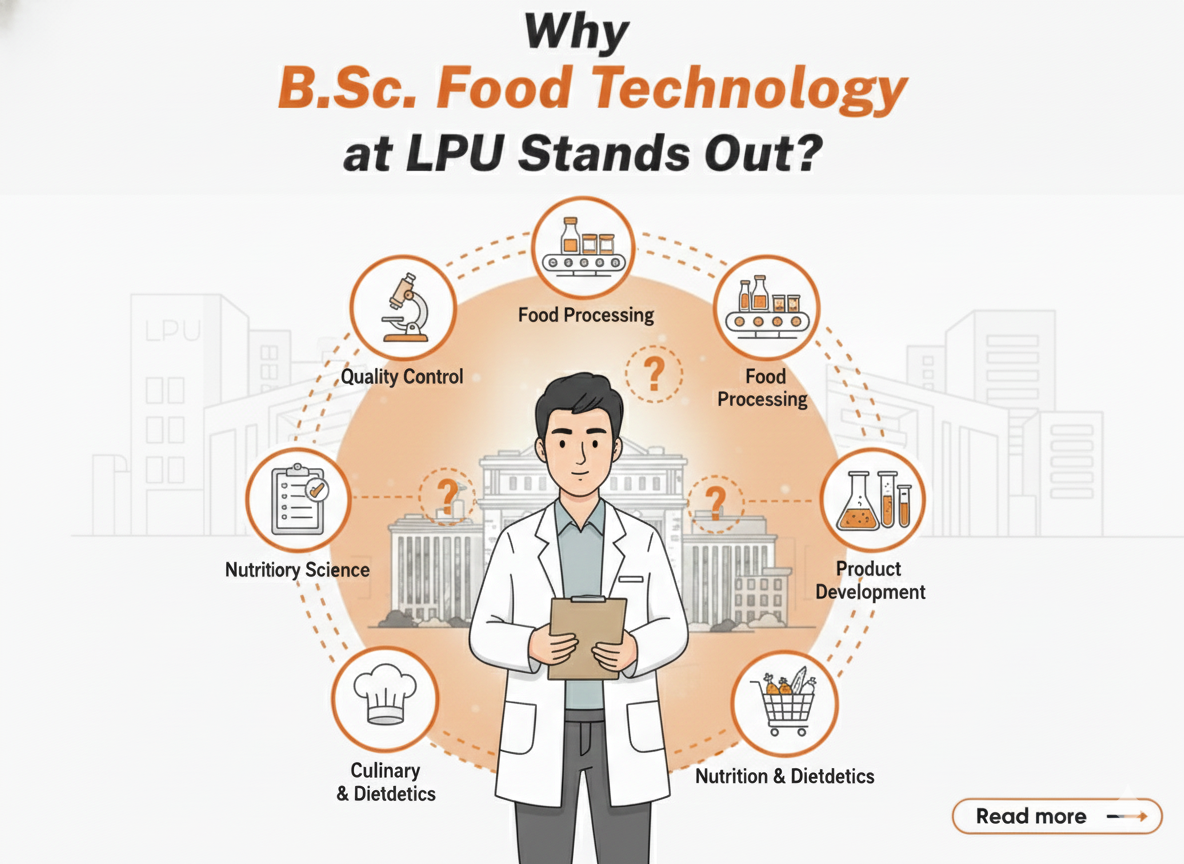
- Why Choose Food Technology at LPU?
- What Makes a Good Food Technology Programme?
- LPU’s Approach to Modern Food Science Education
- Cutting-Edge Infrastructure and Research Facilities
- Hands-on Training and Real-world Application
- Top Recruiters for LPU Food Tech Graduates
- Faculty Expertise and Mentorship at LPU
- Opportunities for Research, Innovation, and Startups
- Student Experience at LPU
- LPU at a Glance
- LPUNEST – Gateway to a Future-Proof Career in Food Technology
- Final Words: Why Choosing LPU Could Be Your Smartest Career Decision?
- Frequently Asked Questions (FAQ)
Why Choose Food Technology at LPU?
Choosing Food Technology at Lovely Professional University (LPU) opens the door to a future-ready education that blends scientific innovation with real-world application. LPU’s School of Agriculture and Food Technology is recognized for its modern infrastructure, experienced faculty, and strong industry linkages.
The programme is designed to give students hands-on exposure to food processing, quality control, product development, and emerging technologies that are shaping the global food industry.
Lovely Professional University (LPU) is one of the top choices for students aspiring to build a strong career in Food Technology. The programme is designed to meet industry demands by integrating scientific knowledge with practical training. LPU offers advanced laboratories, a research-driven curriculum, experienced faculty, and strong industry exposure—ensuring students are well-prepared for both national and global food sectors.
LPU focuses heavily on skill-based learning, innovation, and hands-on experience through workshops, internships, industrial visits, and live projects. Students also benefit from LPU’s strong placement network, which connects them with leading food companies, research organisations, and manufacturing industries.
Why LPU is One of the Best Universities for Food Technology because-
- Modern Lab and research facilities
Industry Aligned Curriculum - Strong Placement Track Record
- Experienced Faculty
- Practical Training and Industry Exposure
- Global Exposure
With state-of-the-art laboratories, interdisciplinary learning opportunities, and a curriculum aligned with national and international standards, LPU ensures that students gain the technical expertise and practical skills needed for successful careers. Moreover, the university’s vibrant campus life, research-driven environment, and excellent placement record make it an ideal destination for aspiring food technologists.
By choosing B.Sc Food Technology at LPU, students position themselves at the forefront of a rapidly growing sector that impacts health, sustainability, innovation, and global food security.
What Makes a Good Food Technology Programme?
A good B.Sc Food Technology Course combines strong scientific foundations, hands-on industry exposure, and modern research facilities.A strong B.Sc Food Technology programme offers a curriculum aligned with current industry needs. It should cover:
- Food chemistry and microbiology
- Food processing and preservation
- Nutrition and dietetics
Hands-on learning is essential. The programme should have:
- Food processing and engineering labs
- Microbiology and biotechnology labs
- Sensory evaluation and product development labs
Professors with expertise in research and industry experience ensure students receive practical and relevant knowledge.
A good programme collaborates with:
- Food manufacturing companies
- Research laboratories
- Food safety agencies
A top-tier Food Technology programme is one that blends scientific knowledge with practical industry skills. It prepares students for diverse roles in food manufacturing, quality assurance, product development, safety, and research.
Leading programmes stand out because they integrate advanced technologies, strong industry partnerships, and extensive hands-on training equipping graduates for a rapidly evolving global food sector.
Ultimately, a well-designed Food Technology programme empowers graduates to contribute meaningfully to global food security, consumer health, and innovation, making it a vital field for the future.
| Did You Know ?
Students of Food Technology learn alongside peers from biotechnology, agriculture, nutrition, and engineering—making the learning ecosystem highly interdisciplinary. |
LPU’s Approach to Modern Food Science Education
LPU’s approach to Modern Food Science Education combines scientific rigor, technological advancement, and industry exposure. By integrating sustainability, innovation, and hands-on learning, LPU prepares its students to become skilled professionals ready to contribute to the future of the food industry.
LPU’s B.Sc Food Technology curriculum is designed to provide a strong foundation in scientific principles while integrating modern trends and industry requirements. The programme covers a wide range of subjects including:
- Food chemistry, microbiology, and biochemistry
- Food engineering and processing technologies
- Dairy, cereal, bakery, fruit & vegetable, and meat technology
The curriculum is updated regularly to align with global advancements in food science, sustainability, and processing innovations. Electives and specialization modules allow students to explore areas like fermentation technology, product development, and emerging technologies.
LPU follows an Outcome-Based Learning approach, ensuring students not only gain knowledge but also develop skills and competencies required in the food industry.
Practical learning is a major component of LPU’s B.Sc Food Technology programme.
The university follows an outcome-based learning approach, ensuring that every course has clear goals focused on skill development, problem-solving, and real-world application rather than rote learning.
Students benefit from hands-on training through advanced laboratories, industrial internships, live projects, and product development activities that mirror actual industry practices. Workshops, field visits, and expert sessions further enhance their practical understanding of food science.
Together, this curriculum, teaching approach, and experiential learning environment prepare students to become competent, industry-ready professionals equipped to excel in the evolving global food sector.
The approach equips students with the technical expertise, hands-on skills, and professional competence needed to thrive in diverse roles within the global food industry, from research and product development to quality assurance and food safety management.
Cutting-Edge Infrastructure and Research Facilities
Lovely Professional University provides state-of-the-art infrastructure and research facilities that give Food Technology students a real-world edge. The university’s laboratories are equipped with modern instruments used in food processing, microbiology, quality testing, and product development, allowing students to gain hands-on experience with industry-standard tools.
LPU’s campus also features pilot plants, sensory evaluation labs, and analytical testing facilities, enabling students to simulate industrial processes and conduct meaningful research. The university encourages innovation by supporting student-led projects, interdisciplinary research, and experimentation with emerging food technologies, such as functional foods, plant-based products, and sustainable processing techniques.
Additionally, well-stocked libraries, digital resources, and specialized research centers provide access to the latest scientific knowledge and global trends. With a focus on practical learning and innovation, LPU’s infrastructure ensures that students not only understand theoretical concepts but also develop the technical skills required to excel in the competitive food industry.
LPU strongly emphasizes research in food science, encouraging students to engage in innovative projects such as developing functional foods, nutraceuticals, alternative protein products, and sustainable processing techniques. Faculty-guided research programmes help students cultivate critical thinking, problem-solving skills, and technical competence necessary for R&D roles in the global food sector.
By combining high-tech labs, research opportunities, and pilot-scale production facilities, LPU ensures that Food Technology students graduate with strong theoretical knowledge, practical expertise, and problem-solving skills. Graduates are well-prepared for careers in R&D, food manufacturing, quality assurance, regulatory affairs, product development, and entrepreneurship in the global food industry.
By combining state-of-the-art infrastructure with industry-relevant research and real-world production simulations, the university equips students with the technical expertise, problem-solving abilities, and practical experience required to excel in diverse careers within the global food industry. This integrated approach ensures that graduates are not only knowledgeable but also ready to innovate and contribute meaningfully to modern food science and technology.
| Did You Know ?
Students get hands-on experience with industry-standard equipment used in processing, quality control, and food safety testing. |
Hands-on Training and Real-world Application
Through hands-on training and real-world application, LPU ensures that students not only understand the scientific principles of food technology but also acquire the skills necessary to work confidently in industrial, research, and entrepreneurial settings. This approach produces graduates who are industry-ready, innovative, and capable of contributing to advancements in food science and technology.
Lovely Professional University (LPU) emphasizes practical learning and real-world exposure as a core part of its B.Sc Food Technology programme. Students are not limited to theoretical knowledge; they engage in hands-on training through advanced laboratories, pilot plant facilities, and industry-linked projects that simulate actual food production and processing environments.
Key Components of Hands-on Learning
- Laboratory Work: Students perform experiments in food chemistry, microbiology, quality testing, and sensory evaluation to develop technical expertise.
- Pilot Plant Training: Real-scale production simulations in dairy, bakery, beverage, and fruit & vegetable processing help students understand industrial processes, workflow management, and quality control standards.
- Industrial Internships: LPU has strong industry collaborations, allowing students to gain practical exposure in food processing companies, R&D labs, and quality assurance units.
- Product Development Projects: Students create new food products, conduct sensory and shelf-life testing, and apply their knowledge to solve real-world challenges.
- Workshops and Field Visits: Frequent interactions with industry experts and visits to food manufacturing units bridge the gap between classroom learning and industry practices.
By combining industrial training, internships, and practical projects, LPU ensures that Food Technology students are industry-ready, confident, and skilled, capable of contributing effectively to research, production, quality assurance, and innovation in the global food sector.
LPU’s emphasis on industrial training, internships, and practical exposure ensures that Food Technology students gain real-world experience, develop essential technical skills, and understand industry operations firsthand. This hands-on approach prepares graduates to be industry-ready professionals, capable of excelling in research, production, quality assurance, and product development within the global food sector.
LPU’s industrial training and practical exposure equip Food Technology students with real-world skills, making them industry-ready professionals.
Top Recruiters for LPU Food Tech Graduates
LPU’s B.Sc Food Technology students benefit from a placement ecosystem that combines broad recruiter reach, specialized food‑industry hiring, and solid salary outcomes making the university a strong option for those aiming to enter the food science and technology sector.
LPU’s Food Technology programme offers excellent placement opportunities, with graduates being recruited by some of the leading companies in the food and beverage industry.
LPU’s placement ecosystem is very strong overall, which helps Food Technology students because many recruiters from its large network also hire from food-related courses.
Students from Food Tech or Food Science have managed to land roles in major FMCG and food corporations, indicating good relevance of the course.
Top Food‑Industry Recruiters Hiring LPU Food Tech Graduates-
- Cadbury, Nestlé, PepsiCo, and Coca‑Cola are explicitly mentioned by students in LPU’s B.Tech Food Tech placements.
- According to M.Sc Food Tech students (2021), Nestle, PepsiCo, Cadbury, and Biocon are among the notable recruiters.
- As per broader LPU placement data, food‑industry recruiters include ITC and Nestle.
While LPU’s overall placement report lists many recruiters, not all of them may specifically hire Food Tech students. Some of the named recruiters (like tech companies) may be recruiting from non-food programmes.
For M.Sc Food Science & Technology, a reported placement rate of 40% means a significant portion of students may not land a placement right after graduation. This is based on alumni reports, so it’s not a guaranteed outcome.
Salary outcomes vary significantly: while some students report high-paying packages, the average placement package is more modest especially for postgraduates in food science.
By actively leveraging these opportunities, graduates are well-prepared for careers in R&D, quality assurance, production management, and product development within the global food sector.
While salary packages vary by course and individual performance, students benefit from hands-on training, pilot plant exposure, and industry internships, which enhance employability.
Faculty Expertise and Mentorship at LPU
LPU’s food technology and food science faculty bring a powerful combination of academic excellence, research experience, and practical mentorship.
This ensures students receive not only rigorous theoretical training but also guided exposure to real-world food science challenges, which significantly boosts their readiness for advanced research or industry careers.
LPU’s Food Technology programme benefits from a team of highly experienced and research-driven faculty who bring both academic excellence and practical insight to the classroom.
LPU’s Department of Food Technology & Nutrition includes faculty members who are PhD holders and active researchers, bringing deep academic rigor to the classroom and labs.
The mentorship helps students not only grasp theoretical knowledge but also translate it into real-world research and innovation, such as valorizing food waste, optimizing processes, and developing functional foods.
The faculty’s areas of research are very relevant to modern food science: they include process engineering, food safety, novel food ingredients, and sustainable food systems.
Their industrial and academic experience ensures that students are exposed to cutting-edge trends in food technology. As per various student and admission reviews, professors are not only knowledgeable but also very supportive and accessible.
LPU as an institution has a significant number of faculty and scientists, contributing to thousands of publications across various disciplines.
This strong research culture ensures that students are learning from faculty who are at the forefront of food science research—not just teaching from textbooks.
Professors at LPU guide students in not only academics, but also practical skill-building such as running pilot plant experiments, product development, and research internships.
| Did You Know ?
LPU professors have patents in food processing and nanotechnology for food safety, giving students exposure to pioneering research. |
Opportunities for Research, Innovation, and Startups
LPU is engaged in several interesting food‐technology research areas.
The food-tech startup ecosystem in India (and more broadly) is vibrant and rapidly maturing. It spans everything from agri-tech and supply chain to food processing, sustainability, and alternative proteins. For entrepreneurs or researchers, it’s a highly promising domain especially if you can build technology-driven, scalable, and impact-oriented solutions.
Lovely Professional University (LPU) has emerged as a hub for food-tech innovation, blending research, sustainability, and entrepreneurship. The university’s Department of Food Technology & Nutrition has pioneered research on microgreens, exploring how LED light spectra can enhance growth and antioxidant content, while developing value-added products such as powders, beverages, and smoothies.
With strong interdisciplinary collaboration, access to labs and funding, and a focus on sustainability, LPU offers significant opportunities for students and researchers to translate cutting-edge food-tech research into scalable innovations and commercial ventures.
Key research initiatives include the study of microgreens, where LPU researchers are investigating the effects of different LED light spectra on growth, nutritional content, and antioxidant levels, while also developing value-added products such as powders, beverages, and smoothies.
LPU researchers have also patented an eco-friendly desalination process that uses food waste to purify seawater efficiently, reflecting a strong focus on environmental sustainability.
The food-tech startup ecosystem in India (and more broadly) is vibrant and rapidly maturing. It spans everything from agri-tech and supply chain to food processing, sustainability, and alternative proteins. For entrepreneurs or researchers, it’s a highly promising domain especially if you can build technology-driven, scalable, and impact-oriented solutions.
Overall, the convergence of research, technology, and entrepreneurship in food tech presents immense opportunities for sustainable innovation, commercial success, and social impact, making it one of the most promising sectors for new ventures and research-driven startups.
Across India, startups are leveraging AI, IoT, and circular-economy principles to address challenges in farm productivity, supply chains, and value-added food products, supported by government policies, incubation programmes, and increasing investment.
Student Experience at LPU
Students pursuing Food Technology at LPU often describe the experience as a rich blend of academic rigor, practical exposure, and community engagement.
From the very first year of their B.Sc or B.Tech programmes, they are exposed not just to theoretical concepts like food chemistry, microbiology, and food engineering, but also to a wide variety of processing, safety, packaging, and nutrition topics.
Students in Food Technology frequently get industry exposure via internships, guest lectures, and live projects with food companies. According to the B.Tech‑Food Tech course details, companies like Nestlé, Amul, etc., are part of their placement / internship pipeline.
The curriculum is structured to make students “industry ready” balancing food safety, processing, product development, and quality assurance.
Moreover, LPU’s placement cell is active: food‑tech students have reported good support, helping them convert their academic learning into meaningful roles after graduation.
Overall, for a Food Technology student, LPU seems to offer a very well-rounded and immersive experience: strong infrastructure, a practical curriculum, plenty of opportunities to connect with industry, and a campus culture that supports innovation and community. Students not only learn the science behind food but also get to apply it in real‑life settings, preparing them for both research and industry roles.
The student experience in Food Technology at LPU combines rigorous academics, hands-on learning, and a vibrant campus culture, creating a holistic environment for growth. With well-equipped laboratories, training kitchens, and research opportunities, students gain practical skills in food processing, safety, product development, and quality control.
The diverse and dynamic campus fosters collaboration, cultural exchange, and extracurricular engagement, while industry interactions, internships, and placements ensure professional readiness.
Although managing academics, lab work, and social life can be challenging, the supportive infrastructure, mentorship, and innovation-focused environment make LPU a strong platform for aspiring food technologists to develop both technical expertise and practical industry experience.
LPU at a Glance
LPU is a large, well-resourced, and forward‑looking university with a strong focus on industry alignment, innovation, and global exposure. It combines academic excellence with an entrepreneurial ecosystem, making it an attractive choice for students seeking both rigorous education and practical opportunities.
Lovely Professional University (LPU), founded in 2005, is a large private university located in Phagwara, Punjab, India.
LPU has grown into a global higher-education institution offering 200+ professional programmes across more than 40 disciplines, including engineering, management, agriculture, law, pharmacy, and more.
In global rankings, LPU is recognized for innovation according to its own brochure, it ranked 3rd in India in the WURI (World University Rankings for Innovation).
With over 500 international tie-ups, LPU ensures strong global exposure for its students, facilitating exchange programmes, joint research, and a cosmopolitan campus environment.
Its curriculum is designed to be industry-relevant, and the faculty includes professionals with strong domain expertise.
LPU regularly honors high-performing students: in one year, it awarded 655 students across academics, sports, innovation, and community service.
The university offers a broad range of scholarships — merit-, need-, and performance-based — to support students from diverse backgrounds.
Its holistic approach — encompassing rigorous academics, hands-on learning, international collaborations, sports achievements, and cultural engagement — ensures that students are well-prepared for professional and personal success.
The university’s emphasis on research, entrepreneurship, and sustainable development further distinguishes it as an institution that not only imparts knowledge but also fosters innovation, leadership, and global citizenship.
LPUNEST – Gateway to a Future-Proof Career in Food Technology
The Lovely Professional University National Entrance and Scholarship Test LPUNEST serves as a critical gateway for aspiring students to secure admission in LPU’s diverse programmes, including the rapidly evolving field of Food Technology.
By qualifying LPUNEST, students gain access to LPU’s state-of-the-art laboratories, hands-on training kitchens, and research centers dedicated to food processing, safety, nutrition, and product development. The exam also opens doors to merit-based scholarships, reducing financial barriers and allowing students to focus on skill-building and innovation.
LPUNEST is your gateway to a world of opportunities in both undergraduate and postgraduate programmes. This national-level entrance and scholarship test evaluates your academic potential and opens the door to exciting scholarship opportunities.
LPU aims to provide accessible and affordable quality higher education. The university offers extensive scholarships based on LPUNEST scores.
A career in Food Technology at LPU is designed to be future-proof, combining traditional food science with modern technology trends such as AI-enabled food analytics, smart kitchen devices, sustainable food production, and functional foods.
Through LPUNEST, students can directly enter programmes that emphasize practical exposure, industry internships, research projects, and entrepreneurship opportunities, preparing them for roles in food manufacturing, quality control, R&D, regulatory affairs, and startup ventures.
LPUNEST empowers students to enter a field that is rapidly expanding in India and globally—covering sectors like food processing, R&D, quality assurance, nutrition, and sustainable food innovation. For anyone aiming to pursue Food Technology, LPUNEST is not just an admission route but a strategic opportunity to secure quality education, industry exposure, and a future-ready career path.
With clearly defined eligibility criteria, flexible testing options, and generous scholarship slabs, the exam helps students reduce financial pressure while opening doors to B.Tech, M.Tech, and even Ph.D. programmes in Food Technology.
Final Words: Why Choosing LPU Could Be Your Smartest Career Decision?
Choosing LPU can be a turning point for your academic journey and future career because the university blends quality education, industry relevance, global exposure, and innovation-driven learning in a way few others do.
With world-class infrastructure, NAAC A++ accreditation, strong industry partnerships, and a proven placement record, LPU ensures that students graduate not only with a degree but with the skills, confidence, and practical experience needed to succeed in competitive industries.
With a diverse range of globally benchmarked programmes, industry-driven curricula, and an ecosystem that blends innovation with practical learning, LPU ensures students are prepared not just for today’s careers but for the evolving demands of tomorrow.
The university’s world-class infrastructure—equipped with advanced labs, collaborative workspaces, incubation centers, and smart classrooms—creates an environment where ideas can grow into impactful solutions.
LPU’s strong industry partnerships, internships, and live projects help students gain real-world exposure, while its exceptional placement record reflects the trust top companies place in its graduates.
Beyond academics, the vibrant multicultural campus nurtures leadership, creativity, and personal growth, helping students build not only strong professional profiles but also meaningful global networks.
Ultimately, choosing LPU means choosing a future-oriented institution that empowers you to dream bigger, achieve more, and step confidently into a world full of possibilities. And that forward-looking, opportunity-rich ecosystem is what makes LPU one of the smartest career decisions you can make.
With its cutting-edge academic model, industry-driven training, global exposure opportunities, and an ecosystem that nurtures innovation, LPU ensures that every student is equipped with both the knowledge and the confidence to thrive in a competitive world.
The university’s consistent placement achievements, world-class infrastructure, and multicultural environment further reinforce its commitment to holistic student development.
Frequently Asked Questions (FAQ)
1. What is Food Technology?
Food Technology is the science and technology behind food processing, preservation, quality control, packaging, and product development. It combines biology, chemistry, engineering, and nutrition to ensure safe, nutritious, and innovative food products.
2. What subjects are taught in Food Technology?
Key subjects include: Food Chemistry, Food Microbiology, Food Processing & Preservation, Dairy Technology etc.
3. What is the placement scenario for Food Technology?
Food Technology graduates have strong placement opportunities because the food sector is one of India’s fastest-growing industries.
4. Is Food Technology a good career?
Yes. With continuous growth in food processing, food safety regulations, and global demand for innovative food products, Food Technology offers excellent career stability and growth.
5. Can Food Technology students pursue government jobs?
Yes. Graduates can work as: Food Safety Officer, Food Analyst, Quality Inspector, FSSAI, ICAR, CFTRI positions.