- How to Decide if M.P.Ed. (Master of Physical Education) Is the Right Choice?
- What Exactly Is M.P.Ed. (Master of Physical Education)? A Quick Overview
- The Core Purpose of Pursuing an M.P.Ed. (Master of Physical Education)
- Who Should Consider Pursuing M.P.Ed. (Master of Physical Education)?
- Core Skills and Attributes You’ll Develop
- Challenges and Realities in the Field of Physical Education
- The Impact of M.P.Ed. (Master of Physical Education) Professionals on Society and Youth
- Comparing M.P.Ed. (Master of Physical Education) with Other Postgraduate Sports Courses
- Future Scope: How the Sports Industry Is Expanding Globally?
- Alumni Success Stories
- Final Words
- Frequently Asked Questions (FAQs)
How to Decide if M.P.Ed. (Master of Physical Education) Is the Right Choice?
An M.P.Ed. (Master of Physical Education) is the right course for you if you are genuinely passionate about sports, fitness, and teaching, and want to build a professional career in the fields of physical education, coaching, or sports science.
It is especially suitable for students who have completed a B.P.Ed. and want to advance their qualifications for roles such as physical education teacher, sports coach, fitness trainer, or even lecturer in colleges with further exams like NET.
The programme involves both practical and theoretical learning in areas like exercise physiology, biomechanics, sports psychology, and training methods, making it ideal for those who enjoy a mix of physical activity and scientific understanding.
However, if you prefer desk-based corporate jobs or are not interested in sports-related careers, this may not be the best option for you.
Overall, M.P.Ed. (Master of Physical Education) is a great choice for individuals who are dedicated to promoting health, fitness, and sports, and who seek stable and respected career opportunities in this growing field.
Pursuing an M.P.Ed. Course (Master of Physical Education) opens the door to a wide range of career opportunities in physical education.
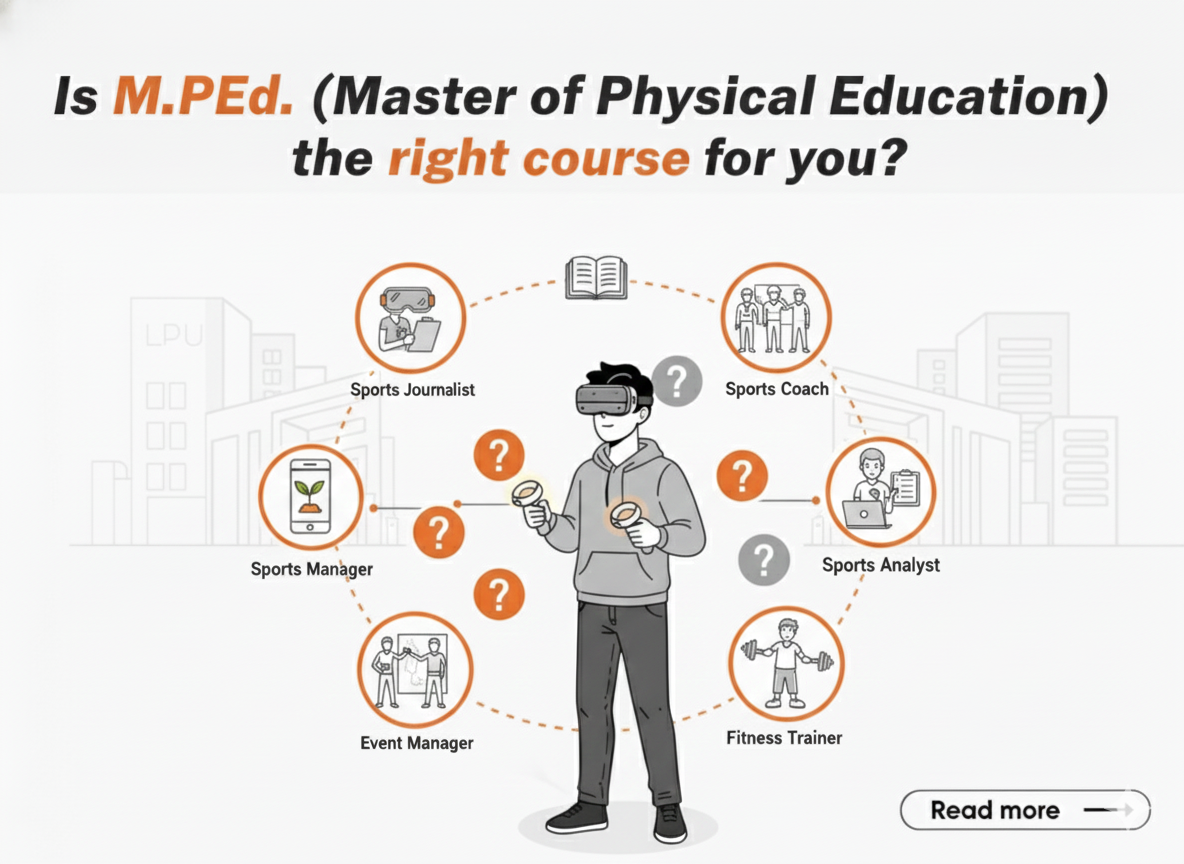
Graduates can work as physical education teachers (TGT/PGT), sports coaches, fitness trainers, gym managers, sports officers, sports coordinators, and wellness consultants in schools, colleges, universities, sports academies, fitness centers, government departments, and private sports organizations.
With additional qualifications like NET, SET, or a Ph.D., individuals can build strong academic careers as lecturers, assistant professors, or researchers in higher education.
The programme also equips students with the skills needed for careers in sports analysis, sports journalism, personal training, and sports event management.
Because it strengthens both your professional credibility and your career prospects in the sports and education sectors. It is the ideal choice for individuals who love sports, enjoy physical activity, and want to help others improve their fitness and performance.
The course not only enhances subject knowledge but also develops leadership, teamwork, communication, and coaching skills qualities that are essential for success in the rapidly growing fields of physical education and sports science.
Overall, an M.P.Ed. (Master of Physical Education) is a rewarding pathway for those committed to building a meaningful and respected career in the world of sports, health, and physical education.
What Exactly Is M.P.Ed. (Master of Physical Education) ? A Quick Overview
M.P.Ed. (Master of Physical Education) is a postgraduate degree programme focused on advanced learning in physical education, sports science, and fitness training.
It is designed for students who have already completed B.P.Ed. or an equivalent qualification and want to deepen their knowledge and skills in the field of sports and physical education.
The course typically covers subjects like exercise physiology, sports psychology, biomechanics, kinesiology, training methods, sports management, and research methods.
Along with theory, it includes practical training, coaching sessions, internships, and sport-specific skill development. The goal is to prepare students for professional roles in teaching, coaching, sports administration, and sports science research.
M.P.Ed. (Master of Physical Education) is the next step for anyone who wants a professional, science-based, and leadership-oriented career in sports and physical education.
It helps you develop both classroom and field expertise, making you eligible for jobs in schools, colleges, sports academies, fitness centers, and government sports departments.
The course blends theoretical knowledge with practical training, focusing on the scientific and educational aspects of sports and physical activity. Key areas of study include:
1. Exercise Physiology – understanding how the body functions during physical activity.
2. Sports Psychology – mental aspects of performance and motivation.
3. Biomechanics & Kinesiology – movement analysis and body mechanics.
4. Sports Training Methods – coaching principles and performance improvement.
Most programmes also include internships, coaching practice, lab work, fitness assessments, and participation in sports activities or tournaments.
Students passionate about sports, fitness, teaching, or coaching. Those seeking careers in schools, colleges, sports academies, or fitness centers. Individuals interested in sports science or research.
The M.P.Ed. Master of Physical Education is the perfect programme for anyone passionate about physical fitness, sports science, teaching, and coaching.
It is highly respected, career-oriented, and provides both scientific knowledge and practical expertise needed for a successful career in the sports and education sectors.
With increasing focus on sports in education and society, the demand for qualified physical education professionals is rising, making M.P.Ed. (Master of Physical Education) a valuable and future-oriented qualification.
It offers advanced scientific knowledge, practical training, and coaching skills that prepare students for diverse roles in schools, colleges, sports academies, fitness centers, and government sports departments.
The Core Purpose of Pursuing an M.P.Ed. (Master of Physical Education)
The core purpose of pursuing an M.P.Ed. (Master of Physical Education) is to gain advanced knowledge and professional expertise in the fields of sports, fitness, and physical education so you can build a meaningful and impactful career.
This programme is designed to transform passionate learners into skilled coaches, educators, and sports science professionals who understand the scientific, psychological, and managerial aspects of human movement and athletic performance.
It aims to deepen your understanding of how the body works, how athletes can be trained effectively, and how physical education can be taught in a more structured and scientific way.
Ultimately, the purpose of M.P.Ed. (Master of Physical Education) is to prepare individuals to promote health, develop athletic talent, contribute to sports development, teach effectively, and take up leadership roles in schools, colleges, sports academies, and fitness institutions.
The M.P.Ed. (Master of Physical Education) holds great importance as it equips students with advanced scientific, technical, and pedagogical knowledge needed to excel in the fields of sports, fitness, and physical education.
It enhances professional credibility, deepens understanding of human movement, and prepares graduates for leadership roles in teaching, coaching, and sports administration.
This aligns closely with the goals of physical education, which include promoting lifelong fitness, developing motor skills, encouraging teamwork and discipline, and fostering overall physical, mental, and social well-being.
As a form of postgraduate sports education, M.P.Ed. (Master of Physical Education) helps students specialize in sports science, coaching methods, exercise physiology, biomechanics, and sports management, enabling them to contribute meaningfully to athlete development, health promotion, and educational excellence.
By focusing on the goals of physical education such as promoting health, developing physical and mental abilities, and fostering teamwork and discipline M.P.Ed. (Master of Physical Education) equips graduates to make meaningful contributions as teachers, coaches, sports scientists, and administrators.
As a form of postgraduate sports education, it not only enhances career opportunities but also plays a key role in advancing the standards of sports and physical education in educational institutions and professional sports settings.
| Did You Know ?
M.P.Ed. (Master of Physical Education) is unique because it combines practical athletic training with scientific research, including biomechanics, exercise physiology, and sports psychology. |
Who Should Consider Pursuing M.P.Ed. (Master of Physical Education) ?
M.P.Ed. (Master of Physical Education) is ideal for individuals who are passionate about sports, fitness, and teaching, and who want to build a professional career in physical education or sports science. Specifically, it is suited for:
- Aspiring Physical Education Teachers: Those who want to teach at schools, colleges, or universities and develop expertise in PE pedagogy.
- Sports Enthusiasts and Athletes: Individuals with a strong interest or background in sports who wish to transition into coaching, training, or sports management roles.
- Fitness and Wellness Professionals: People aiming for careers as fitness trainers, strength and conditioning coaches, or wellness consultants.
- Academic and Research-Oriented Candidates: Students interested in research in exercise science, biomechanics, sports psychology, or performance enhancement.
- Professionals Seeking Leadership Roles in Sports: Those who want to become sports officers, coordinators, or administrators in schools, colleges, sports academies, or government departments.
- Lifelong Learners in Sports Science: Anyone who wants a structured, science-based approach to understanding human movement, training techniques, and physical development.
M.P.Ed. (Master of Physical Education) is an ideal choice for dedicated physical education aspirants who wish to advance their knowledge, skills, and career prospects in the fields of sports, fitness, and education.
With clear eligibility criteria and a focus on both theoretical and practical training, it is best suited for individuals passionate about teaching, coaching, research, or sports administration.
Pursuing M.P.Ed. (Master of Physical Education) not only enhances professional credibility but also opens diverse opportunities in schools, colleges, sports academies, fitness centers, and government institutions, making it a valuable pathway for anyone committed to promoting health, athletic performance, and overall physical well-being.
M.P.Ed. (Master of Physical Education) is not just a degree; it is a pathway for passionate individuals to transform their love for physical activity and sports into a respected, fulfilling, and growth-oriented career.
For anyone committed to fostering athletic talent, promoting physical health, or advancing sports science, pursuing M.P.Ed. (Master of Physical Education) provides the expertise, credibility, and opportunities needed to make a meaningful impact in the field of physical education.
Ideal candidates are passionate about sports, committed to promoting health and well-being, and eager to develop expertise in areas like exercise physiology, sports psychology, biomechanics, coaching, and sports management.
Core Skills and Attributes You’ll Develop
Pursuing an M.P.Ed. (Master of Physical Education) helps you develop a combination of physical, scientific, educational, and managerial skills that are essential for a successful career in sports, fitness, and physical education.
1. Leadership in Sports
- Team Management: Learn to organize, motivate, and lead teams in schools, colleges, or sports clubs.
- Event Coordination: Skills to plan and manage sports events, tournaments, and competitions efficiently.
2. Fitness Skills
- Exercise Programming: Design and implement fitness plans tailored to different age groups and fitness levels.
- Strength and Conditioning: Develop skills to enhance athletes’ strength, endurance, and agility.
3. Teaching and Coaching Skills
- Pedagogical Knowledge: Learn effective teaching methods for physical education in schools and colleges.
- Coaching Techniques: Train athletes in sport-specific skills, strategies, and performance improvement.
- Lesson Planning & Assessment: Create structured lesson plans, monitor progress, and evaluate performance.
Pursuing an M.P.Ed. (Master of Physical Education) equips you with a powerful blend of leadership, fitness, and teaching/coaching skills that are essential for a successful career in physical education and sports.
It prepares you to lead teams, manage events, and mentor athletes effectively, while also providing the scientific knowledge and practical expertise needed to design fitness programmes, assess performance, and promote overall health.
| Did You Know ?
Many M.P.Ed. (Master of Physical Education) graduates find jobs in schools, colleges, universities, sports academies, defense services, and government sports departments, making it a highly secure career path. |
Challenges and Realities in the Field of Physical Education
While pursuing an M.P.Ed. (Master of Physical Education) and building a career in physical education or sports can be highly rewarding, there are several challenges and realities that aspirants need to understand:
1. Intense Competition and Limited Opportunities
Although the demand for PE professionals is growing, high-level positions in schools, colleges, sports academies, and government departments are limited.
2. Physical and Mental Demands
M.P.Ed. (Master of Physical Education) and sports careers require high physical fitness, stamina, and mental resilience.
3. Infrastructure and Resource Constraints
Not all institutions have proper sports facilities, equipment, or funding, which can limit effective teaching and training.
4. Balancing Multiple Roles
Real-world sports careers often involve juggling teaching, coaching, research, and administration simultaneously.
5. Keeping Up with Advances in Sports Science
Modern sports demand knowledge of exercise physiology, biomechanics, nutrition, sports psychology, and fitness technology.
Despite these challenges, M.P.Ed. (Master of Physical Education) and careers in physical education are deeply rewarding for those passionate about sports and fitness.
Success requires dedication, adaptability, continuous learning, and a love for teaching and coaching. With the growing importance of health, fitness, and sports in education and society, skilled professionals in this field are increasingly valued.
However, these realities are balanced by the immense rewards of the profession: the opportunity to teach, coach, inspire, and shape athletes, contribute to health and fitness, and build a respected career in a growing field.
Success in this domain requires passion, dedication, adaptability, and continuous learning, but for those committed to sports and physical education, it offers a fulfilling and impactful professional journey.
Pursuing an M.P.Ed. (Master of Physical Education) and a career in physical education or sports comes with its share of challenges, including intense competition, physical and mental demands, infrastructure limitations, and the need to continually update skills.
The Impact of M.P.Ed. (Master of Physical Education) Professionals on Society and Youth
Physical education teachers play a vital role in promoting health, fitness, and sports awareness both within schools and in the wider community.
They design and implement structured exercise routines and sports programmes that improve physical fitness, teach students about healthy lifestyles, nutrition, and injury prevention, and encourage long-term wellness habits.
Beyond physical health, they foster sports awareness by introducing students to various games, organizing competitions, and instilling values like teamwork, discipline, and fair play.
PE teachers also act as role models, influencing communities to adopt active lifestyles through workshops, wellness programmes, and awareness campaigns.
By identifying and nurturing athletic talent, they contribute to national sports development, while their guidance in team activities supports students’ social, emotional, and leadership skills.
Overall, physical education teachers are catalysts for healthier, more active communities and play a crucial role in shaping both individual and societal well-being.
In addition to fitness, PE teachers are central to promoting sports awareness and participation. They introduce students to a variety of sports and recreational activities, organize inter-school and intra-school tournaments, and encourage participation in community sports events.
This exposure helps develop qualities such as teamwork, leadership, discipline, time management, and perseverance, which extend far beyond the sports field into academic and personal life.
Physical education teachers also serve as mentors and role models, motivating students to pursue sports at higher levels and nurturing athletic talent for professional development.
Their influence often extends into the wider community, where they conduct fitness workshops, health awareness campaigns, and wellness programmes, promoting an active lifestyle among parents, peers, and local populations.
By integrating physical activity with mental, social, and emotional development, PE teachers contribute to reducing lifestyle-related health issues, stress, and sedentary habits in society.
Physical education teachers are key drivers of holistic development, fostering physical health, social skills, sports culture, and community well-being, making them indispensable to both youth development and societal health initiatives.
Comparing M.P.Ed. (Master of Physical Education) with Other Postgraduate Sports Courses
M.P.Ed. (Master of Physical Education) differs from other postgraduate sports courses in its focus, skill development, and career outcomes.
Unlike an M.Sc. in Sports Science, which emphasizes research, physiology, biomechanics, and scientific analysis, M.P.Ed. (Master of Physical Education) centers on teaching, coaching, athlete training, and practical application in physical education.
Compared to an MBA in Sports Management, which develops administrative, marketing, and leadership skills for managing sports organizations and events, M.P.Ed. (Master of Physical Education) prioritizes hands-on fitness training, coaching, and pedagogy.
Similarly, while a Master of Physiotherapy (M.P.T.) in Sports focuses on injury prevention, rehabilitation, and therapy for athletes, M.P.Ed. (Master of Physical Education) aims at performance enhancement, physical development, and structured sports education.
In essence, M.P.Ed. (Master of Physical Education) is best suited for those passionate about teaching, coaching, and promoting physical fitness, while other postgraduate sports courses cater to careers in research, management, rehabilitation, or scientific specialization.
The choice depends on individual career goals, whether one wants to work in academia, coaching, fitness training, sports administration, or health and therapy sectors.
M.P.Ed. (Master of Physical Education) stands out among postgraduate sports courses for its strong emphasis on teaching, coaching, and practical application in physical education, making it ideal for those passionate about developing athletic performance and promoting fitness.
While other programmes like M.Sc. in Sports Science, MBA in Sports Management, or M.P.T. in Sports focus on research, administration, or rehabilitation, M.P.Ed. (Master of Physical Education) equips professionals with the skills to educate, train, and inspire students and athletes.
Ultimately, the choice of course should align with one’s career goals, whether in academia, coaching, sports administration, fitness training, or specialized health and sports science roles, with M.P.Ed. (Master of Physical Education) providing a clear pathway for those committed to hands-on physical education and sports development.
M.P.Ed. (Master of Physical Education) is ideal for: Those passionate about teaching, coaching, and developing fitness and athletic performance.
Other postgraduate sports courses may be better suited for careers in research, rehabilitation, management, or sports science specialization.
The choice depends on your career goals, whether you want to work in academia, coaching, administration, research, or health and therapy sectors.
Future Scope: How the Sports Industry Is Expanding Globally?
Graduates with an M.P.Ed. (Master of Physical Education) degree are well-positioned to benefit from this expansion. Their training in coaching, physical education, fitness assessment, and sports science equips them for careers in schools, colleges, professional sports teams, fitness centers, sports academies, and international sports organizations.
With the industry emphasizing holistic athlete development, performance optimization, and community health, the scope for M.P.Ed. (Master of Physical Education) professionals is set to grow significantly worldwide.
The sports industry is experiencing unprecedented growth worldwide, offering immense opportunities for professionals in physical education, coaching, sports science, and management.
Globally, the increasing focus on health, fitness, and active lifestyles is driving demand for qualified sports professionals, from coaches and trainers to sports scientists and administrators.
Key Factors Driving Global Expansion
- Rising Health and Fitness Awareness – Governments and organizations are promoting active lifestyles to combat obesity, lifestyle diseases, and mental health issues, creating more opportunities for fitness and physical education experts.
- Professionalization of Sports – More countries are investing in professional leagues, academies, and infrastructure for sports like football, cricket, basketball, and athletics, increasing the demand for coaches, trainers, and sports managers.
- Technological Integration – Sports analytics, wearable tech, performance tracking, and virtual training platforms are transforming the industry, requiring skilled professionals who understand both science and technology.
- Government Initiatives and Policies – Programmes like Khelo India, grassroots sports development, and international collaborations are boosting sports participation and infrastructure globally.
- Career Diversification – The sports sector now includes fitness training, physiotherapy, nutrition, sports psychology, coaching, sports management, and event organization, offering diverse career paths.
With their expertise in physical education, sports science, and performance enhancement, M.P.Ed. (Master of Physical Education) graduates are well-equipped to take advantage of these emerging trends.
The future promises a dynamic, rewarding, and globally relevant career path for those committed to advancing sports, fitness, and community health.
This growth has created diverse opportunities for M.P.Ed. (Master of Physical Education) professionals, from coaching and teaching to fitness training, sports management, and athlete development.
Alumni Success Stories
LPU invests heavily in sports infrastructure and encourages physical education and sports courses which has translated into some remarkable alumni outcomes.
LPU students and alumni have recently won medals at national and international-level weightlifting, wrestling, boxing, and other sports events.
This demonstrates how a university environment combined with proper training even via degrees like M.P.Ed. (Master of Physical Education) or related physical‑education courses can help students reach elite levels of performance and recognition.
M.P.Ed. (Master of Physical Education) (and similar sports‑education degrees) can be a strong launching pad for careers far beyond just teaching from national‑level coaching and athlete development to roles in sports media, management, and beyond.
Such professionals often shape sports culture, raising standards of training, nurturing talent, and inspiring younger generations to pursue sports seriously.
Some of the alumni achievements are-
1. Rahul Rana- Serving as an Assistant Professor in Physical Education through the Haryana Public Service Commission he exemplifies dedication, excellence and the true academic spirit.
- Monika Singh- Serving as a Physical Education Teacher at PACE Creative British School, Ajman, UAE, passion for fostering holistic student development.
3.Neeta Devi- Achieved remarkable success at the 2025 World Cup Kho-Kho held in New Delhi.
The success stories of M.P.Ed. (Master of Physical Education) alumni and sports-education graduates—from nationally recognized coaches like Sunil Dabas and K.P. Thomas to LPU students excelling in international competitions—highlight the tremendous impact that specialized training in physical education can have.
These professionals not only achieve personal career milestones but also contribute to athlete development, sports promotion, and community fitness, inspiring the next generation of talent.
Their achievements demonstrate that with dedication, proper education, and practical experience, an M.P.Ed. (Master of Physical Education) degree can open doors to diverse and rewarding careers in coaching, teaching, sports management, athlete development, and global sports initiatives, making it a highly valuable and future-oriented pathway in the world of sports.
Alumni from institutions like Lovely Professional University (LPU) have gone on to represent India in international competitions, work in sports media, and participate in global events such as the Olympics, showing that sports education can lead to recognition at the highest levels.
Final Words
Pursuing a M.P.Ed. (Master of Physical Education) is a strategic choice for those passionate about sports, fitness, and holistic development.
The programme equips graduates with a strong foundation in coaching, teaching, fitness assessment, sports science, and athlete development, preparing them for diverse career paths such as physical education teacher, sports coach, fitness trainer, sports administrator, or researcher.
The benefits of M.P.Ed. (Master of Physical Education) extend beyond career opportunities. It enhances leadership, communication, and organizational skills, while also fostering a deep understanding of human physiology, sports psychology, and modern training techniques.
Graduates are empowered to promote health and fitness, mentor young athletes, and contribute to community wellness, making a tangible impact on society.
With the global sports industry expanding rapidly, careers in physical education are becoming increasingly dynamic and rewarding.
Whether you aim to work in schools, colleges, professional sports teams, fitness centers, or international sports organizations, an M.P.Ed. (Master of Physical Education) degree provides the knowledge, skills, and credibility needed to excel.
Choosing M.P.Ed. (Master of Physical Education) is choosing a career that blends passion with purpose—a pathway that allows you to inspire, train, and lead while contributing to the growth of sports, health, and fitness in society. It is an investment in a profession that is fulfilling, impactful, and future-oriented.
One of the key benefits of M.P.Ed. (Master of Physical Education) is the development of core skills and attributes that are valuable across all professional contexts.
Graduates enhance their leadership, communication, organizational, and motivational abilities, enabling them to guide teams, mentor athletes, and manage sports programmes effectively.
They also gain a deep understanding of exercise physiology, nutrition, sports psychology, injury prevention, and modern training techniques, allowing them to optimize performance and ensure the holistic development of students and athletes.
With the global sports industry expanding rapidly, M.P.Ed. (Master of Physical Education) graduates are increasingly in demand.
International sports events, professional leagues, and a growing focus on health and fitness create dynamic career paths in coaching, sports management, research, and athletic development. The degree not only ensures job security and professional recognition but also allows individuals to pursue a fulfilling career aligned with their passion for sports and physical well-being.
Frequently Asked Questions (FAQs)
1. What is M.P.Ed. (Master of Physical Education) ?
M.P.Ed. (Master of Physical Education) , a postgraduate programme focused on physical education, sports coaching, fitness training, and sports science. It equips graduates with theoretical knowledge and practical skills to excel in teaching, coaching, fitness, and sports management roles.
2.What are the Career Options After M.P.Ed. (Master of Physical Education) ?
M.P.Ed. (Master of Physical Education) graduates have a wide range of career opportunities in sports, fitness, and education: Physical Education Teacher – Schools, colleges, and universities, Sports Coach/Trainer – For national teams, academies, or private clubs, Fitness Instructor/Personal Trainer – Gyms, wellness centers, or private coaching, Sports Administrator/Manager – Organizing events, managing sports facilities, Researcher/Sports Scientist – Exercise physiology, biomechanics, sports psychology.
3. Why Choose M.P.Ed. (Master of Physical Education) ?
Provides a specialized career in sports and physical education.
Offers practical experience and hands-on training.
Contributes to personal development, community health, and youth fitness.
Opens pathways to national and international sports careers.
4.Is M.P.Ed. (Master of Physical Education) a good option for career growth?
Yes, graduates can progress from teaching or coaching roles to sports administrators, national-level coaches, researchers, or entrepreneurs, with increasing salary potential and recognition.With the global sports industry expanding and increasing focus on health, wellness, and youth fitness, M.P.Ed. (Master of Physical Education) professionals enjoy growing demand, diverse opportunities, and potential for high earnings. It is a future-oriented, rewarding path that combines personal passion with societal impact, making it a strong choice for long-term career growth.
5.What is the difference between M.P.Ed. (Master of Physical Education) and M.Sc. Sports Science?
M.P.Ed. (Master of Physical Education) focuses on teaching, coaching, and physical education practice, while M.Sc. Sports Science emphasizes research, biomechanics, physiology, and lab-based studies. M.Sc. Sports Science is more research- and science-oriented, focusing on exercise physiology, biomechanics, nutrition, and sports performance analysis, preparing graduates for roles as sports scientists, researchers, or specialists in athlete performance and rehabilitation.