
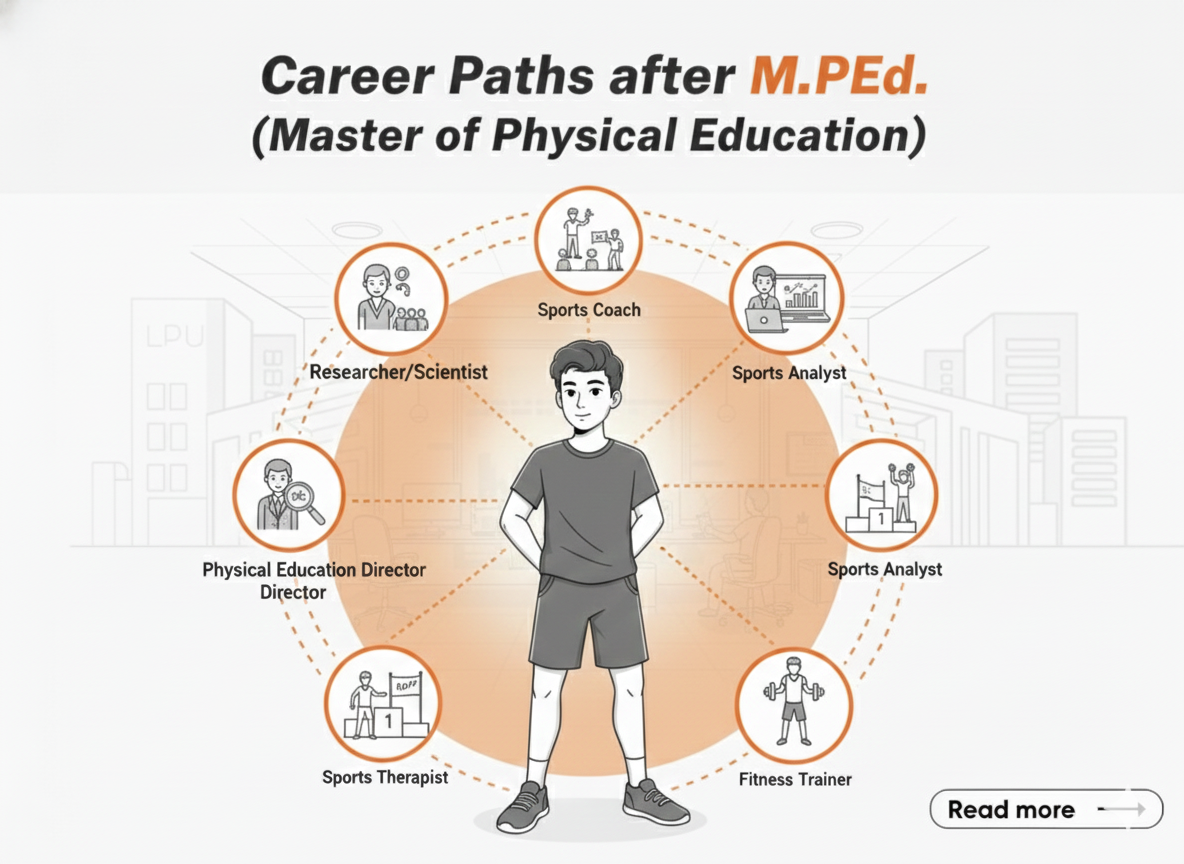
- What Awaits You After an M.P.Ed. (Master of Physical Education) Degree?
- Understanding the Scope of M.P.Ed. (Master of Physical Education) in Modern Sports and Education
- Career Opportunities in Schools, Colleges, and Universities
- Coaching and Training Careers in Sports Organizations
- Fitness and Wellness Industry Opportunities
- Research and Sports Science Roles
- Government and Public Sector Jobs for M.P.Ed. (Master of Physical Education) Graduates
- Careers in Sports Management and Event Coordination
- Higher Studies and Specialized Certifications After M.P.Ed. (Master of Physical Education)
- Entrepreneurship and Private Coaching Academies
- Conclusion: Building a Rewarding Career in Sports Education
- Frequently Asked Questions (FAQ)
What Awaits You After an M.P.Ed. (Master of Physical Education) Degree?
An M.P.Ed. (Master of Physical Education) degree opens diverse professional pathways in the sports, fitness, and education sectors.
With the growing emphasis on health, wellness, and sports culture in schools, universities, and society at large, the scope for qualified physical education professionals is expanding rapidly.
Graduates gain advanced knowledge of sports science, biomechanics, sports psychology, training methodologies, and sports management—making them suitable for both academic and professional roles.
Career after M.P.Ed. (Master of Physical Education)-
1.Physical Education Teacher (PET / PGT)
2. Assistant/Associate Professor (Physical Education)
- Sports Coach / Trainer
- Fitness Trainer / Gym Instructor / Strength & Conditioning Coach
- Sports Officer / Director of Physical Education (DPE)
- Sports Analyst / Sports Scientist (with specialization)
- Sports Manager / Event Coordinator
Physical Education Career Opportunities are-
- Academic Careers
- Sports & Athletics Careers
- Sports Science Careers
- Health & Fitness Careers
- Government Sector Jobs
An M.P.Ed. (Master of Physical Education) degree offers excellent scope, combining passion for sports with strong career stability.
Whether you choose teaching, coaching, research, fitness, or sports management, the field provides both growth and high societal value.
With rising awareness of fitness and increased investment in sports infrastructure, career opportunities are expected to grow even more in the coming years.
Understanding the Scope of M.P.Ed. (Master of Physical Education) in Modern Sports and Education
The scope of a M.P.Ed. (Master of Physical Education) has expanded significantly in today’s rapidly evolving sports and educational landscape.
With increased awareness of fitness, mental well-being, and athletic excellence, the demand for professionally trained physical educators and sports specialists is higher than ever.
Modern institutions schools, universities, sports academies, fitness centers, and government bodies now recognize physical education as an essential component of holistic development, not just an extracurricular activity.
An M.P.Ed. (Master of Physical Education) equips students with advanced knowledge in sports science, biomechanics, exercise physiology, sports psychology, and training methodologies.
This specialized skill set allows graduates to play pivotal roles in shaping athletes, promoting fitness culture, and designing research-backed training programmes. The degree also aligns with the growing emphasis on structured physical education under policies like the National Education Policy (NEP) 2020, which highlights the need for skilled PE teachers and sports professionals.
Beyond traditional teaching, the modern sports ecosystem offers an array of career opportunities from coaching and sports management to performance analysis, sports technology, and wellness consultancy. Those with a passion for research can contribute to sports science innovations, while others may pursue leadership roles in sports administration and event management.
In essence, the scope of M.P.Ed. (Master of Physical Education) is dynamic and far-reaching. Graduates are not only empowered to build meaningful careers but also positioned to contribute to healthier communities and a more professional, competitive sports environment.
The degree serves as a gateway to a future where sports and education intersect to create opportunities that are impactful, diverse, and continuously expanding.
M.P.Ed. (Master of Physical Education) empowers individuals not only to build successful careers but also to influence healthier lifestyles, nurture athletic talent, and strengthen the overall sports ecosystem.
As modern education and sports industries continue to expand, the value of trained physical education professionals will only grow making this degree a powerful stepping stone toward a vibrant and impactful future.
Career Opportunities in Schools, Colleges, and Universities
Career opportunities in schools, colleges, and universities are diverse and offer pathways for individuals with different skills, qualifications, and interests.
From teaching and research roles to administrative, technical, and student-support positions, each level of the education system provides unique opportunities for professional growth and contribution.
Some of the career opportunities are-
School (K-12)
| Category | Position |
| Teaching | Primary Teacher, Secondary Teacher |
| Support | Special Education Teacher |
| Administration | Principal, Vice Principal |
| Non-Teaching | Librarian, IT Support Staff |
- Colleges
| Category | Position |
| Teaching | Lecturer, Assistant Professor |
| Academic Support | Academic Advisor, Lab Technician |
| Administration | Dean (Academic/Admin), Registrar |
| Non-Teaching | Librarian |
- Universities
| Assistant Professor | Professor |
| Research Scholar | Vice-Chancellor |
Together, these institutions create a comprehensive ecosystem where educators, administrators, and support staff all play essential roles in shaping learners’ futures.
Coaching and Training Careers in Sports Organizations
Coaching and training careers in sports organizations offer diverse and dynamic opportunities for individuals passionate about athlete development and performance enhancement.
These roles range from direct coaching positions such as head coaches, assistant coaches, and youth coaches to specialized support roles in strength and conditioning, sports psychology, biomechanics, and nutrition.
Professionals in these fields work to improve athlete skills, physical fitness, mental resilience, and overall performance.
Sports organizations also rely on technical and administrative experts, including performance analysts, training coordinators, and academy directors, to create structured development pathways and ensure smooth operations.
With the growing integration of sports science and technology, careers in coaching and training continue to expand, providing rewarding opportunities for those committed to advancing athletes and contributing to the success of sports teams and institutions.
For postgraduate specialization, Lovely Professional University offers programmes like MPT (Sports), focusing on sports injuries, rehabilitation, and advanced therapy techniques, preparing students for careers in physiotherapy and sports rehabilitation.
LPU’s state-of-the-art infrastructure, including indoor and outdoor stadiums, swimming pools, gyms, and courts for various sports, allows students to gain hands-on training in multiple disciplines.
Additionally, the university emphasizes internships, practical workshops, and placement support, enabling students to develop professional skills and connect with sports organizations.
LPU equips students with both theoretical knowledge and practical experience, providing a strong foundation for a successful career in the sports industry.
| Did You Know ?
The university reportedly hosts and participates in national and inter‑university sports competitions, which gives students real exposure to high-level sports events. |
Fitness and Wellness Industry Opportunities
The fitness and wellness industry offers a wide range of dynamic and rapidly growing career opportunities, driven by increasing health consciousness, lifestyle-related diseases, and demand for holistic well-being.
Professionals can pursue roles such as personal trainers, fitness instructors, wellness coaches, nutritionists, sports nutritionists, and group fitness or studio instructors, guiding individuals and groups in achieving physical health and balanced lifestyles.
The industry also includes specialized careers like corporate wellness consultants, rehabilitation trainers, and therapeutic fitness experts, as well as managerial and entrepreneurial roles in gyms, studios, and wellness centers.
Success in this sector typically requires a combination of knowledge in exercise science, nutrition, and human physiology, along with strong communication, motivational, and interpersonal skills.
Certifications and formal training are often essential to establish credibility, while business, marketing, and digital skills are increasingly valuable for online coaching and entrepreneurship.
With India’s fitness market projected to more than double by 2030 and a shift toward boutique studios, holistic wellness programmes, and digital platforms, the sector presents significant growth potential.
Careers in fitness and wellness not only offer flexible work options and financial prospects but also allow professionals to make a meaningful impact by improving health, well-being, and quality of life for individuals and communities.
Success in this field depends on a combination of technical knowledge, certifications, practical experience, and strong interpersonal skills, with additional value from business and digital expertise for those pursuing independent or online careers.
| Did You Know ?
LPU has a massive campus (about 600 acres), combining academic, residential and sports infrastructure — useful for students who want to train, study and live in one place. |
Research and Sports Science Roles
Careers in sports research, biomechanics, exercise physiology, and sports analytics are at the forefront of modern sports performance and athlete development.
Professionals in sports research conduct studies on training methods, performance optimization, injury prevention, and recovery strategies, often working in universities, research labs, or national sports organizations.
Biomechanists analyze athletes’ movements using motion capture, video analysis, and advanced software to improve technique, enhance efficiency, and reduce injury risk. Exercise physiologists study the body’s physiological responses to training and physical activity, designing individualized programmes to enhance endurance, strength, and overall health, while also contributing to rehabilitation and preventive care.
In sports analytics, experts use data-driven approaches to assess performance metrics, predict outcomes, monitor training load, and inform tactical and strategic decisions for teams and athletes. These roles require a strong foundation in human anatomy, physiology, and biomechanics, as well as analytical and research skills, often supported by advanced degrees or specialized certifications.
With the increasing integration of technology, wearable devices, and data analysis in sports, these fields offer expanding opportunities for professionals to make a measurable impact on athlete performance, injury prevention, and evidence-based training programmes.
Pursuing a career in these areas not only offers strong professional growth and specialization opportunities but also allows individuals to make a meaningful impact on athlete development, performance enhancement, and the overall advancement of sports science.
Careers in sports research, biomechanics, exercise physiology, and sports analytics represent a critical and rapidly growing segment of the sports and fitness industry.
These roles combine scientific knowledge, data analysis, and practical application to optimize athlete performance, prevent injuries, and advance evidence-based training methods.
As technology and data-driven approaches become increasingly integral to sports, professionals in these fields are in high demand across teams, academies, research institutions, and wellness centers.
Government and Public Sector Jobs for M.P.Ed. (Master of Physical Education) Graduates
M.P.Ed. (Master of Physical Education) graduates have a wide range of government and public sector career opportunities, spanning teaching, coaching, administration, fitness management, and research.
With a growing emphasis on health, fitness, and sports development at national and state levels, these roles offer job stability, opportunities for professional growth, and the chance to contribute to sports promotion and physical education in India.
Government and public sector job opportunities for M.P.Ed. (Master of Physical Education) graduates are-
| Job Role | Recruiting Bodies |
| Physical Education Teacher / Lecturer | Kendriya Vidyalaya, Navodaya Vidyalaya, State Government Schools, Universities |
| Sports Officer / Physical Training Officer (PTO) | Indian Railways, Defense Services, Central & State Govt. Departments, PSUs |
| Coach / Trainer in Government Sports Academies | Sports Authority of India (SAI), State Sports Academies, National Institutes of Sports (NIS) |
| Sports Scientist / Fitness Consultant | NIS, Indian Railways, Armed Forces, Defense Research Establishments |
| Government Coaching / Administrative Positions | Ministry of Youth Affairs & Sports, Indian Railways, State Sports Boards, PSUs |
| Physical Training Instructor / Coach in Defense & Paramilitary Forces | Army, Navy, Air Force, BSF, CRPF, CISF |
M.P.Ed. (Master of Physical Education) graduates have diverse opportunities in government and public sector roles, including PE teaching, coaching, sports officer positions, and fitness/science roles in sports authorities. These positions provide stable employment, professional growth, and the chance to contribute to athlete development and national sports initiatives.
By leveraging their specialized knowledge in physical education, sports science, and coaching, M.P.Ed. (Master of Physical Education) graduates can build rewarding careers while promoting health, fitness, and excellence in sports at both grassroots and professional levels.
Careers in Sports Management and Event Coordination
Careers in sports management and event coordination focus on the business, organizational, and operational aspects of sports, combining management skills with a passion for athletics.
Professionals in sports management handle administration, planning, and marketing for sports teams, clubs, academies, and organizations, ensuring smooth operations and strategic growth.
Roles include sports managers, team managers, marketing and sponsorship coordinators, facility managers, and athlete managers. In event coordination, individuals plan, organize, and execute sports events, tournaments, and competitions at local, national, or international levels.
Responsibilities include scheduling, budgeting, logistics, marketing, compliance with regulations, and coordinating with sponsors, athletes, officials, and media. Key skills for success include strong organizational ability, leadership, communication, negotiation, and knowledge of sports laws and marketing strategies.
Career opportunities exist in professional sports leagues, federations, sports clubs, government and private sports organizations, and event management companies.
With the increasing commercialization of sports, growing sponsorship deals, and rising popularity of national and international sporting events, sports management and event coordination offer dynamic and high-growth career paths, allowing professionals to combine their love for sports with business and organizational expertise.
Careers in sports management and event coordination offer dynamic opportunities for individuals to combine their passion for sports with skills in administration, marketing, and organization.
These roles are essential for the smooth operation of sports teams, clubs, academies, and large-scale events, requiring expertise in planning, logistics, sponsorship, and communication.
With the rapid growth and commercialization of sports, professionals in this field can pursue rewarding careers in professional leagues, sports federations, clubs, government bodies, and event management companies, contributing not only to successful sporting events but also to
the overall development and promotion of sports at regional, national, and international levels.
Higher Studies and Specialized Certifications After M.P.Ed. (Master of Physical Education)
After completing an M.P.Ed. (Master of Physical Education) graduates have numerous opportunities to advance their knowledge and enhance their career prospects through higher studies and specialized certifications.
For those interested in academic and research careers, pursuing a Ph.D. in Physical Education, Sports Science, Exercise Physiology, or Sports Psychology allows for in-depth study and positions in universities, research institutions, or high-performance sports labs.
Higher Studies and Specialized Certifications After M.P.Ed. (Master of Physical Education) are-
Ph.D. in Physical Education or Sports Science
Career: University faculty, researcher, sports scientist.
M.Phil. in Physical Education or Sports Science
Career: Academic or research positions.
Postgraduate Diplomas / Advanced Courses
Career: Specialized roles in coaching, fitness centers, or sports organizations.
Specialized Certifications
- Sports Coaching Certifications.
- Fitness and Personal Training Certifications.
- Yoga and Wellness Certifications.
- Sports Analytics and Biomechanics Certifications.
- Nutrition and Sports Dietetics Certifications.
By combining advanced education with targeted certifications, M.P.Ed. (Master of Physical Education) graduates can enhance their credibility, remain competitive in a rapidly evolving industry, and contribute effectively to athlete development, fitness promotion, and the overall growth of the sports and wellness sector.
Entrepreneurship and Private Coaching Academies
Entrepreneurship in sports and fitness offers M.P.Ed. (Master of Physical Education) graduates the opportunity to leverage their expertise and passion into building their own ventures.
One of the most popular avenues is establishing private coaching academies or fitness centers, where professionals can provide personalized training, sports coaching, and wellness programmes for individuals or teams. These academies can focus on specific sports disciplines (like football, cricket, swimming, gymnastics) or on general fitness, strength and conditioning, or rehabilitation.
Entrepreneurs can also offer online coaching programmes, which have grown significantly due to digital platforms, enabling them to reach clients beyond their local area.
Running a private academy requires not only technical knowledge in sports, fitness, and coaching but also business acumen, including marketing, client management, financial planning, and staff supervision. This path allows for flexibility, creative control over training methods, and the potential for high income, while contributing to the development of athletes and promoting fitness in the community.
With increasing health awareness, competitive sports culture, and demand for professional coaching, entrepreneurship in sports and private coaching academies represents a promising and rewarding career option for M.P.Ed. (Master of Physical Education) graduates.
Success in sports entrepreneurship requires not only expertise in sports, coaching, and fitness but also business skills such as marketing, client management, financial planning, and staff supervision. This career path offers flexibility, creative control, and the potential for high income, while contributing to community health, athletic development, and talent nurturing.
With growing awareness of fitness, wellness, and competitive sports, entrepreneurship and private coaching ventures are increasingly viable and rewarding career options for M.P.Ed. (Master of Physical Education) graduates.
Another avenue is self-employment as a personal trainer, fitness coach, or wellness consultant, either through one-on-one sessions, small fitness studios, or online platforms. Online coaching and digital fitness programmes have become increasingly popular, allowing professionals to reach clients globally and offer personalized training, nutrition advice, and performance monitoring.
Conclusion: Building a Rewarding Career in Sports Education
The future scope for M.P.Ed. (Master of Physical Education) graduates is highly promising, driven by the rapid growth of sports education, fitness awareness, and wellness initiatives across India.
With government programmes like Khelo India promoting grassroots sports development and improved infrastructure in schools, colleges, and communities, the demand for qualified professionals in physical education, coaching, and sports management is steadily increasing.
M.P.Ed. (Master of Physical Education) graduates can pursue diverse career paths, including teaching as PE instructors, coaching athletes in academies or clubs, working in sports administration, fitness and wellness consulting, research, and entrepreneurship through private coaching or sports academies.
Emerging areas such as sports analytics, rehabilitation, corporate wellness, and online coaching further expand opportunities, making the field versatile and future-proof. While entry-level roles may offer modest pay, advanced qualifications, certifications, and practical experience can significantly enhance employability and income potential.
Overall, M.P.Ed. (Master of Physical Education) equips graduates with specialized knowledge and skills that are increasingly valued, offering long-term career growth, professional flexibility, and the ability to contribute meaningfully to sports development, athlete performance, and community health.
M.P.Ed. (Master of Physical Education) offers a promising and versatile career path, with growing opportunities in teaching, coaching, sports management, fitness, wellness, and research. The increasing emphasis on sports education, health awareness, and professional athlete development ensures strong demand for qualified graduates.
By combining advanced skills, certifications, and practical experience, M.P.Ed. (Master of Physical Education) professionals can secure rewarding roles in government, private, and entrepreneurial sectors.
Overall, the degree not only provides career stability and growth but also enables graduates to make a meaningful impact on sports development, fitness promotion, and community well-being.
Frequently Asked Questions (FAQ)
- What is M.P.Ed. (Master of Physical Education) ?
M.P.Ed. (Master of Physical Education) is a postgraduate degree that focuses on advanced study in physical education, sports science, fitness, health, coaching, and sports management. A Bachelor’s degree in Physical Education (B.P.Ed.) or related field, often with minimum marks; some universities require entrance exams.
- What subjects are covered in M.P.Ed. (Master of Physical Education) ?
Exercise Physiology, Biomechanics, Sports Psychology, Coaching Techniques, Health, Fitness & Wellness etc. Yes, options include Ph.D. in Physical Education, Sports Science, Exercise Physiology, or Sports Psychology, as well as specialized certifications in coaching, fitness, rehabilitation, sports management, or analytics. - What is the future scope of M.P.Ed. (Master of Physical Education) in India?
With growing awareness of fitness, wellness, and professional sports, M.P.Ed. (Master of Physical Education) graduates have strong prospects in teaching, coaching, management, research, wellness, and entrepreneurial roles. Government initiatives like Khelo India also promote sports development, increasing demand for qualified professionals.
- What is the difference between B.P.Ed. and M.P.Ed. (Master of Physical Education) ?
B.P.Ed. is an undergraduate course focusing on foundational physical education and sports training.
M.P.Ed. (Master of Physical Education) is a postgraduate course emphasizing advanced coaching, sports science, research, management, and specialized skills.
- Are there entrance exams for M.P.Ed. (Master of Physical Education) ?
Yes, some universities conduct entrance exams or interviews based on physical fitness, academic performance, and sports aptitude. Examples include university-specific exams and tests conducted by NIS or other institutes.



![Career Paths after B.Sc. Information Technology [Lateral Entry]](https://www.lpu.in/blog/wp-content/uploads/2026/01/Career-Paths-after-B.Sc_.-Information-Technology-Lateral-Entry-100x70.png "Career Paths After B.Sc. Information Technology [Lateral Entry]")