- Why Career Planning After a Diploma Matters?
- Inside the Diploma Mechanical Engineering (ME): Course Overview and Highlights
- Core Skills and Technical Knowledge You Gain from a Mechanical Diploma
- Applications of Mechanical Engineering Across Industries
- Entry-Level Job Roles After a Diploma Mechanical Engineering (ME)
- Career Opportunities in Design, Manufacturing, and Quality Control
- Government and PSU Opportunities for Mechanical Diploma Holders
- Pathways for Higher Studies After a Diploma (B.Tech., AMIE, Lateral Entry, etc.)
- Emerging Careers in Automation, Robotics, and Renewable Energy
- Entrepreneurship and Small Business Opportunities in Mechanical Field
- Final Thoughts
- Frequently Asked Questions (FAQ)
Why Career Planning After a Diploma Matters?
Completing a diploma is an important milestone, but it is only the first step toward building a successful and fulfilling career. In today’s competitive job market, simply having a qualification is not always enough what truly makes a difference is having a clear plan for what comes next.
Career planning after completing a diploma is essential because it helps students move from education into employment or higher studies with clarity and confidence. A diploma provides technical knowledge, but proper planning ensures that the skills gained are used in the right direction.
With a structured career plan, students can identify suitable job roles, understand industry expectations, set realistic goals, and choose pathways such as advanced diplomas, degree programs, certifications, or immediate employment that align with their long-term aspirations.
Career guidance plays a crucial role in helping diploma holders make informed decisions. Many students are unaware of the wide range of opportunities available after their diploma, and expert guidance helps them explore options that match their interests, skills, and personality.
Career counsellors, mentors, and industry professionals can provide insights into current job trends, future skill requirements, and growth prospects in various sectors. Effective guidance prevents career confusion, reduces the risk of choosing unsuitable paths, and empowers students to build a strong, future-ready career.
Students with a mechanical engineering diploma have a wide range of opportunities in both the industrial and academic paths. The field remains one of the most in-demand branches of engineering due to its application in manufacturing, automotive, aerospace, energy, robotics, HVAC, and maintenance sectors.
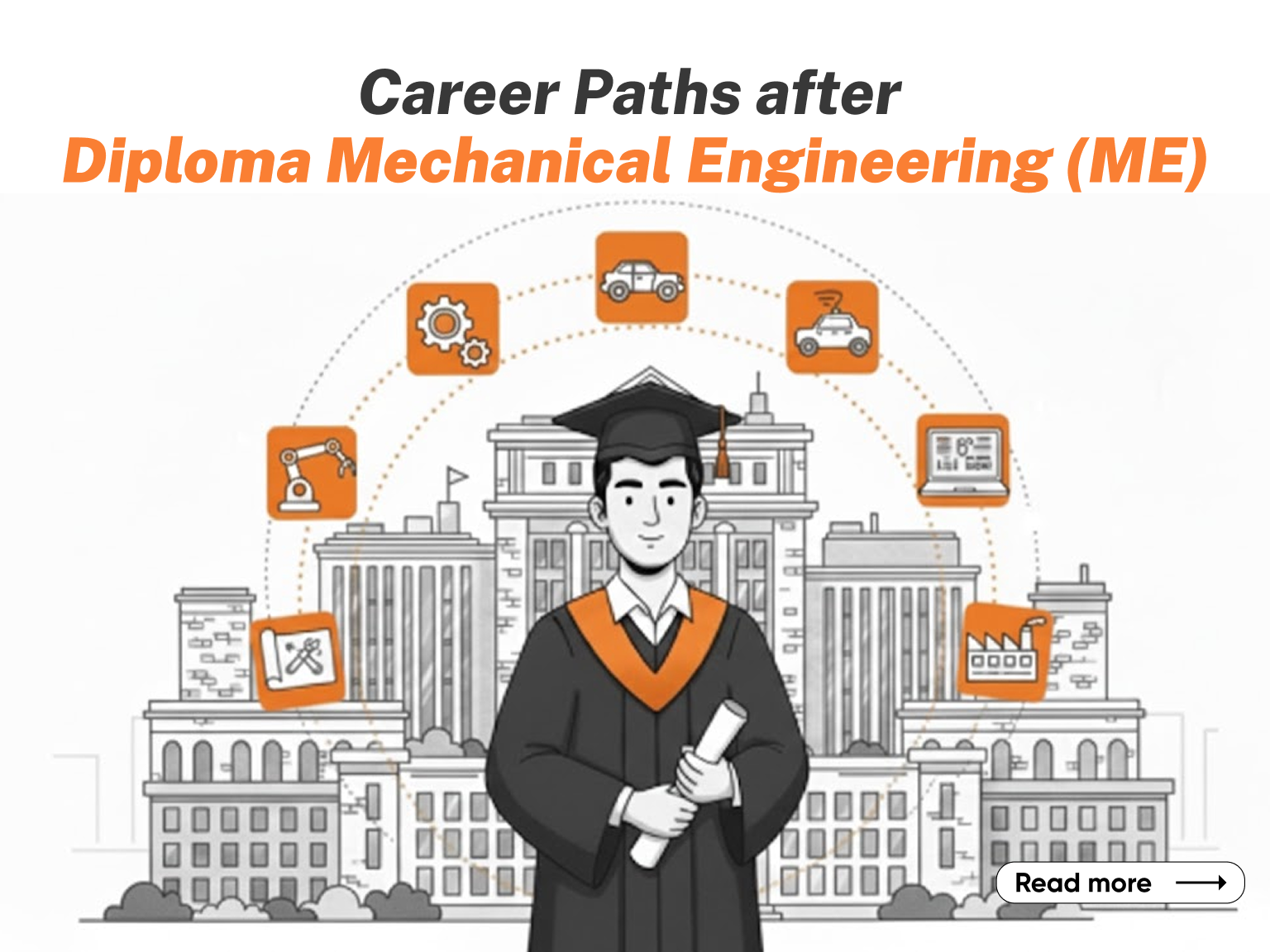
Possible career paths include: Junior Engineer / Technician, CNC / Lathe Operator, Automotive Service Technician, HVAC and Refrigeration Technician, etc.
As technology continues to evolve, those who plan ahead, seek proper career advice, and upgrade their skills will be best positioned to succeed. In essence, thoughtful career planning and timely guidance turn a diploma into a strong foundation for a rewarding and future-ready career.
Inside the Diploma Mechanical Engineering (ME): Course Overview and Highlights
The Diploma Mechanical Engineering (ME) is a three-year program designed to equip students with strong technical knowledge and hands-on skills in the field of mechanics, machines, manufacturing, and industrial processes.
This course lays the foundation for understanding how mechanical systems work and prepares students for technical roles in various engineering industries.
The Diploma Mechanical Engineering (ME) curriculum combines theoretical concepts with practical training, emphasizing problem-solving, machine operation, and engineering design. Students learn the fundamentals of physics, mathematics, and materials science, which form the backbone of mechanical engineering.
Key learning areas include:
- Engineering Mechanics – Understanding force, motion, and equilibrium in mechanical systems.
- Thermodynamics – Study of heat, energy, and their applications in machines and engines.
- Fluid Mechanics – Behavior of fluids and their role in pumps, turbines, and hydraulics.
- Manufacturing Technology – Processes like welding, casting, machining, and fabrication.
Highlights of the Course-
a. Practical Workshops and Labs
Workshops in machining, fitting, welding, and CNC operations give students hands-on experience, making them industry-ready.
b. Industrial Training
Most diploma programs include internships or industrial visits that expose students to real-world engineering environments.
c. CAD and Designing Skills
Students learn tools like AutoCAD, SolidWorks, CATIA, and other design software widely used in industries.
d. Project Work
Final-year projects encourage innovation and practical problem-solving, often involving machine components, automation systems, or energy solutions.
The Diploma Mechanical Engineering (ME) provides a strong foundation in both theoretical principles and practical skills, preparing students for diverse roles in the engineering and manufacturing sectors.
Core Skills and Technical Knowledge You Gain from a Diploma Mechanical Engineering (ME)
Mechanical engineering equips students with a wide range of technical competencies that are essential in designing, analyzing, and manufacturing mechanical systems. Among these, CAD/CAM, machine design, thermodynamics, and manufacturing processes form the core skill areas that shape a strong mechanical engineering foundation.
1. CAD/CAM Skills
CAD (Computer-Aided Design) and CAM (Computer-Aided Manufacturing) are critical tools used in modern engineering and production.
2. Machine Design
Machine design focuses on creating safe, efficient, and functional mechanical components.
3. Thermodynamics
Thermodynamics deals with energy, heat, and their transformation into mechanical work.
4. Manufacturing Processes
A core area that focuses on how raw materials are transformed into finished products.
5. Overall Mechanical Engineering Skills-
Besides subject-specific knowledge, students also develop broader engineering skills such as:
- Problem-solving and analytical thinking
- Engineering drawing interpretation
- Maintenance and troubleshooting of mechanical systems
A mechanical diploma builds strong technical, analytical, and practical skills that prepare students for immediate employment and advanced engineering education. These skills form the backbone of a successful career in industries like manufacturing, automotive, aerospace, energy, and robotics.
These skills make graduates job-ready and capable of working with machines, tools, manufacturing systems, and engineering processes across various industries.
A Diploma Mechanical Engineering (ME) equips students with a strong blend of theoretical understanding and hands-on technical abilities.
Applications of Mechanical Engineering Across Industries
Mechanical engineering plays a central role in the development, operation, and innovation of major industrial sectors. Its principles ranging from mechanics and thermodynamics to manufacturing and automation support the creation of efficient machines, processes, and systems.
1. Automotive Sector-Mechanical engineering is the backbone of vehicle design and manufacturing.
Key contributions:Engine design, powertrain development, and vehicle dynamics, Fuel efficiency, emission control, and thermal management, Electric vehicle (EV) components: motors, battery systems, cooling systems.
2. Aerospace Sector- The aerospace industry relies heavily on mechanical engineering for high-performance and reliable aircraft systems.
Key contributions:Jet engine and propulsion system design, Aerodynamics, structural analysis, and lightweight materials, Landing gear, hydraulic systems, and cabin environmental control.
3. Power and Energy Sector- Mechanical engineers drive innovation in both conventional and renewable energy systems.Key contributions: Turbine design (steam, gas, wind, hydro), Heat exchangers, boilers, and cooling systems, Energy conversion, thermodynamics, and efficiency improvement.
4. HVAC (Heating, Ventilation, and Air Conditioning) Sector- HVAC systems depend on mechanical engineering to maintain indoor comfort and air quality. Key contributions: Designing air-conditioning, ventilation, and refrigeration systems, Heat load calculations and duct design.
5. Production and Manufacturing Sector- Mechanical engineering forms the foundation of industrial production and automation. Key contributions: Machine design, CNC machining, and tooling, Assembly line optimization and automation systems.
Mechanical engineering is deeply integrated across industries—from designing vehicles and aircraft to generating power, maintaining climate control systems, and operating manufacturing plants. Its broad applications make it one of the most impactful and versatile fields, supporting innovation and technological growth in multiple sectors.
Mechanical engineering’s applications span nearly every industry, making it one of the most impactful and future-proof engineering fields.
Entry-Level Job Roles After a Diploma Mechanical Engineering (ME)
A Diploma Mechanical Engineering (ME) opens the door to multiple entry-level job opportunities across manufacturing, production, maintenance, and design sectors. Roles such as Junior Engineer, Production Assistant, Maintenance Technician, and CNC Operator allow diploma holders to gain practical, hands-on experience while building strong technical foundations.
With continuous learning, skill development, and industry exposure, these entry-level positions can lead to advanced roles and long-term career growth in the mechanical engineering field.
Jobs After Diploma Mechanical Engineering (ME) are-
| Job Role | Description |
| Junior Mechanical Engineer | Assists senior engineers in design, planning, and project execution. |
| Production Assistant / Production Engineer (Trainee) | Supports production processes, machine operation, and workflow management. |
| Maintenance Technician | Performs maintenance, troubleshooting, and repair of mechanical equipment. |
| CNC Operator | Operates CNC milling, turning, and drilling machines based on drawings. |
| Quality Control (QC) Inspector | Checks product quality using measurement tools and inspection procedures. |
| CAD Technician / Draughtsman | Creates 2D and 3D mechanical drawings using AutoCAD or SolidWorks. |
| Machine Operator (Lathe / Milling) | Operates conventional machines for machining processes. |
| HVAC Technician | Installs and maintains air-conditioning and refrigeration systems. |
| Field Service Technician | Provides on-site installation, servicing, and repairs of machinery. |
| Supervisor Trainee (Production / Maintenance) | Assists in managing team operations, safety, and workflow on the shop floor. |
Career Opportunities in Design, Manufacturing, and Quality Control
Mechanical engineering offers a variety of career opportunities across design, manufacturing, quality, and process optimization roles. Mechanical design jobs involve creating detailed 2D and 3D models of components and systems using CAD software, helping turn concepts into real products.
Career Opportunities in Design, Manufacturing & Quality Control are-
| Job Role | Description |
| CAD Technician / Draughtsman | Creates 2D & 3D mechanical designs using AutoCAD, SolidWorks, CATIA. |
| Design Assistant | Helps engineers develop models, prototypes, and engineering drawings. |
| Production Assistant | Supports daily operations on the shop floor and machine handling. |
| Machine Operator (Lathe/Milling) | Operates conventional machines for machining processes. |
| QC Inspector | Conducts inspections using gauges, vernier, micrometer, CMM, etc. |
| QA Technician | Ensures process compliance and maintains documentation. |
| Testing Technician | Performs material and performance tests on components. |
| Calibration Technician | Calibrates tools, instruments, and equipment to maintain accuracy. |
Mechanical engineering provides strong career opportunities across design, manufacturing, quality control, and process improvement. Mechanical design roles help bring ideas into reality through detailed modeling and drafting, while manufacturing engineers ensure efficient and cost-effective production. Quality inspectors maintain product accuracy and reliability, and process engineers optimize workflow for higher productivity and safety. Together, these roles contribute to the smooth functioning of industries and offer promising growth for individuals starting their careers in mechanical engineering.
Government and PSU Opportunities for Mechanical Diploma Holders
Mechanical Diploma holders have strong job prospects in various Government Departments and Public Sector Undertakings (PSUs). These roles offer job security, stable income, benefits, and long-term career growth. Opportunities typically come through competitive exams, skill-based tests, or direct recruitment processes.
1. Government Departments
Diploma holders can apply for technical posts in:
- Indian Railways (Technician, Junior Engineer – Diploma Level)
- State Electricity Boards (Technician, Lineman, Junior Engineer)
- Public Works Department (PWD)
- Irrigation & Water Resources Department
2. Public Sector Undertakings (PSUs)
Many major PSUs recruit diploma-qualified mechanical professionals for technician, operator, and junior engineer roles. Common organizations include:
- BHEL (Bharat Heavy Electricals Limited)
- NTPC (National Thermal Power Corporation)
- ONGC (Oil and Natural Gas Corporation)
- IOCL, BPCL, HPCL (Oil & Gas PSUs)
3. Typical Job Roles
Mechanical Diploma holders in government/PSU sectors can work as:
- Technician / Technical Assistant
- Junior Engineer (JE) – Diploma Posts
- Mechanical Operator / Fitter
4. Advantages of Government & PSU Jobs
- High job security
- Stable salary with allowances
- Pension and long-term benefits
- Medical and housing facilities
Government and PSU sectors offer excellent opportunities for mechanical diploma holders through roles in maintenance, operations, manufacturing, and technical support.
Pathways for Higher Studies After a Diploma (B.Tech., AMIE, Lateral Entry, etc.)
After completing a Mechanical Diploma, students have several pathways for higher studies that can significantly enhance their career prospects.
One of the most common routes is pursuing a B.Tech or BE degree, either from the first year or through lateral entry into the second year, which allows diploma holders to complete the degree in a shorter time.
Lateral entry admissions are usually based on state-level entrance exams like LEET or CET. Another popular option is AMIE (Associate Member of the Institution of Engineers), which is recognized as equivalent to a B.E/B.Tech and provides flexibility in study duration, making it suitable for working professionals.
Diploma holders can also enroll in specialized degree programs offered by universities, including online or part-time courses in Mechanical, Production, Automotive, or Industrial Engineering.
After completing a degree, students have the option to pursue postgraduate studies such as M.Tech/ME or even an MBA in operations or industrial management. Additionally, short-term professional certifications in CAD/CAM, CNC programming, robotics, or HVAC can enhance employability and technical skills.
These pathways collectively provide diploma holders with opportunities to advance into higher technical roles, managerial positions, government/PSU jobs, or research-oriented careers.
Mechanical diploma holders have multiple pathways for higher studies that can greatly enhance their career prospects.
Options such as lateral entry into B.Tech, pursuing AMIE, specialized degree programs, or professional certifications allow students to gain advanced technical knowledge, improve employability, and qualify for higher-level roles in engineering, management, or research.
By continuing education, diploma holders can transition from entry-level positions to more responsible and well-paying roles in industry, government, or academia, ensuring long-term career growth and professional development.
| Did You Know ?
Many Indian PSUs like BHEL, NTPC, and IOCL actively recruit diploma holders as junior engineers or technicians. |
Emerging Careers in Automation, Robotics, and Renewable Energy
Mechanical diploma holders today have a wide range of opportunities in emerging and high-growth fields such as robotics, automation, renewable energy, and mechanical innovation. In robotics, professionals design, program, and maintain robots for manufacturing, healthcare, and service industries, requiring skills in sensors, actuators, CAD, and robotics programming.
Automation engineers focus on implementing and managing automated systems using PLCs, SCADA, and mechatronics to optimize production efficiency across manufacturing, automotive, electronics, and pharmaceutical sectors.
In the renewable energy sector, technicians and engineers install, maintain, and optimize solar, wind, and biomass energy systems, applying knowledge of thermodynamics, energy systems, and sustainability.
Meanwhile, mechanical innovation roles involve developing new mechanical systems, prototypes, and advanced products using CAD/CAE tools, 3D printing, and innovative problem-solving techniques in product development companies, startups, and research labs.
By gaining specialized skills in these areas, diploma holders can enter technologically advanced industries, contribute to sustainable and innovative solutions, and achieve rewarding career growth.
In the renewable energy sector, mechanical diploma holders can work as technicians or engineers installing, operating, and maintaining solar panels, wind turbines, biomass plants, and energy storage systems. They are involved in energy audits, system optimization, and preventive maintenance, contributing to sustainability and the green energy revolution. Key skills include thermodynamics, fluid mechanics, energy system design, and knowledge of renewable energy technologies.
By acquiring specialized skills in robotics, automation, energy systems, CAD/CAE, and innovation methodologies, diploma holders can transition from traditional roles into high-tech industries, participate in industrial transformation, and achieve rewarding career growth with opportunities both in India and internationally.
| Did You Know ?
Mechanical diploma holders skilled in CNC operations are in high demand because CNC machines produce precise parts used in automobiles, aerospace, and medical equipment. |
Entrepreneurship and Small Business Opportunities in Mechanical Field
Diploma Mechanical Engineering (ME) holders can leverage their technical skills and practical knowledge to start small businesses or entrepreneurial ventures in various sectors of the mechanical field. These opportunities often require modest initial investment, hands-on expertise, and a strong understanding of the market.
1. Automotive and Vehicle Services
- Opportunities: Vehicle repair workshops, spare parts shops, two-wheeler and car servicing, custom modifications, vehicle detailing.
2. Fabrication and Welding
- Opportunities: Manufacturing metal components, gates, grills, furniture, structural parts, or custom machinery parts.
3. CNC and Precision Machining Services
- Opportunities: CNC job shops for milling, turning, drilling, or prototyping mechanical parts for industries or startups.
4. HVAC and Refrigeration Services
- Opportunities: Installing and maintaining air-conditioning, refrigeration units, and ventilation systems for residential, commercial, or industrial clients.
5. Small-Scale Manufacturing / Product Development
- Opportunities: Producing mechanical products such as pumps, gear assemblies, industrial tools, or mechanical prototypes.
Diploma Mechanical Engineering (ME) holders have numerous opportunities to become entrepreneurs and establish small businesses in areas such as automotive services, fabrication, CNC machining, HVAC, and product development.
Entrepreneurship in the mechanical field also encourages innovation, problem-solving, and self-reliance, making it an attractive career path for motivated diploma holders.
Final Thoughts
A Diploma Mechanical Engineering (ME) opens diverse career opportunities across design, manufacturing, maintenance, quality control, automation, robotics, and renewable energy sectors.
Diploma holders can start as Junior Engineers, Technicians, CAD/CAM Operators, CNC Operators, Production Assistants, or Quality Inspectors in both private industries and government/PSU organizations like BHEL, NTPC, IOCL, and Indian Railways.
Emerging fields such as industrial automation, robotics, renewable energy, and mechanical innovation provide high-growth career paths. Additionally, diploma holders can pursue higher studies (B.Tech via lateral entry, AMIE, or specialized certifications) to enhance technical knowledge and career prospects.
Entrepreneurship opportunities, such as vehicle servicing, fabrication, CNC machining, HVAC services, or small-scale manufacturing, allow diploma holders to establish profitable businesses and achieve financial independence.
A Diploma Mechanical Engineering (ME) provides practical and industry-ready skills, making graduates immediately employable in shop-floor, production, and technical roles.
Industries value diploma holders for their hands-on knowledge, ability to operate and maintain machinery, proficiency in CAD/CAM, and understanding of manufacturing processes.
They serve as a bridge between theoretical engineers and practical operations, ensuring smooth production, maintenance, and quality control. Moreover, diploma holders are essential in supporting innovation, automation, and sustainability initiatives, making them a vital part of the modern mechanical engineering workforce.
Diploma holders can pursue traditional job roles, government and PSU positions, emerging high-tech fields, higher studies, or even entrepreneurship.
By combining technical expertise with continuous learning and skill development, mechanical diploma professionals can achieve long-term career growth, contribute to industrial innovation, and secure both financial stability and professional recognition in the engineering industry.
Frequently Asked Questions (FAQ)
1. What is the scope of a Diploma Mechanical Engineering (ME)?
A Diploma Mechanical Engineering (ME) opens opportunities in design, manufacturing, maintenance, quality control, automation, robotics, and renewable energy. Diploma holders can work in private industries, government departments, PSUs, and emerging technology sectors, or pursue entrepreneurship and higher studies. The diploma also allows lateral entry into B.Tech programs for further education.
2. Can I pursue higher studies after a Mechanical Diploma?
Yes. Options include: B.Tech / BE via lateral entry (2nd year admission in most colleges).
AMIE (Associate Member of Institution of Engineers) – Recognized as equivalent to B.Tech.
Specialized degree programs (part-time or online).
3. Is a Mechanical Diploma important in the industry?
Absolutely. It provides hands-on, practical skills that industries highly value for production, maintenance, quality control, and operational roles. Diploma holders act as a bridge between theoretical engineers and shop-floor operations, making them essential in both traditional and emerging sectors.
4. Can I work abroad with a Mechanical Diploma?
Yes, especially in countries like Germany, UAE, Canada, Australia, and the Middle East, where skilled mechanical technicians and operators are in demand. Jobs in manufacturing, maintenance, HVAC, and CNC operations are common for diploma holders. Additional certifications in CNC, CAD, or automation can improve global employability.
5. What are the advantages of a mechanical diploma in industry?
Practical, hands-on knowledge of machines and processes.
Immediate employability in production and maintenance roles.
Cost-effective training for industries compared to fresh graduates.